Why the Virtual Master Presenter Certification Is Becoming a Competitive Advantage
The Virtual Master Presenter (VMP) certification is the most advanced professional designation available to virtual keynote speakers. In 2026, it is emerging as the credential that clearly distinguishes elite virtual presenters from those who are simply capable of delivering on the platform.
The CVP answered one question for planners: Is this speaker technically capable of presenting virtually? The VMP answers a harder one: Is this speaker genuinely excellent at it?
Those are different questions, and in 2026, the second one is where more bookings are decided than most speakers realize.
The Certified Virtual Presenter designation, covered in the previous article in this series, validates the essentials: your equipment setup, your presentation environment, and your core competence on your primary virtual platform. It tells planners that a speaker's setup won't embarrass them. It answers the technical threshold question. And for a market where unverified virtual presenters have burned planners, that threshold matters.
But a threshold is not a ceiling. And the speakers who are consistently winning virtual bookings at the highest fee levels, filling their virtual calendars without competing on price, and generating post-event testimonials that specifically praise their virtual delivery craft, those speakers aren't just technically capable. They're practicing a discipline that most of their competitors have never formally studied.
That discipline is what the Virtual Master Presenter (VMP) certification, administered by eSpeakers and created and taught by Rebecca Morgan, CSP, CMC, CVP, VMP, is designed to produce. It is the most advanced designation available for virtual presenters. The pool of holders is deliberately small. The course is live, intensive, and assessed by a human evaluator across five competency areas. And in a market where the difference between "good" and "outstanding" determines whether a planner books you or the next speaker on their list, the VMP is becoming something that was hard to predict when it launched: a genuine competitive advantage.
This article makes the case for why.

John Doe
Chief Marketing Officer at eSpeakers
The Gap Between "Capable" and "Outstanding"
Here's the honest reality of the virtual speaking market in 2026: there are a lot of speakers who are technically capable of presenting virtually, and not many who are genuinely outstanding at it.
The technically capable speaker has a good setup. They know how to share their screen. They've done enough virtual engagements that they're comfortable on camera. They don't have visible technical problems. If you asked a planner about their experience, they'd say "it went fine."
"Fine" is not a referral. "Fine" is not a testimonial that wins new bookings. "Fine" is not the description that makes a planner reach for your name when their next virtual keynote slot opens.
The outstanding virtual presenter does something different. They engineer engagement rather than hoping it happens. They understand why the 20-minute virtual session requires a fundamentally different structural approach than a 60-minute in-person keynote, and they've built that understanding into their program design. They know how to manufacture presence through a screen: the camera technique, the intentional pause that would feel different in a room but lands differently through a lens, the way vocal range needs adjustment when you're competing with a home office environment, and the inherent psychological distance of a video grid.
They design their slides specifically for virtual viewing, accounting for how typography, contrast, and layout appear on laptop screens rather than ballroom displays. They understand platform tools well enough to integrate them seamlessly into the presentation instead of breaking momentum to figure them out mid-session. They also prepare practical, ready-to-execute contingency plans for technical issues, built for real-world conditions and pressure moments.
Most importantly, they've received structured feedback on their virtual delivery from someone with the expertise to identify the subtle things that work on stage but flatten on camera, and they've refined accordingly.
The CVP certification verifies that a speaker can show up professionally. The VMP certification builds the practitioner who knows why what they do works, how to adapt when conditions change, and how to produce a virtual engagement experience that planners describe with words that generate referrals.
What the VMP Course Actually Builds
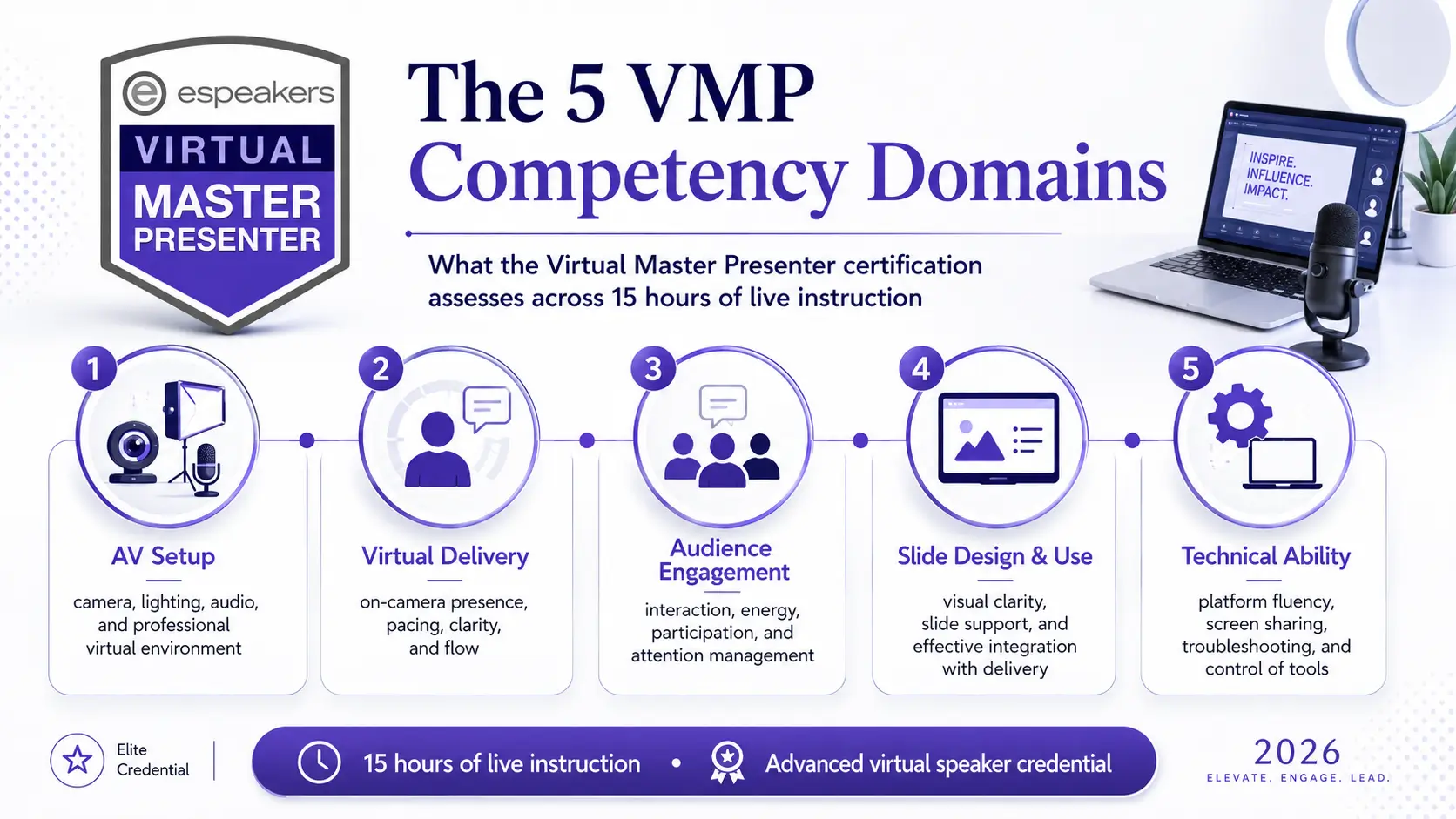
The Virtual Master Presenter course is not a collection of tips. It is fifteen hours of live, facilitated instruction delivered across five half-day sessions, with Rebecca Morgan as the instructor, a small class size to enable real engagement, and a formal competency assessment at the end. The structure matters: this is not a self-paced video course you can half-watch on a Tuesday evening. Attendance at four of the five live sessions is required to qualify for the VMP badge.
The course develops competency across five areas that also form the domains of the certification assessment. Understanding these areas makes it clear why the VMP produces measurably stronger virtual presenters, not just credentialed ones.
Audio/Visual Setup, Advanced
The CVP establishes baseline AV competency. The VMP goes deeper: the subtleties of camera positioning that affect perceived authority and connection, the specific audio configurations that serve different presentation contexts, the lighting nuances that affect how different skin tones and hair colors render on camera (an area Rebecca specifically addresses in her teaching, including questions like whether your hair blends into your background and disappears). These are the details that separate a professional-grade presentation from a polished amateur one, and they're the kind of thing you wouldn't know to look for unless someone who has spent decades studying what works on camera teaches you directly.
Virtual Delivery
This is the competency that most speakers most significantly underestimate. Delivery in a virtual context is not the same skill as delivery on a physical stage, even if it looks similar from the outside. The camera is a different instrument from a room. Eye contact with a camera requires a different physical discipline than eye contact with an audience; it requires looking at a lens rather than at the faces on your screen, which is counterintuitive and takes deliberate practice to make natural. Vocal dynamics need recalibration: the energy level and projection that reads as confident in a ballroom can read as overwhelming through a speaker, while a conversational tone that works in a boardroom can disappear into the digital medium. The VMP course works specifically on the performance calibration that converts strong in-person delivery skills into equally strong virtual delivery skills.
Engagement
This is where the VMP most directly influences booking outcomes. Virtual audiences are not passive recipients who can be held through presence alone. They are sitting in front of screens with email open in another tab, Slack notifications active, and the constant ability to disengage without anyone noticing.
The VMP course treats engagement as a design discipline, not a matter of occasionally adding polls. It teaches a structured methodology for engineering active participation throughout a session: when to introduce interaction, which tools align with specific engagement goals, how to calibrate interaction frequency so it builds energy rather than distraction, and how to respond to live input in a way that deepens the content instead of disrupting it.
Interactive features are now a proven driver of audience ROI at virtual events, with 76% of attendees reporting meaningful use of these tools in professional settings. The VMP prepares speakers to be the ones who intentionally create that level of engagement, rather than those who simply hope it happens.Interactive features are now a proven driver of audience ROI at virtual events, with 76% of attendees reporting meaningful use of these tools in professional settings. The VMP prepares speakers to be the ones who intentionally create that level of engagement, rather than those who simply hope it happens.
Slide Design and Use
Slides designed for in-person projection are often poorly suited for virtual delivery. The VMP course treats slide design as a virtual-specific discipline, focusing on type sizes that remain legible on laptop screens rather than large venue projections, contrast ratios that hold up across varying monitors, and the intentional use of animation to support comprehension instead of showcasing production effects.
It also covers design patterns that keep attention anchored on the speaker rather than competing with the visuals. This includes the “Slooks” concept introduced by Rebecca Morgan, slide structures designed to function both as live presentation support and as durable leave-behind reference materials, extending the impact of a session well beyond its delivery.
Technical Ability
This fifth area goes beyond knowing which buttons to click. It reflects full platform mastery, the kind that separates a presenter who confidently runs a virtual session from one who is constantly reacting to the technology.
It includes managing participant views, shifting between presentation modes without visible disruption, handling chat and Q&A in real time while maintaining delivery flow, and executing contingency plans when something goes wrong without losing audience engagement.
The VMP requires more than technical knowledge. It demands technical fluency, the ability to operate the platform so smoothly that the mechanics disappear and the audience experience stays uninterrupted.
Who Rebecca Morgan Is, and Why It Matters
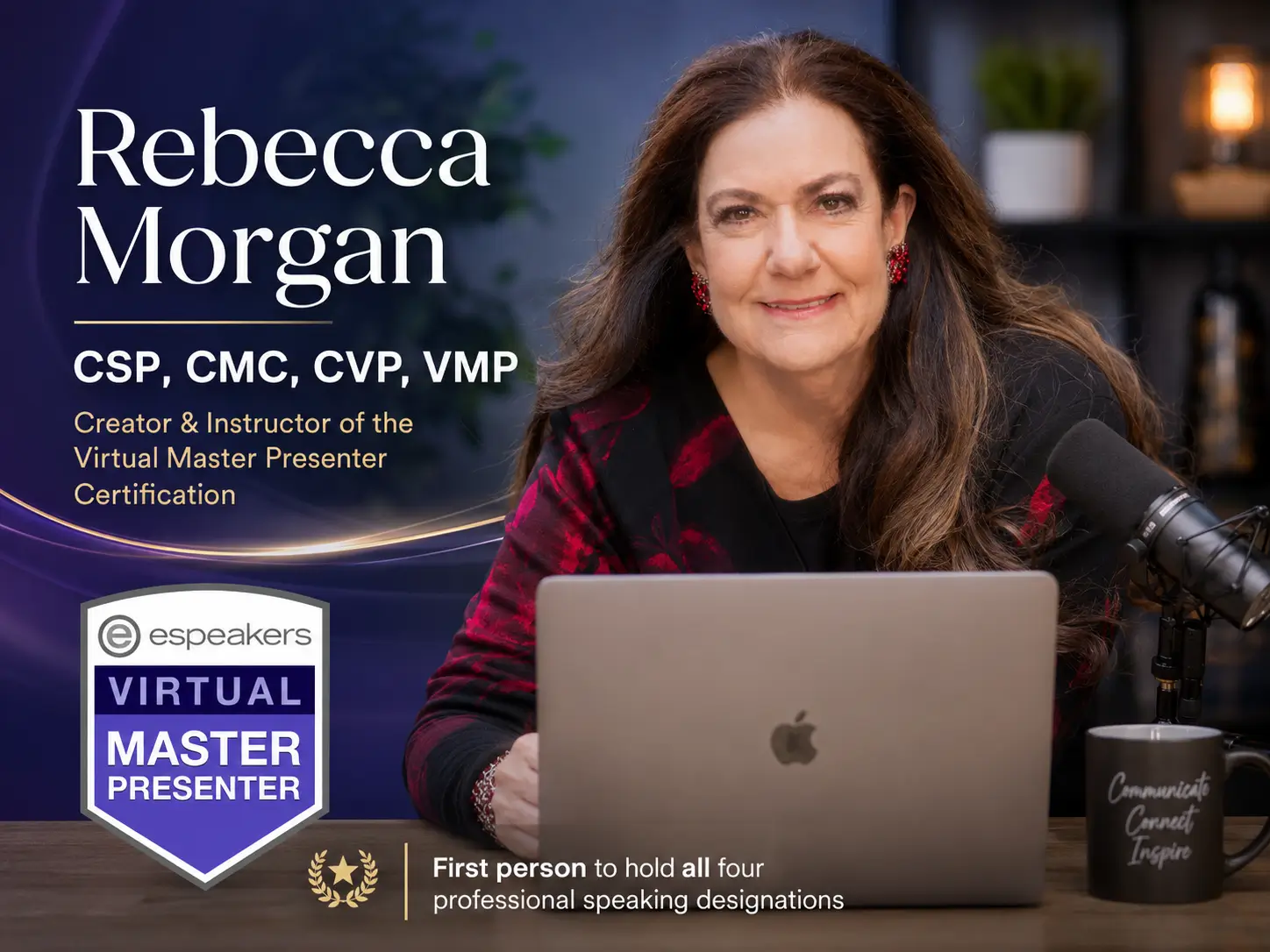
The VMP is not a credential you earn from a committee or an automated system. It is a course created and taught by Rebecca Morgan, and assessed by her, which means the quality of the credential is inseparable from the depth of expertise she brings to it.
Rebecca Morgan, CSP, CMC, CVP, VMP, has been giving professional presentations since 1980 and virtual presentations since 1996, a decade and a half before most speakers had ever seen a Zoom interface. She is the first person in the world to hold all four designations: Certified Speaking Professional (CSP), Certified Management Consultant (CMC), Certified Virtual Presenter (CVP), and Virtual Master Presenter (VMP). She co-created the VMP designation with eSpeakers and is the sole course designer and primary instructor.
Her client roster includes Apple, Hewlett-Packard, Adobe, Microsoft, Airbnb, Singapore Airlines, Wells Fargo Bank, Stanford University, and dozens more of the world’s most demanding organizations. She is the bestselling author of 28 books, two of which have sold over 250,000 copies each and been translated into nine languages. She has spoken professionally in 54 countries. Her media appearances include 60 Minutes, Oprah, the Wall Street Journal, Forbes, National Public Radio, CNBC, and USA Today.
The significance of this background to the VMP is not credential-stacking for its own sake. It is that the course content reflects forty-plus years of continuously refined expertise in professional presentation, including nearly three decades of virtual-specific experience that predates the field as most speakers know it. When Rebecca identifies the common mistakes that even experienced virtual presenters make, and the course is explicitly built around those mistakes, she is drawing on a body of direct observation and experimentation that has no real parallel in the speaking industry.
Speakers who take the VMP course don’t just get certification. They get instruction from the person who has most systematically studied what works in virtual presentation delivery and built a formal curriculum around it.
Why Rarity Is a Feature, Not a Limitation
The VMP designation’s limited pool of holders is one of its most underappreciated properties.
The CSP designation, the National Speakers Association’s highest earned credential, is held by roughly 800 speakers worldwide in a field of hundreds of thousands. The rarity of the CSP is part of what makes it meaningful as a signal: it represents a filtering mechanism that took years to pass through. The VMP functions similarly, but at a much earlier stage of development. The number of VMP holders globally remains very small, a function of the limited class sizes, the live attendance requirement, and the genuine competency bar the assessment imposes.
This rarity is directly relevant to the competitive advantage argument. When a planner sees a VMP badge on an eSpeakers profile, they are seeing something that very few speakers they will ever evaluate carry. Not because it was expensive (though the investment is real), and not because it was obscure, but because it required 15 hours of live training, attendance at four of five sessions, and demonstrated competency across five assessed domains, all of which most speakers who present virtually have never committed to.
The VMP is the speaking industry’s equivalent of board certification in a medical specialty. General practitioners exist in abundance. Board-certified specialists in a specific area of practice are deliberately scarce when the case is complex enough to require the specialist; the credential matters precisely because it’s rare.
In the virtual keynote market of 2026, where planners are raising their standards for what constitutes an excellent virtual experience and where session quality is the top driver of event success, the VMP positions its holders as specialists in a field where most practitioners are still generalists.
The Business Case for the Investment
The VMP course costs $1,895. That is a real investment, and the business case for it deserves to be stated plainly rather than assumed.
The direct argument runs as follows. If virtual engagements represent a meaningful portion of your speaking business, and for most professional speakers in 2026, they either do or should, then your virtual delivery quality directly determines your virtual fee ceiling, your booking conversion rate for virtual inquiries, and the quality of post-event testimonials that drive referrals. All three of those factors compound. A speaker who is genuinely outstanding at virtual delivery commands fees closer to their in-person rate rather than the 20–50% discount that “average” virtual speakers accept. They convert a higher proportion of virtual inquiries. And they generate testimonials that include phrases like “the most engaging virtual keynote we’ve ever hosted”, which is the kind of language that wins the next booking without requiring the planner to take any risk.
One additional paid virtual engagement per year at a $10,000 fee covers the investment 5x. If the VMP produces even one booking that would not have otherwise happened, through the credential’s presence on your eSpeakers profile, through a planner who would have chosen a competitor, through a testimonial that referenced your virtual delivery excellence specifically, the ROI is clear.
The indirect argument is harder to quantify but more important. The fifteen hours of instruction in the VMP course will change how you approach every virtual engagement you do for the rest of your career. The slide design principles, the engagement architecture, the delivery calibration, and the platform fluency are not techniques you apply for the first few months and then forget. They become your standard practice. They raise the quality floor of every virtual session you deliver. And in a market where planners increasingly use attendee engagement data, post-event surveys, and word of mouth to evaluate speakers for future bookings, the quality floor of your delivery is your reputation.
Rebecca Morgan describes the goal of the course in terms that strip away the credentialing frame: if your virtual presentations are “pretty good,” why not take them to “stellar”? The fifteen hours are not fifteen hours toward a badge. They are fifteen hours building the practitioner who deserves to carry it.
The VMP in Your eSpeakers Profile and Marketing
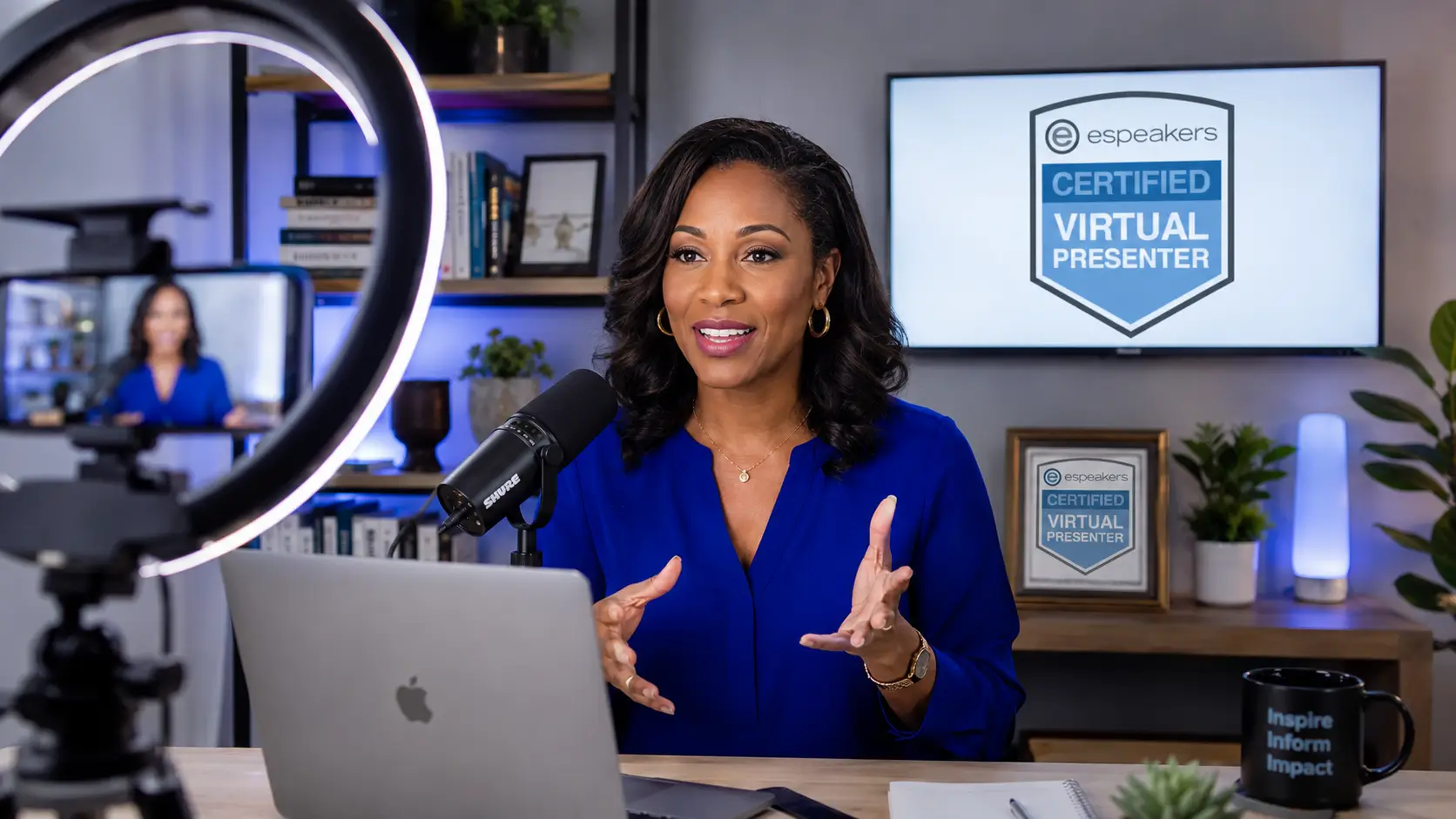
The VMP badge on your eSpeakers profile is visible to every planner who visits your profile, and it operates differently from the CVP in a specific way: it signals mastery to planners who are not specifically filtering for virtual credentials, not just readiness to planners who are.
A planner evaluating two speakers with similar topics, similar fees, and similar testimonials will notice the VMP badge on one profile and not the other. They may not know exactly what it entails. But in an era when credentials that require demonstrated competency are meaningful precisely because they’re rare, the presence of an advanced certification in virtual delivery tells a story in a single image: this speaker has invested seriously in the craft of virtual presentation.
This distinction matters especially for speakers competing for premium virtual bookings, enterprise all-hands meetings, global association keynotes, and high-stakes training programs where the virtual delivery quality directly reflects on the event organizer. At that level of booking, the planner’s risk tolerance is lower, and their attention to credential signals is closer.
Your marketing copy changes. With the VMP, you can make specific, verifiable claims about your virtual delivery competency that most speakers cannot make: that you’ve been assessed across five performance domains by the field’s foremost expert, that your engagement methodology has been formally validated, and that your slide design is specifically optimized for virtual rendering. These aren’t self-assessments. They’re independently verified claims backed by a named credential from a recognized institution.
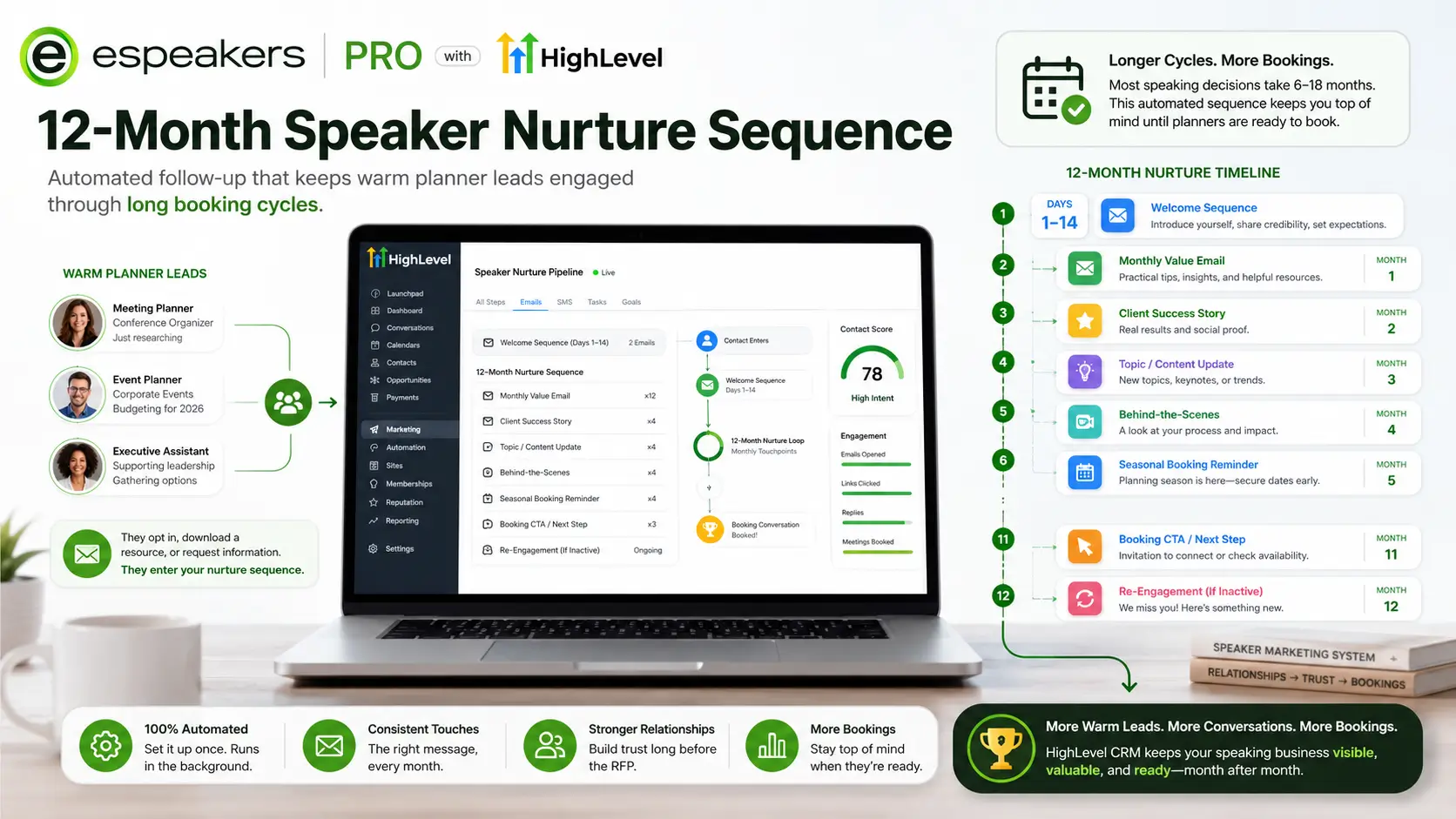
Your outbound pitch sharpens. In the HighLevel CRM outbound sequences for virtual bookings, the broadcast campaigns targeting associations that run virtual events, the targeted follow-ups with organizations that have expressed interest in virtual programming, the VMP becomes a specific differentiator you can name in the email body. Not “I’m experienced in virtual presentations” but “I hold the Virtual Master Presenter certification, the most advanced virtual presentation credential in the speaking industry.” That’s a sentence a planner reads and treats differently.
Your post-engagement debrief generates more specific evidence. When you deliver a virtual engagement at the VMP level and ask for a testimonial, you can prompt specifically: “Would you be willing to describe how the engagement and interactivity felt for your audience?” Testimonials that specifically reference engagement quality, “our audience participation was higher in this 25-minute virtual keynote than in most of our hour-long in-person sessions”, are the testimonials that convert other planners. The VMP gives you the delivery quality to earn that kind of testimonial.
Where the VMP Fits in the Credential Ladder
For speakers building a serious professional credential stack, the relationship between CVP, VMP, and CVH bears stating clearly.
CVP (Certified Virtual Presenter) is the baseline. Equipment, environment, and platform competence. Free for eSpeakers PRO members, $85 otherwise. Required as a prerequisite for both VMP and CVH.
VMP (Virtual Master Presenter) is the advanced designation. Fifteen hours of live instruction, five competency areas, and a formal assessment by Rebecca Morgan. $1,895. Requires CVP.
CVH (Certified Virtual Host) is the facilitation designation. For speakers who also serve as panel moderators, event hosts, or virtual meeting facilitators. Taught by Rebecca Morgan. Separate track from VMP. Requires CVP.
These three credentials represent a complete virtual professionalism stack for speakers who make virtual delivery a core part of their business. Each is automatically added to your eSpeakers profile on earning, building a visible progression that communicates sustained investment in the medium.
The logical path for a speaker who has recognized that virtual is permanent and wants to be among the best in the field: earn CVP first (required for the others and free with PRO), use what you learn preparing for the CVP assessment to bring your setup to professional standard, then enroll in the VMP when you’re ready to invest 15 hours and $1,895 in becoming genuinely exceptional at a medium that is generating a meaningful and growing share of your revenue.
FAQ
No. The CVP is a prerequisite for the VMP course. eSpeakers requires it because the VMP curriculum builds on the foundational competencies the CVP establishes. If you don’t have your CVP, that’s the starting point, and for eSpeakers PRO members, that starting point costs nothing.
After completing the five-course sessions, you schedule a 30-minute live meeting with your facilitator and demonstrate competency across the five areas covered in the course: AV setup, virtual delivery, engagement, slide design and use, and technical ability. If your facilitator sees demonstrated competency in all five areas, you receive the VMP badge. If one or more areas need improvement, the facilitator explains what’s required, and you schedule a retest, which is included in your enrollment fee.
Five half-day sessions (3 hours each) = 15 hours of live instruction, plus the 30-minute assessment. The sessions are typically spread over 5 weeks (one per week), though the schedule varies by cohort. Recordings are provided, but you must attend 4 of the 5 sessions live to qualify for the badge.
The standard enrollment is $1,895, which includes all 15 hours of instruction and the certification assessment. Early bird pricing (when available) has historically offered $400 off for a limited period before enrollment closes. Individual sessions can also be purchased at $395 each for speakers who want to sample the course before committing to full enrollment; the per-session fee can be applied toward the full course price.
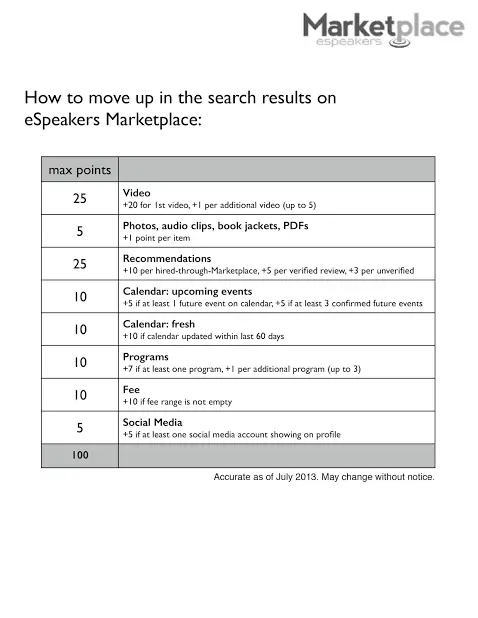
The VMP badge is automatically added to your eSpeakers profile and contributes to your eSEO score, the ranking system that determines how you appear in searches on the eSpeakers Marketplace. Virtual credential signals, including both CVP and VMP, are weighted positively in the algorithm, particularly for searches that include virtual delivery filters. More directly, the VMP badge is visible to every planner who views your profile, regardless of what they searched for.
The question to ask isn’t “how much do I currently present virtually?” but “how much should I be presenting virtually, and what’s limiting me from doing more of it?” For most professional speakers, the honest answer is that virtual represents a significant expansion opportunity, different geographic markets, additional engagements that fit around travel-heavy in-person schedules, and access to organizations whose budget for in-person speakers is constrained but whose budget for virtual delivery is more flexible. If virtual is currently a small part of your business because your delivery isn’t strong enough to command the fees and the bookings you want, the VMP is an investment in making virtual a larger and more profitable part of your business.
“Pretty Good” Is the Competition You’re Leaving Behind
The speaking industry has a lot of virtual presenters who are pretty good. They’ve been doing it long enough to be comfortable. They don’t have obvious problems. Their sessions run cleanly. Planners book them without anxiety.
And then there are the speakers who are genuinely excellent at it. Whose virtual sessions produce attendee engagement metrics that surprise even the planners who booked them. Whose post-event testimonials specifically name the delivery quality, the interactivity, and the way the session felt alive rather than streamed. Whose eSpeakers profiles carry the two badges that signal both verified readiness and advanced mastery. Whose outbound pitches can make a specific, independent claim about their virtual presentation competency that their competitors cannot match.
Those speakers are rare. The VMP’s limited pool of holders is not an accident; it’s the point.
The window for positioning yourself in that small group is still open. Virtual is not going to stop growing. The planners booking virtual keynotes are not going to lower their standards for what constitutes excellent virtual delivery. And the credential that distinguishes the master from the merely capable is not going to become easier to earn.
The 15 hours are the investment. The competitive distance it creates is the return.
Start your eSpeakers PRO 60-day trial →
Earn your CVP at no additional cost as an eSpeakers PRO member, then take the next step toward the VMP with Rebecca Morgan’s course. Your eSpeakers profile will carry both badges, and every planner who sees them will know exactly what they mean.
Joe Heaps, Chief Marketing Officer at eSpeakers
Joe Heaps is the Chief Marketing Officer at eSpeakers and is responsible for creating and accelerating the company's sales & marketing strategies. He is focused on driving the company's vision of helping organizations and individuals improve in substantial, long-term ways. He believes it happens when the perfect speaker is in front of the right audience. Over 25 years in the industry, Joe’s strategic vision and leadership have propelled eSpeakers to the leading software platform for speakers, coaches, and experts.
Joe Heaps
Chief Marketing Officer, eSpeakers
Latest Articles

Related Articles