The Speaker Marketing System: Funnels, Emails, and Workflows That Actually Work
A speaker marketing system is a connected infrastructure, not a collection of tactics, that reliably turns planners who have never heard of you into planners who have you on their agenda. It has five layers: directory presence that generates inbound discovery, lead capture funnels that convert interest into contact records, automated email sequences that nurture relationships through long booking cycles, a CRM pipeline that converts inquiries into confirmed bookings, and post-event workflows that turn past clients into referral sources and repeat bookings.
Most speakers have some version of each layer operating independently. They have a profile, some social content, an email list they occasionally send to, and a CRM they partially use. The results are inconsistent because the pieces aren't connected: a great LinkedIn post with no clear next step, an email campaign with no follow-up sequence, and a booking inquiry with no automated acknowledgment. This article builds the complete connected architecture using eSpeakers PRO and HighLevel CRM, the specific sequences, funnels, and integration logic that compound the system over time.
John Doe
Chief Marketing Officer at eSpeakers
The Speaker Marketing System: What It Is and Why Most Speakers Don't Have One
A marketing system, at its core, is a set of connected processes that consistently turn strangers into clients. For a speaker, that means turning meeting planners who have never heard of you into planners who have you booked on their agenda.
The keyword is connected. Most speakers rely on scattered activities: a LinkedIn post here, an email there, an eSpeakers profile updated occasionally. Activities on their own produce inconsistent results because they are not working together. A LinkedIn post that gets 200 views goes nowhere if there is no clear next step for a planner who’s interested. An email campaign that generates replies loses momentum if those replies sit in a personal inbox without a structured follow-up.
A true speaker marketing system is different. It is not a collection of efforts; it is a coordinated engine. And it has three defining characteristics that set it apart from disconnected activity:
It captures attention and converts it to contact
Every content touchpoint, a LinkedIn article, a YouTube video, an eSpeakers directory listing, a conference mention, has a clear, low-friction next step that moves an interested planner into your CRM. Attention that doesn't convert to a contact is wasted.
It nurtures contacts systematically over time
Not every planner who discovers you is ready to book right away. Some respond after a few touchpoints; others need months of consistent exposure before they reach out. A system accounts for both. It nurtures every lead in parallel, keeping you visible over time without requiring you to manually track or manage each individual relationship.
It converts readiness into booking without manual intervention
When a planner becomes ready to book, when the timing is right, the event is confirmed, the budget is approved, and the system makes it easy for them to take the next step. Real-time calendar availability, a direct inquiry path, and an immediate response are all handled automatically.
HighLevel CRM is the platform where all of this lives. What follows is how to build it.?
The Four-Layer Architecture
A complete speaker marketing system runs on four connected layers. Each layer feeds the next, and each is powered by specific HighLevel tools.
LAYER 1: TRAFFIC & VISIBILITY
(Where planners discover you)
LAYER 2: CAPTURE & CONVERSION
(Where interest becomes a contact)
LAYER 3: NURTURE & QUALIFICATION
(Where contacts become warm leads)
LAYER 4: CONVERSION & BOOKING
(Where warm leads become confirmed engagements)
Most speakers are strong on Layer 1; they're visible on LinkedIn, they have an eSpeakers profile, and they occasionally get referrals. They're weak on Layers 2, 3, and 4; they don't capture that visibility into their CRM, they don't systematically nurture the leads they have, and they don't make booking frictionless when a planner is ready.
The system works when all four layers are functioning and connected. Here's how to build each one.
Layer 1: Traffic and Visibility
Your job in Layer 1 is to create enough touchpoints that planners in your target market encounter you regularly, in their search results, in their LinkedIn feed, in the speaker directories they use, and in the recommendations of colleagues they trust.
The most effective Layer 1 channels for speakers in 2026 are not complicated, but they require consistency.
The eSpeakers Marketplace
This is your highest-leverage visibility channel because planners using eSpeakers are actively searching for speakers to hire. They've self-identified as buyers. Your profile's quality determines whether you appear in their search results and whether they click through when you do.
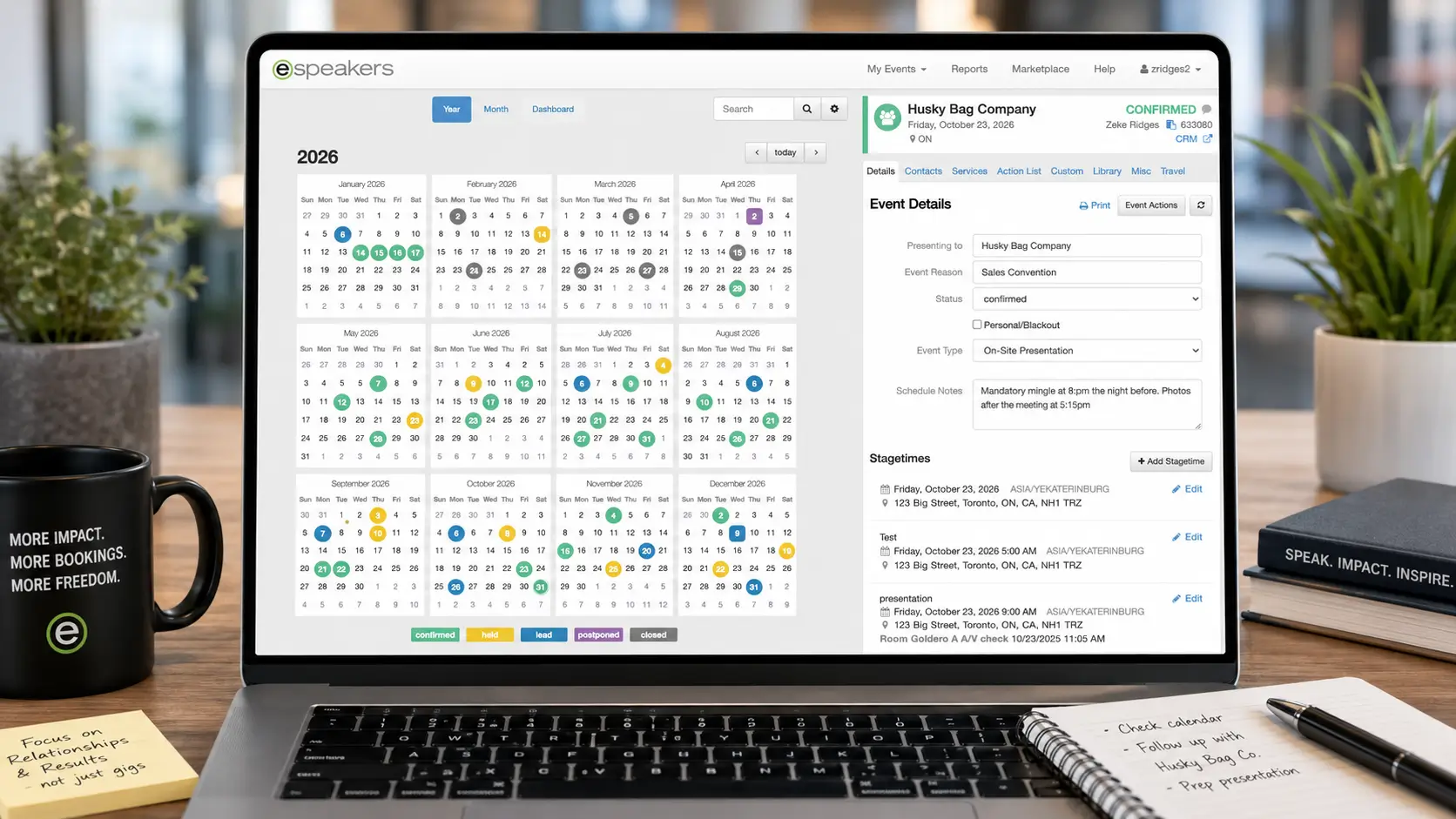
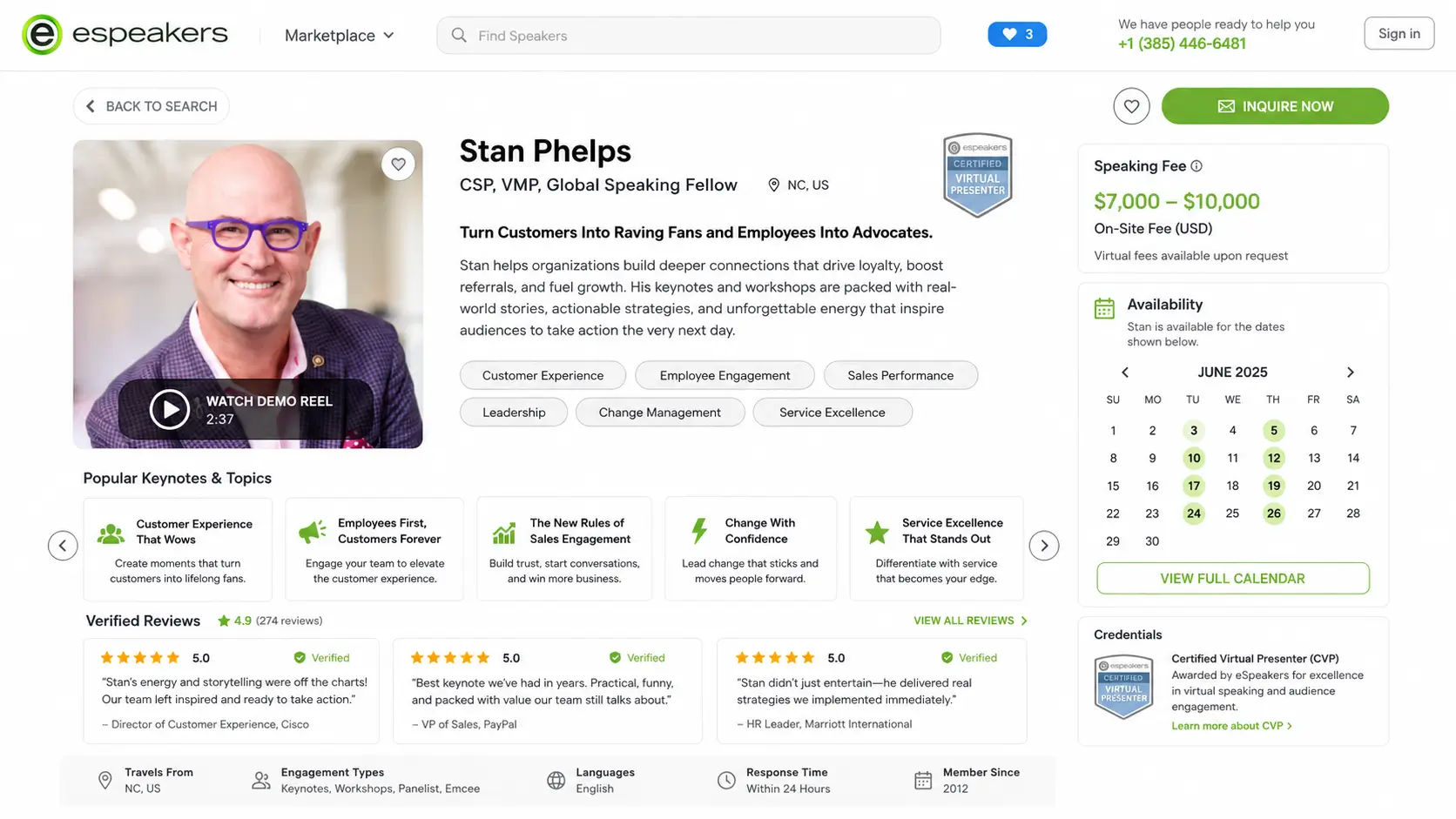
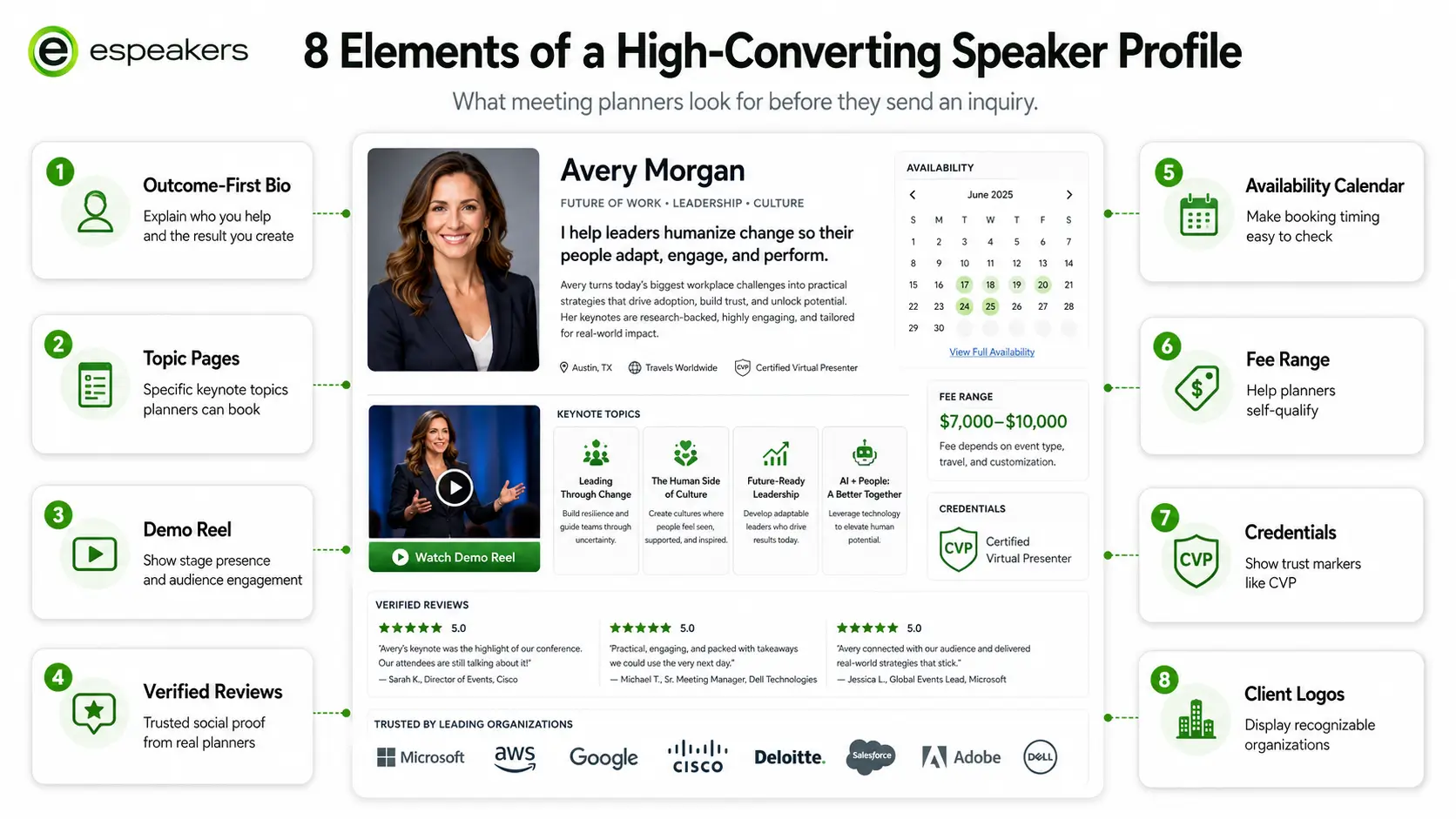
Everything covered in the profile articles of this series applies here. The single most important Layer 1 action you can take is making sure your eSpeakers profile is current, specific, and connected to a live HighLevel calendar showing accurate availability.
LinkedIn as a Content Authority Channel
In 2026, personal profiles generate more engagement than company pages on LinkedIn, and the platform rewards posts that teach specific expertise over generic thought leadership. The algorithm now explicitly prioritizes content with "genuine insight, actionable ideas, and thoughtful perspectives."
For speakers, the winning LinkedIn content system is simple: one authority post per week teaching a core concept from your keynote, one proof post per week showing a client outcome or testimonial, and one personality post per week that shows the person behind the expertise. That's three posts per week, each with a distinct job, each building a different dimension of trust with planners who scroll past it.
The Layer 1-to-Layer 2 bridge on LinkedIn: every post should have a clear next step for planners who want more. For most speakers, that's a link to a lead magnet or a direct link to book a discovery call. LinkedIn now supports Calendly integration directly in profiles; use it.
YouTube and Podcast Appearances
A YouTube video, even a five-minute explanation of a core framework, creates a searchable, evergreen asset. Planners who find you via LinkedIn will often search your name on YouTube to see you in action before deciding to reach out. A video of you delivering real content, not just a highlight reel, answers their implicit question: "Can this person hold an audience?"
Podcast appearances serve a similar function. They create discoverability in audio search, build your credibility through association with established shows, and often generate a concentrated burst of new email list subscribers when the episode drops.
Both channels primarily feed your eSpeakers profile and your email list; they create awareness that Layer 2 converts.
Referral Activation
The most powerful Layer 1 channel is the one most speakers underutilize: their existing network of happy clients, bureau agents, and fellow speakers who could refer them but aren't doing so systematically. PCMA's annual research on how planners source speakers consistently shows referrals from trusted colleagues as the top discovery channel, ahead of both directory search and bureau relationships.
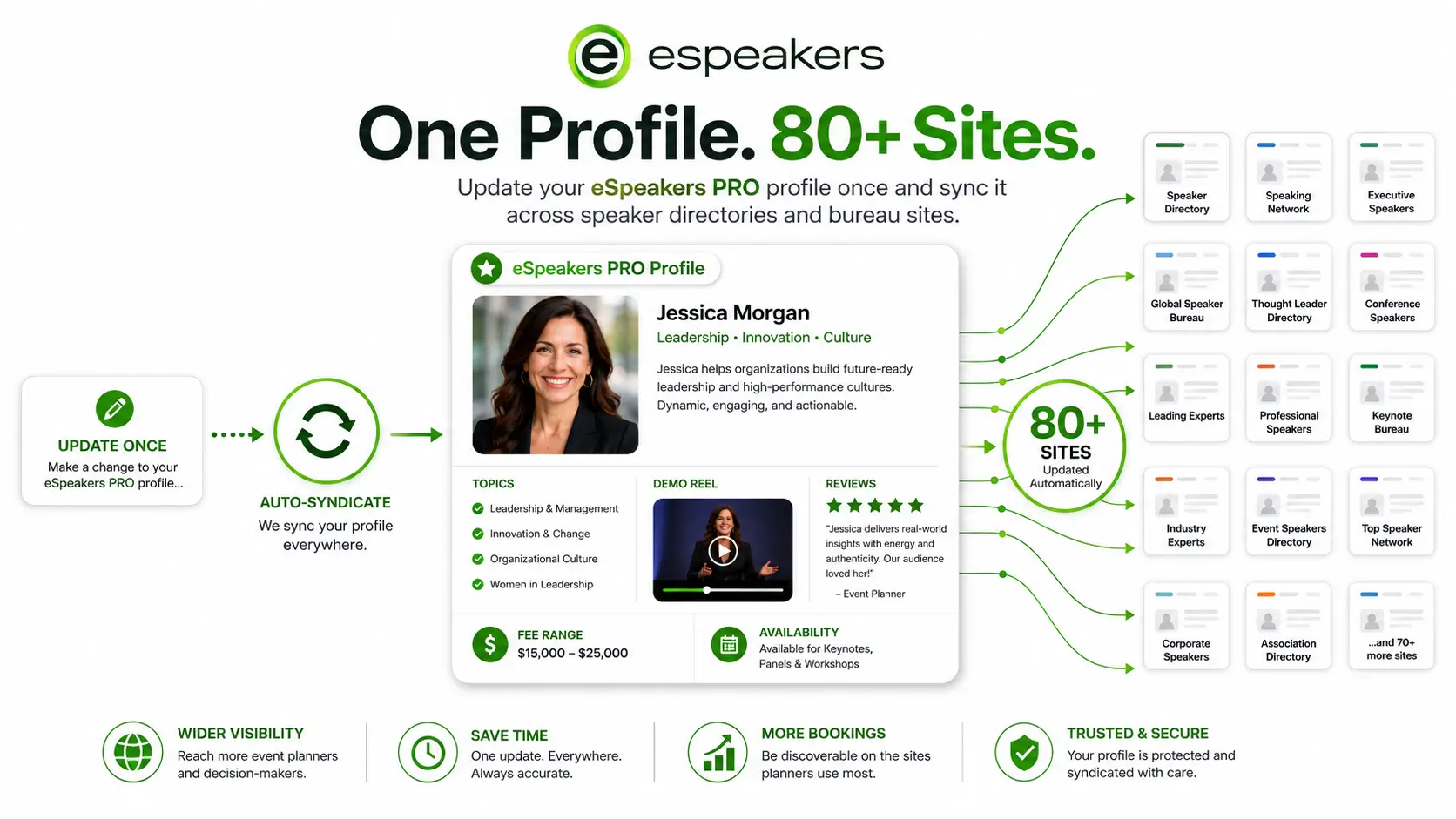
The HighLevel referral activation workflow (covered in Article 4) handles this layer automatically. Once it's running, referral requests go to satisfied clients at predictable intervals, and every introduction that comes back enters the Layer 2 capture process immediately.
Layer 2: Capture and Conversion
Layer 2 has one job: convert attention into a CRM contact. A planner who watches your LinkedIn post, reads your eSpeakers profile, or listens to your podcast appearance and then moves on without leaving any contact information is permanently lost. Layer 2 is what changes that.
The Two Funnels Every Speaker Needs
Funnel 1: The Speaker Inquiry Funnel
This funnel captures planners who are ready now, they've seen your work, they have a specific event, and they want to know if you're available. It's a direct path to a booking conversation.
Page 1, The Inquiry Landing Page:
- Your positioning statement (two sentences maximum) and a 90-second speaker reel above the fold
- Two or three client logos or event types for instant credibility
- A single strong testimonial from an event organizer
- A focused inquiry form: first name, last name, email, phone, organization, approximate event date, audience size, and one topic interest dropdown
The topic interest dropdown is the detail most speakers miss. When someone selects “leadership in uncertainty” from your dropdown, that selection applies a HighLevel tag automatically, topic-leadership-uncertainty, and they enter a nurture sequence that sends content specifically relevant to that topic. Their first email after submitting the form isn’t a generic acknowledgment; it’s a resource directly related to the topic they selected.
Page 2, The Thank You / Expectation Page:
- Confirmation that the inquiry was received
- Explicit next steps: “You’ll hear from me within one business day” (or faster if you have the inquiry response automation running)
- A direct link to your eSpeakers calendar to check availability immediately
- An option to book a discovery call now if they want to move faster
HighLevel connection: Form submission triggers the New Inquiry workflow instantly (see Article 2). Contact is created, tagged, added to the pipeline at Stage 1, and a personalized acknowledgment SMS and email fire within five minutes.
Funnel 2: The Authority / Lead Magnet Funnel
This funnel captures planners who are not ready now, who found you through content, they're interested but not booking-ready, and they need to be in your system so the nurture sequence can develop the relationship over time.
The lead magnet is the offer that makes them willing to exchange an email address. The best lead magnets for speakers address a planner’s problem, not a speaker’s expertise:
- “The Meeting Planner’s Speaker Vetting Checklist” is a practical tool that positions you as someone who understands their job
- “2026 Keynote Speaker Budget Guide: What Corporate Events Actually Pay”, High-value, addresses the most frequent planner question.
- “10 Questions Every Meeting Planner Should Ask Before Booking a [Your Topic] Keynote” frames your expertise while helping the planner make a better decision
Notice that none of these lead magnets are about you. They’re about the planner. That’s intentional. A planner who downloads a speaker vetting checklist from your site has told you exactly what they need to help make a good booking decision. Your follow-up nurture sequence can speak directly to that.
Page 1, The Lead Magnet Landing Page:
- Headline naming the specific resource and its benefit to the planner
- Three to five bullet points describing what’s inside
- Two-field form: first name and email only (minimum friction)
- One line below the form: “You’ll also occasionally receive event planning insights from [your name]. Unsubscribe anytime.”
Page 2, The Delivery / Thank You Page:
- Download link or confirmation that the resource is on its way
- Brief note: who you are, what you speak about, and a soft invitation to explore more
- Link to your eSpeakers profile for those who want to go deeper
HighLevel connection: Form submission applies tags source-website and warm-lead, creates the contact record, delivers the lead magnet via automated email, and enrolls the contact in the Long-Term Nurture sequence.
Layer 3: Nurture and Qualification
Layer 3 is where the system does its most important invisible work. Most of the planners in your CRM aren't ready to book today. They're waiting for the right event to come up, the right budget to be approved, the right timing to align. Layer 3 keeps you present in their minds during that waiting period, so that when the moment arrives, you're the speaker they think of first.
The Three Email Sequences That Power Layer 3
Sequence A: The Welcome / Lead Magnet Delivery Sequence (Days 1–14)
This sequence runs immediately after a planner submits an inquiry. Its job is to convert a fresh contact into a warm, trusting relationship before the next sequence takes over.
Email 1 (Day 1), Delivery and warmth: Delivers the lead magnet if applicable. Short, personal, not salesy. References something specific about what the planner is likely planning. “Here’s the resource you requested. I’ve worked with [industry type] organizations on [topic] for several years, and the question planners always ask is [relevant question]. I hope this helps.”
Email 2 (Day 3), The expertise proof email: One specific, valuable insight from your area of expertise. Not a pitch. A genuine teaching moment that demonstrates you know what you’re talking about. This email establishes you as a resource before you’re ever positioned as a vendor.
Email 3 (Day 7), The social proof email: One strong organizer testimonial with context. “Last spring, I worked with [organization type] on their annual leadership summit. Here’s what the program director said afterward: [testimonial].” This email does one thing: it makes the planner picture you at their event.
Email 4 (Day 14), The gentle invitation: The first soft ask. “If you have an event coming up where [your topic] would resonate, I’d love to learn about it. You can check my availability directly at [eSpeakers link] or reply to this email.” No pressure. Easy to ignore. Easy to act on.
The sequence uses HighLevel’s business-hours filter on all four emails so none arrive on weekends or at odd hours. A planner who receives a discovery call booking confirmation at 11 PM on a Saturday questions the professionalism of the speaker they’re about to hire.
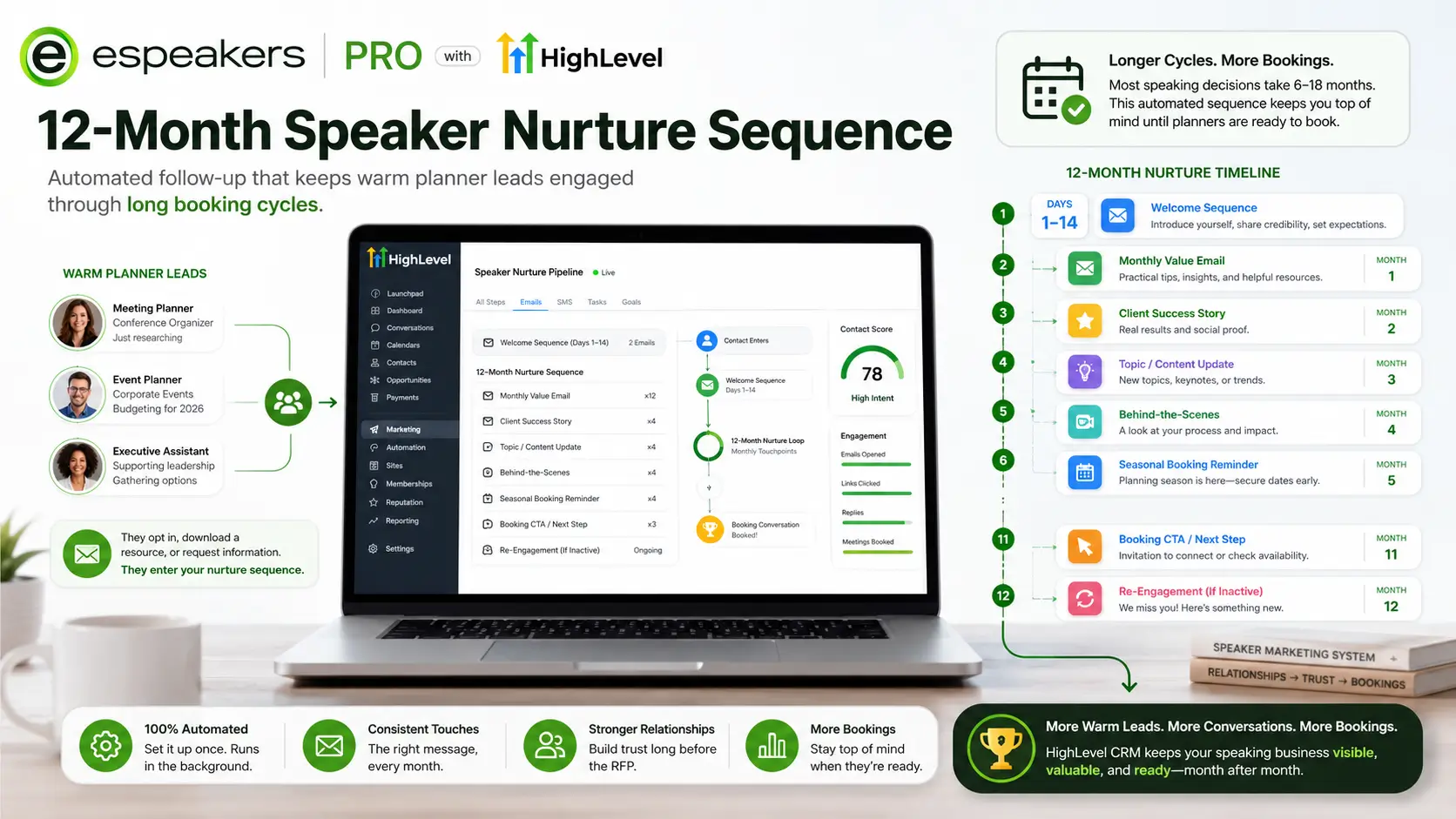
Sequence B: The Long-Term Nurture Sequence (Months 1–12)
This sequence runs after the Welcome Sequence completes. Its job is to stay relevant over a 12-month horizon without becoming noise.
The key principle: every email in this sequence provides value before it asks for anything. 80% of the emails in this sequence are purely educational or perspective-driven. Only 20% make any kind of ask.
The spacing is deliberate. Research on B2B email marketing consistently shows that daily email in a B2B context doesn’t build urgency; it builds resentment. Space sales sequence emails two to four days apart. For nurture sequences, longer gaps are fine. The Long-Term Nurture sequence runs on this cadence:
Month 1: Value content email, a trend, insight, or framework from your keynote topic, delivered as genuinely useful reading. Month 2: Social proof email, a recent case study, event recap, or notable engagement. Keeps your speaking active in their mind. Month 3: Availability check-in, “I’m opening my calendar for Q[X] events. If you have anything coming up where [topic] would be relevant, I’d love to be considered.” Month 4: Value content email, different angle from Month 1. Industry data, a prediction, a contrarian take on a trend. Month 6: Direct re-engagement, “It’s been a few months. Quick check-in, any events on the horizon where [specific outcome your keynote delivers] would be useful?” Month 8: Value content, case study format: here’s a problem an audience faced, here’s the framework we used, here’s what changed. Month 10: Soft availability pitch, “I’m starting to fill my [season] calendar. Happy to share my availability if the timing is right.” Month 12: Internal task created, manual outreach via phone or LinkedIn. Contacts who have been in the sequence for 12 months without responding deserve a personal attempt, not another automated email.
Exit trigger: Contact replies to any email → sequence stops and contact moves to personal follow-up. Contact books an engagement → sequence stops and pipeline moves to active booking. Contact unsubscribes → sequence stops and contact tagged do-not-contact.
Sequence C: The Re-Engagement Sequence (Dormant contacts)
This sequence runs automatically for contacts who have been in your CRM for more than 90 days with no email opens, no pipeline activity, and no replies. It’s your mechanism for cleaning the list while recovering dormant leads.
Three emails, each taking a different angle:
Email 1: Acknowledges the silence without making it awkward. “We’ve been in touch a few times over the past [months]. I want to make sure I’m sending you things that are actually useful. Any events on the horizon?”
Email 2 (Day 10): A new angle entirely. Something the contact has never heard from you, a fresh data point, a recent speaking outcome, or a new topic angle. Anything that doesn’t feel like the same sequence repeating.
Email 3 (Day 24): The graceful exit. “Last note from me, if the timing has passed or this isn’t relevant anymore, I completely understand. Just let me know and I’ll stop reaching out. Otherwise, I’m still [available dates / open for [quarter] events].”
This third email typically generates the highest reply rate of the three. The permission to opt out feels respectful, and planners who were meaning to respond but kept forgetting often do so here.
Layer 4: Conversion and Booking
Layer 4 is where readiness becomes revenue. A planner who has been in your nurture sequence for four months, who opens your availability check-in email, and who clicks to your eSpeakers calendar to see if October 15th is open, that planner is ready. Layer 4's job is not to get in their way.
The Three Layer 4 Elements
Real-time calendar availability
Your eSpeakers profile shows live availability because it syncs with your HighLevel calendar. The planner doesn't email to ask; they see the answer immediately. This single element improves conversion from profile visit to inquiry because it removes the primary friction point in the earliest stage of the booking process.
The immediate inquiry response
The New Inquiry workflow (Article 2) fires within five minutes of a form submission. The planner who submits at 7 PM gets a professional, personalized acknowledgment before they close their laptop. By morning, you have a warm conversation already in progress.
The discovery call booking page
For planners who want to talk before committing to an inquiry form, a direct link to your HighLevel calendar's discovery call event type lets them book a 15-minute call immediately. Confirmation fires automatically. Reminders fire the day before and an hour before. Pre-call form fires with the confirmation, so you walk into the call already knowing the event details, the audience, and what they're hoping to accomplish.
When Layer 4 is running correctly, a planner's path from "I'm interested" to "I'm on your calendar" takes under five minutes and requires no manual action from you.
The Integration Logic: How All Four Layers Connect
The system works because each layer feeds the next in a closed loop. Here's the complete flow:
Traffic → Capture
A planner reads your LinkedIn post, finds your eSpeakers profile, or gets referred by a colleague. They click through to either the Inquiry Funnel (if they're ready to book) or the Lead Magnet Funnel (if they're exploring). Either way, they become a HighLevel contact.
Capture → Nurture
The appropriate tag and pipeline stage are applied automatically. The Welcome Sequence begins. The topic-interest tag determines which version of the welcome email they receive. The system knows who they are, where they came from, and what they expressed interest in.
Nurture → Conversion
Over days, weeks, or months, the nurture sequence keeps you present. When a planner opens the availability check-in email and clicks through to your calendar, HighLevel tracks that click. If they book a call, the pipeline moves to "Discovery Call Scheduled." If they submit an inquiry, they move to "New Inquiry." Either way, they've self-selected into Layer 4.
Conversion → Booking
The booking is confirmed. The pre-event preparation sequence begins automatically. Post-event, the testimonial and referral workflows fire. Happy clients generate referrals that re-enter Layer 1. The loop closes and compounds.
The Content Calendar That Feeds the System
A speaker marketing system only compounds if Layer 1 is consistently producing new attention. That requires a content calendar that's realistic enough to maintain and strategically structured enough to produce results.
Here's a sustainable weekly content schedule for a speaker managing their own marketing:
Monday
LinkedIn post, Teaching content. One insight from your keynote topic, written as a specific lesson a planner could use. No pitch. No CTA except "What's your experience been?" This post builds authority.
Wednesday
LinkedIn post or story, Proof content. A client quote, an event recap, a specific outcome. "Last week I was at [organization type]'s annual summit. Here's what the audience walked away with..." This post builds credibility.
Friday
LinkedIn post, Personality or perspective content. An opinion on an industry trend, a behind-the-scenes moment, a personal reflection that connects to your topic. This post builds trust.
Monthly
Email broadcast to your full list, one valuable piece of content, 500–800 words, on a topic relevant to both your expertise and your planner audience's concerns. Not a pitch. Not an update. Something genuinely useful that they would forward to a colleague.
Quarterly
Long-form LinkedIn article, A deeper exploration of a trend, framework, or prediction in your area of expertise. This piece gets indexed by Google, ranks for long-tail keywords, and works as a persistent Layer 1 asset for months after publishing.
HighLevel's role
The email broadcast goes through HighLevel's email marketing system to your segmented list. Smart Lists ensure the right content reaches the right segment; past clients get a different version than cold prospects. Performance data (open rates, click rates, reply rates) feeds back into HighLevel's reporting dashboard.
The Five Email Subjects That Consistently Generate Replies
In a speaking business, a reply to a marketing email is a booking signal. It means a planner is engaged enough to stop reading and respond. Track your reply rate as the primary success metric for your email sequences, not open rates.
These five subject line formats consistently generate above-average reply rates for service-based businesses contacting B2B buyers:
The Specific Question
"Quick question about [organization]'s Q3 event" or "Are you planning anything for [industry conference season]?", Direct, easy to answer, respects the planner's time.
The Referral Name Drop
"[Mutual contact] suggested I reach out", Social proof upfront. Reply rates for referral-attributed emails are 2–3x higher than cold outreach.
The Insight Lead
"Something your [audience type] leadership teams keep struggling with", Curiosity-driven without being clickbait. Signals that you know their world.
The Availability Signal
"Opening my [quarter] calendar, anything coming up for [organization]?", Low pressure, actionable, easy to respond to with either a yes or a "not this cycle."
The Re-engagement Offer
"Still interested in [topic] content for your team?" Re-engagement emails that ask a simple yes/no question consistently outperform those that explain, justify, or sell.
Short subjects outperform long ones for planner outreach. Keep it under eight words. The goal of the subject line is a single click. The goal of the first sentence is a single scroll. Everything else is secondary.
Measuring the System: The Four Metrics That Matter
A system you can't measure is a system you can't improve. These four metrics, tracked monthly in HighLevel's reporting dashboard, tell you everything you need to know about the health of your speaker marketing system:
New contacts added per month
This measures Layer 1 and Layer 2 performance. If this number is growing, your traffic and capture mechanisms are working. If it's flat, your content needs to reach new audiences or your funnels need better offers.
Email reply rate by sequence
This measures Layer 3 performance. Track the reply rate of each sequence separately. A welcome sequence that generates replies at less than 5% needs its messaging rewritten. A long-term nurture sequence generating 2a –3% reply rate per email is performing well given the cadence. Compare sequences against each other to identify the strongest angles.
Hold-to-confirmed conversion rate
This measures Layer 4 performance. What percentage of holds turn into confirmed bookings? If it drops, your proposals may need work, or your follow-up timing may have slipped. If it climbs, your pipeline management is improving.
New contacts from referrals as a percentage of total
This measures the system's compounding effect. As past clients and warm contacts cycle through post-event workflows and referral activation, the percentage of new contacts arriving via referral should gradually increase over time. A rising referral percentage means the system is working, not just generating new contacts, but regenerating value from existing relationships.
FAQ
Start with Layer 2: build the Inquiry Funnel first. This is the highest-ROI piece because it converts existing traffic (people who are already finding you) into CRM contacts. It requires a landing page, a form, and two workflow automations, doable in a weekend. Once that’s running, add the Welcome Sequence. Then the Lead Magnet Funnel. Then the Long-Term Nurture sequence. Build in order, one layer at a time.
Two funnels: 4–6 hours. Three email sequences: 6–8 hours writing content, 2–3 hours building in HighLevel. LinkedIn content calendar: 2–3 hours upfront to create a 30-day content plan, then 30–45 minutes per week to write and post. Total setup: 15–20 hours spread across two to three weeks. After that, the system maintains itself with two to three hours of active management per week.
Yes, and more so than for large lists. A small list of genuinely warm contacts who receive a well-built nurture sequence converts at dramatically higher rates than a large list of cold subscribers receiving generic emails. The system’s value is in the quality of nurture, not the quantity of contacts. Build the system while the list is small, so it’s already running well when the list grows.
No. Build Layer 2 first (funnels), then Layer 3 (email sequences), then optimize Layer 1 (content) to feed what you’ve built, then refine Layer 4 (conversion) based on where leads are dropping off. A working Layer 2 with no Layer 1 traffic still has value; it converts the traffic you already get. A great Layer 1 with no Layer 2 is just visibility without capture.
The leading indicator is new contacts per month. The lagging indicator is bookings per quarter. If new contacts are rising but bookings aren’t following within two to three months, your Layer 3 sequences need work; the nurture isn’t converting readiness into action. If bookings are rising but new contacts are flat, your Layer 1 and Layer 2 need investment.
The System Compounds. The Activities Don’t.
This is the fundamental difference between a speaker marketing system and a collection of marketing activities.
An activity delivers a result once. A LinkedIn post reaches its audience and fades. An email generates replies and goes quiet. An outbound campaign produces a round of conversations and ends.
A system delivers compounding results. Every planner who enters your CRM becomes a contact in a 12-month nurture sequence. Every satisfied client generates a referral request that brings in a new planner contact. Every email broadcast deepens relationships that future broadcasts will convert. Every new booking becomes a testimonial that improves your eSpeakers profile, which generates more inbound inquiries, which start the whole sequence again.
The difference in outcomes between a speaker running activities and a speaker running a system isn’t visible in month one. It’s visible in month twelve, and compounding through years two and three. That’s when the calendar stops being reactive, filling when referrals happen to arrive, and becomes predictable, full because the system reliably generates the conversations that consistently convert to bookings.
Start your 60-day eSpeakers PRO trial, get a pre-configured HighLevel speaker marketing system →
eSpeakers PRO includes a speaker-configured HighLevel environment with the inquiry funnel, welcome sequence, long-term nurture, and eSpeakers integration pre-built. Customize the copy, connect your calendar, and your speaker marketing system is live in days.
Joe Heaps, Chief Marketing Officer at eSpeakers
Joe Heaps is the Chief Marketing Officer at eSpeakers and is responsible for creating and accelerating the company's sales & marketing strategies. He is focused on driving the company's vision of helping organizations and individuals improve in substantial, long-term ways. He believes it happens when the perfect speaker is in front of the right audience. Over 25 years in the industry, Joe’s strategic vision and leadership have propelled eSpeakers to the leading software platform for speakers, coaches, and experts.
Joe Heaps
Chief Marketing Officer, eSpeakers
Latest Articles


Related Articles