10 Speaker Profile Mistakes That Are Costing You Gigs (and How to Fix Them)
Speaker profiles lose bookings silently; a planner finds you, spends 30 seconds on your profile, and moves on without inquiring. Not because you're underqualified, but because the profile failed to answer the questions they needed answered: who is this speaker for, what will my audience walk away with, and have other planners hired them with good results. Most of those failures stem from 10 specific, fixable mistakes that are costing speakers inquiries every week.
Speaker profile optimization isn't about gaming algorithms or adding keywords for their own sake. It's about removing every friction point that stands between a planner's interest and an inquiry in your inbox. This article identifies each mistake, explains exactly why it drives planners away, and shows what to replace it with.

John Doe
Chief Marketing Officer at eSpeakers
Mistake #1: Your Positioning Sounds Like Everyone Else’s
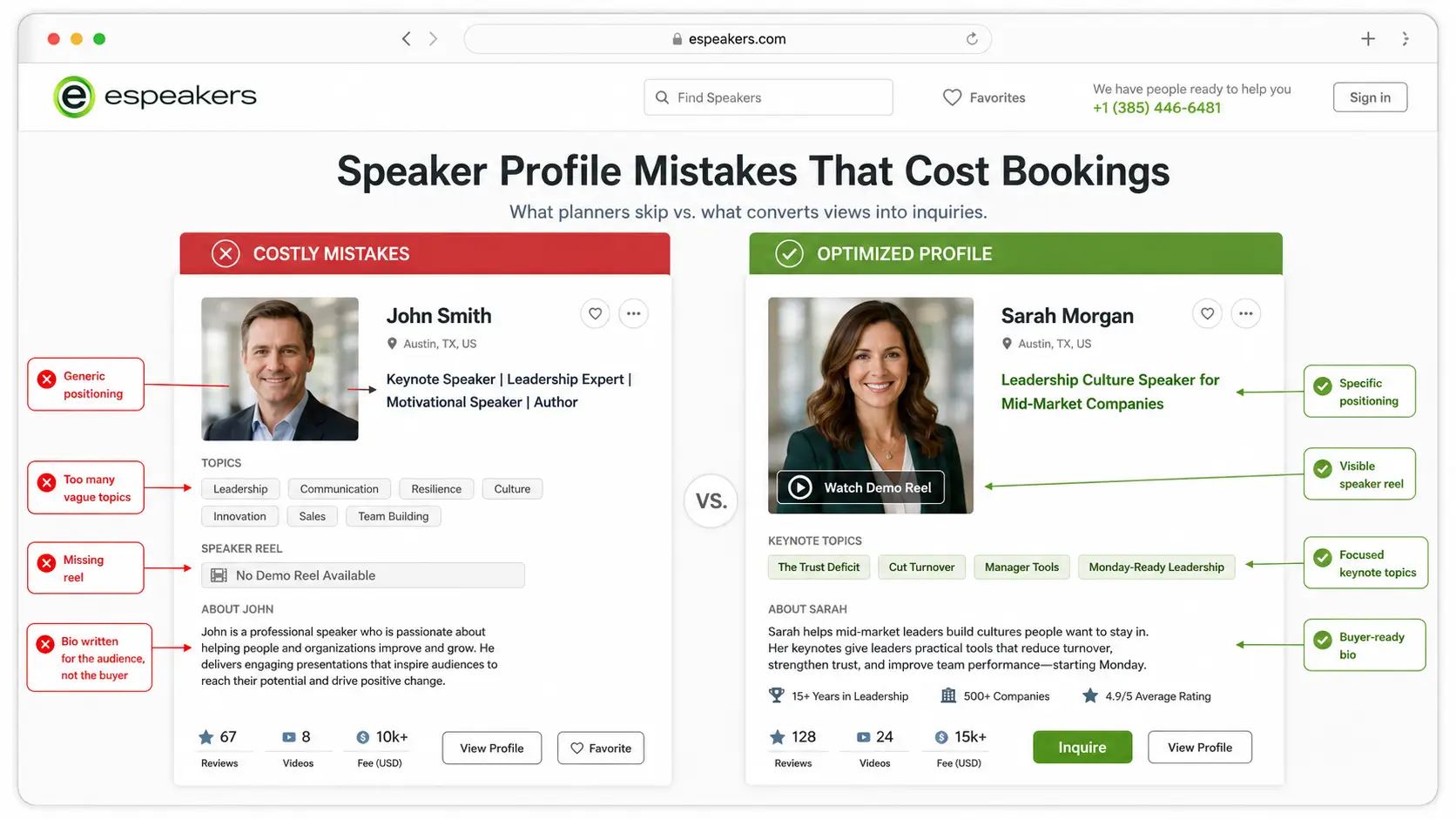
What it looks like: “Keynote Speaker | Leadership Expert | Motivational Speaker | Author | Coach”
Walk through any speaker directory, and you’ll see this title pattern repeated hundreds of times. It’s the speaker equivalent of a résumé that lists “detail-oriented team player with excellent communication skills.” True, perhaps, but utterly invisible.
The professional speaker market is a $2+ billion industry. The professional speaker market sits at $2.19 billion in 2025 and is projected to reach $2.61 billion by 2030 (per IBISWorld’s professional speakers industry analysis. That means the competition for a planner’s attention is intense, and generic positioning is the fastest way to become a commodity.
Why does it cost you bookings? When a planner compares you to five other speakers on the same shortlist, identical positioning gives them no reason to choose you. Worse, overly broad positioning signals that you’ll say yes to anything, which actually reduces perceived expertise.
The fix: Replace your title with a specific, outcome-driven positioning statement that names who you help, what problem you solve, and what changes for the audience afterward.
- Generic: “Leadership & Communications Speaker”
- Specific: “I assist mid-market companies in building leadership cultures that cut turnover, through keynotes that give managers tools they use the Monday after the event.”
One sharp sentence beats four vague credentials every time. If a planner has to read your entire bio to understand what you do, your positioning has already failed.
Mistake #2: Your Bio Is Written for the Audience, Not the Buyer
What it looks like: A bio that’s warm, inspirational, and full of phrases like “passionate about empowering others”, but light on the specifics that justify a booking decision.
This is one of the most common and most costly speaker profile optimization errors. Your bio is read by two very different people at two very different moments: by a meeting planner who needs to justify your hire to a committee, and by an audience member who wants to know if your session is worth attending. Most bios try to do both jobs at once and end up doing neither well.
A weak or generic bio can undermine your authority, making potential attendees question your relevance or the value of your presentation. But the bigger risk is what it does to the planner, the person actually writing the check.
Why does it cost you bookings? A planner can’t sell you internally if your bio doesn’t give them the ammunition to do it. They need named clients, specific credentials, and tangible outcomes, not inspiration.
The fix: Write your profile bio primarily for the buyer. Lead with your single strongest credibility marker, name at least two recognizable clients or associations you’ve worked with, state the transformation your audiences experience in concrete terms, and close with one human detail that makes you memorable. Save the inspirational language for your keynote.
A bio written for a planner answers: “Why this speaker, for this audience, at this budget?” If yours doesn’t answer that question in the first 100 words, rewrite the opening.
Mistake #3: Too Many Topics, or Topics That Sound Like Categories
What it looks like: A topic list with 8–12 entries, each one a single noun or broad category: Leadership. Communication. Change Management. Resilience. Culture. Innovation. Sales. Team Building.
Or the opposite: just one or two vague titles that don’t tell a planner anything specific about what the audience will experience.
Planners are pushing back on canned keynotes. The speakers booking the most dates are the ones willing to do real prep calls, review attendee data, and tailor at least the opening and closing segments to the room. That expectation begins with how you present your topics on your profile; if the topics themselves look like plug-and-play templates, you’ve already suggested that customization isn’t part of your offering.
Why does it cost you bookings? Too many topics signal unfocused expertise. Too few, or too vague, give planners nothing to work with when they’re trying to match you to an event brief. Either way, the planner moves on to a speaker who makes the match obvious.
The fix: Limit yourself to three or four topics maximum. Give each one a title that sounds like an actual keynote, specific, intriguing, and benefit-forward, not a subject category.
- Category: “Leadership Development”
- Keynote title: “The Trust Deficit: Why Your Best Managers Are Making Their Teams Smaller, and How to Reverse It”
For each topic, include a 75-word description, three to five audience outcomes (“Attendees will leave with…”), and the formats available (keynote, workshop, virtual, breakout). A planner reading this can immediately picture it on their agenda. A planner reading “Leadership Development” cannot.
Mistake #4: No Demo Reel, or One That Starts Too Slowly
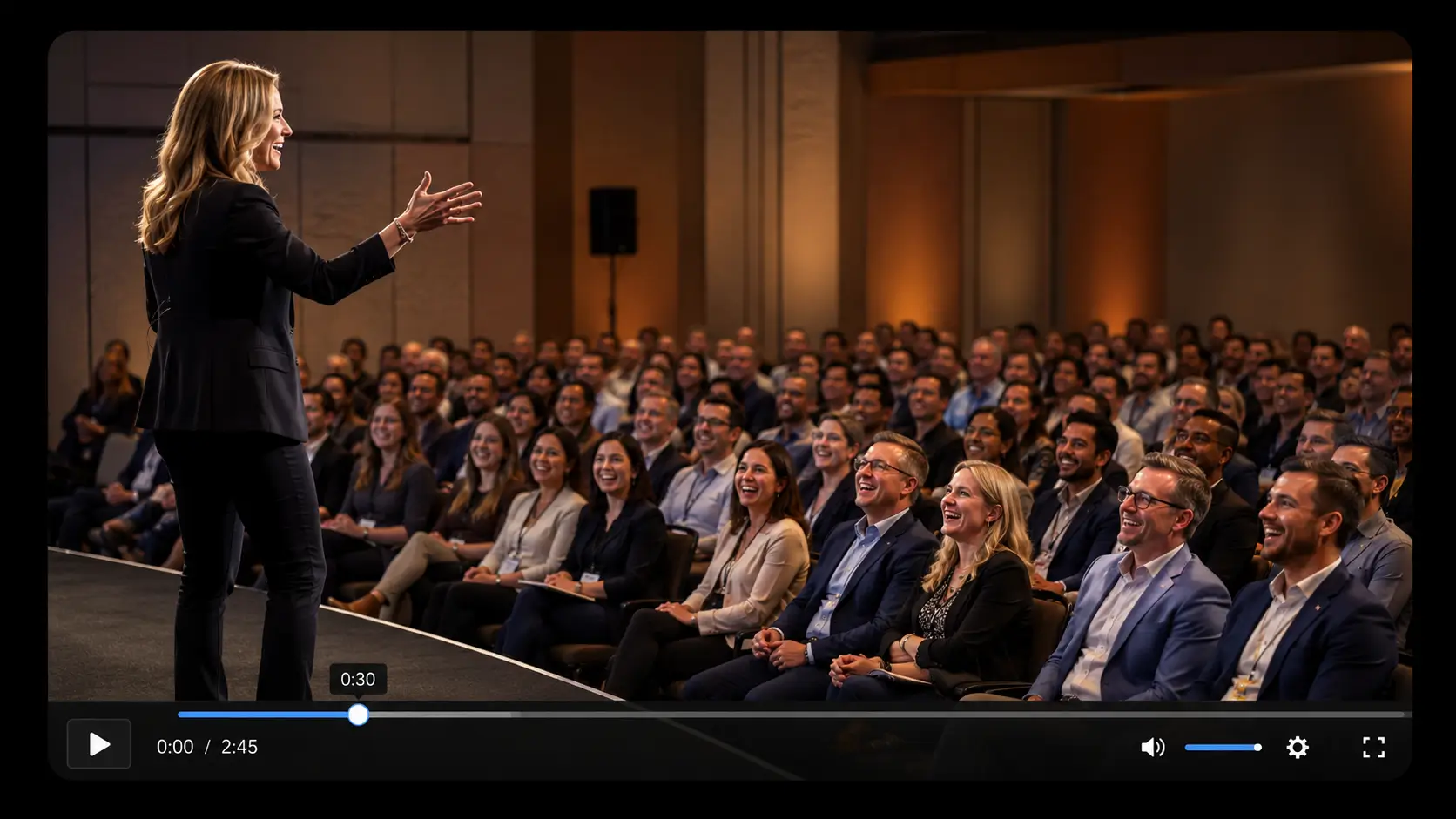
What it looks like: Either no video at all on the profile, or a reel that opens with 45 seconds of titles, logos, and background music before the speaker appears on screen.
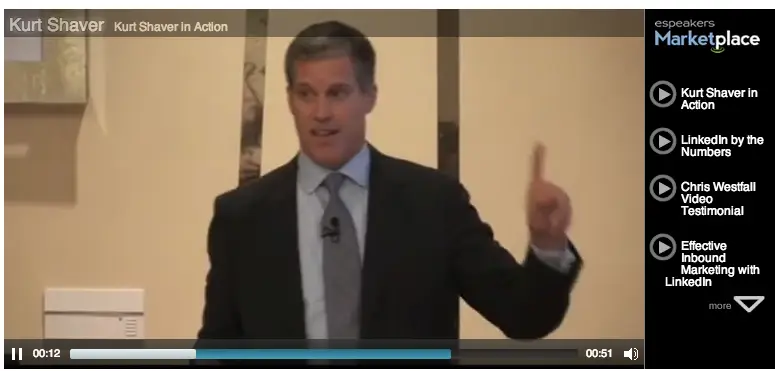
In 2026, a profile without video is a profile that gets skipped. Planners aren’t just buying your content; they’re buying how your content lands in a room. Video is the only way to demonstrate that before a contract is signed.
Why does it cost you bookings? Meeting planners check speaker websites for detailed client lists, media appearances, and published work, and review online presence, including social media engagement. Video is the highest-impact element of that review. A missing reel forces planners to make a booking decision on faith alone; most won’t.
A reel that opens slowly has essentially the same problem. Planners watch dozens of reels during a search cycle. If yours doesn’t make the case in the first ten seconds, it doesn’t make the case.
The fix: Your reel should open with your best moment, the clearest demonstration of your stage presence, your delivery, and your audience’s response. No slow builds. No intro music. Show yourself commanding a room within the first five seconds, then cut to reaction shots, different venue sizes, and a 15-second sample of your content.
Keep the full reel under three minutes. Host it prominently at the top of your profile page and on YouTube, “your name + speaker reel” is a search query planners commonly run during due diligence, and a YouTube-hosted reel gives you a second discovery surface.
If you don’t have reel footage yet, a clean, well-lit recording from a recent presentation, good audio, and a real audience visible is substantially better than nothing.
Mistake #5: Testimonials from Audiences Instead of Organizers
What it looks like: A profile full of glowing quotes from audience members: “Best speaker I’ve ever seen!” “Changed my life!” “Absolutely inspiring!”
These feel like strong social proof. To a planner, they’re nearly useless.
Why does it cost you bookings? Planners are not the audience. They’re the ones who have to justify the booking, manage the logistics, and report to their boss if something goes wrong. The voice they trust is their peer, another event organizer, not an attendee who experienced the talk.
The fix: Make organizer testimonials your priority. After every significant engagement, send a brief follow-up to the event organizer within 48 hours while their experience is fresh. A simple email asking for a sentence or two about the impact on the event, not the content, but the outcome for them as a planner, will yield far more useful testimonials than waiting for audience feedback to trickle in.
The most powerful testimonial format for a planner audience names the event type, the audience, and a specific result: “We had 400 sales managers in the room for our Q3 kickoff, and [Speaker Name] had them on their feet for a standing ovation. Three months later, our regional managers are still referencing specific frameworks from the session.”
That quote answers every question a planner has. “Best speaker I’ve ever seen” answers none of them.
Mistake #6: Your Profile Is Inconsistent Across Platforms
What it looks like: Different bios on your website, your eSpeakers profile, and LinkedIn. A professional photo on one platform, a casual shot on another. Topics are listed in different orders with different descriptions. A fee is mentioned on one page but not another.
Planners cross-reference. It’s one of the first things they do once a name makes their shortlist.
Why does it cost you bookings: Inconsistency creates doubt, even when a planner can’t articulate why. If your eSpeakers profile says you speak on leadership and your website says you speak on culture and innovation, a planner wonders which is actually your focus. If your headshot looks like a different person on each platform, the impression is one of disorganization, exactly the opposite signal you want to send to someone who’s about to trust you in front of their audience.
The fix: Do a platform audit at least twice a year. Your positioning statement, primary topics, headshot, and bio (in their appropriate lengths) should be identical across your eSpeakers profile, your personal website, and LinkedIn. When you update one, update all three. Treat your eSpeakers profile as the master version; it’s the most heavily indexed by planners searching for speakers, and sync everything else to it.
Mistake #7: No Fee Information at All
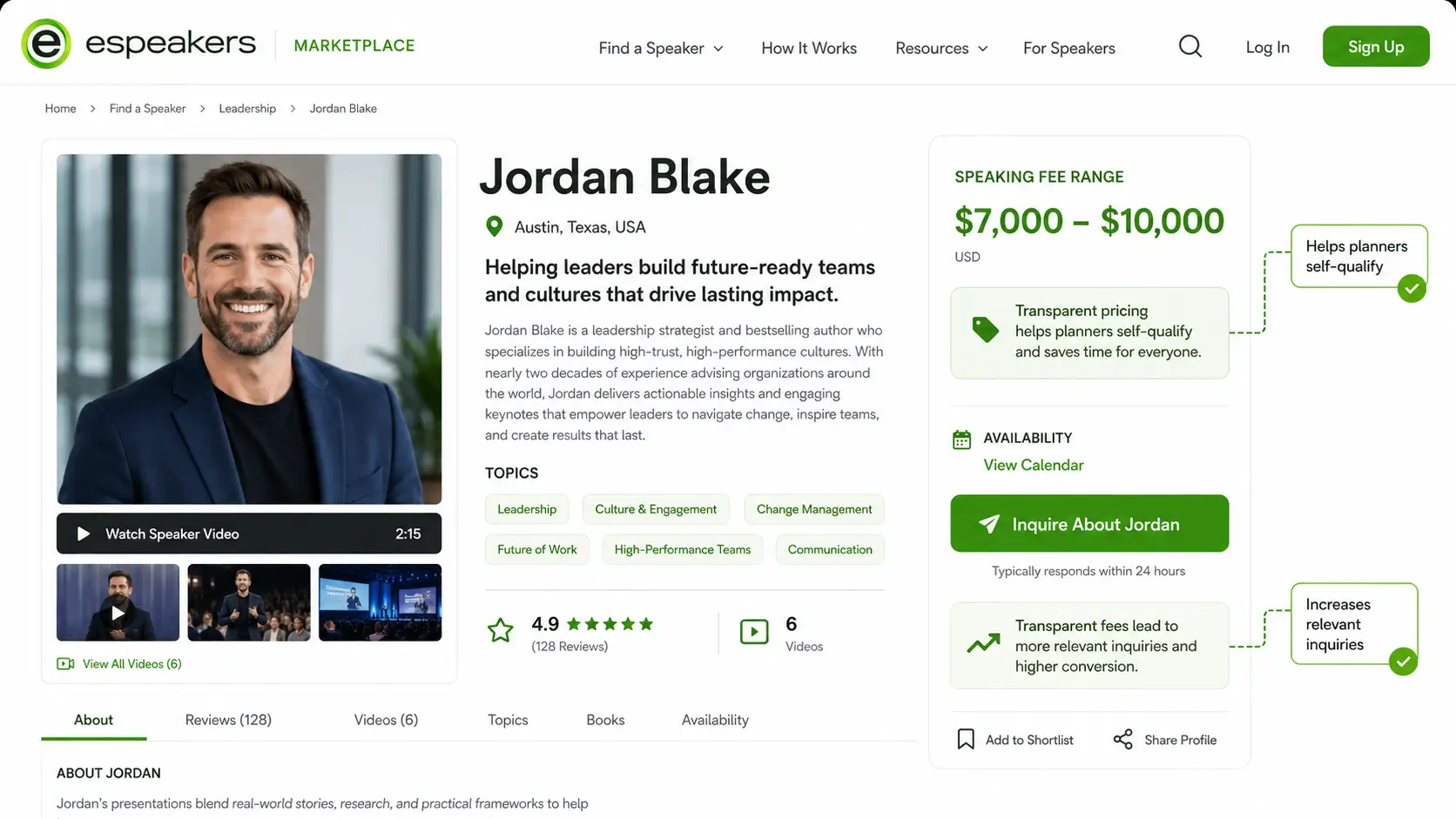
What it looks like: A profile that says “Contact for pricing” with zero context about fee range, and no other signals that would help a planner assess fit.
This is a well-intentioned mistake. Many speakers avoid publishing fees to preserve negotiating flexibility or to avoid scaring off prospects. In practice, it often has the opposite effect.
Why it costs you bookings: There are estimated to be hundreds of thousands of people on LinkedIn who call themselves keynote speakers, making due diligence non-negotiable. Planners working through a shortlist use a fee range as an early filter. If your profile gives them no signal at all, they can’t qualify you, so they either skip you entirely or invest time in an inquiry only to discover you’re outside their budget. Neither outcome serves you.
The fix: You don’t need to publish an exact fee. Publishing a starting range, “Keynotes from $X” or “Available for events of all sizes, contact for current availability and fees” with a general tier indicated, filters unqualified inquiries and attracts planners who are already in range. It also signals confidence: speakers who know their value don’t hide their price.
If you’re on eSpeakers, the platform lets you display fee information in ways that give planners enough context without locking you into a fixed number.
Mistake #8: An Outdated Profile That Signals You’re Not Active
What it looks like: A “2023 Upcoming Events” section with no events listed. A bio that still mentions a role you left two years ago. A client list that hasn’t included a new logo in three years. A reel from a 2019 keynote where you look significantly younger.
Staleness is invisible to speakers who see their own profile every day. To a planner encountering it for the first time, it raises an immediate question: Is this person still actively speaking?
Why does it cost you bookings? Being good isn’t enough anymore. You need to be visible and dependable. Findable and easy to work with. An outdated profile undermines all three. It signals that you’re not actively managing your speaking business, which makes a planner less confident that the logistics of working with you will be smooth.
The fix: Set a calendar reminder to review your profile on the first of every month. The review takes 15 minutes:
- Is there a new client logo to add?
- Is there a new testimonial to post?
- Has anything in your bio changed (new book, new credential, new certification)?
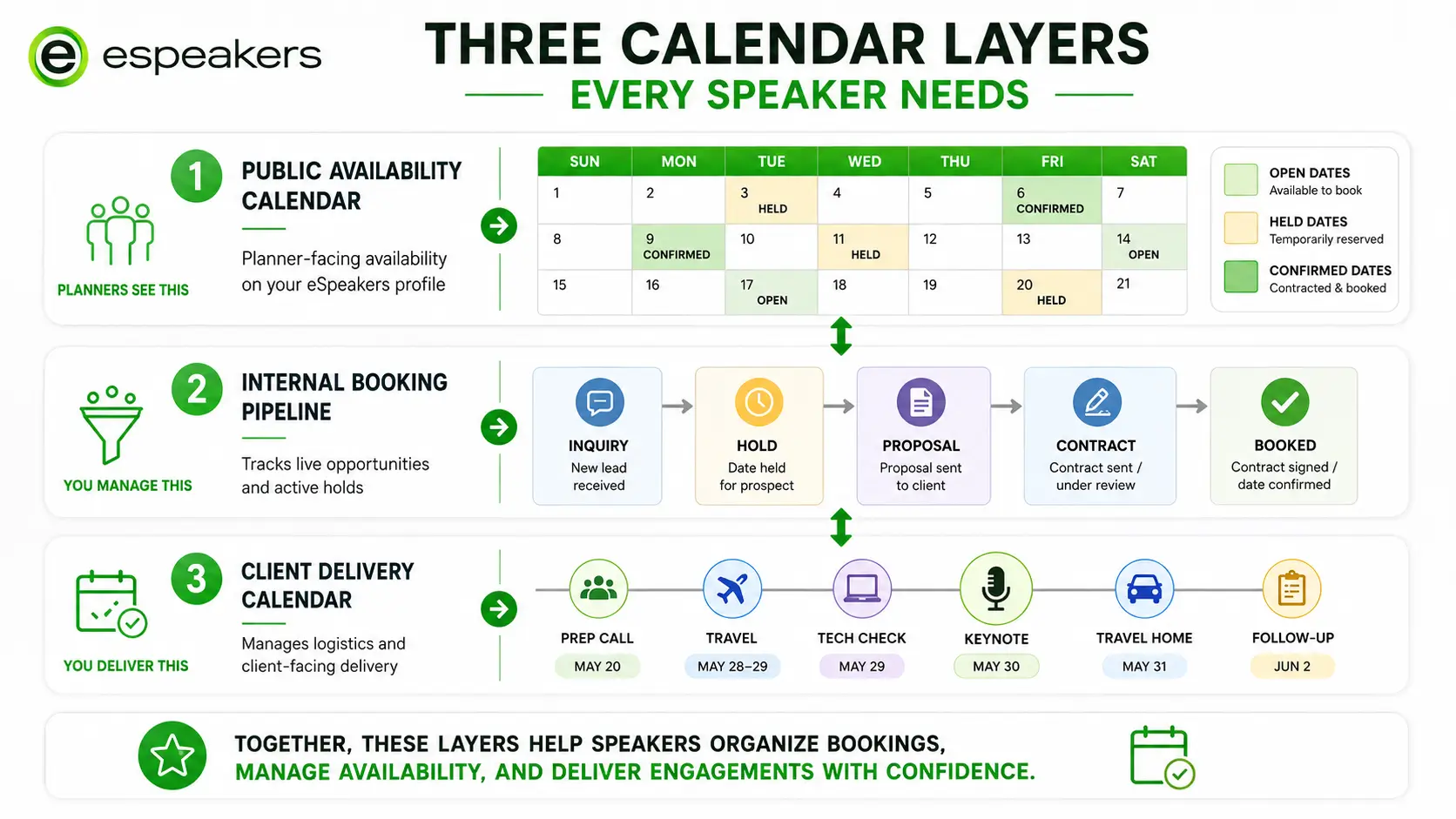
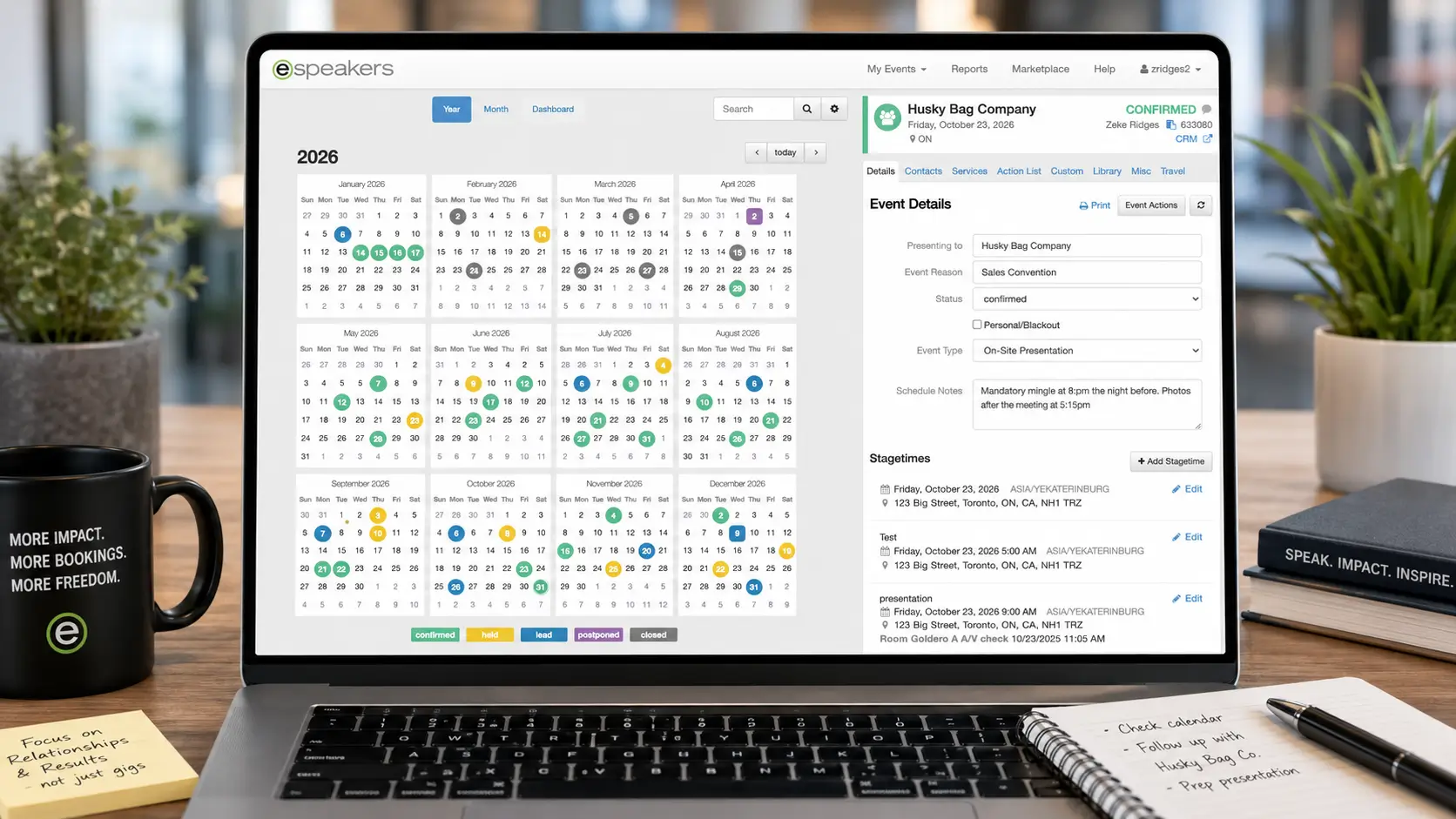
- Is your eSpeakers calendar current so planners can see your actual availability?
Consistent maintenance is one of the highest-ROI activities in your speaking business. A profile that looks actively managed signals a speaker who takes their business seriously.
Mistake #9: A Booking Path With Too Much Friction
What it looks like: A “Contact Me” button that leads to a generic form asking for a name, email, organization, event date, event size, event location, event type, and budget, before you’ve had a single conversation.
Or a contact page that lists an email address and a note that responses may take 3–5 business days.
Why does it cost you bookings? Slow responses create doubt. Delayed follow-through creates stress. And stress kills repeat gigs. Planners in 2026 are working with compressed booking timelines; many are now selecting speakers in a three-to-six-month window, and some are moving faster. A planner who has to fill out a lengthy form just to start a conversation will often move to the next speaker who makes it easier.
The fix: Your profile’s primary call-to-action should have one clear, low-friction next step. “Check my availability” linking to your eSpeakers calendar is ideal, it lets a planner see open dates immediately without waiting for a response. A simple inquiry button that asks for an email address and event date is the maximum barrier you should put between interest and contact.
The goal is to make a planner’s path to booking as easy as possible. Every additional field in your contact form is a place where someone can decide it’s not worth their time.
Mistake #10: Treating Your Profile as a One-Time Setup
What it looks like: A profile that was built carefully when you first launched your speaking business, and hasn’t been meaningfully updated since.
This is the meta-mistake that enables all the others. Speaker profile optimization is not a one-time project. It’s an ongoing practice.
Why do bookings cost you? The speaking industry is changing fast. If 2025 was the year planners tested AI tools, 2026 is the year AI became the co-pilot running everything behind the scenes. AI-powered matching tools now compare speaker profiles to event briefs automatically, and a profile that hasn’t been updated to reflect current topics, current clients, and current format offerings will rank lower in those matches than one that has.
Beyond technology, the market itself shifts. Survey data points to growing interest in specific topics for corporate events: leadership and teamwork attract 66% of corporate event interest, motivation sits at 50%, and AI and machine learning at 49% (per PCMA’s annual Meetings Outlook). If your topic framing doesn’t reflect what planners are actively searching for, you’re leaving matches on the table.
The fix: Build a quarterly profile review into your business calendar. Each quarter, ask:
- Do my topic titles reflect what planners are currently looking for?
- Does my positioning still differentiate me, or has the market moved?
- Have I added new clients, credentials, or certifications that belong on the profile?
- Is my reel still representative of my best current work?
- Am I showing up in eSpeakers search results for the keywords I should own?
A speaker who treats their profile as a living business asset, not a static bio page, consistently outperforms one who sets it and forgets it.
Your Profile Optimization Checklist
Run your profile against this list right now. Every “no” is a booking you may be losing.
Positioning
- My positioning statement is outcome-specific, not a generic title
- A planner can understand what I do and who I help in under 10 seconds
Bio
- My bio is written primarily for the buyer (planner), not the audience
- It leads with my strongest credibility marker
- It names at least two specific clients or associations
- I have versions in three lengths (long, medium, short)
- It has been updated within the last 12 months
Topics
- I list 3–4 topics, not 8–12
- Each topic has a specific title, not a category name
- Each topic includes outcomes and available formats
Video
- I have a demo reel on my profile
- It opens with a strong stage presence within the first 10 seconds
- It’s under 3 minutes
- It includes visible audience reaction shots
Social Proof
- My testimonials include quotes from event organizers (not just audiences)
- At least one testimonial names a specific outcome or result
- My client logos are current
Consistency
- My bio, photo, and topics match across my eSpeakers profile, website, and LinkedIn.
Fees
- My profile gives planners some indication of my fee range.e
Booking Path
- My call-to-action is a single, low-friction step
- Planners can check my availability without waiting for an email response
Maintenance
- My profile has been reviewed and updated within the last 90 days.
FAQ
If you’re getting traffic or referrals to your profile but not converting them to inquiries, the profile is the bottleneck. Check your eSpeakers analytics for profile views versus contact requests; a large gap between the two is a clear signal. Common culprits are vague topics, no video, or a friction-heavy contact path.
Three to four is the sweet spot. One topic positions you as extremely specialized, which is powerful in some niches but limiting for general outreach. More than four starts to look unfocused. If you genuinely speak across multiple distinct topic areas, group them into three or four thematic umbrellas with specific keynote titles under each.
Use it with an update plan. An older reel that demonstrates strong stage presence is better than no reel. But make capturing new footage a priority at your next significant engagement, even a professionally edited clip from a single event can replace an aging full reel.
After every engagement, as standard practice. The 48 hours immediately following an event are the window where organizers are most likely to respond. A short, specific email, “Would you be willing to share a sentence or two about how the session landed with your audience?”, makes it easy to say yes.
A fee range, at a minimum. Exact fees can stay private or be available on request, but a general tier (starting fee, or a range) filters bad-fit inquiries and reassures planners that you’re a serious professional with established pricing. Speakers without a fee signal are often assumed to be either unpriced or out of range.
eSpeakers first, because it’s actively searched by planners looking to hire. But then update your website, planners who find you on eSpeakers will Google you next, and an outdated personal site creates an inconsistency that undermines the strong eSpeakers profile you’ve built.
Fix Your Profile Before the Next Planner Clicks Away
Profile optimization isn’t about adding more content; it’s about removing the friction, vagueness, and inconsistency that cause planners to hesitate. Every mistake on this list is fixable in an afternoon. And fixing even three or four of them can meaningfully change your inquiry rate.
Build your complete eSpeakers PRO profile, start your 60-day free trial →
Get your profile in front of meeting planners actively searching for speakers, connect your calendar for real-time availability, and use HighLevel CRM to track every inquiry from first contact to confirmed booking.
Joe Heaps, Chief Marketing Officer at eSpeakers
Joe Heaps is the Chief Marketing Officer at eSpeakers and is responsible for creating and accelerating the company's sales & marketing strategies. He is focused on driving the company's vision of helping organizations and individuals improve in substantial, long-term ways. He believes it happens when the perfect speaker is in front of the right audience. Over 25 years in the industry, Joe’s strategic vision and leadership have propelled eSpeakers to the leading software platform for speakers, coaches, and experts.
Joe Heaps
Chief Marketing Officer, eSpeakers
Latest Articles

Related Articles