How to Build a Speaker Profile That Gets You Booked: The Complete 2026 Guide
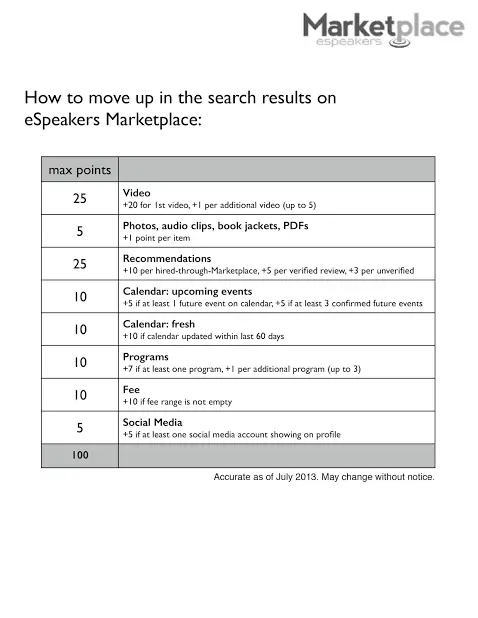
An online speaker profile that gets you booked has six non-negotiable elements: an outcome-first bio that leads with what audiences walk away with, topic pages that name a specific audience and problem, an embedded demo reel with visible audience engagement, verified client reviews from real planners, a live availability calendar, and a displayed fee range. Missing any one of these reduces both your eSEO ranking in the eSpeakers Marketplace and the conversion rate of profile views into planner inquiries.
Your online speaker profile is working for you or against you right now.
While you're on stage, traveling between gigs, or building your next keynote, meeting planners are online searching for their next booking. They'll type something like "leadership keynote speakers for corporate events" or simply Google your name after hearing you mentioned at a conference. What they find in the next 30 seconds will determine whether they send an inquiry or click to the next result.
In 2026, a great online speaker profile isn't a nice-to-have; it's your most important sales asset. Event planners are working with tighter budgets, shorter booking windows, and audiences who can fact-check a claim from their seats. They're not just looking for a speaker; they're looking for confidence. Your profile has to give them that instantly.
This guide covers exactly what goes into an online speaker profile that converts browsers into bookings, from your bio and speaker reel to your topics, testimonials, and the strategic use of a speaker directory like eSpeakers to put your profile in front of planners who are actively looking to hire.
John Doe
Chief Marketing Officer at eSpeakers
What Is an Online Speaker Profile, and Why Does It Matter More Than Ever
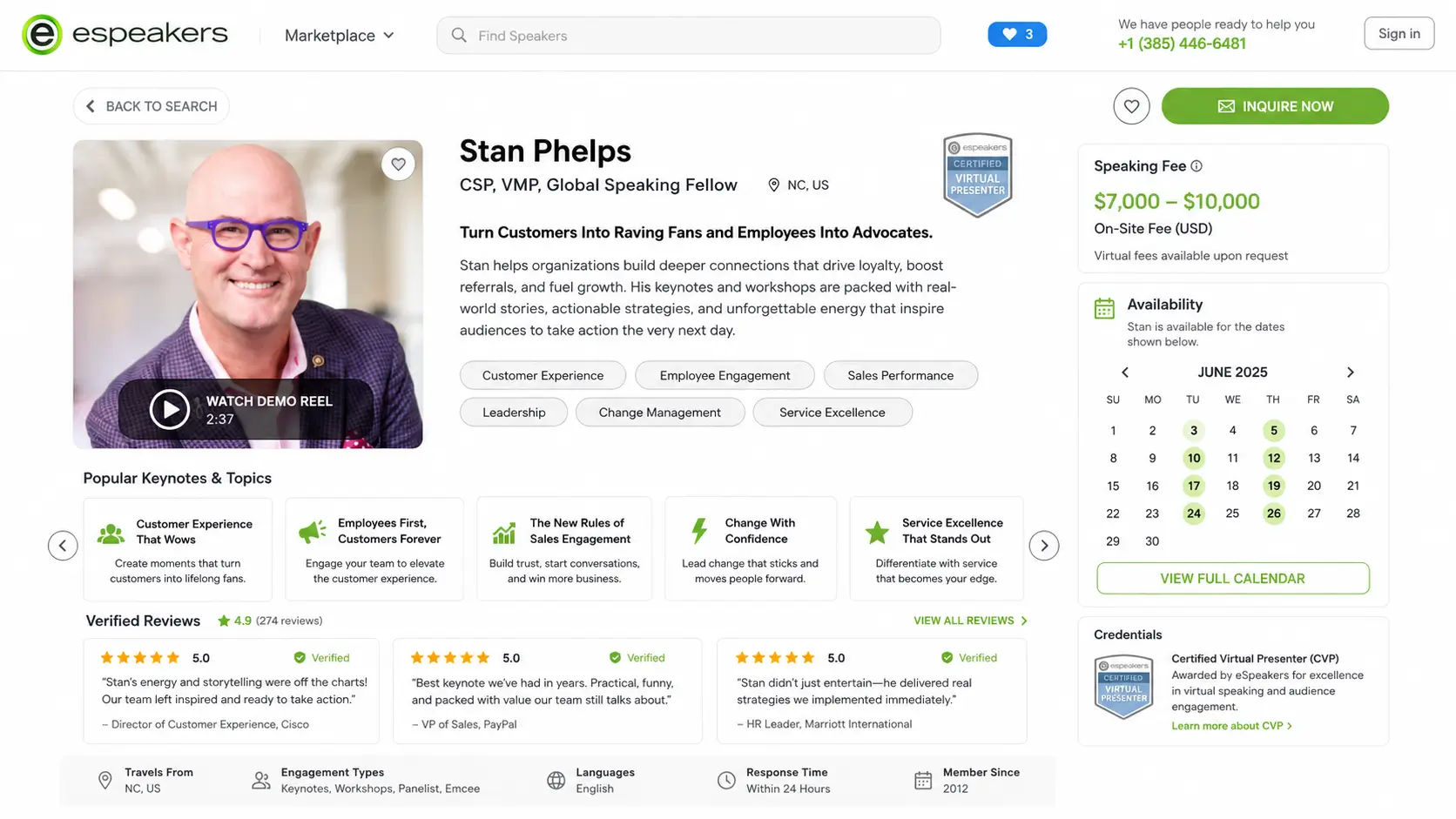
An online speaker profile is a dedicated, searchable page that presents your speaking credentials, topics, past clients, demo video, testimonials, and booking information in one place. Think of it as your professional speaking resume, except it needs to work as hard as a sales page.
In the past, a speaker’s website and a bureau listing might have been enough. In 2026, planners are using multiple channels to vet speakers before making contact:
- Speaker directories (like eSpeakers) to browse and filter by topic, fee, and location
- Search engines to find speakers organically by topic or name
- AI-powered tools to match speaker profiles to event briefs
- Social proof channels like LinkedIn and YouTube to validate credibility
If your profile isn’t optimized for how planners actually search and evaluate, you’re invisible to a large share of your potential market.
The 8 Elements of a High-Converting Speaker Profile
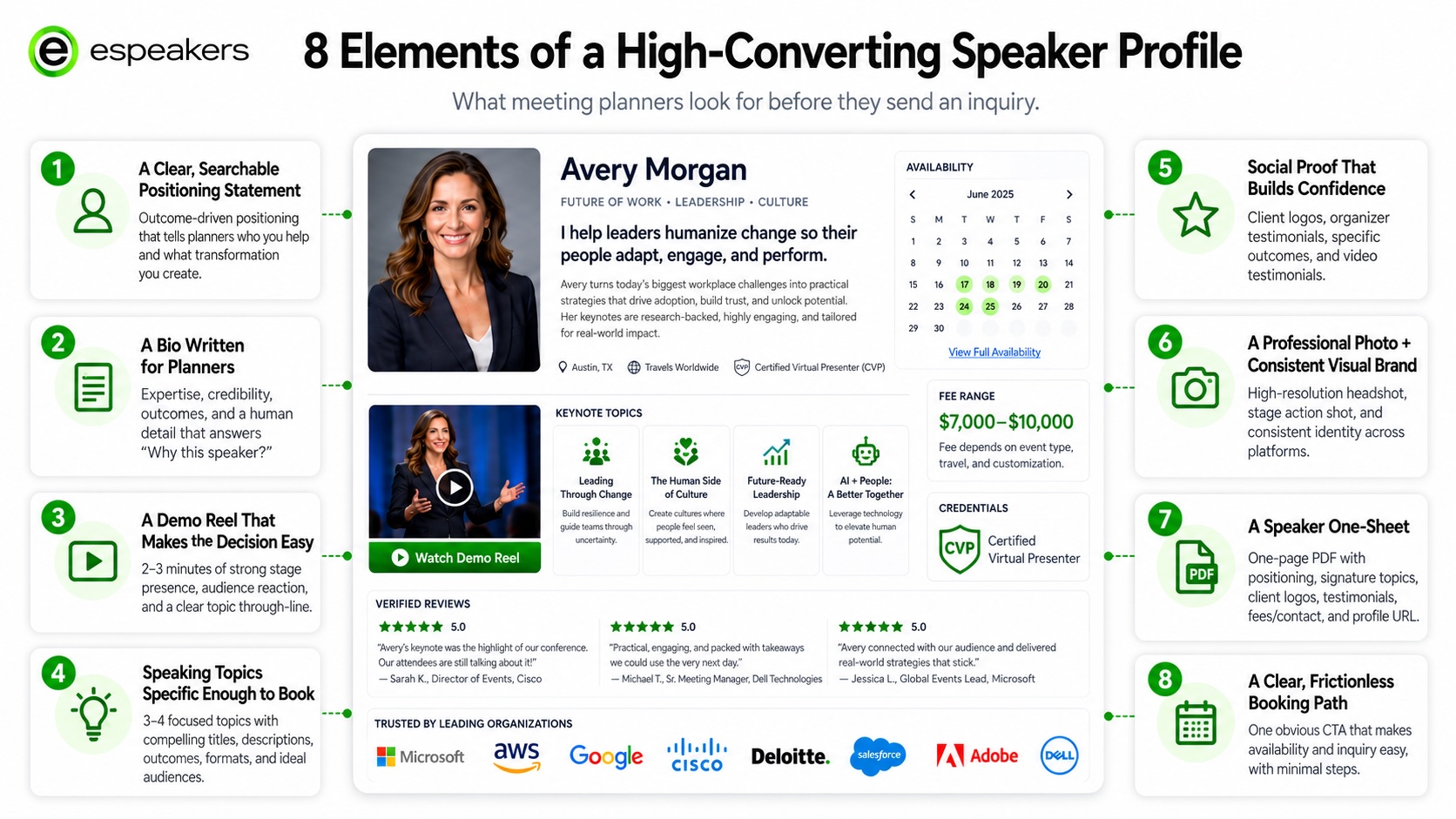
1. A Clear, Searchable Positioning Statement
The first thing on your profile, before your bio, before your photo, should answer one question: What transformation do you create for your audience?
This isn’t your job title. It’s not “Keynote Speaker and Author.” It’s a specific, outcome-driven statement that tells a planner immediately whether you’re the right fit for their audience.
Weak: “Keynote Speaker | Leadership Expert | Author”
Strong: “I teach 5 steps that mid-size companies can use to build leadership cultures that retain top performers, through keynotes that move people from insight to action.”
The second version works because it names the problem, the audience, and the outcome. That’s what planners scan for when they’re building a shortlist. It’s also the kind of clear, direct language that AI tools and search engines use to match profiles to event briefs.
Keep your positioning statement to two sentences maximum. Lead with the result you create for audiences, not a list of your credentials.
2. A Bio Written for Planners, Not Audiences
Your speaker bio does double duty: it helps planners justify the booking internally, and it gets read aloud as your introduction on stage. Most speaker bios fail at the first job because they’re written with the audience in mind.
Planners need to answer a question their boss or committee will ask: “Why this speaker?” Your bio has to make that answer easy.
What an effective speaker bio includes:
- Your specific area of expertise (not just a topic category)
- Concrete evidence of credibility: past clients, books, research, media appearances, certifications
- The outcome or transformation your audiences experience
- A human detail or two that makes you memorable and approachable
A practical structure that works:
- Opening hook, your most impressive or surprising credential
- What you do, your area of expertise, and the result you create
- Proof, 2–3 specific credibility markers (named clients, publications, certifications)
- Human element, one authentic personal detail
- Closing action line, a phrase that signals you’re available and easy to work with
Create three versions of your bio: a long version (300–400 words) for your profile page, a medium version (150–200 words) for directory listings and event programs, and a short version (75–100 words) for introductions and social profiles. Keep all three current; an outdated bio with old client names or stale stats can quietly cost you bookings.
3. A Demo Reel That Makes the Decision Easy
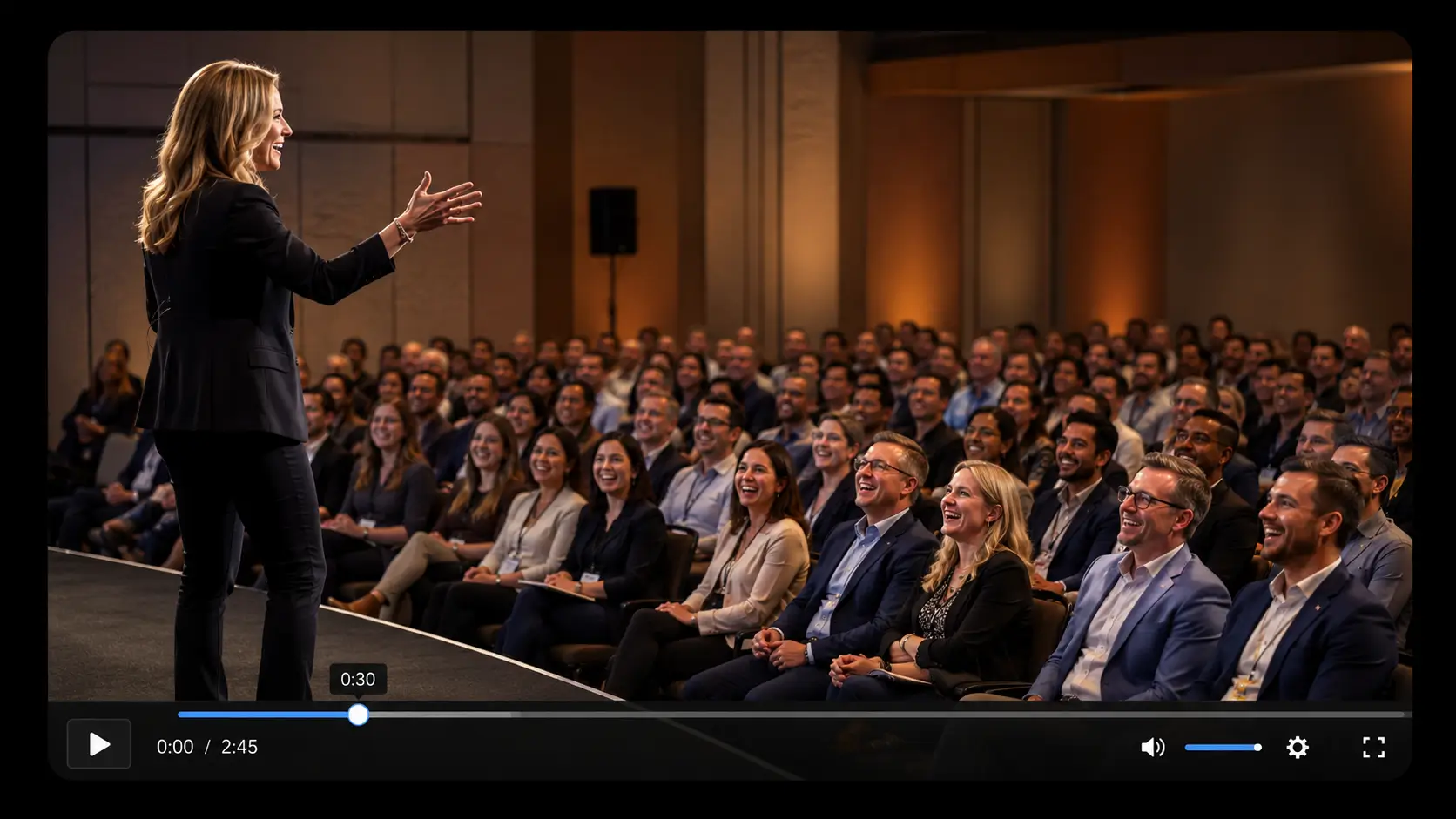
In 2026, planners are using digital vetting tools to preview speakers, and video has become the single most important element in the evaluation process. A planner who watches your reel and sees your stage presence, delivery, and audience’s response has answered most of their questions without a single email.
Your demo reel should be 2–3 minutes maximum. That’s it. Planners don’t watch longer reels. If you haven’t made the case in three minutes, a longer reel won’t save you.
What belongs in a strong speaker reel:
- Opening impact, your best 15 seconds of stage presence, right at the start. No slow buildups.
- Multiple environments, show yourself at different event types if possible: conference stage, corporate setting, virtual format.
- Audience reaction shots, laughing, taking notes, visibly engaged. Planners are buying the audience experience, not just your content.
- A clear topic through-line, your reel should reinforce your positioning, not confuse it with too many different topics.s
- Clean production doesn’t need to be Hollywood, but poor audio will kill it.
Keep your reel hosted on your profile page and on YouTube. The YouTube version creates an additional search surface; “your name + speaker reel” is a common search query planners use during due diligence.
4. Speaking Topics That Are Specific Enough to Book
Vague topic titles are one of the most common and most expensive mistakes on speaker profiles. “Customized for your audience” is now table stakes. Planners are pushing back on canned keynotes. The speakers booking the most dates are the ones willing to do real prep calls, review attendee data, and tailor at least the opening and closing segments to the room.
That expectation starts with how you present your topics.
Generic (hard to book): “Leadership and Team Building.”
Specific (bookable): “The Trust Deficit: Why Your Top Performers Are Planning Their Exit, and What Leaders Can Do About It.”
For each topic on your profile, include:
- A compelling title that sounds like a keynote, not a category
- A 75-word description that names the problem, the audience, and the takeaway
- 3–5 audience outcomes written in plain language (“Attendees will leave with…”)
- Suggested formats: keynote, half-day workshop, virtual, breakout session
- Ideal audience types: industry, role, event size
Limit yourself to 3–4 topics maximum on your public profile. Presenting 10 topics signals that you’re unfocused. Planners want a specialist, not a generalist with a long menu.
5. Social Proof That Builds Confidence
Audience response and direct planner feedback carry more weight than social media follower counts when planners make booking decisions. Your profile needs to make that proof visible and specific.
The four types of social proof that move planners:
Client logos. A row of recognizable company or association logos does more work per pixel than almost anything else on your profile. You don’t need Fortune 500 logos; you need logos that resonate with your target market.
Testimonials from event organizers (not audience members). A quote from a planner saying “Our attendees gave this the highest feedback scores in five years” is more powerful than 20 glowing audience reviews. Planners trust their peers.
Specific outcome statements. Generic praise (“Best speaker we’ve ever had!”) is weak. Specific results are strong: “We saw a measurable shift in how our leadership team approached difficult conversations after [Speaker Name]’s session.”
Video testimonials. Even a 30-second clip of a satisfied event organizer speaking to the camera carries significant weight. If you can collect one after each major engagement, your profile will compound in credibility over time.
Ask for testimonials within 48 hours of an event, while the organizer’s experience is fresh. A simple email template requesting a quote or short video makes this frictionless.
6. A Professional Photo and Consistent Visual Brand
This sounds obvious, but poor photos remain epidemic on speaker profiles. Meeting planners check speaker websites for detailed client lists, media appearances, and published work, and review online presence, including social media engagement. Visual inconsistency across your profile page, directory listing, and social accounts creates doubt, even if the planner can’t articulate why.
Your speaker profile needs:
- A high-resolution headshot (minimum 1200px wide) that looks like who you actually are on stage, not a corporate ID photo from 2018
- At least one action shot of you on stage with an audience visible
- Consistent use of your name, photo, and bio across all platforms
Planners who shortlist you will Google you. What they find across your website, your eSpeakers profile, LinkedIn, and YouTube should tell one coherent story.
7. A Speaker One-Sheet Available for Download
Your one-sheet is what gets forwarded internally when a planner is making the case for you to their committee. They’ve already decided they want you; they just need a single document to sell the idea to their boss or board.
A strong speaker’s one-sheet includes:
- Your name, photo, and positioning statement
- Your 2–3 signature topics with one-line descriptions
- 4–6 client logos
- 2 short testimonials from event organizers
- Your fee range or “contact for availability” language
- Your headshot, contact info, and website/eSpeakers profile URL
Keep it to a single page, save it as a PDF, and link it directly from your profile. The easier you make it for a planner to share with you internally, the faster your bookings move.
8. A Clear, Frictionless Booking Path
If a planner reaches the bottom of your profile and isn’t sure how to take the next step, you’ve lost them. Your profile needs one clear CTA, and it needs to be impossible to miss.
What the CTA should do:
- Tell them exactly what happens when they click (“Check my availability for 2026” is better than “Contact me”)
- Link directly to your eSpeakers calendar or a booking inquiry form
- Do not require them to fill out a lengthy form just to have a first conversation
Planners are working with tighter booking windows than ever. Many are now planning events in a three-to-six-month window, and some are moving even faster. A profile that makes it easy to check your availability and send a quick inquiry wins over one that requires multiple steps.
The Biggest Profile Mistakes That Cost You Bookings
Even experienced speakers make these. Audit your profile against this list:
Outdated content. A “2023 speaking schedule” or a reel from five years ago signals that you’re not actively managing your speaking business. Planners notice.
No fee information at all. You don’t have to publish exact fees, but “contact for pricing” with no context leaves planners unsure whether you’re even in their budget range. A general fee tier (“Keynotes starting at $X” or “Available for events of all sizes”) filters out bad fits early and attracts better-qualified inquiries.
Topic titles that are categories, not keynotes. “Innovation” is not a keynote title. “The Innovation Trap: Why the Companies Playing It Safe Are Falling the Furthest Behind” is.
A bio written in the third person that reads like a LinkedIn summary. Your bio should sound like someone who’s excited about what you do, wrote it, because ideally, that someone is you, just through a better lens.
No video at all. In 2026, a profile without video is a profile that gets skipped. If you don’t have professional reel footage yet, a well-lit, well-audio’ed clip from a recent presentation is better than nothing.
A profile on eSpeakers that doesn’t match your website. Planners cross-reference. Inconsistencies, different bio, different topics, different photos, create doubt.
Using eSpeakers to Maximize Your Profile’s Reach
Your profile on eSpeakers isn’t just a listing; it’s an active search surface that puts you in front of meeting planners who are actively looking to hire. Unlike your website (which planners have to find), the eSpeakers directory is where planners start their search.
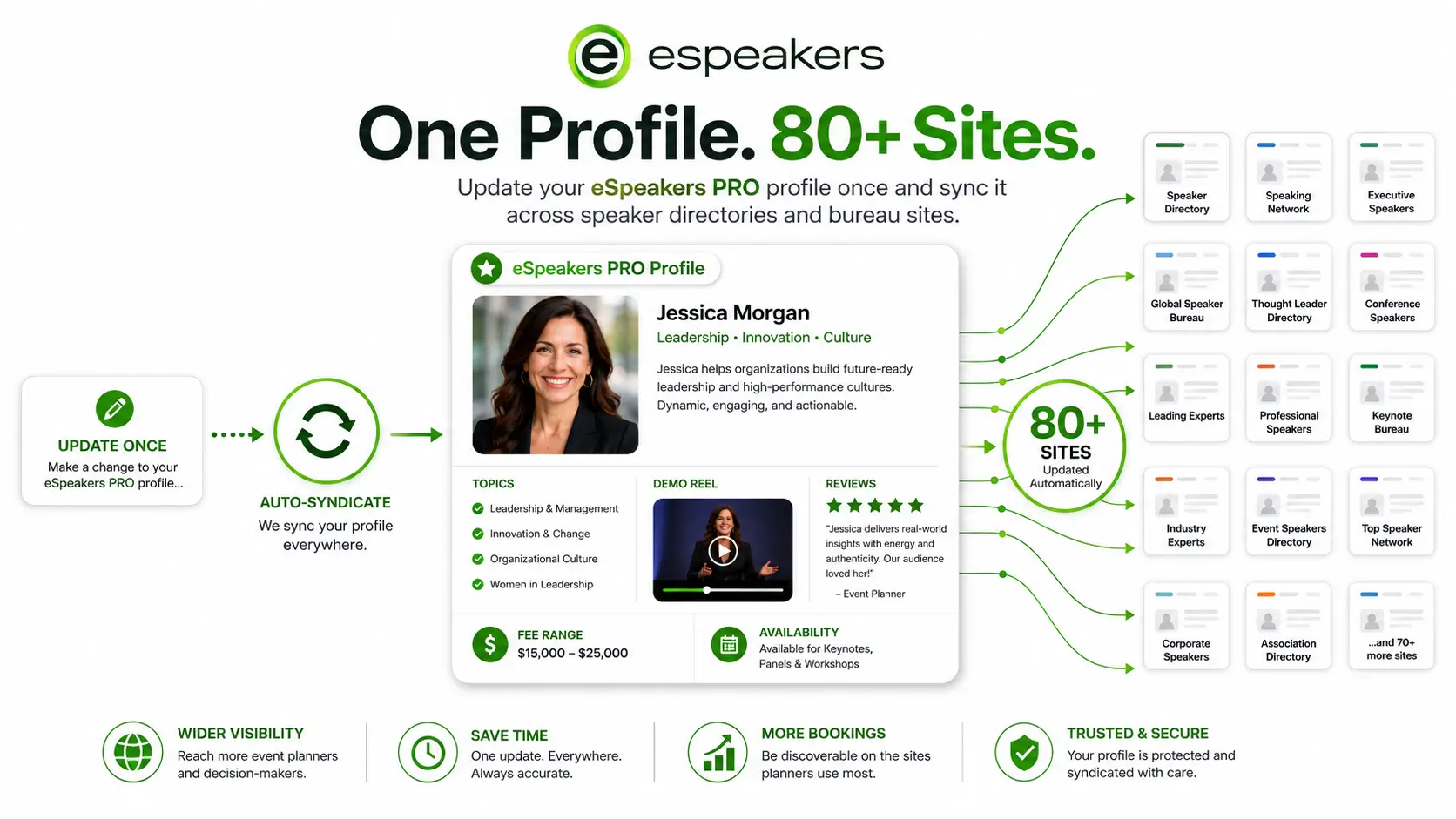
A complete eSpeakers PRO profile gives you:
- Visibility in directory searches filtered by topic, industry, fee, location, and format
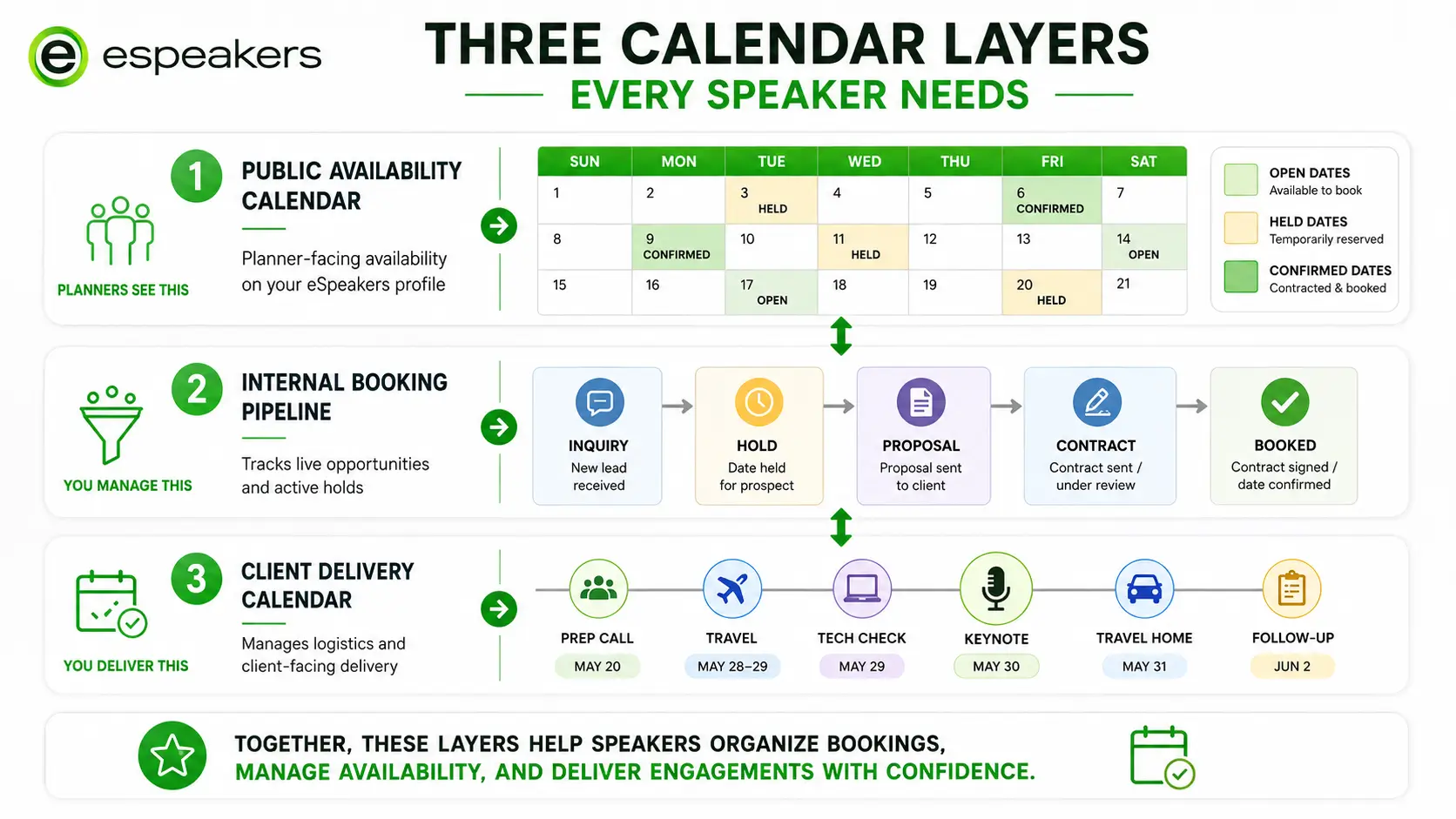
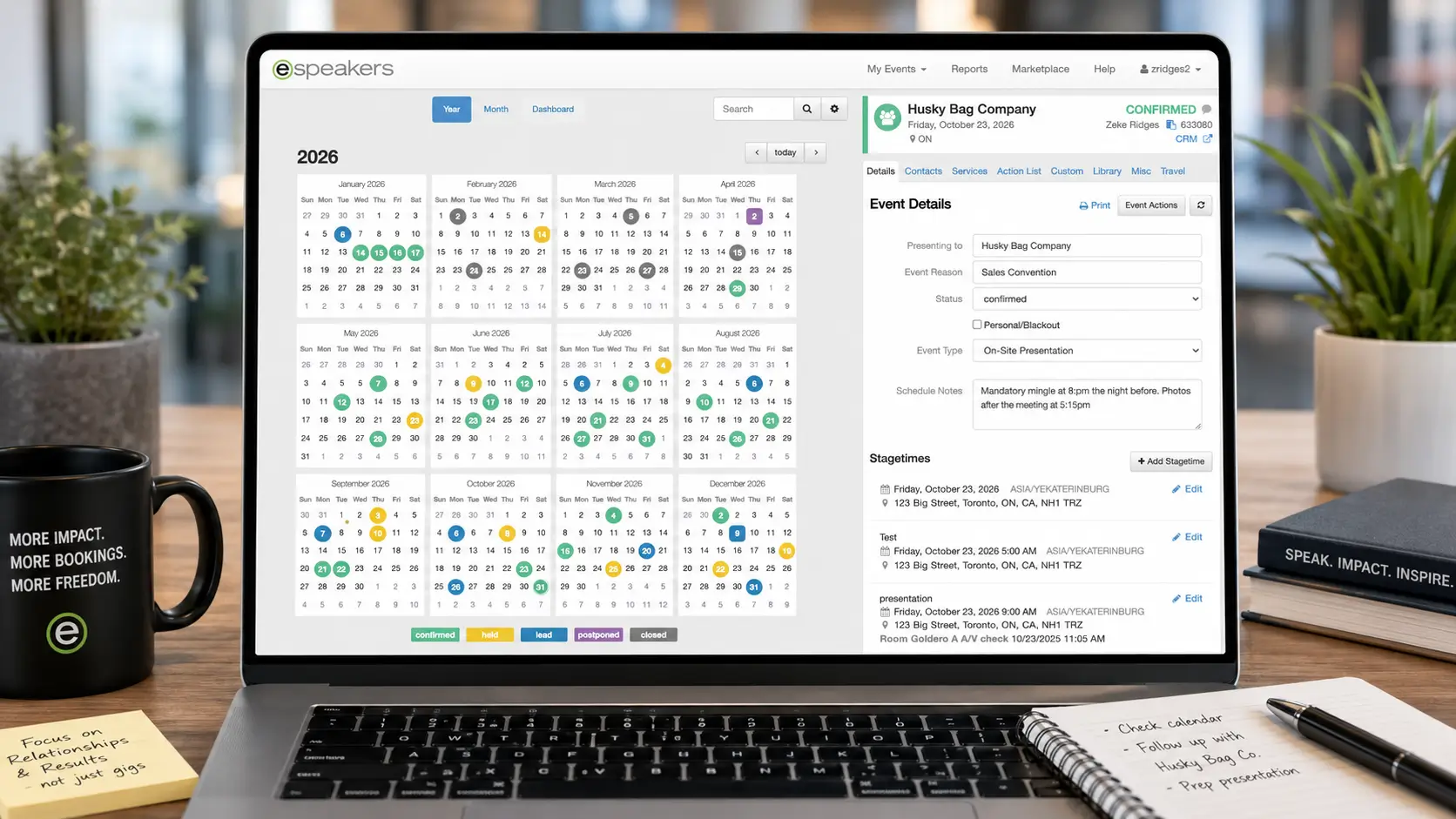
- Calendar integration so planners can check your availability in real time without waiting for an email response
- HighLevel CRM connection to track inquiries, follow-ups, and bookings in one system
- Video hosting for your demo reel directly on your profile
- Review collection to build verified social proof over time
The speakers who get found on eSpeakers consistently have complete profiles, every section filled in, a current reel, specific topic descriptions, and active calendar management. An incomplete profile ranks lower in search results and converts at a fraction of the rate of a complete one.
A Quick-Start Profile Audit Checklist
Use this to identify your gaps before your next booking push:
- Positioning statement is specific, outcome-driven, and in the first 100 words
- Bio exists in three lengths (long, medium, short) and is updated within the last 12 months
- Demo reel is under 3 minutes, starts strong, and includes audience reaction shots
- 3–4 speaking programs or speeches are listed with specific titles and outcome descriptions
- Client logos are visible and current
- At least 2 testimonials from event organizers (not just audience members) are on the profile
- Professional headshot and at least one stage action shot are high-resolution
- Speaker one-sheet PDF is linked and downloadable
- Booking CTA is prominent and links to the calendar or inquiry form
- Profile is consistent across eSpeakers, personal website, and LinkedIn
FAQ
Create three versions: 300–400 words (full profile page), 150–200 words (directory and event programs), and 75–100 words (introductions and social). Always lead with your most compelling credential, not your name. PCMA’s research on how planners evaluate speaker profiles shows that outcome-focused descriptions convert at significantly higher rates than credential-led bios.
Professional production helps, but a high-quality clip from a real event, good audio, a visible audience, and a clear message will outperform a polished studio reel that feels artificial. Start with what you have and upgrade over time.
Three to four, maximum. More than that signals you’ll say yes to anything. Planners are looking for a specialist if you have broad expertise, group it under two or three distinct topic areas with strong titles.
You don’t have to publish exact fees, but including a fee tier (“Keynotes starting at $X”) filters unqualified inquiries and helps planners know immediately whether you’re in range. eSpeakers allows you to display fees selectively based on your preference.
Review it at least once every six months. Update immediately after adding a major new client, credential, or certification. An outdated profile is worse than a sparse one; it suggests you’re not actively managing your speaking business.
Your eSpeakers profile is discoverable by planners actively searching for speakers; it’s the inbound channel. Your website is the destination they verify once they’ve found you. Both need to tell a consistent story, with your eSpeakers profile optimized for search and your website optimized for conversion.
Next Steps
Your profile is your most important sales tool, and most speakers underinvest in it. The good news is that the fixes are mostly structural, not talent-dependent. A clearer positioning statement, a sharper bio, a focused topic list, and a strong reel can transform how planners perceive you before they’ve ever sent an inquiry.
Start your 60-day eSpeakers PRO free trial →
Build your complete online speaker profile, get listed in the eSpeakers Marketplace, and connect your calendar so planners can book you in real time.
Joe Heaps, Chief Marketing Officer at eSpeakers
Joe Heaps is the Chief Marketing Officer at eSpeakers and is responsible for creating and accelerating the company's sales & marketing strategies. He is focused on driving the company's vision of helping organizations and individuals improve in substantial, long-term ways. He believes it happens when the perfect speaker is in front of the right audience. Over 25 years in the industry, Joe’s strategic vision and leadership have propelled eSpeakers to the leading software platform for speakers, coaches, and experts.
Joe Heaps
Chief Marketing Officer, eSpeakers
Latest Articles
Related Articles