Why Speaker Directories Still Matter, and How to Rank at the Top
Speaker directories still matter in 2026 because meeting planners actively search them, using specific criteria, with buying intent and a shortlist to fill. A speaker who is not in the directories planners use does not exist in those searches, regardless of their website, social media presence, or referral network. And in an era where AI tools can generate speaker name lists but cannot provide verified reviews, live availability calendars, or credentialed profiles, curated directories with real vetting infrastructure have actually strengthened their position in the planner's discovery process.
The eSpeakers Marketplace ranks speaker profiles using the eSEO algorithm, a scoring system that rewards profile completeness, demo reel presence, verified client reviews, credential badges, and calendar activity. Speakers who understand how it works can systematically improve their ranking, appear more prominently in planner searches, and generate more inquiries without paid advertising. This article breaks down how the algorithm works, highlights the highest-impact optimizations, and shows how integrating with the eSpeakers Calendar makes your profile more accurate, more responsive, and more competitive than when speakers manage the two systems separately.

John Doe
Chief Marketing Officer at eSpeakers
The Three Ways Planners Find Speakers, and Why Directories Are the Third Rail
eSpeakers, which has been operating in the professional speaking industry since 1999, describes how buyers discover and hire speakers through three primary channels:
Direct: The planner already knows the speaker. They’ve seen them before, been referred by a trusted colleague, or the speaker has been in their orbit for long enough that they’re the obvious choice. Direct bookings are the highest-trust, highest-conversion path, but they’re passive. You can’t manufacture them on demand. They grow slowly through reputation, relationships, and time on the circuit.
Bureau: The planner goes to a speakers bureau like Excel Speakers Agency, and an agent builds a shortlist based on the planner’s event goals, budget, and audience type. Bureau relationships are valuable but selective. Agents carry established rosters and protect their own credibility by recommending speakers they know will deliver. Getting onto that roster is a process that takes time, references, and a proven track record.
Directory: The planner searches a speaker marketplace directly. They type in a topic, an industry, a fee range, and a date, and a ranked list of speakers appears. They click through profiles. They watch demo reels. They compare testimonials. They check availability. When they find a speaker who looks right, they send an inquiry.
Most speakers invest heavily in the first channel (relationships and referrals) and pursue the second channel (bureaus) when they’re ready. The third channel, the one where planners are actively searching with buying intent and finding whoever ranks at the top, is systematically underinvested by the majority of speakers on every platform.
That’s the gap this article closes.
Why Directory Relevance Has Grown, Not Shrunk, in the Age of AI
The obvious counterargument to prioritizing speaker directories in 2026 is that planners can now use AI to find speakers. ChatGPT can generate a list of keynote speakers on any topic in seconds. Perplexity can surface names from across the web. Why would a planner spend time in a speaker database when they can ask a chatbot?
The answer is that AI and directories serve different stages of the search process, and they increasingly work together in ways that favor speakers with strong directory presence.
AI answers the awareness question; directories answer the procurement question
When a planner asks ChatGPT, "Who speaks about AI and leadership?", they get a list of names. When they then need to verify credentials, check availability, compare fees, watch demo reels, read organizer testimonials, and actually submit an inquiry, they need a structured, verified database. A chatbot response is a starting point, not a procurement system. Directories are the infrastructure that converts awareness into inquiry.
In November 2025, Scurati launched as an AI-powered keynote speaker recommendation service, built by a former head of operations at Global Speakers Bureau. Its model is telling: it recommends speakers based on planner input, then routes to human consultants and structured databases to confirm fees and availability. This is the AI-to-directory handoff in practice. The AI surfaces options; the directory provides the structure to act on them.
About half of meeting planners now expect to use AI tools throughout the event planning process, including speaker sourcing.
The implication for speakers is practical: your directory presence needs to work for both structured search and the natural language queries AI tools use when scanning for speaker options.
A complete, keyword-rich, regularly updated eSpeakers profile performs well in both environments. A thin or outdated profile performs well in neither.
The eSpeakers Marketplace syndicates to 50+ directories, industry sites, and bureaus.
When your eSpeakers profile is complete and optimized, it doesn't just appear in the eSpeakers search results. It populates the National Speakers Association member directory, association-specific directories, bureau sites, and industry platforms, all updated automatically from a single source of truth. That network effect is something no individual outreach campaign can replicate. One well-optimized profile generates presence across dozens of buyer-facing surfaces simultaneously.
For planners who aren’t using AI to start their search—and many still aren’t, especially those who book infrequently—a directory is often the first stop. It’s purpose-built for speaker discovery in a way general search engines simply aren’t. A Google search for "leadership speaker for healthcare conference" returns a mix of bureau pages, speaker websites, aggregator articles, and ads. A search within eSpeakers for "leadership," filtered by "healthcare," fee range, and available date, returns an immediately actionable ranked list. Planners who've discovered this difference don't go back to Google for speaker research.
How the eSEO Ranking System Works
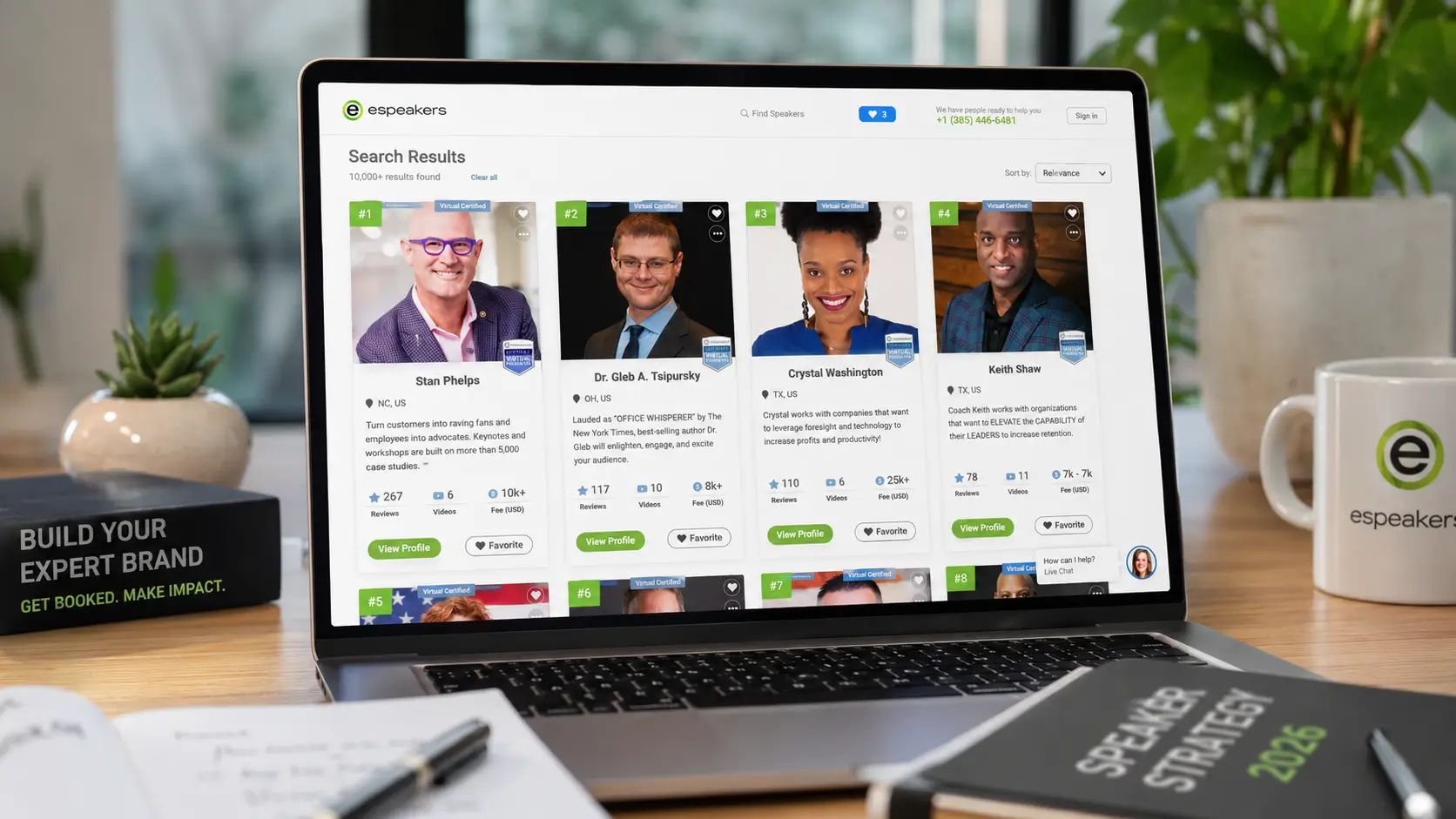
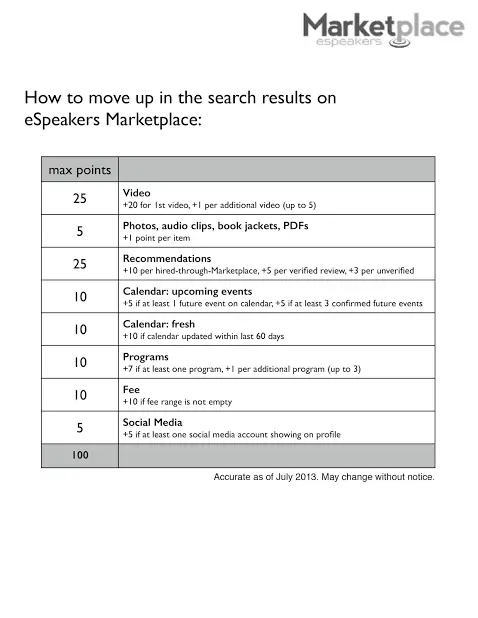
eSpeakers uses a point-based ranking system called eSEO, short for eSpeakers Search Engine Optimization, to determine which profiles appear at the top of search results when planners filter and search the Marketplace.
The description on eSpeakers' own platform is precise: "The points mimic the habits of buyers by rewarding the quality of the content speakers have on their profiles."
That framing is the key to understanding it. The algorithm isn't arbitrary. It's designed to surface the profiles that provide the most useful information to a planner who is evaluating speakers. The more thoroughly your profile answers the questions a buyer asks, "What do you speak about? Who have you worked with? What do audiences say? Are you available on my date? Can I see you in action?", the higher your eSEO score, the higher you rank.
The practical implication: eSEO is a completeness and quality score, not a gaming target. Speakers who complete their profiles deliberately, keep them current, and connect all available features to their profiles naturally earn high eSEO scores. Speakers who fill in the minimum fields and leave the rest blank consistently rank lower, regardless of how accomplished they are as presenters.
PRO profiles consistently rank in the top 5% in nationwide directory search results. PRO users have 2.5x more repeat customers than BASIC users. These numbers reflect the compounding effect of profile quality, ranking visibility, and calendar integration working together over time.
The eSEO score is visible on your eSpeakers Marketing Dashboard. Check it now. If you don't know your score, you don't know where you rank.
The Eight Ranking Factors That Move Your eSEO Score
Profile Completeness, Personal Info, Bio, and Credentials
The planner's question: "Who is this person, and are they a legitimate professional speaker?"
Your full name, business address, phone number, email, credentials (CSP, CVP, Hall of Fame, Ph.D., entered in the Credentials field, not buried in the bio text), and a well-written bio are the baseline. eSpeakers specifically notes that credentials should be entered in the dedicated Credentials field rather than in the Last Name field or bio, because the system reads structured fields differently than free text.
Your bio needs to do the work of a positioning statement: who you help, what problem you solve, what changes for the audience, and why you're the credible expert to deliver it. Generic bios that describe you as "a dynamic, passionate speaker" with "20 years of experience" are common and invisible. Specific bios that name an audience type, a challenge, and a measurable outcome are rare and memorable.
Professional Photo
The planner's question: "Does this speaker project the professionalism my event requires?"
A high-quality, current headshot is a foundational trust signal that has an outsized impact on first impressions. Directory listings are scanned quickly, and a professional image that conveys authority, warmth, and stage presence keeps a planner engaged with your profile. A dim, tightly cropped, or outdated photo does the opposite—it gives them a reason to move on.
The photo should be updated every two to three years at a minimum, or any time there's a significant change in your appearance. A planner who books based on a photo that doesn't match the speaker who walks in has a legitimately negative first impression before the event begins.
Demo Video, The Most Critical Ranking and Conversion Element
The planner's question: "Can this person actually hold an audience?"
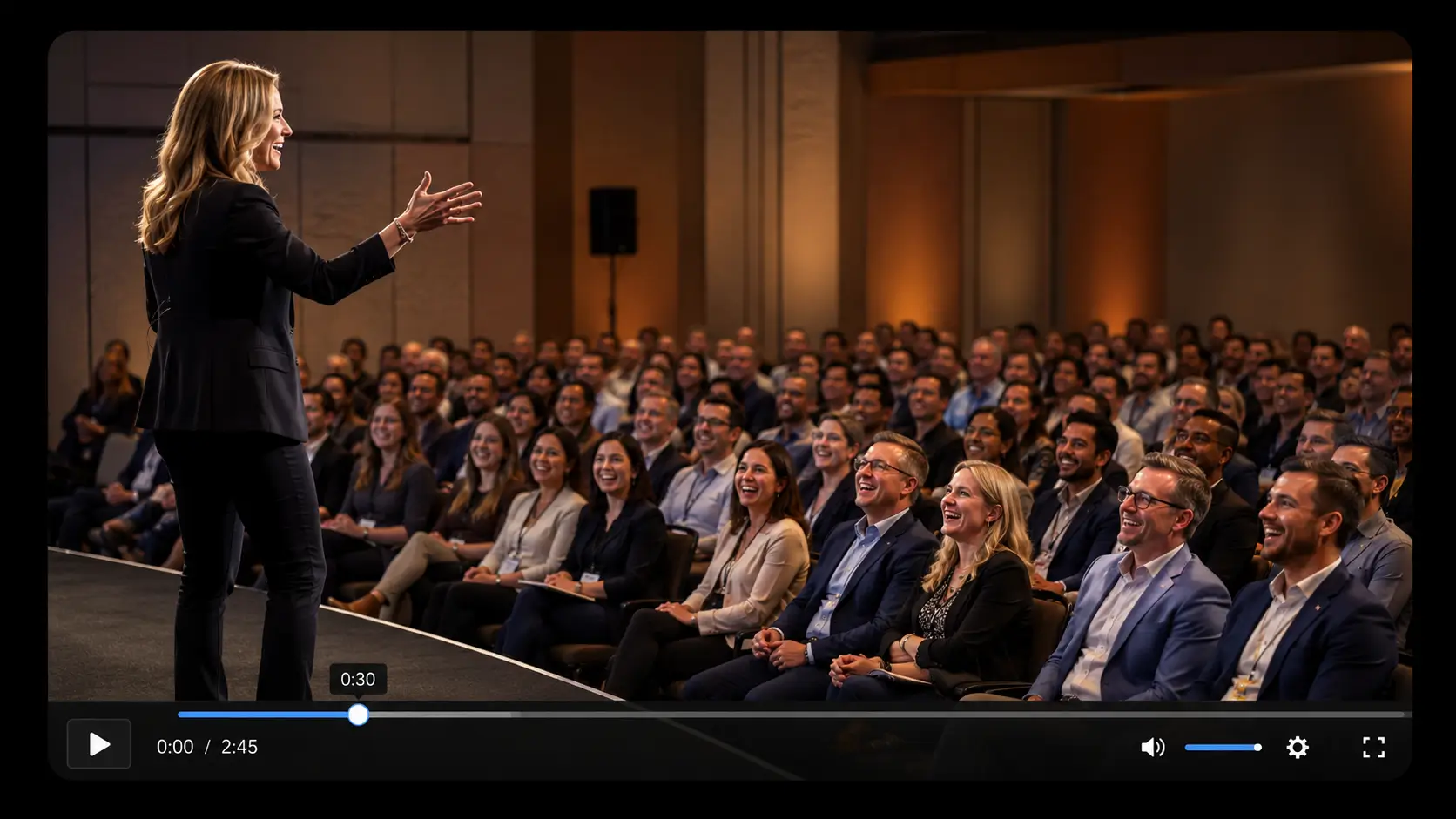
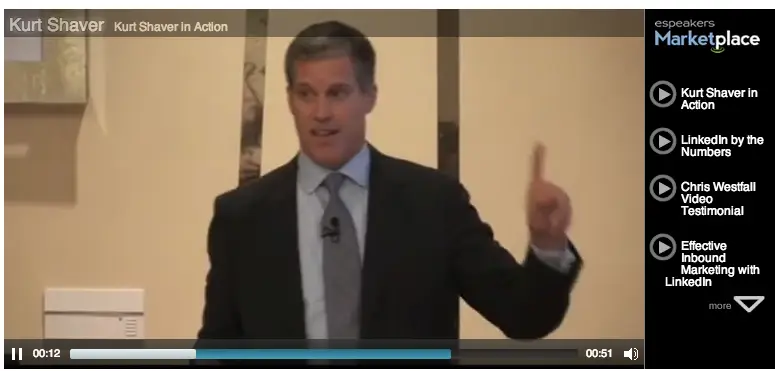
Video is both an eSEO ranking factor and the single highest-conversion element on any speaker profile. A planner who clicks through to your profile and sees a strong, current demo reel is a planner who answers their own question in 90 seconds.
Several specifics matter for the video to work as a conversion tool:
Your reel must open with a stage performance, not an intro card. The first ten seconds of the video determine whether the planner watches more. If those ten seconds are a logo animation, a slow fade, or background music over text, they've already moved on. The first ten seconds must show you on stage, in motion, with an audience responding.
The reel should be current. A reel from 2019 signals to a planner that either you haven't spoken recently, or you're not investing in your marketing. In the current market, where planners are increasingly pressed for time and increasingly cautious with budgets, visual evidence of recent, relevant work matters.
Audience reaction shots are often more persuasive than your content. Seeing people laugh, lean in, take notes, or applaud confirms that the energy translates to a real room, something a highlight reel of talking-head clips cannot replicate.
Topic Descriptions, Specific, Searchable, Outcome-Focused
The planner's question: "Does this speaker address what my audience needs right now?"
Topic titles and descriptions are among the most searched fields in the eSpeakers directory. Planners filter by topic. They search for keywords. They read descriptions to decide whether a topic is specific enough to fit their program.
Generic topic categories, "Leadership," "Sales," "Communication", return too many results to be useful. Specific topic titles with defined outcomes narrow the field and signal that you've thought through the program from the planner's perspective.
"Leading Through Disruption: How to Build Teams That Thrive When Everything Changes" is a session a planner can put directly on an agenda. "Leadership" is a category containing 400 other speakers.
Your topic descriptions should include the audience type the session is designed for, the specific problem it addresses, the format (keynote, workshop, half-day, virtual), and the three outcomes attendees leave with. The more precisely your description answers a planner's brief, the more likely the inquiry.
This is also where current topic relevance pays dividends. A topic description that references the organizational challenges of 2026, AI adoption and the leadership skills it requires, workforce mental health as a retention and performance issue, and building culture across hybrid teams signals that your content is alive, not archived.
Client Recommendations and Testimonials
The planner's question: "What do other planners say about working with this speaker?"
Recommendations from event organizers, not audience members, not colleagues, but planners who hired you and managed the logistics, carry more weight in a directory context than any other social proof. A planner evaluating you is asking a peer-to-peer question: Would someone in my role recommend this speaker?
A specific testimonial from a named event director with a recognizable organization, describing a concrete outcome, is worth more than ten generic enthusiastic quotes. "Our audience engagement scores for this session were the highest we've seen in five years, and we've already had three chapter directors request the same program for their regional events" is evidence. "Best speaker we've ever had! So inspiring!" is noise.
Collect testimonials within 48 hours of each event, while the experience is fresh and the organizer's enthusiasm is at its peak. The post-event workflow in HighLevel (covered in Article 2 of this series) automates this request so it never gets missed.
Calendar Availability, Real-Time and Accurate
The planner's question: "Are you available on the date I need?"
This is the factor most speakers underestimate, and most planners find most frustrating.
A planner who has spent ten minutes reviewing your profile, watching your reel, and reading your testimonials doesn't want to send an inquiry and wait two days to find out you're already booked for their date. The eSpeakers calendar real-time availability transforms the evaluation process from a multi-step back-and-forth into an immediate answer.
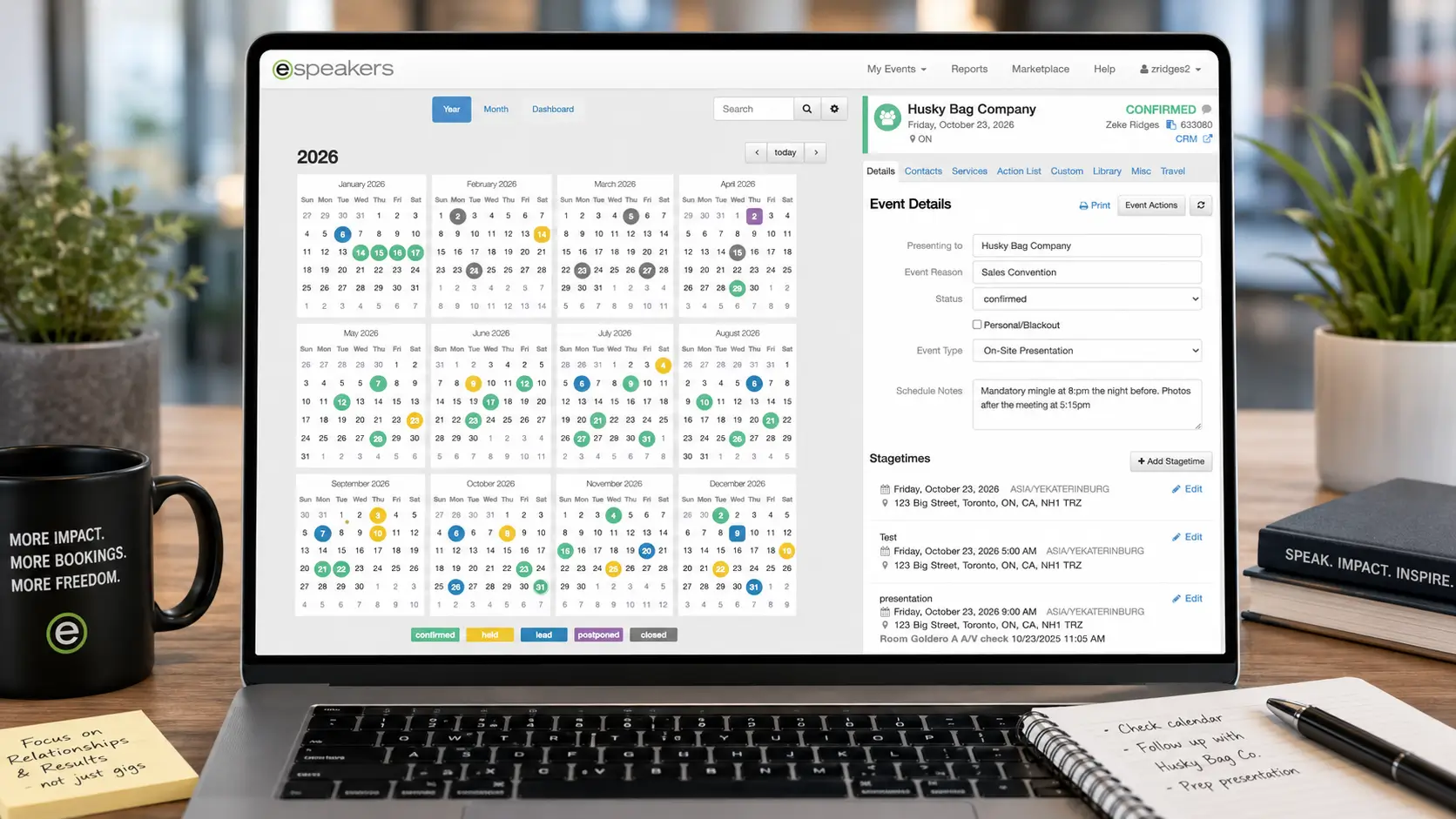
When your eSpeakers calendar is connected to your eSpeakers profile, every booking update syncs automatically. A date confirmed in your eSpeakers calendar shows as unavailable on eSpeakers Marketplace searches immediately. A hold marked in eSpeakers calendar appears on your public calendar as tentative. No manual reconciliation. No stale data.
This integration also feeds the eSEO score; an active, maintained calendar is a signal of an engaged, professionally managed speaking business. Profiles with connected, current calendars rank higher than profiles with no calendar information.
Marketing Materials, One-Sheet, Speaker Page, Downloadables
The planner's question: "Can I easily share information about this speaker with my committee?"
Most booking decisions aren't made by a single planner. They’re shared with committees, signed off by budget owners, or vetted by event leaders. If a planner has to piece together your information just to present you internally, they’re far more likely to move on to someone who’s already made that process effortless.
Your eSpeakers profile supports attachment of a one-sheet PDF, sample programs, and other downloadable assets. A well-designed one-sheet, your photo, positioning statement, three to five topic titles, three to five client logos, one strong testimonial, contact information, and your eSpeakers profile link, makes you easy to present. Speakers who are easy to present get presented more often.
Fee Range, Listed, Current, Accurate
The planner's question: "Is this speaker in my budget?"
Planners filter by fee range before they read a single word of your profile. A missing or outdated fee range means you're invisible to every planner who uses the fee filter, which is most of them.
Fee transparency feels vulnerable for speakers who worry about pricing themselves out of conversations. In practice, the opposite is true: a clearly listed fee range that planners filter for means every inquiry you receive is from someone who has pre-qualified your pricing. The conversations that follow are more efficient, the holds that come out of them convert at higher rates, and the planners who reach out are already prepared to say yes.
Update your fee range at a minimum once per year, and any time you adjust your fees. Check the eSpeakers Hiring Trends Dashboard (available to PRO members) to see what fee ranges are currently in demand in your topic area. Pricing yourself relative to actual market demand, rather than guessing, is data that eSpeakers makes available, and most speakers never use.
The eSEO Score in Practice: What to Check Today
If you're looking at your eSpeakers Marketing Dashboard right now, your eSEO score is displayed at the top of the screen. Here's how to read it and what to do with it:
- A score under 50: Your profile is incomplete in multiple significant areas. Prioritize in this order: add a professional photo, upload a demo video, complete your bio with specific positioning language, add at least two topic descriptions with outcome-focused language, and list your fee range. This work alone will move your score substantially.
- A score of 50–75: Your profile has the basics but is missing depth in the areas that differentiate top-ranked profiles. Prioritize: add organizer recommendations (the most weighted testimonial type), make your topic descriptions more specific and outcome-focused, connect your calendar, and upload marketing materials.
- A score above 75: You're in competitive territory for your topic categories. Maintain your ranking by keeping the profile current, adding new testimonials after each engagement, refreshing topic descriptions annually to incorporate current industry language, updating your photo and reel as they age, and monitoring your ranking position in your primary topic areas using eSpeakers' performance insights tools.
The practical goal is not a perfect score. The goal is consistently ranking above the speakers in your topic area who are not actively managing their profiles, which, based on how most speakers treat directory maintenance, is the majority.
How eSpeakers Calendar Connects Directly to Your Directory Ranking
Most speakers manage their eSpeakers profile in one place and their booking pipeline in another. The manual reconciliation between the two, updating availability, adding new testimonials to the profile, and keeping fee information current, is the administrative overhead that causes profiles to go stale.
eSpeakers Calendar is integrated with your profile and eliminates this gap. The connection works in both directions:
- Pipeline to profile (outbound sync): When a booking is confirmed in your eSpeakers Calendar pipeline, the stage moves to "Deposit Received", and your eSpeakers calendar updates automatically to show that date as confirmed. A hold marked in your eSpeakers Calendar appears on your public calendar as tentative. Your availability information is always current without any manual action.
- Profile to pipeline (inbound capture): When a planner submits an inquiry through your eSpeakers profile, an event is created in your eSpeakers Calendar, and synced with your HighLevel CRM account, where it can be tagged as part of your automation, and the New Inquiry workflow fires immediately. The planner receives a professional acknowledgment within minutes. You receive an internal notification. The lead is in your pipeline before you've looked at your phone.
- SpeakerTRACK intelligence: eSpeakers PRO includes SpeakerTRACK email marketing, which notifies you when planners in your target market are actively searching for speakers matching your profile. It also lets them know when you’ll be in town so they can book you easily.
The result is a feedback loop where your eSpeakers Calendar pipeline activity directly improves your directory ranking (through accurate calendar availability), and your directory ranking drives qualified leads into your eSpeakers Calendar pipeline. The two systems compound each other rather than operating independently.
The Speaker Directory Ecosystem Beyond eSpeakers
eSpeakers is the platform this series focuses on, and the one that powers the eSpeakers Calendar, HighLevel CRM integration, but understanding the broader directory landscape helps speakers think about presence strategically.
NSA and CAPS member directories are powered by eSpeakers technology. If you’re an NSA member, your eSpeakers profile is the same profile that appears in the NSA Find a Speaker directory. Optimizing one optimizes both. This is one of the most underutilized leverage points for NSA members; a single profile investment appears in two buyer-facing surfaces.
Bureau and agency websites often draw on eSpeakers profiles for the speakers they represent. The profile completeness and eSEO score that makes you rank higher in the eSpeakers Marketplace also makes your bureau-facing profile more compelling when bureau agents are showing shortlists to corporate clients.
Industry-specific directories, healthcare speaker directories, financial services speaker resources, and association-specific speaker databases often list speakers sourced from eSpeakers. The 80+ directory syndication means your profile update propagates automatically to surfaces you may not even know exist.
AI aggregators and search tools are increasingly pulling structured data from speaker directories when planners use AI tools to build shortlists. A complete eSpeakers profile with specific topic language, structured credential fields, and a clear fee range provides the machine-readable data that AI recommendation tools can process. A sparse profile provides nothing for those tools to surface.
The Profile Maintenance Calendar
A speaker profile isn't a one-time project. It's a living asset that needs regular attention to maintain its ranking and conversion effectiveness.
After every engagement
Add the new client logo to your website under “Past Clients.” Request a testimonial and add it to your eSpeakers profile and your website when received. Update your topic descriptions if the program has evolved based on audience feedback.
Quarterly
Review your eSEO score and identify which elements have dropped. Check the Smart Trends Dashboard for shifts in demand. Confirm your calendar is syncing accurately from your eSpeakers Calendar.
Annually
Update your professional photo if it's more than two years old. Refresh your demo reel if the most recent clip is more than 18 months old. Rewrite your bio and topic descriptions, incorporating current industry language. Review your fee range against market data.
Immediately after any significant credential
Earned your CSP or CVP? Published a book? Received a major client endorsement? Update your profile within a week. These additions have immediate eSEO impact and give existing profile visitors new reasons to submit an inquiry.
FAQ
The most common causes are low eSEO score (incomplete profile elements, no video, no testimonials), outdated topic descriptions that don’t match current planner search terms, and missing or stale calendar availability. Check your eSEO score on the Marketing Dashboard first; it will show you specifically which elements are incomplete. Then audit your topic titles against current market language: do they reference 2026 concerns, or were they written in 2021?
eSpeakers notes that changes to your profile take up to 24 hours to be visible across all directories where your profile is published. eSEO score adjustments typically reflect in ranking within one to two business days of a profile update.
Yes, adding dates to your calendar and keeping it fresh within 60 days is worth 10 points each. It also automatically keeps your availability current on your profile, which both improves your eSEO score (an active, accurate calendar is a quality signal) and prevents the planner’s frustration of finding an apparently available speaker who then says they’re already booked.
Create distinct topic entries for each program rather than listing everything under broad categories. Each topic entry should be specific, outcome-focused, and contain the keywords a planner searching for that program would use. Do not conflate multiple topics into a single entry to keep the profile tidy; separate entries rank separately for separate searches.
eSpeakers PRO members have access to the Hiring Trends Dashboard, which shows which topics and fee ranges are currently active in the meetings market. This is real-time buyer behavior data, more accurate than any external survey or industry report, and it’s available to every PRO member. Use it to decide which of your programs to lead with in your profile, and which to deprioritize or retire.
Directories Are Infrastructure, Not Optional
It’s easy to treat a speaker directory as a nice-to-have, one more marketing channel to maintain alongside a website, LinkedIn profile, and outreach campaigns. That framing misses what directories actually are.
A speaker directory is the tool that answers all of their evaluation questions in one place for meeting planners: who is this person, what do they speak about, who have they worked for, what do audiences say, are they available, and what do they charge. No other single channel answers all six questions simultaneously, with verified information, for a planner who is ready to hire.
eSpeakers is the infrastructure layer that powers the NSA directory, 80+ other speaker-facing surfaces, and the buyer-facing Marketplace where planners with active booking intent search every day. Your profile on this platform, complete, specific, current, and connected to your HighLevel CRM, is not a marketing asset. It is your professional storefront.
Most speakers have one. The ones who fill their calendars treat it like it matters.
Start your eSpeakers PRO 60-day trial →
Get your profile syndicating across 80+ directories, connect your HighLevel CRM for real-time calendar availability, and access the eSEO tools and Hiring Trends Dashboard that show you exactly how to rank at the top for your topics.
Joe Heaps, Chief Marketing Officer at eSpeakers
Joe Heaps is the Chief Marketing Officer at eSpeakers and is responsible for creating and accelerating the company's sales & marketing strategies. He is focused on driving the company's vision of helping organizations and individuals improve in substantial, long-term ways. He believes it happens when the perfect speaker is in front of the right audience. Over 25 years in the industry, Joe’s strategic vision and leadership have propelled eSpeakers to the leading software platform for speakers, coaches, and experts.
Joe Heaps
Chief Marketing Officer, eSpeakers
Latest Articles



Related Articles