The Complete Guide to Budgeting for a Keynote Speaker
Keynote speaker cost is one of the most misunderstood budget items in event planning, and one of the most consequential. Planners routinely underestimate the total cost of a speaker engagement, overbuy on name recognition they don't need, or underbuy on delivery quality they can't recover from. And they often set a budget number before they have enough information to know whether that number is realistic for what they actually need.
This guide fixes all of that. It covers what keynote speakers actually cost in 2026, across every experience tier, event type, format, and topic category; what drives those costs; what gets added after the speaking fee; and how to build a budget that reflects the real investment you're making. It also covers the strategies that smart planners use to get more speaker quality per dollar, without compromising the outcomes their events are designed to produce.
By the end, you'll know exactly what to budget, why, and how to make the case for that investment internally.

John Doe
Chief Marketing Officer at eSpeakers
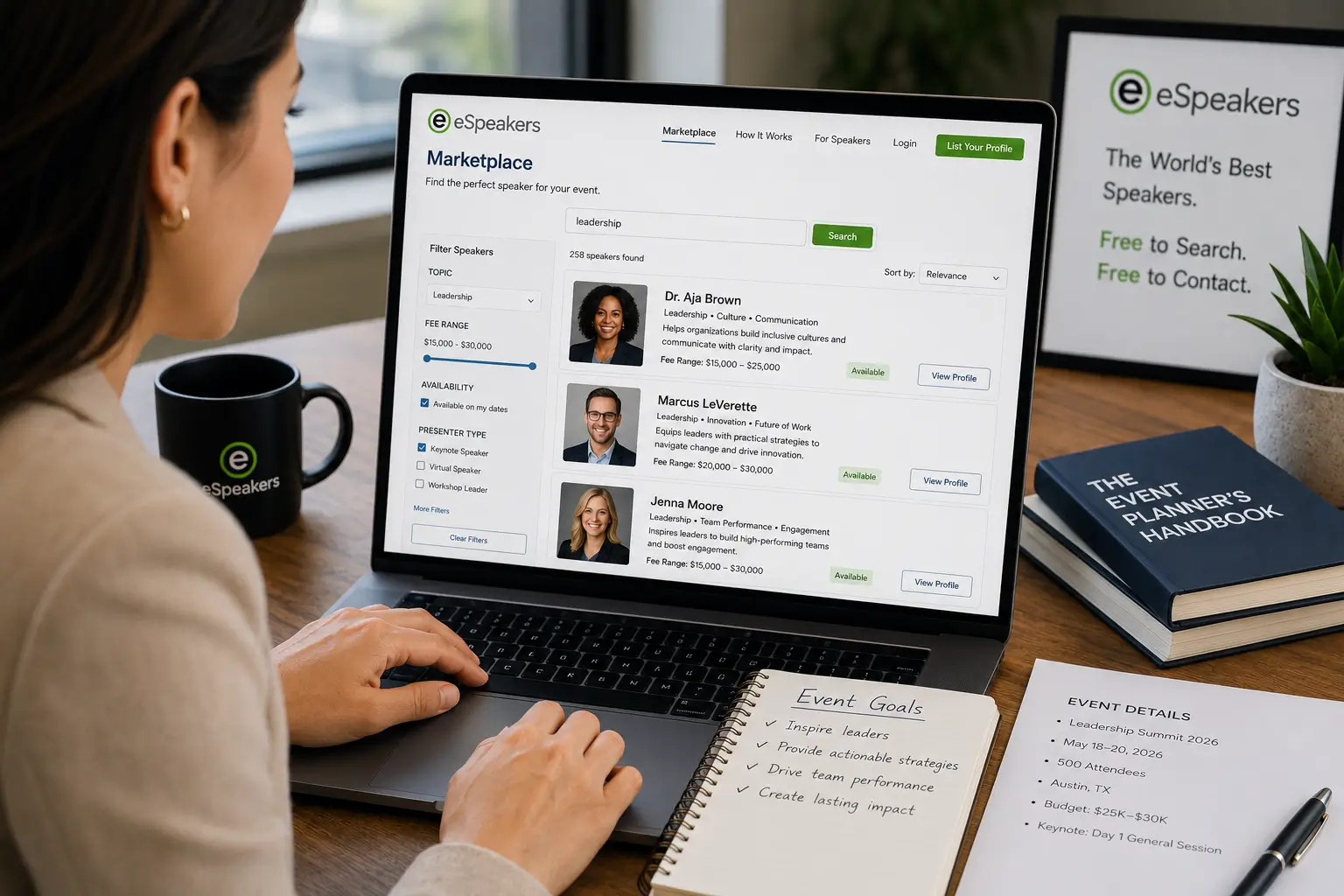
Every speaker profile shows their fee range, free to browse.
The eSpeakers Marketplace displays fee ranges on every speaker profile, so you only evaluate speakers whose published rates match your budget. Filter by fee range, topic, format, and availability before investing time in evaluation. No fees to search or contact.
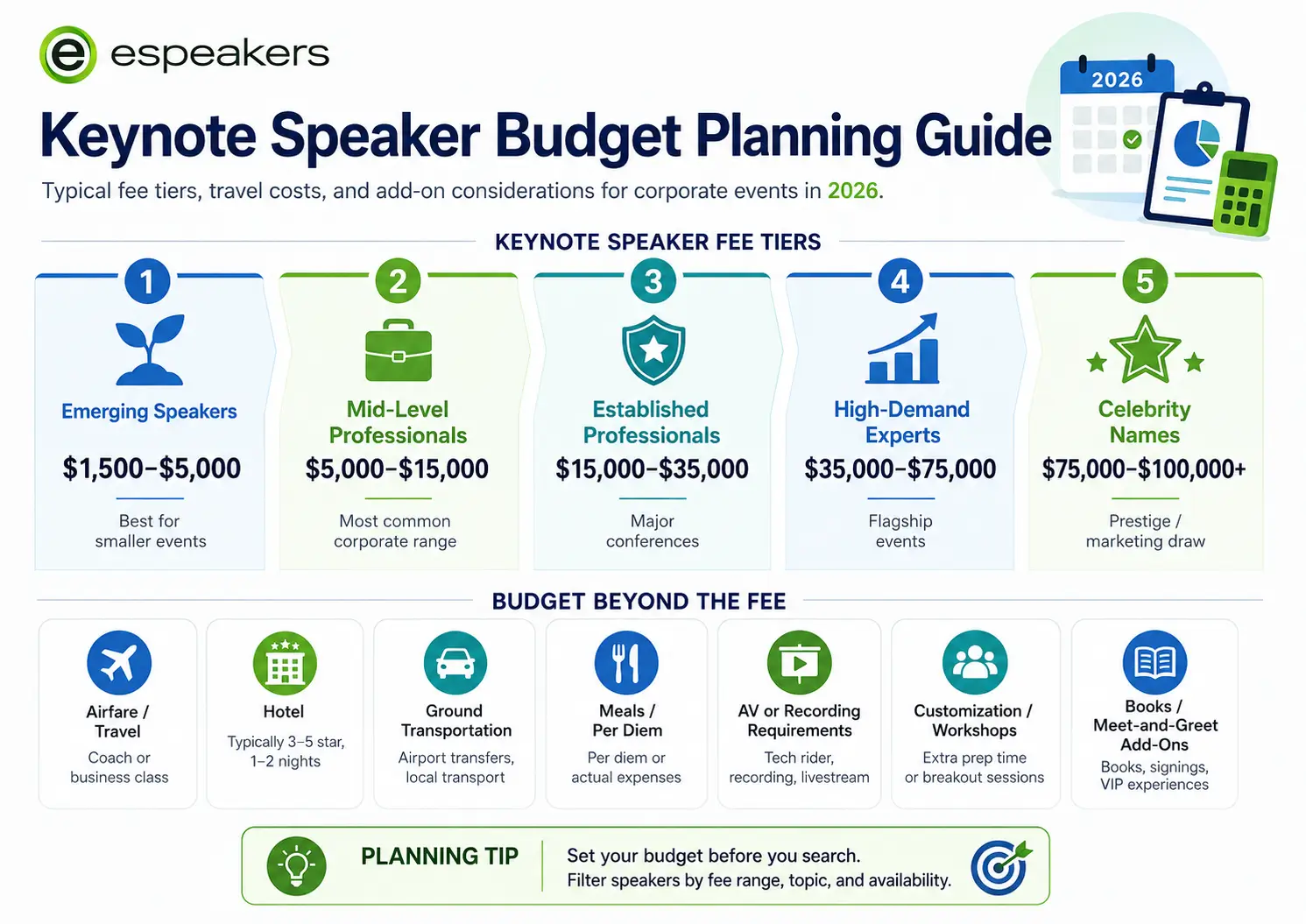
The First Rule of Speaker Budgeting: Set the Number Before You Search
The Smooth Sailing ebook is direct on this point: “Budget is a significant factor when choosing a speaker; don’t even start your search until you know what you’re willing and able to pay. The key is to be honest about your budget so you don’t waste your time considering speakers you can’t afford.”
This rule has a corollary: don’t set the number in a vacuum. Many planners either anchor to a number from a previous year’s event (which may not reflect current market rates), a round number with no particular rationale, or a figure they’ve heard from a colleague. None of those approaches ensures you’re budgeting appropriately for what your event actually needs.
The right sequence:
- Define your event goals and the type of speaker experience required
- Understand the market rate for that type of speaker
- Set your budget against market reality
- Search within that budget
Skipping step 2 is where most budgeting errors happen. This guide gives you step 2 in full detail.
Part 1: What Keynote Speakers Actually Cost in 2026
The Fee Tiers, What They Mean and What You Get
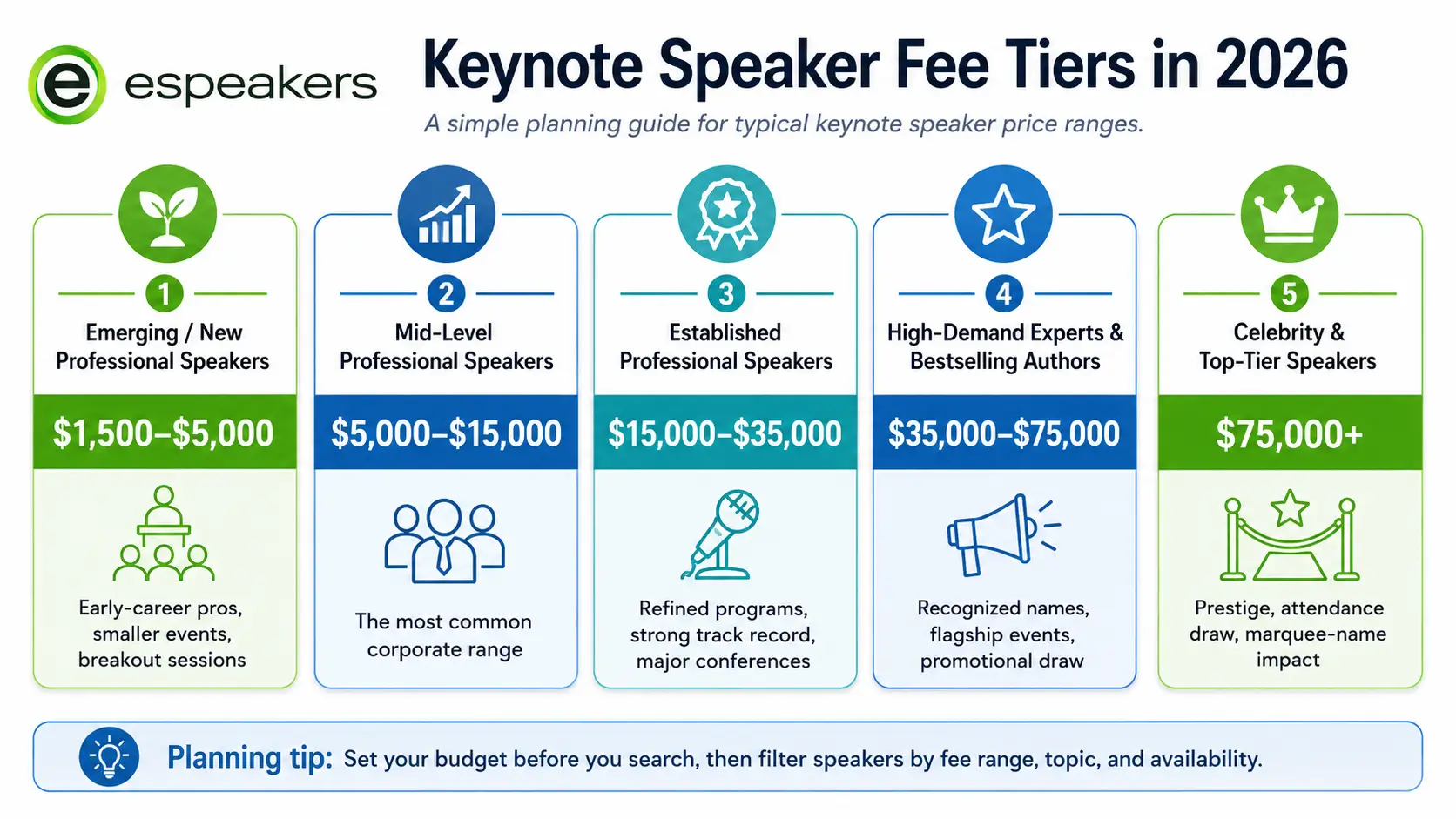
Keynote speaker fees in 2026 span a wide range, and the tiers are meaningful; each corresponds to a different combination of experience, track record, content quality, and delivery excellence.
Emerging / New Professional Speakers: $1,500 – $5,000
Speakers in this range are typically early in their professional speaking career, professionals with genuine expertise and real stories who have begun packaging that expertise as a keynote program, but who have a limited speaking track record. They may have strong content and authentic delivery, but fewer verified reviews, less refined programs, and less experience adapting to different audiences.
Best for: Smaller corporate events, team meetings, breakout sessions at larger conferences, small business events, nonprofit events, regional association meetings, and organizations where the message matters more than the marquee.
What you get: Genuine expertise and content at accessible price points. The best speakers in this tier are often exceptional value; their content is strong, their energy is real, and their fees reflect career stage rather than quality ceiling.
What you don’t get: The proven consistency, the polished customization process, and the documented multi-event track record of more established speakers.
Mid-Level Professional Speakers: $5,000 – $15,000
The most populated tier in the professional speaking market. Speakers here have established track records, typically 50–150 documented paid engagements, multiple client types, and a developing body of verified reviews. Their programs are more refined. Their customization processes are more structured. Their delivery has been tested across different audiences and formats.
Best for: Mid-size corporate conferences, annual company all-hands events, association regional and national conferences, leadership development programs, sales kickoffs, and team events where the speaker’s impact is a meaningful part of the event’s overall investment.
What you get: Professional speaker infrastructure, a pre-event process, consistent delivery, audience-tested content, and enough verified reviews to evaluate the consistency of their performance.
What you’re starting to get: Credential differentiation. Many speakers in this tier hold or are working toward their CSP (Certified Speaking Professional), and verified reviews from eSpeakers or similar platforms tell you how their delivery has actually landed across different audiences.
Established Professional Speakers: $15,000 – $35,000
Speakers in this range have built a sustainable professional speaking business, typically 150–500 paid engagements, diverse client lists including recognizable organizations, published books or significant media presence, and in many cases the CSP designation or equivalent. Their programs are highly refined, and their customization processes are genuinely systematic rather than gestural.
Best for: Major corporate annual conferences, large association national meetings, leadership summits, and flagship corporate events where the speaker is a significant part of the event’s value proposition and promotional draw.
What you get: Documented professional excellence, not just good delivery, but a structured pre-event process, genuine customization, diverse audience experience, and consistency across high-stakes events.
The credential signal: CSP-holders in this tier have documented proof of professional standards across hundreds of paid engagements, peer video review, and a 5-year renewal process. The eSpeakers Marketplace displays these credentials on profiles, making them visible before you contact anyone.
High-Demand Experts and Bestselling Authors: $35,000 – $75,000
Speakers at this level have national or industry-specific name recognition, major book publications, significant media presence, and, in some cases,s organizational leadership credentials (former CEOs, sitting executives, prominent academics). Their name often appears in event marketing as a draw in itself.
Best for: Flagship industry conferences, CEO and executive events, events where the speaker’s reputation is part of the event’s attendance value, and organizations that can justify the investment through event size, ticket revenue, or the caliber of the audience.
What you’re paying for: The speaker’s reputation and reach, in addition to their delivery. At this tier, the speaker’s name in your event marketing may generate registrations, media coverage, or executive attention that the fee partially offsets.
Celebrity and Top-Tier Speakers: $75,000 – $500,000+
Former heads of state, Fortune 500 CEOs, Olympic athletes, Grammy-winning musicians, and nationally recognized entertainment figures occupy this tier. The investment is almost entirely reputational and marketing-driven; the speaker’s name generates attendance, press, and organizational prestige.
For most corporate and association events: This tier is rarely the right investment for the speaking content itself. A former U.S. president doesn’t deliver a better leadership keynote than an established professional speaker at $20,000. What they deliver is a different event experience, one that may or may not be the right strategic choice for your organization’s goals.
What the Research Shows: The $15,000–$30,000 Corporate Average
Industry data consistently shows that most professional corporate events budget $15,000–$30,000 for an established keynote speaker. This range reflects the sweet spot where verified professional excellence meets accessible investment for mid-to-large corporate events.
The Smooth Sailing ebook notes, and it remains true in 2026, that “many people think that only celebrity speakers and high-fee speakers have the experience to make an event successful. The fact is that there are many quality speakers with great content and delivery who charge significantly less.”
This is one of the most important reframes in speaker budgeting. A $7,500 speaker with a perfect fit for your audience and specific, verified reviews from similar organizations will almost always outperform a $30,000 speaker with generic content and a famous name. Budget appropriately for what your event needs, not for what the number implies about quality.
Part 2: What Drives Keynote Speaker Costs
Understanding what determines a speaker’s fee helps you make better decisions about where in the range to invest, and what you’re actually paying for.
Experience and Track Record
The most direct driver of fee level is the speaker’s documented professional history. How many paid presentations have they given? How many different client types have they served? How consistently do their verified reviews reflect strong delivery across different audiences and event types?
This is what the CSP designation documents: 250+ paid presentations, 100+ different clients, $50,000+ annual speaking income in 5 of 10 years. The designation doesn’t certify content quality, but it certifies that a speaker has operated at a professional scale for a sustained period and has been peer-reviewed on delivery.
For budgeting purposes: higher track record = higher baseline fee. But track record alone doesn’t predict fit with your specific audience. A speaker with 500 paid engagements who has never worked with a healthcare audience is less valuable for your healthcare conference than a speaker with 80 engagements who has worked with 12 health systems.
Topic Demand and Specialization
Some topics command higher fees because demand exceeds the supply of qualified speakers. In 2026, the highest-demand topic areas, and correspondingly the topics where speaker fees tend toward the top of their experience tier, include artificial intelligence and the future of work, cybersecurity, and economic disruption. These areas require genuinely current knowledge, which limits the pool of credible speakers and drives fees up.
More established topic areas, such as leadership, motivation, resilience, customer service, teamwork, and sales, have deeper speaker pools and correspondingly more pricing competition across fee tiers.
Budget implication: If your event requires a speaker on a high-demand, specialized topic, budget toward the upper end of the applicable experience tier. If your event needs a speaker on a well-established topic with a deep speaker market, you have more pricing flexibility.
Degree of Customization Required
Speakers who do significant pre-event research, audience surveys, stakeholder interviews, industry research, and organizational document review charge more than speakers who deliver their standard program with minimal modification. Genuine customization represents a significant time investment that the speaking fee reflects.
Budget implication: If your event requires deep customization, specific organizational references, industry-specific examples, and content built around your attendees’ unique situation, budget for a speaker whose process supports that and whose fee reflects the preparation investment. Trying to get heavy customization from a speaker at a fee level that doesn’t account for it produces frustration for both parties.
Event Type and Audience Size
Corporate events with larger audiences and higher-stakes objectives typically command higher fees than smaller internal events, even for the same speaker. Association national conferences, company-wide all-hands events, and leadership summits are high-visibility engagements that speakers price accordingly.
General guidelines:
- Small corporate team events (under 100 people): fees may be negotiated modestly lower
- Mid-size corporate conferences (100–500): standard market rate
- Large national conferences (500+): standard to above-market rate, plus increased travel complexity
- Executive-only events (small but high stakes): often above-market rate reflecting audience caliber
Format: In-Person vs. Virtual vs. Hybrid
Virtual keynote speaker cost is consistently lower than in-person, typically 20–50% less, because travel and accommodation are eliminated. A speaker who charges $15,000 for an in-person keynote may charge $8,000–$12,000 for the same content delivered virtually.
This cost differential varies by speaker and by engagement. Some speakers have invested significantly in their virtual delivery infrastructure, professional camera equipment, soundproofed studio setups, dedicated lighting, platform mastery, and priced virtual engagements at a smaller discount than travel-heavy in-person events. Others are priced virtually at a significant discount relative to in-person.
Budget implications for virtual and hybrid events:
- Virtual keynotes: expect 20–50% below the speaker’s in-person rate
- Hybrid keynotes (speaker at venue, simultaneous virtual audience): may be priced closer to in-person since the speaker is physically present
- Multi-session virtual programs: typically negotiated as packages rather than per-session rates
For virtual bookings, look for the CVP (Certified Virtual Presenter) badge on the eSpeakers Marketplace. It tells you that the speaker’s equipment, environment, and platform competence have been independently verified.
Direct vs. Bureau Booking
Speaker bureaus provide valuable services, curated rosters, negotiation support, logistics management, and the relationship networks that surface appropriate candidates for unusual or high-profile events. Their compensation for these services is typically 20–30% added to the speaker’s base fee.
What this means for budgeting:
- If you’re booking through a bureau, budget the bureau commission on top of the speaker’s base rate
- If you’re booking directly through the eSpeakers Marketplace, the fee you see is the speaker’s fee, no commission added
- For high-profile or complex bookings where bureau support adds genuine value, the commission is justified. For most corporate and association events, direct booking through a platform like eSpeakers produces equivalent vetting capability at the speaker’s base rate.
Part 3: The Full Budget, What Comes After the Speaking Fee
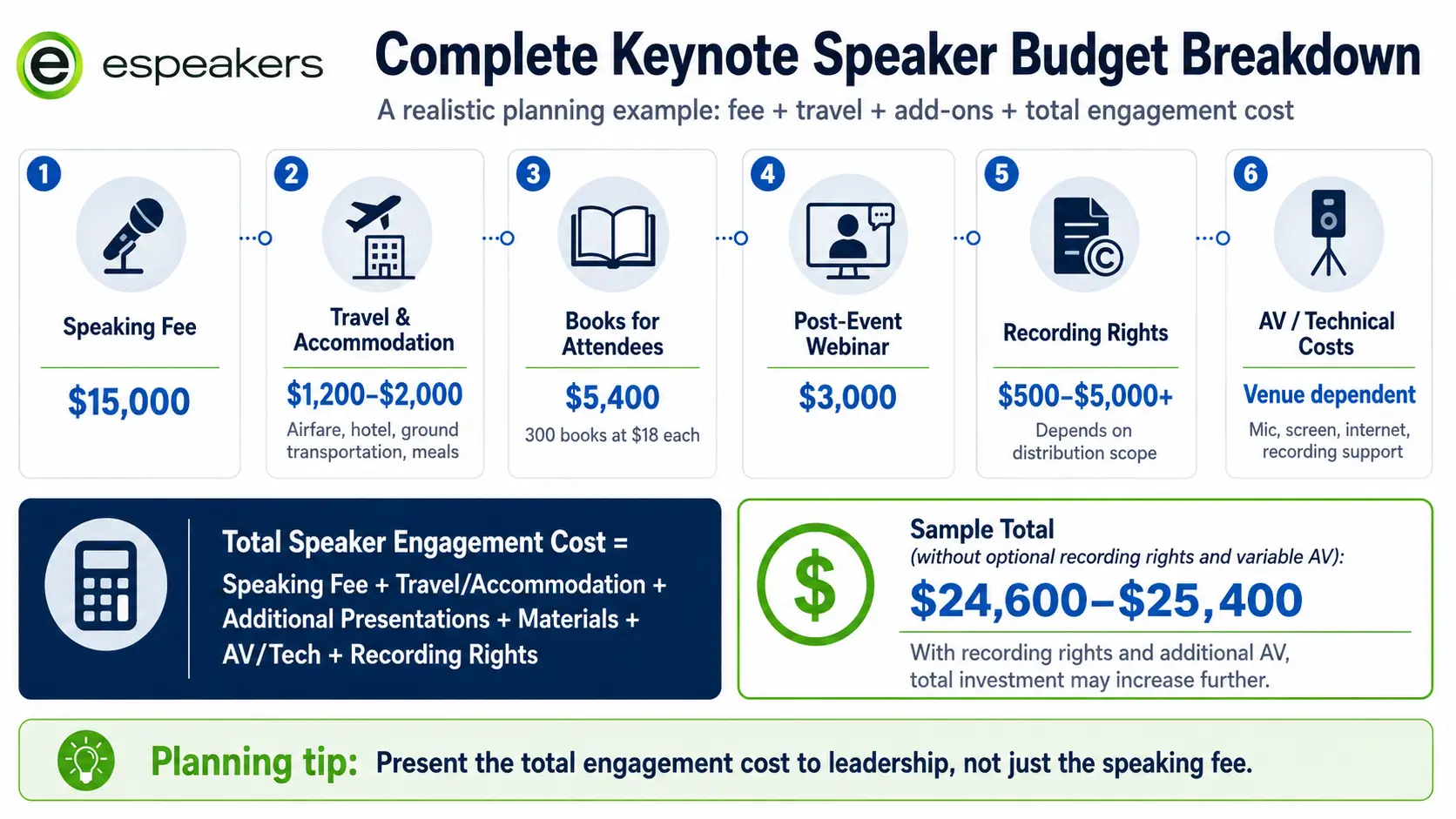
The speaking fee is only part of the total speaker budget. Experienced planners always build a complete speaker budget that accounts for every cost component, because surprises in the “additional costs” column are one of the most common sources of event budget overruns.
Travel and Accommodation
For in-person events, travel and accommodation are almost always billed separately from the speaking fee. Budget these explicitly:
Airfare: $400–$1,500 domestic, depending on origin, destination, and how far in advance tickets are purchased. International engagements: $1,500–$5,000+.
Hotel: $150–$400/night, depending on city and event hotel rate. Most speakers expect at minimum one night’s accommodation, two nights if they’re arriving the day before or have a post-event commitment. Some contracts specify a hotel category (standard, business, business class).
Ground transportation: $50–$200 depending on airport distance, city, and mode. Budget for both airport arrival and event departure.
Class of travel: Many speaker contracts specify economy class for domestic travel and business class for international engagements over 5 hours. Always clarify what’s included in the contract.
Per diem or meals: Some speakers include a per diem in their contract. If not specified, budget $75–$150/day for meals.
Total travel budget per domestic in-person engagement: $800–$2,500 on top of the speaking fee, depending on origin and destination.
Additional Presentations and Add-Ons
Many speakers offer extended engagement options beyond the primary keynote. These are priced separately and can meaningfully increase the value of the engagement:
- Pre-event audience survey administration: Often included in the speaking fee; sometimes priced at $500–$1,500
- Books for attendees: Most speakers sell books at a negotiated bulk rate, budget $15–$30 per copy for hardcover titles, sometimes less for paperback titles
- Post-event webinar or follow-up session: $2,000–$8,000, depending on length and speaker tier, often reduced from standard rates when bundled with the keynote.e
- Breakout session: $1,500–$5,000 in addition to the keynote fee, depending on duration and speaker tier
- Pre-event workshop with leadership team: $3,000–$10,000, depending on duration and speaker tier
- Recording rights: If you want to record and distribute the presentation, this is almost always a separate licensing fee, $500–$5,000+, depending on distribution scope and audience size
AV and Technical Requirements
The speaker’s AV requirements add cost to your venue or technical budget, not typically to the speaker’s contract, but they should be accounted for in your overall speaker engagement budget:
- Wireless lavalier or handheld microphone (in addition to lectern mic)
- Confidence monitor or teleprompter (some speakers require, most don’t)
- Clicker/presentation remote
- Specific screen size or resolution requirements
- Internet connectivity for interactive elements
- For virtual: confirm whether the speaker or the event organization bears the cost of the virtual platform
The Total Speaker Engagement Budget
For planning purposes, use this formula:
Total speaker engagement cost = Speaking fee + Travel/accommodation + Additional presentations + Materials + AV/tech + Recording rights (if applicable)
For a typical corporate keynote at $15,000:
- Speaking fee: $15,000
- Travel and accommodation: $1,200–$2,000
- Books for 300 attendees at $18/copy: $5,400
- Post-event follow-up webinar: $3,000
- Total: $24,600–$25,400
For planners presenting a speaker budget to leadership, the total engagement cost, not just the speaking fee, is the number that needs approval.
Part 4: What Keynote Speaker Cost Looks Like by Event Type
Corporate Annual Conference
Typical speaker budget: $10,000–$35,000 for the keynote, plus travel and additional components
Large annual corporate conferences typically allocate 15–25% of the total event budget to the keynote speaker, for a $150,000 event, which suggests a speaker budget of $22,500–$37,500. For a $75,000 event, the range is $11,000–$19,000.
Corporate events favor credentialed speakers with documented corporate event experience. CSP-holders and speakers with verified reviews from similar corporate contexts are the most defensible budget investments when the CEO or CFO asks why you spent $20,000 on a speaker.
Association National Conference
Typical speaker budget: $12,000–$30,000 for opening keynote, $5,000–$15,000 for closing keynote
Association conferences often have multiple keynote slots. The opening keynote typically commands the highest fee; it sets the tone for the event and often drives attendance. The closing keynote is important,t but can be budgeted at a lower fee tier.
Association planners should specifically seek speakers with experience in the association context, who understand that association members are often industry experts themselves and require a speaker who either has genuine domain depth or has worked extensively with similar professional communities.
Sales Kickoff / Team Meeting
Typical speaker budget: $7,500–$20,000
Sales kickoffs and team meetings need energy, motivation, and specific, applicable frameworks, not celebrity status. The mid-range of the professional speaker market is often the most efficient investment here: established speakers with strong corporate reviews, high energy delivery, and content that generates commitment and direction.
Motivational speaker booking cost in this context should be weighted against the expected impact on team performance. A $12,000 speaker who generates genuine recommitment from a 50-person sales team producing $5M annually is an extraordinarily efficient investment. Frame the budget conversation in those terms.
Leadership Retreat / Executive Event
Typical speaker budget: $15,000–$40,000
Executive audiences are sophisticated. They have seen many speakers and have a low threshold for generic content. Leadership speakers for executive events need demonstrated depth, either through genuine leadership experience, significant research credentials, or a highly developed proprietary framework that isn’t available anywhere else.
This is the event type where the Expert Who Speaks premium is most justified. A former Fortune 500 executive who speaks from direct organizational transformation experience is a more efficient investment for an executive leadership retreat than a polished motivational speaker, even at a significantly higher fee.
Small Business / Nonprofit Event
Typical speaker budget: $2,500–$8,000
The emerging speaker tier is where small business events and nonprofits find genuine value. Speakers early in their career often have exceptional content, authentic stories, and genuine enthusiasm for proving their value, and their fees are accessible to organizations with constrained event budgets.
Strategies for small business and nonprofit events:
Search local. Keynote speakers near your event city don’t carry travel and accommodation costs. The eSpeakers Marketplace location filter surfaces speakers who are local or regional to your event location, and at the emerging to mid-level tier, local speakers can be found in virtually every major market who are capable of delivering a genuinely excellent presentation at accessible price points.
Consider virtual. Virtual keynote speaker cost is 20–50% below in-person. A speaker who would be $8,000 in-person may be $5,000–$6,500 virtually, and for smaller events, the virtual format can actually be higher-impact, since the entire audience has equal visibility to the speaker.
Prioritize fit over recognition. A speaker whose content precisely addresses your audience’s situation and whose verified reviews reflect strong delivery for similar organizations is worth more than a name your audience might recognize, but whose content doesn’t match.
Virtual Summit / Remote Conference
Typical speaker budget: $5,000–$20,000 per keynote
Virtual events allow access to speakers whose in-person fee or travel requirements would otherwise be prohibitive. A speaker who charges $20,000 in-person and travels internationally may be accessible at $12,000–$15,000 for a virtual keynote, a meaningful difference for events with constrained budgets.
Look for CVP-certified speakers. The Certified Virtual Presenter credential on the eSpeakers Marketplace tells you the speaker’s technical setup has been independently verified, and in a virtual format, technical professionalism is a core component of the audience’s experience.
Part 5: Strategies for Getting the Most Value Per Dollar
Strategy 1: Be Completely Transparent About Your Budget
This feels counterintuitive to planners who worry that disclosing their budget limits their negotiating position. In practice, the opposite is true.
When you tell a speaker your specific budget, they can tell you quickly whether they work at that level, offer alternative formats that fit the budget, or propose adjustments to the scope that make the engagement work. Time spent evaluating a speaker you can’t afford is time you could have spent finding the right speaker within your range.
The eSpeakers Marketplace fee range filter makes this practical: you set your budget range before browsing, and only speakers whose published rates fall within your range appear in your results. No guessing, no awkward fee discovery conversations.
Strategy 2: Bundle Multiple Engagements
Many speakers offer better rates for bundled engagements: a keynote plus a breakout session, a keynote plus a leadership workshop, a keynote plus a post-event webinar. The keynote rate stays firm, but the add-on is priced at a lower incremental rate than it would be as a standalone booking.
This bundling often produces better event outcomes, too. Multiple touchpoints with the same speaker throughout an event reinforce the core message in ways that a single keynote cannot.
Strategy 3: Book the Same Speaker for Multiple Events
Organizations that book a speaker for a second or third event typically negotiate more favorable rates, because the speaker values the relationship and the predictable revenue. If a speaker’s content is genuinely aligned with your organization’s ongoing development needs, a multi-year relationship at negotiated rates is often better economics than sourcing a new speaker annually.
Strategy 4: Book Earlier for Better Value
Top speakers at any fee level fill their calendars in advance. Early commitment often opens negotiating flexibility that doesn’t exist when you’re booking 60 days before your event. More importantly, early booking gives you access to the full field of appropriate candidates, including the ones who are already booked when last-minute planners start searching.
Strategy 5: Consider the Full Investment Frame
Speaker budgets are often evaluated in isolation: “Is $15,000 too much for a speaker?” The more useful frame is: what is the total event investment, and what percentage is going to the element most directly responsible for whether attendees leave with something that changes their behavior?
If your event budget is $100,000 and you’re spending $10,000 on the keynote, you’re spending 10% of your total investment on the element most directly tied to your event’s stated outcomes. If the keynote underdelivers, what percentage of that $100,000 achieved its intended impact?
The keynote speaker is often the most leveraged investment in your event budget. A speaker who costs twice as much but produces three times the behavior change is the more efficient spend.
Strategy 6: Negotiate Scope, Not Just Rate
Experienced planners who want to optimize speaker value negotiate what’s included before they negotiate the rate. A speaker who charges $15,000 for a keynote might, for $18,000, include a keynote, a 30-minute leadership team briefing, a post-event webinar at 60 days, and bulk book purchases for attendees. That’s a significantly different value package for a 20% increase in the fee, often better economics than pushing for a $12,000 rate on the keynote alone.
Ask directly: “What would you include at your standard rate, and what could you add if we extended the engagement to $X?”
Strategy 7: Use a Platform That Shows Fees Upfront
The fastest way to work within a budget is to only evaluate speakers whose published fees are within range. The eSpeakers Marketplace displays fee ranges on every speaker profile, before you contact anyone, before you watch the reel, before you invest evaluation time.
Searching for keynote speakers for corporate events on eSpeakers with the fee range filter active means every speaker you evaluate is a speaker you can afford to book. No fee discovery surprises. No conversations that end at “sorry, that’s outside our budget.” Efficient, transparent, and free.
Part 6: Making the Internal Case for Your Speaker Budget
Most corporate event planners don’t just need to choose a speaker; they need to get the budget approved. Here’s the framework for making that case effectively.
The ROI Frame
Position the speaker as an investment with a return, not a cost with a receipt. Calculate or estimate:
- Event attendance: How many people will hear this speaker? At a 500-person conference with a $15,000 keynote, the per-person cost is $30, what is $30 per attendee worth if it changes the way those people show up at work?
- The behavior change math: If the speaker’s session on performance conversations results in even 20 managers having one previously avoided conversation, and that conversation results in improved performance from one direct report, what is that performance improvement worth in revenue or cost savings?
- The event purpose: What is the stated goal of the event, and how does the keynote speaker directly support achieving it? Frame the speaker as the primary delivery mechanism for the event’s organizational goals.
The Benchmark Frame
Present your proposed speaker budget in the context of comparable events. What do peer organizations budget for keynote speakers at similar events? Industry data consistently shows $15,000–$30,000 as the corporate average for established professional speakers, positioning your proposal within that range as “market rate” rather than “expensive.”
The Risk Frame
A budget reduction that forces you to compromise on speaker quality or fit is not a cost savings; it’s a risk increase. The cost of a keynote that doesn’t land, that wastes 500 people’s attention, and that generates “that was a waste of time” feedback is measurable in audience cynicism, reduced event attendance the following year, and a planning credibility hit that takes time to recover from.
Framing it this way: “We could save $8,000 on the speaker and book someone cheaper, but we’d be taking a meaningful risk on the most visible element of a $100,000 event investment.”
Strategies for Getting the Most Value Per Dollar
Strategy 1: Be Completely Transparent About Your Budget
This feels counterintuitive to planners who worry that disclosing their budget limits their negotiating position. In practice, the opposite is true.
When you tell a speaker your specific budget, they can tell you quickly whether they work at that level, offer alternative formats that fit the budget, or propose adjustments to the scope that make the engagement work. Time spent evaluating a speaker you can’t afford is time you could have spent finding the right speaker within your range.
The eSpeakers Marketplace fee range filter makes this practical: you set your budget range before browsing, and only speakers whose published rates fall within your range appear in your results. No guessing, no awkward fee discovery conversations.
Strategy 2: Bundle Multiple Engagements
Many speakers offer better rates for bundled engagements: a keynote plus a breakout session, a keynote plus a leadership workshop, a keynote plus a post-event webinar. The keynote rate stays firm, but the add-on is priced at a lower incremental rate than it would be as a standalone booking.
This bundling often produces better event outcomes, too. Multiple touchpoints with the same speaker throughout an event reinforce the core message in ways that a single keynote cannot.
Strategy 3: Book the Same Speaker for Multiple Events
Organizations that book a speaker for a second or third event typically negotiate more favorable rates, because the speaker values the relationship and the predictable revenue. If a speaker’s content is genuinely aligned with your organization’s ongoing development needs, a multi-year relationship at negotiated rates is often better economics than sourcing a new speaker annually.
Strategy 4: Book Earlier for Better Value
Top speakers at any fee level fill their calendars in advance. Early commitment often opens negotiating flexibility that doesn’t exist when you’re booking 60 days before your event. More importantly, early booking gives you access to the full field of appropriate candidates, including the ones who are already booked when last-minute planners start searching.
Strategy 5: Consider the Full Investment Frame
Speaker budgets are often evaluated in isolation: “Is $15,000 too much for a speaker?” The more useful frame is: what is the total event investment, and what percentage is going to the element most directly responsible for whether attendees leave with something that changes their behavior?
If your event budget is $100,000 and you’re spending $10,000 on the keynote, you’re spending 10% of your total investment on the element most directly tied to your event’s stated outcomes. If the keynote underdelivers, what percentage of that $100,000 achieved its intended impact?
The keynote speaker is often the most leveraged investment in your event budget. A speaker who costs twice as much but produces three times the behavior change is the more efficient spend.
Strategy 6: Negotiate Scope, Not Just Rate
Experienced planners who want to optimize speaker value negotiate what’s included before they negotiate the rate. A speaker who charges $15,000 for a keynote might, for $18,000, include a keynote, a 30-minute leadership team briefing, a post-event webinar at 60 days, and bulk book purchases for attendees. That’s a significantly different value package for a 20% increase in the fee, often better economics than pushing for a $12,000 rate on the keynote alone.
Ask directly: “What would you include at your standard rate, and what could you add if we extended the engagement to $X?”
Strategy 7: Use a Platform That Shows Fees Upfront
The fastest way to work within a budget is to only evaluate speakers whose published fees are within range. The eSpeakers Marketplace displays fee ranges on every speaker profile, before you contact anyone, before you watch the reel, before you invest evaluation time.
Searching for keynote speakers for corporate events on eSpeakers with the fee range filter active means every speaker you evaluate is a speaker you can afford to book. No fee discovery surprises. No conversations that end at “sorry, that’s outside our budget.” Efficient, transparent, and free.
The Speaker Budget Planning Worksheet
Use this to build a complete, defensible speaker engagement budget for any event.
Section 1: Base Fee
- Speaker fee: $___________
- Source: direct booking (eSpeakers Marketplace, no commission) or bureau (add 20–30%)?
- If bureau: bureau commission: $___________
Section 2: Travel and Accommodation (In-Person)
- Airfare (estimate round trip): $___________
- Hotel (# nights × estimated rate): $___________
- Ground transportation (each way): $___________
- Per diem/meals: $___________
- Miscellaneous travel: $___________
- Travel subtotal: $___________
Section 3: Additional Engagement Components
- Breakout session or workshop (if included): $___________
- Post-event webinar or follow-up (if included): $___________
- Books for attendees (# attendees × per-book cost): $___________
- Pre-event audience survey (if separate): $___________
- Recording rights (if required): $___________
- Add-ons subtotal: $___________
Section 4: AV and Technical
- Speaker-specific AV requirements above venue standard: $___________
- Platform costs for virtual/hybrid (if applicable): $___________
- AV subtotal: $___________
Section 5: Total Budget
- Base fee: $___________
- Travel (if applicable): $___________
- Add-ons: $___________
- AV/tech: $___________
- Total speaker engagement budget: $___________
Section 6: Per-Attendee Investment
- Total engagement budget ÷ event attendance = $___________/attendee
FAQ
Keynote speaker fees in 2026 range from $1,500 for emerging professional speakers to $500,000 or more for heads of state and top celebrity figures. Most established professional speakers for corporate events charge between $10,000 and $35,000 for in-person keynotes. The most common range for mid-to-large corporate conferences is $15,000–$30,000. Virtual keynote speakers typically charge 20–50% less than in-person since travel costs are eliminated. The total cost of a speaker engagement, including travel, accommodation, materials, and any add-ons, is typically 25–40% higher than the speaking fee alone.
A standard keynote speaker fee typically includes the primary presentation, basic pre-event preparation (usually one or two calls), and standard customization effort. It does not typically include travel and accommodation (billed separately for in-person events), books for attendees, recording rights, breakout sessions, post-event workshops or webinars, or premium customization requiring significant additional research time. Always clarify what is and is not included in the quoted fee before contract signing.
Virtual keynote speaker cost is typically 20–50% less than the same speaker’s in-person rate, because travel and accommodation costs are eliminated. A speaker who charges $15,000 in-person may charge $8,000–$12,000 for a virtual keynote. The exact discount varies by speaker, some with significant virtual production investments price virtual closer to in-person rates. When budgeting for virtual keynote speakers, plan for the speaking fee (at the discounted virtual rate) plus any platform costs, recording rights, and engagement add-ons.
Motivational speaker booking cost for corporate events ranges from approximately $3,500 for emerging speakers to $75,000 or more for nationally recognized names. The most effective range for most corporate team events, sales kickoffs, and annual meetings is $7,500–$20,000, where established professional speakers with strong delivery skills and documented corporate event experience are well represented. The right investment depends on your audience size, event stakes, and how central the speaker experience is to your event’s overall value proposition.
Leadership speakers for corporate events typically range from $10,000 to $40,000 depending on their experience tier and the sophistication of the audience. For executive leadership retreats and senior leader development programs, budget toward the higher end, experienced executives and leadership development experts with specific frameworks often command $20,000–$35,000 and justify the investment for high-caliber audiences who would find generic leadership content dismissive. For general manager development programs, $10,000–$20,000 provides access to a strong field of experienced leadership speakers.
Use the fee range filter in the eSpeakers Marketplace to search only within your budget before evaluating any candidates. Emerging professional speakers, those with strong content and delivery but earlier in their speaking career, often provide excellent value at $3,500–$7,500. Local and regional speakers eliminate travel costs that can add $2,000–$5,000 to the total engagement cost. Virtual keynote speakers typically charge 20–50% less than in-person. The eSpeakers location filter helps you find speakers near your event city, and the virtual format filter surfaces speakers available for lower-cost virtual delivery.
Yes. Speaker bureaus typically charge 20–30% commission on the speaker’s base fee, which is added to the total cost for the planner. Booking directly through a platform like the eSpeakers Marketplace connects you to the speaker at their base rate with no commission layer. For most corporate and association events, direct booking through a verified speaker platform provides equivalent vetting capability at the speaker’s standard rate. Bureau fees are most justified for high-profile, complex, or time-constrained bookings where the bureau’s relationships and logistics support add genuine value beyond what a self-service platform provides.
The most effective strategies for getting the best rate include: being fully transparent about your budget early in the conversation (which allows speakers to propose appropriately scoped engagements rather than starting from their premium rate); booking well in advance (6+ months often creates more scheduling flexibility and goodwill); bundling multiple engagement components into a package negotiation rather than negotiating the keynote fee alone; booking the same speaker for multiple events over multiple years (volume relationships often yield better rates); and focusing negotiations on what’s included rather than just the headline fee.
Start Building Your Speaker Budget, Search eSpeakers Free.
The eSpeakers Marketplace makes speaker budget planning concrete and efficient: every profile displays a fee range, so you only invest evaluation time in speakers whose published rates match your available budget. No fee inquiry required. No budget surprises. Just a searchable pool of professional speakers, filtered to your topic, format, location, availability, and budget, free to search and contact.
→ Search Keynote Speakers by Budget
→ Find Affordable Keynote Speakers Near You
→ Browse Budget-Friendly Virtual Keynote Speakers
→ Find Motivational Speakers for Corporate Events
→ Search Leadership Speakers for Corporate Events
This guide was written for meeting planners, corporate event managers, and association executives who are building a speaker budget and want accurate, current market data for keynote speaker costs in 2026. The eSpeakers Marketplace is free for event planners to search and use.
Last updated: April 2026
Joe Heaps, Chief Marketing Officer at eSpeakers
Joe Heaps is the Chief Marketing Officer at eSpeakers and is responsible for creating and accelerating the company's sales & marketing strategies. He is focused on driving the company's vision of helping organizations and individuals improve in substantial, long-term ways. He believes it happens when the perfect speaker is in front of the right audience. Over 25 years in the industry, Joe’s strategic vision and leadership have propelled eSpeakers to the leading software platform for speakers, coaches, and experts.
Joe Heaps
Chief Marketing Officer, eSpeakers
Latest Articles

Related Articles