The Ultimate Speaker Vetting Checklist for Corporate Events
Finding keynote speakers for corporate events is one of the highest-stakes decisions a corporate event planner makes. The speaker is typically the most visible element of the event, the most discussed in post-event feedback, and the most directly tied to whether attendees leave with something that changes what they actually do at work.
The hiring decision is also made under pressure. Timelines are compressed. Stakeholders have opinions. Budgets are fixed. And the field of speakers available for any given topic is enormous, ranging from credentialed industry veterans with decades of real-world experience to polished communicators with limited depth, to everything in between.
What separates a confident, successful speaker selection from an expensive gamble is a systematic vetting process. Not a gut feeling. Not the most impressive name in the program. Not the speaker who responds fastest to your inquiry. A structured evaluation against criteria that actually predict whether a speaker will deliver outcomes, not just a good presentation.
This checklist gives corporate event planners exactly that: a complete, stage-by-stage vetting framework for evaluating keynote speakers for corporate events, with specific questions to ask at each stage, red flags to recognize, and green flags that tell you a speaker is worth booking.

John Doe
Chief Marketing Officer at eSpeakers
Apply this checklist to real candidates who are free on eSpeakers.
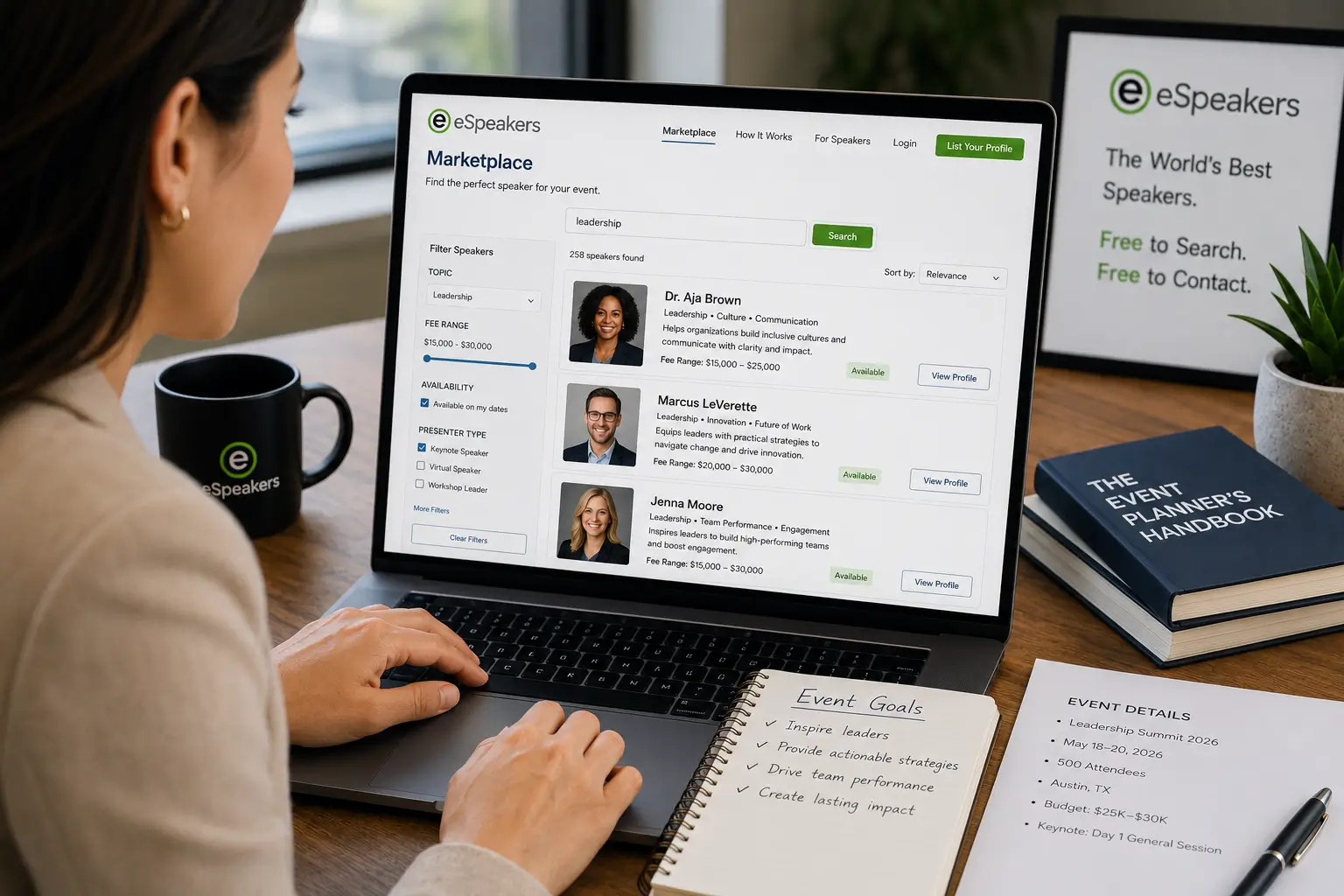
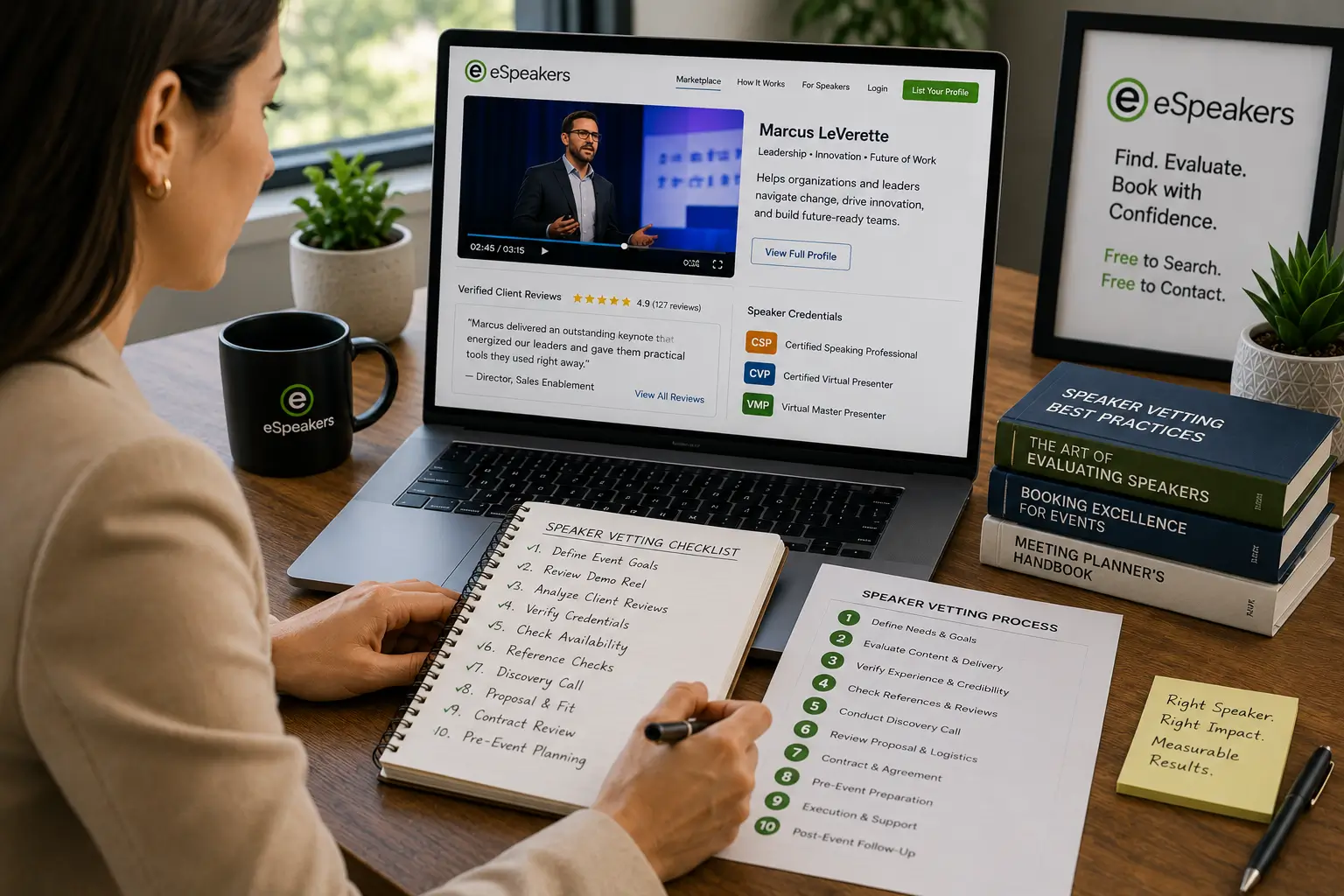
eSpeakers Marketplace gives you the tools this checklist requires: demo reels, verified client reviews, credential badges (CSP, CVP, VMP), live availability calendars, and direct speaker contact, all on one profile, free to search.
Before You Start: The Corporate Event Context That Shapes Everything
Corporate event speaker selection operates in a specific environment that's different from association conferences, nonprofit fundraisers, or public events. Understanding those differences shapes how you evaluate candidates.
Corporate audiences are sophisticated
Your attendees are professionals who work full days, attend meetings, and have seen their share of generic keynotes. They're not a captive student audience obligated to pay attention. They will disengage, visibly, if a speaker doesn't earn their focus within the first few minutes.
The speaker often bears the organization's credibility
When your CEO introduces the keynote speaker at your company's annual leadership summit, they're implicitly vouching for that speaker's relevance to your people. A poor fit doesn't just disappoint, it reflects on the judgment of everyone who approved the booking.
Outcomes are measured, or they should be
Corporate event ROI is increasingly tracked. HR teams survey employees after events. Leaders ask what changed. Sales leaders track whether the kickoff speaker's framework was implemented. The speaker you hire will be evaluated, not just appreciated.
Budget scrutiny is real
Speaker fees are a visible line item that finance teams and executives can easily question. The speaker's decision requires justification beyond "they were inspiring." Being able to point to specific credentials, verified client reviews from similar organizations, and concrete outcome language in their topic descriptions gives you the documentation to defend the investment.
Stage 1: Define Before You Search
The most common vetting failure happens before any speaker is ever evaluated: starting the search without clear criteria. Corporate event planners who skip this stage end up vetting speakers against undefined standards, which means they’re essentially choosing based on who impresses them most in their reel, rather than who is most likely to deliver what the event actually needs.
The Pre-Search Definitions Checklist
Event purpose:
- “The goal of this event is to [specific outcome, not theme]…”
- Written, agreed upon by key stakeholders, and specific enough that you could measure whether it was achieved
Speaker’s specific role:
- “By the end of the speaker’s presentation, attendees should be able to / will feel / will commit to…”
- Distinguishes this from the general event purpose, defines what this slot in the agenda is specifically responsible for
Audience profile:
- Primary audience: industry, functional area, career level, experience
- What they already know about this topic (to avoid pitching below their level)
- The specific challenges they’re currently navigating, not generic industry challenges
- What they’re likely to be skeptical about or resistant to
- How they prefer to engage: interactive vs. presented-at, data-driven vs. story-driven
Format and logistics:
- In-person, virtual, or hybrid?
- Keynote only, or keynote + Q&A, workshop, breakout, or facilitated session?
- Presentation length
- Position in the agenda (opening keynote, post-lunch, closing session, each has different energy requirements)
- AV and technical environment
Budget:
- Total budget including travel and accommodation (not just the speaking fee)
- Fee range you’re authorized to approve vs. fee range requiring additional sign-off
- Whether the budget for add-ons (books, follow-up session, pre-event survey tool) is separate
Timeline:
- Event date confirmed
- Deadline to have a speaker confirmed (usually 2–3 months before the event to allow for promotion)
- Key dates: contract signing, deposit payment, prep call, material submissions
Stage 2: Building Your Long List
With your criteria defined, you’re ready to search. The goal of this stage is not to find the speaker; it’s to build a realistic field of candidates without cutting too quickly.
Long-List Checklist
Sources to search:
- eSpeakers Marketplace, filter by topic, fee range, format, availability, and location simultaneously; all profiles include demo reels, verified reviews, and live availability
- Referrals from trusted colleagues, other corporate planners who’ve hired speakers recently, are your most reliable source; ask, “Who blew your audience away at your last event?”
- Association networks, MPI, PCMA, SHRM, and industry-specific associations often maintain speaker resources or recommendation systems.
- Post-event programs from comparable corporate events, which keynoted your industry’s major conference last year?
First-pass filters (apply quickly, don’t over-analyze at this stage):
- Topic alignment: Does their listed expertise address your event’s stated purpose?
- Fee range: Is the listed fee within your budget (remembering to add travel/accommodation if not included)?
- Format availability: Do they explicitly offer the format you need (virtual, in-person, hybrid)?
- Date availability, do they show as available on your event date?
- Credential check: Do they hold any verified credentials (CSP, CVP, VMP) that signal a documented professional standard?
Long-list target: 8–12 candidates who pass first-pass filters. Resist the urge to narrow more aggressively at this stage; you haven’t done the deeper evaluation yet.
Red flags that eliminate from the long list immediately:
- No demo reel or video of any kind
- No client reviews or testimonials of any kind
- Fee listed far below market rate without explanation (can indicate inexperience or poor-quality delivery)
- Generic program descriptions that could apply to any audience (“Unlocking Your Potential for Results!”)
- Profile clearly not updated in more than a year (outdated headshot, dated event references)
Stage 3: The Demo Reel Evaluation
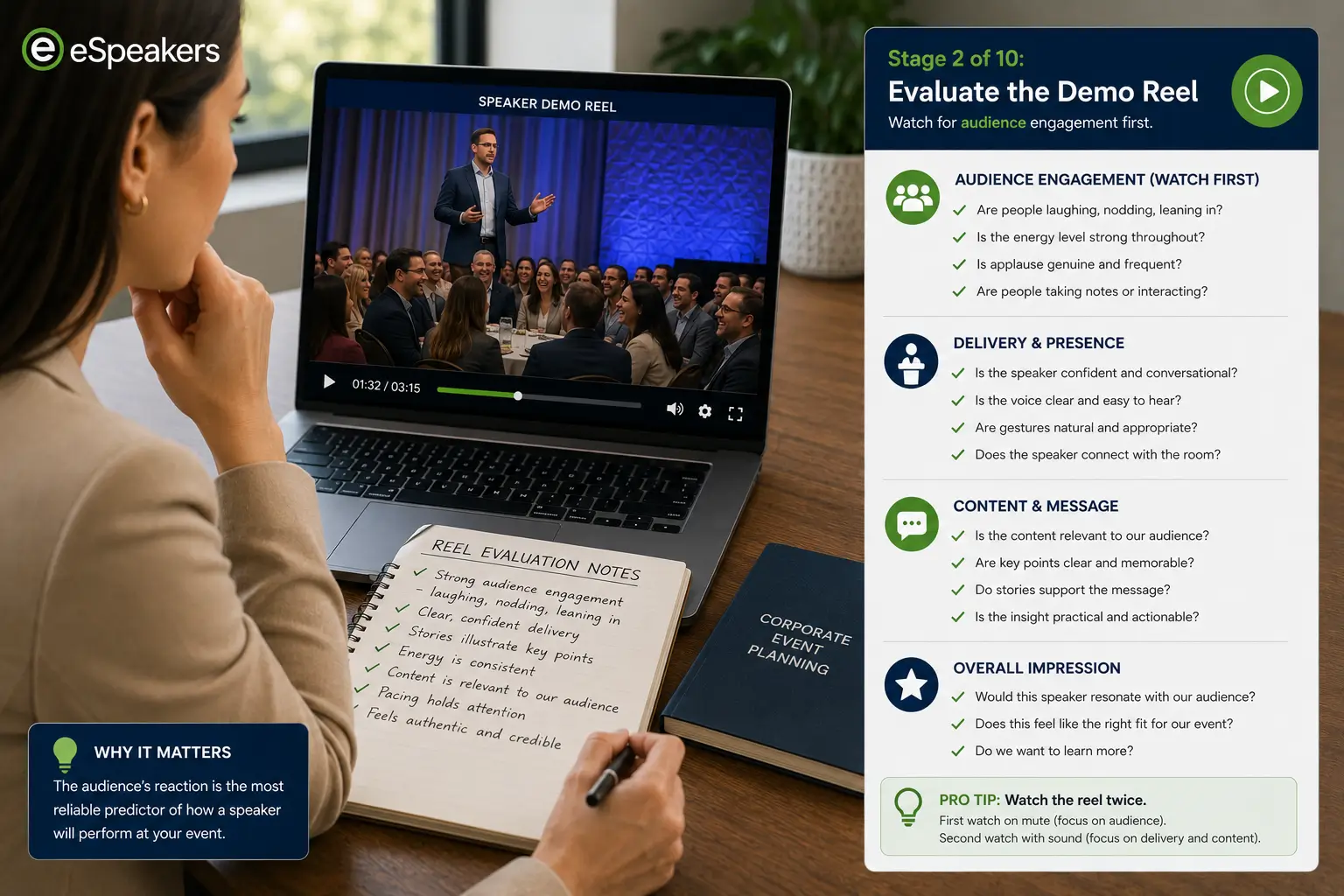
Every speaker on your shortlist gets their demo reel watched, deliberately, systematically, and with specific criteria in mind. Not passively while you’re doing something else, but actively, as a structured evaluation.
Reel Evaluation Checklist
Watch the reel twice. First time: general impression. Second time: systematic evaluation against these criteria.
Watch the audience, not just the speaker:
- Are audience members visibly engaged, leaning forward, laughing, nodding, and taking notes?
- Is there genuine audience reaction to content (not just applause at the end)?
- Are there moments where you can see people being visibly moved, surprised, or energized?
- Does the energy in the room feel authentic, or does it feel like a highlight reel assembled from the most favorable moments?
Evaluate delivery quality:
- Does the speaker maintain genuine eye contact with the audience, or do they spend significant time looking at slides, notes, or away from the room?
- Is there vocal variety, changes in pace, volume, tone, and emphasis, or is the delivery flat and monotonous?
- Are they reading from slides? (Red flag: corporate audiences disengage from slide-reading speakers faster than almost anything else)
- Do they use specific, vivid stories, things they personally experienced, or do they primarily reference other people’s stories and research?
- Does their energy feel sustained throughout the clip, or does it peak at a produced opening and decline?
Evaluate content relevance:
- Can you imagine this content landing with YOUR specific audience, not just a general corporate audience?
- Does the speaker demonstrate genuine depth on their topic, or does the content feel surface-level?
- Are there moments where you think “our attendees would find that immediately applicable”?
- Does the content feel current, reflecting the state of the topic as it exists today, not five years ago?
For virtual keynote speakers, evaluate specifically:
- Is the video quality professional (clear image, good framing, not a laptop webcam in bad lighting)?
- Is the audio clean without echo, background noise, or inconsistent volume?
- Does the speaker maintain eye contact with the camera, or are they clearly looking at their screen rather than the lens?
- Does their energy translate through the screen, or does it flatten?
- Do they demonstrate comfort with virtual interaction tools, or do they present as if the audience isn’t there?
Green flags in the reel:
- Authentic audience reaction visible in wide shots
- Specific, personal stories with vivid detail
- Moments of genuine humor that land (not scripted jokes)
- Content that references real organizations, specific data, and named situations
- A speaker who is clearly comfortable with the medium, not performing for the camera
Red flags in the reel:
- Audience reaction footage that looks obviously staged or assembled
- All clips from the same single event (no range evidence)
- Opening with a slow logo animation or speaker credential recitation before showing any content
- Heavily produced music and graphics that compensate for underpowered delivery
- No audience visible in any clip, only talking-head footage
Reel evaluation outcome: Based on reels, reduce your 8–12 long list to 3–5 candidates for deeper evaluation.
Stage 4: The Profile Deep Dive
For your 3–5 shortlisted candidates, go beyond the reel. The eSpeakers profile, or the speaker’s professional profile on their own site, contains signals that the reel alone can’t provide.
Profile Deep Dive Checklist
Biography and professional background:
- Does their bio lead with audience outcomes, or primarily with credentials? (Outcome-first bios usually indicate a speaker who thinks like their clients)
- What did they do before, or alongside, speaking? Is there documented real-world experience in the area they speak about?
- If they’re an expert-who-speaks, can you verify they actually practiced what they teach? (Look for specific role titles, organization names, tenure)
- If they’re an expert speaker, does the bio demonstrate genuine research depth, or is the background thin?
Topic page analysis:
- Do their topic descriptions name a specific audience, or are they generic (“for organizations that want to grow”)?
- Do the outcome statements answer the question “attendees will be able to…”?
- Is the content clearly differentiated from what any speaker in this general category would offer?
- Does reading the topic page make you think “yes, this is exactly what our people need,” or is the connection unclear?
Client history:
- Have they spoken for organizations similar to yours in size, industry, or function?
- Are recognizable client logos displayed? (Not a requirement, but a signal)
- Is there diversity in their client list, different industries, and different audience types, which suggests adaptability?
Verified client reviews:
- Read every review displayed on their eSpeakers profile (not curated testimonials, verified reviews from actual bookings)
- Are reviews specific or generic? (“Rebecca’s three frameworks for managing conflict through organizational change were immediately applicable” vs. “Great speaker! Loved it!”)
- Do reviews mention audience outcomes, not just delivery quality?
- Is there consistency across reviews, or do they tell different stories about the speaker?
- Are there reviews from organizations that ran corporate events, not just association conferences or public events?
Credentials:
- CSP (Certified Speaking Professional), NSA’s highest earned designation; requires 250+ paid presentations, 100+ different clients, documented income, peer video review, and ethics oath. Fewer than 12% of professional speakers globally hold it. NSA’s highest-earned designation; requires 250+ paid presentations, 100+ different clients, documented income, peer video review, and an ethics oath. Fewer than 12% of professional speakers globally hold it. If present, signals documented track record and professional standards.
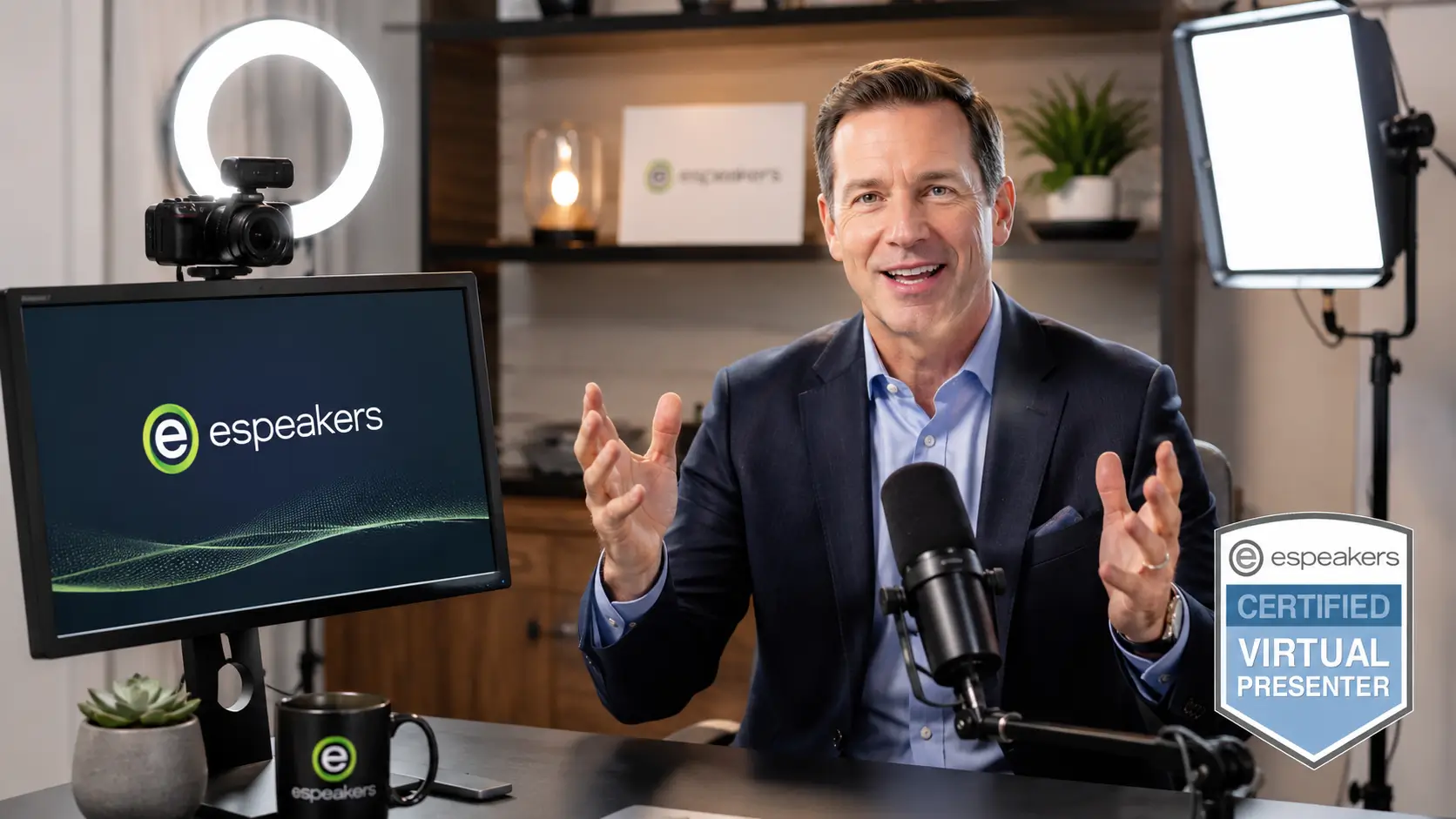
- CVP (Certified Virtual Presenter), eSpeakers certification verifying equipment, environment, and platform competence for virtual delivery. Critical credential for any virtual or hybrid booking.
- VMP (Virtual Master Presenter) is an advanced virtual delivery credential requiring 15 hours of live instruction and a formal competency assessment. Indicates mastery-level virtual delivery for high-stakes virtual events.
Profile completeness:
- Current headshot (professional, within the last 2–3 years)
- Live availability calendar showing real-time open dates
- Fee range displayed
- At a minimum, one video clip is visible, preferably multiple
Stage 5: Reference Checks
Reference checking is the most skipped step in corporate speaker vetting, and the one most likely to surface information that changes a hiring decision.
Reference Check Checklist
Who to contact:
- Ask each finalist speaker for 2–3 references from recent (within 18 months) corporate events, preferably for organizations similar to yours.
- Check whether any of your professional network contacts have hired this speaker; direct peer referrals carry more weight than speaker-provided references.
- If the speaker has recent verified reviews on eSpeakers, consider reaching out directly to the reviewing planner with a brief message.e
How to conduct the reference call:
Call, don’t email. Email references almost universally produce positive responses regardless of actual experience. A five-minute phone call produces real information.
Reference questions that reveal the most:
- “Walk me through how you briefed the speaker, what information you provided, and how they used it?”
- “What specific moments in the presentation were most effective? What was the audience’s reaction?”
- “Did anything not go as planned? How did the speaker handle it?”
- “What would you tell the speaker to do differently if they were working with an organization like ours?”
- “Would you hire them again, and have you?”
- “On a scale of 1–10, how would you rate the value for the fee you paid? What would have made it a 10?”
Green flags in references:
- Planner references specific content moments without being prompted
- Speaker is described as responsive, easy to work with, and proactive in seeking information
- Planner volunteers that the speaker adapted or customized without being asked
- “We’ve booked them again,” or “We’ve recommended them to colleagues.”
Red flags in references:
- Reference is vague and positive without specifics (“They were great, everyone loved it”)
- Reference mentions logistics or communication difficulties (“A little hard to get a hold of before the event”). The reference describes a presentation that sounds identical to what the speaker would give to any audience.
- Reference pauses or hesitates when asked about the specific content impact.
Stage 6: The Discovery Call
The discovery call is your direct evaluation of how a speaker thinks, how they listen, and whether they’re genuinely oriented toward your event’s outcomes or toward their own program. It is not just a logistics call.
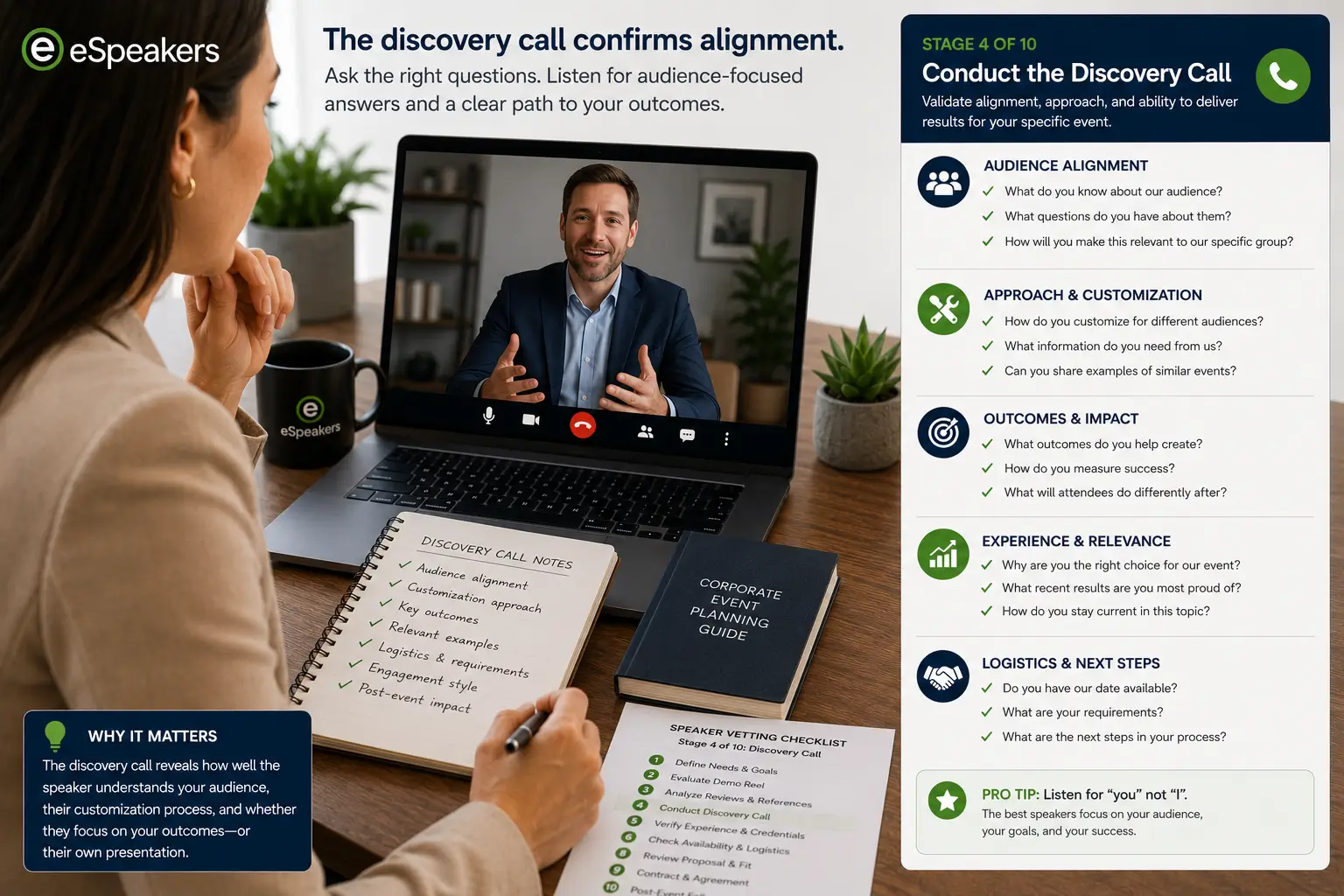
Discovery Call Checklist
Before the call:
- Send your event brief in advance, audience profile, event purpose, speaker’s specific role, event format, and timeline
- Prepare your questions in advance
- Note whether the speaker reviewed the brief before the call (a speaker who asks questions about content they should have read signals poor preparation habits)
During the call, evaluate these signals:
Do they listen more than they pitch?
- Does the speaker ask questions about your audience, or do they primarily talk about their program?
- Do they reference specific things you’ve shared in the brief, or do they treat it as background noise?
- When you describe your audience’s specific situation, do they engage with the specifics or redirect to their standard material?
Do they demonstrate genuine customization?
- Can they explain specifically, not generically, how they would adapt their content for your audience?
- Do they ask for information beyond what you’ve provided, or are they satisfied with the basics?
- Do they have a concrete pre-event preparation process (audience survey, stakeholder interviews, industry research) or is “customization” just a promise?
Discovery call questions to ask:
- “Based on what I’ve shared about our audience, what would you change about your standard program, and why?”
- “What information would you need from us to prepare effectively, beyond what I’ve already provided?”
- “Can you describe a similar engagement, same type of organization or audience, and what the specific outcome was?”
- “How do you typically handle it when a presentation isn’t landing the way you expected mid-session?”
- “What would you include in your preparation that would help this specific group leave ready to act?”
- “Beyond the keynote itself, what do you offer that could extend the impact of this engagement?”
Virtual-specific discovery call questions:
- “What platform do you present on most frequently, and what do you do to create engagement when you can’t read the room physically?”
- “Walk me through your virtual setup, camera, mic, lighting, and internet connection backup?”
- “Are you CVP certified? If so, can I see your virtual proof video?”
- “How do you typically build interactive elements into a virtual keynote of our length?”
Green flags in the discovery call:
- The speaker asks about things you didn’t include in the brief; they want to know more
- Speaker references something specific from your audience profile or event purpose
- Speaker pushes back thoughtfully, tells you something doesn’t fit, rather than agreeing with everything
- Speaker volunteers specific examples from past engagements without being asked for case studies
- Speaker is clearly already thinking about the specific people who will be in the room (or virtual room)
Red flags in the discovery call:
- The speaker spends most of the call describing their program without asking about your audience
- Speaker’s “customization” response is generic (“I always tailor it to the group I’m speaking to”)
- The speaker is unable to describe a specific outcome from a past comparable engagement
- Speaker is dismissive of your event’s specific context (“This is a universal message, it works for any audience”)
- The discovery call feels like a sales call, not a collaboration conversation
Stage 7: The Final Evaluation, Scoring, and Selection
With your discovery calls complete, you have rich information about each finalist. This is the stage where you make the decision, systematically, not by gut feel.
Scoring Checklist
Create a simple scoring matrix for your top 2–3 candidates. Rate each on these criteria (1–5 scale):
Criterion | What You’re Evaluating |
Content fit | How precisely does their expertise match your audience’s specific situation? |
Delivery quality | Reel assessment, engagement, energy, storytelling, vocal variety |
Customization evidence | Demonstrated, not promised, what did references and the discovery call reveal? |
Client review quality | Specific outcomes mentioned, consistency, and similarity to your organization type |
Professional credentials | CSP, CVP, VMP, or other verified designations |
Reference quality | Specific, consistent, positive with detail; would-hire-again rate |
Discovery call response | Listened vs. pitched; specific vs. generic; proactive vs. reactive |
Logistical fit | Budget, availability, format, travel, timeline |
Responsiveness | How they’ve communicated throughout the vetting process |
Total each candidate’s score. In most cases, the right selection becomes clear. Where scores are close, weight customization, evidence, and reference quality are most heavily weighted; these are the two criteria that most directly predict whether a speaker will serve your specific audience rather than deliver a polished generic program.
Share the shortlist with stakeholders. Present your top 2–3 candidates, with your scoring rationale, to your planning committee or key decision-makers before finalizing. Two benefits: you get an additional perspective, and stakeholders who participated in the selection are more invested in the event’s success.
Stage 8: The Contract, What to Verify Before Signing
Once you’ve selected your speaker, a complete written contract is non-negotiable. The contract isn’t a formality; it’s the shared definition of what both parties have agreed to.
Contract Verification Checklist
Engagement basics:
- Event date, time, and location (or virtual platform) are correct
- Presentation title or topic description matches what was discussed
- Presentation length is specified, including whether Q&A time is within or in addition to that length
- Format is specified: keynote only, keynote + workshop, virtual keynote, hybrid format
Financial terms:
- Total speaking fee matches what was agreed in the discovery process
- Deposit amount and due date are specified (typically 50% at contract signing)
- Balance payment timeline is specified (typically 30 days before the event, or net-30 after)
- Travel and accommodation: explicitly included in the fee or billed separately, and at what standard (economy vs. business class; hotel budget)
- Cancellation terms for BOTH parties are specified. What happens if the event is postponed, canceled, or the speaker cannot attend?
Content and preparation:
- The level of customization agreed to is documented
- Pre-event call schedule is specified: how many calls, approximate timing
- Speaker’s material deliverable deadlines are set: bio, headshot, topic description, audience survey (if applicable)
Intellectual property:
- Recording rights: Can the event be recorded? If so, can the recording be distributed internally? Externally? To how many people? For how long?
- Exclusivity: Does the speaker agree not to deliver the same content to a direct competitor within a specified window?
- Speaker’s IP: Is there any content in the presentation that the speaker considers proprietary that cannot be reproduced in event materials?
Additional provisions:
- Books or materials for attendees: who provides them, who pays, and how are they distributed?
- Post-event follow-up session: included, priced separately, or at the speaker’s discretion?
- Social media: Does the speaker agree to promote the engagement (before or after)? Or are there restrictions?
- Substitution clause: if the speaker cannot attend, what are the options: substitute speaker, refund, or postponement?
Using eSpeakers for the contract and invoicing process streamlines this for both planners and speakers, ensuring both parties are working from a documented agreement rather than an email thread.
Stage 9: Pre-Event, The Brief That Makes or Breaks Customization
Signing the contract doesn’t end the vetting process; it begins the preparation process. And how well you prepare your speaker is as important as how well you select them.
Pre-Event Preparation Checklist
The detailed brief (should be provided at least 6 weeks before the event):
About the audience:
- Full audience profile: role titles, functional areas, company tenure, experience level
- What they already know about this topic, be honest about their sophistication
- The top 3 challenges your audience is facing right now, specific, not generic
- What they’re likely to be skeptical of or resistant to hearing
- Recent relevant organizational context: major changes, new leadership, challenging performance period, upcoming strategic shift
About the event context:
- Full agenda: where does the speaker slot sit? What comes before and after?
- Your event’s stated purpose (in writing)
- The specific outcome you want from this presentation
- What other speakers or sessions will cover, so the speaker can differentiate
- Any topics, examples, or stories to avoid
Logistics:
- AV setup details: room layout, screen size and format, microphone type, clicker availability
- For the virtual platform, expected attendee count, and whether cameras will be on or off
- Run-of-show: when does the speaker arrive, how long is their session, and how is Q&A handled?
Pre-event prep call(s):
- At least one substantive prep call scheduled (not just logistics) 4–6 weeks before the event
- The speaker has reviewed and responded to the detailed brief before the call
- Discussion of specific content adaptation, not just logistics confirmation
- Speaker’s questions about the audience are answered in depth
- Final run of the engagement confirmed: topic, length, Q&A, materials
Promotion:
- Speaker featured in event invitations, agenda communications, and registration pages
- Speaker bio, headshot, and topic description incorporated in all event materials
- Speaker’s demo reel clip or event-specific teaser video included in pre-event emails.
- Attendees primed: what will this speaker cover, and why does it matter to them specifically?
Stage 10: Virtual and Hybrid Events, Additional Vetting Requirements
For corporate events that are fully virtual or hybrid, standard vetting criteria apply,y plus a specific set of virtual-readiness checks.
Virtual Speaker Vetting Checklist
Platform and technical readiness:
- Speaker holds CVP (Certified Virtual Presenter) certification, equipment, environment, and platform competence, independently verified
- Speaker has confirmed experience with your specific platform (Zoom, Teams, WebEx, Hopin, or other)
- Speaker’s internet connection is reliable; ask about their backup plan if the primary connection fails
- Tech check scheduled 48–72 hours before the event (not the morning of)
Virtual setup verification:
- Camera quality: external webcam or DSLR, not a built-in laptop camera
- Audio quality: external microphone with no echo or background noise
- Lighting: key light in front of the speaker, no backlight, creating a silhouette
- Background: professional, controlled environment, no pets, family traffic, or visual distractions
- Have you seen the speaker’s virtual proof video from their CVP assessment? This shows exactly what their virtual setup produces.
Engagement capability:
- Does the speaker explicitly include interactive elements in virtual keynotes, polls, chat prompts, and Q&A integration?
- Can they share their screen while remaining visible on camera?
- Do they have a plan for maintaining audience attention in a 20–45 minute virtual format (the effective range for virtual keynotes)?
- For hybrid events: how do they ensure remote attendees feel equally included, not like an afterthought?
Budget for virtual:
- Virtual keynote speakers typically charge 20–50% less than in-person speakers
- Budget should still include prep calls and any post-event follow-up
- High-production virtual events with extensive interaction design may reduce the price difference
The Red Flags and Green Flags Quick Reference
Red Flags, Reconsider the Booking
Content and fit:
- Generic topic descriptions with no audience specificity
- Demo reel with no visible audience reaction
- Speaking history with no corporate event experience
- References that are vague and positive without specifics
Professionalism and preparation:
- Slow or inconsistent communication during the vetting process
- The discovery call focused on their program, not your audience
- No pre-event prep process or interest in a detailed brief
- Unable to name a specific customization they’d make for your audience
Virtual (if applicable):
- No CVP certification or evidence of a verified virtual setup
- Virtual demo footage using a built-in laptop camera or in a distracting environment
- No mention of interactive virtual engagement tools
Contract and logistics:
- Resistance to a written contract
- Inability to provide references from corporate events
- Fee significantly below or above the market range without explanation
Green Flags, Proceed with Confidence
Content and fit:
- A topic page that describes your audience’s exact situation without you having to tell them
- Verified reviews from organizations similar to yours mentioning specific outcomes
- Client list with recognizable organizations at your event’s scale
- CSP, CVP, or VMP credential indicating independently verified professional standards
Professionalism and preparation:
- Proactive in requesting detailed audience information
- Discovery call where they listen more than they pitch
- Specific customization ideas offered during the discovery call
- References who describe the speaker as easy to work with and responsive
Virtual (if applicable):
- CVP badge on eSpeakers profile
- Virtual proof video that demonstrates professional setup quality
- References that specifically describe effective virtual audience engagement
The Corporate Speaker Vetting Checklist: One-Page Summary
Use this as your working reference for every corporate speaker evaluation.
Stage 1, Before You Search
- Event purpose written and agreed on.
- Speaker’s specific role defined
- Audience profile documented
- Budget set (fee + travel)
- Timeline confirmed
Stage 2, Long List (8–12 candidates)
- eSpeakers Marketplace searched with filters
- First-pass criteria applied (topic, fee, format, availability, credentials)
- Obvious red flags eliminated
Stage 3, Reel Evaluation (to 3–5 candidates)
- Watch the audience, not just the speaker
- Assess delivery quality systematically
- Check content relevance for your specific audience
- Virtual-specific criteria applied if applicable
Stage 4, Profile Deep Dive
- Bio and professional background reviewed.
- Topic pages analyzed for specificity
- Client history assessed for comparability
- Verified client reviews read carefully
- Credentials verified
Stage 5, Reference Checks
- 2–3 references called (not emailed) for each finalist
- Specific questions asked about outcomes and handling challenges
- “Would you hire again?” answered directly
Stage 6, Discovery Call
- Brief sent in advance
- Speaker evaluated: listens vs. pitches, specific vs. generic
- Customization process assessed
- Virtual setup verified if applicable
Stage 7, Scoring and Selection
- Scoring matrix completed for top 2–3 candidates
- Shortlist shared with stakeholders
- Final selection made
Stage 8, Contract
- All engagement specifics documented.
- Financial terms complete
- Recording rights and exclusivity addressed
- Cancellation terms for both parties are included
Stage 9, Pre-Event
- Detailed brief provided
- Prep call(s) completed
- Speaker featured in event promotion
Stage 10, Virtual/Hybrid (if applicable)
- CVP certification confirmed
- Tech check scheduled
- Engagement plan reviewed
FAQ
The most efficient way to find keynote speakers for corporate events is through the eSpeakers Marketplace, which lets you filter by topic, fee range, format (virtual, in-person, hybrid), location, availability, and credential status simultaneously. Every profile includes a demo reel, verified client reviews from actual planners, live availability, and fee range, so you can evaluate candidates comprehensively without leaving the platform. Referrals from other corporate planners, post-event programs from comparable industry conferences, and association networks are also strong sources.
The CSP (Certified Speaking Professional), conferred by the National Speakers Association, is the speaking industry’s highest earned designation, it verifies 250+ paid presentations, 100+ different clients, documented income standards, and a peer video review. For virtual or hybrid events, the CVP (Certified Virtual Presenter) verifies equipment, environment, and platform competence through a live assessment. The VMP (Virtual Master Presenter) indicates advanced virtual delivery mastery. These credentials don’t guarantee content quality, but they do signal a verified professional standard that reduces booking risk for corporate events where the stakes are high.
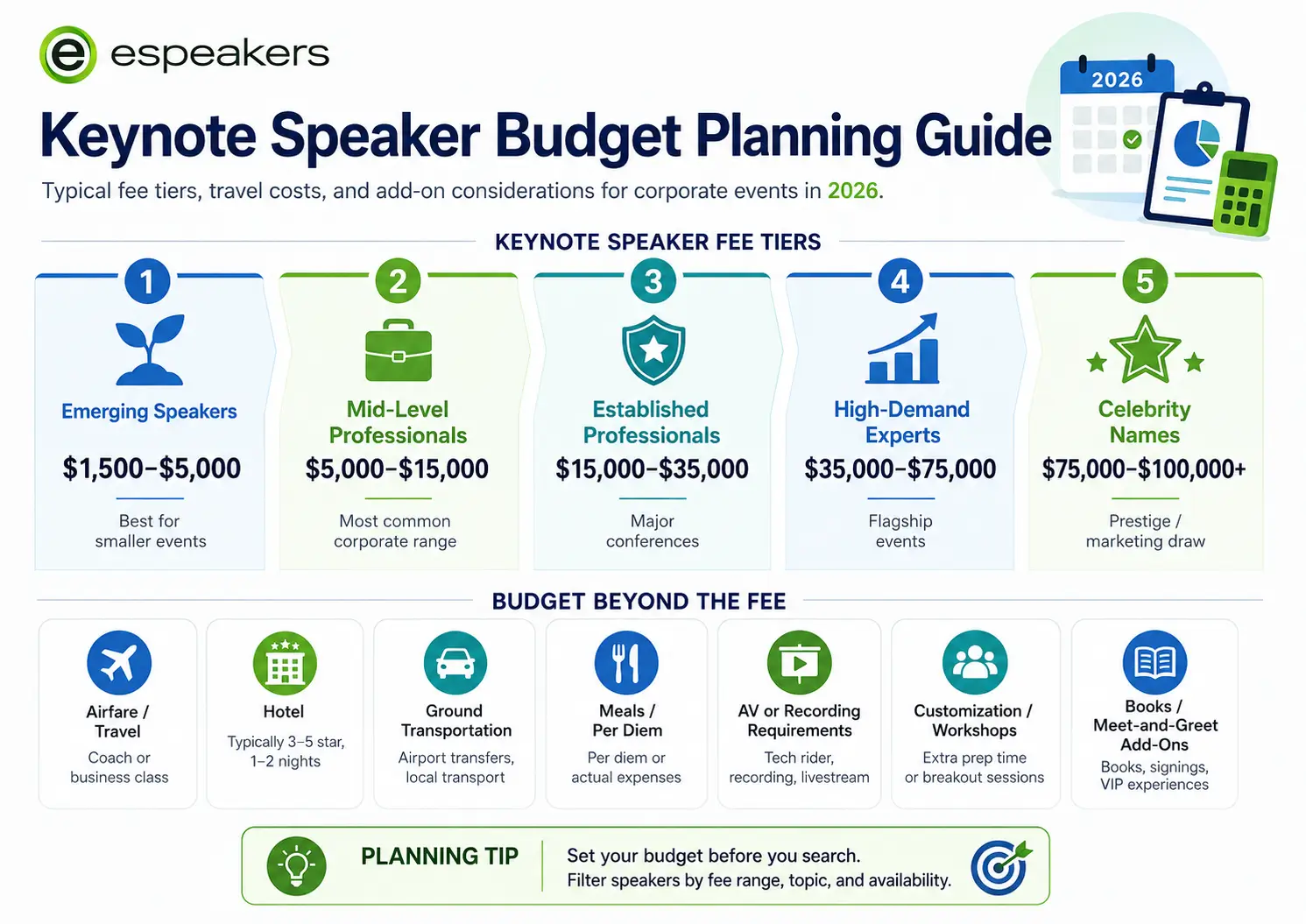
Corporate keynote speaker fees range from $5,000 for emerging speakers to $100,000 or more for celebrity-level names. Most established professional speakers for mid-to-large corporate events charge between $10,000 and $35,000 for in-person keynotes. Virtual keynote speakers typically charge 20–50% less. Budget planning should include travel and accommodation (usually billed separately from the speaking fee), which can add $1,500–$5,000 for domestic in-person events. eSpeakers Marketplace displays fee ranges on every profile, so you can filter to your budget before beginning detailed evaluation.
Watch the reel twice, first for general impression, then systematically. Focus most of your attention on the audience, not the speaker: are people visibly engaged, leaning forward, reacting authentically? Evaluate delivery quality: does the speaker maintain eye contact, use vocal variety, and tell specific personal stories rather than generic content? Ask whether you can imagine this content landing with YOUR specific audience, not just a general corporate audience. Red flags include no visible audience reaction, all footage from a single event, and heavily produced graphics that compensate for underpowered delivery.
Call references rather than emailing, you get real information in phone conversations that emails don’t produce. The most revealing questions are: Walk me through how you briefed the speaker and how they used that information. What specific moments were most effective? Did anything not go as planned, and how did they handle it? What would you tell them to do differently for an organization like ours? Would you hire them again, and have you? On a scale of 1–10, how would you rate the value for the fee, and what would have made it a 10?
A complete corporate speaker contract should cover: event date, location/platform, presentation title and length, speaking fee and deposit terms, travel and accommodation (included in fee or billed separately), cancellation terms for both parties, recording rights (can it be recorded, distributed, and to whom?), exclusivity provisions, level of customization agreed to, pre-event call schedule, material submission deadlines, and any additional offerings (books, post-event sessions, social media). eSpeakers Marketplace includes contract and invoicing tools that make the formal agreement process straightforward for both planners and speakers.
Virtual speaker vetting requires all standard criteria plus specific virtual-readiness checks. Look for the CVP (Certified Virtual Presenter) badge on the speaker’s eSpeakers profile, this verifies their equipment, environment, and platform competence through an independent live assessment. Request their virtual proof video, which shows exactly what their setup produces on camera. Ask about interactive elements they build into virtual presentations, confirm platform compatibility, and schedule a tech check 48–72 hours before your event. Effective virtual keynotes run 20–45 minutes with planned interaction points, not a 60-minute in-person format transplanted to a screen.
Yes. Searching the eSpeakers Marketplace, browsing speaker profiles, watching demo reels, reading verified client reviews, checking real-time availability, and contacting speakers is completely free for corporate event planners and organizers. There is no account required to browse, and no fee for submitting inquiries through the platform.
Find Corporate Speakers Who Pass Every Checkpoint
The eSpeakers Marketplace is built for exactly this vetting process. Every corporate speaker profile includes the information you need at every stage: a demo reel to evaluate delivery, verified client reviews from real planners, live availability so you know what’s open before you reach out, fee ranges so you stay within budget, and credential badges (CVP, VMP, CSP) that signal a verified professional standard.
Filtering by topic, budget, format, location, and certification status takes you from thousands of options to a focused, vetted shortlist in minutes.
Free for corporate event planners. No account required to start.
→ Search Corporate Keynote Speakers
→ Find Motivational Speakers for Corporate Events
→ Browse Virtual Keynote Speakers
→ Find Leadership Speakers for Corporate Events
This vetting checklist was developed for corporate event planners, meeting managers, and HR professionals responsible for sourcing and booking professional speakers for company events. eSpeakers Marketplace is free for event planners to search and use. eSpeakers has connected professional speakers with planners since 1999.
Last updated: April 2026
Joe Heaps, Chief Marketing Officer at eSpeakers
Joe Heaps is the Chief Marketing Officer at eSpeakers and is responsible for creating and accelerating the company's sales & marketing strategies. He is focused on driving the company's vision of helping organizations and individuals improve in substantial, long-term ways. He believes it happens when the perfect speaker is in front of the right audience. Over 25 years in the industry, Joe’s strategic vision and leadership have propelled eSpeakers to the leading software platform for speakers, coaches, and experts.
Joe Heaps
Chief Marketing Officer, eSpeakers
Latest Articles


Related Articles