How to Choose a Keynote Speaker Who Aligns With Your Event Goals
When you book a keynote speaker for a conference, you're not buying a presentation. You're making a strategic investment in what your attendees will think, feel, and do differently as a result of being in the room.
That framing changes everything about how you choose.
Most speaker selection processes are driven by availability, budget, and whether the speaker "seems like a good fit." Those are real constraints. But they're downstream of the question that should drive every other decision: what exactly does this event need to accomplish, and which speaker is most likely to make that happen?
Alignment, between your event goals, your audience's specific situation, and the speaker's expertise, style, and track record, is what separates a keynote that generates lasting impact from one that generates polite applause and a forgotten handout.
This guide gives you the framework for achieving that alignment at every stage of the speaker selection process, for every type of event, from corporate conferences and association meetings to virtual summits, leadership retreats, sales kickoffs, and everything in between.

John Doe
Chief Marketing Officer at eSpeakers
Find speakers aligned with your event goals, free.
Search eSpeakers Marketplace by topic, fee range, format, availability, and credential status. Every profile includes a demo reel, verified client reviews, and live availability, everything you need to evaluate alignment before you reach out.
The Alignment Problem: Why the Wrong Speaker Happens to Good Planners
Most speaker selection failures aren't caused by bad speakers. They're caused by a misalignment between what the event needed and what the speaker was hired to deliver, a gap that was visible in the briefing process but wasn't caught in time.
The most common misalignments:
Topic alignment without audience alignment
The speaker covers the right general topic, but their content is pitched at the wrong level, from the wrong angle, or for a different type of organization. A change management speaker who specializes in startup culture will deliver different content than one who works primarily with healthcare systems navigating regulatory shifts, even if both search results appear under "change management."
Delivery style misalignment
A planner books a high-energy, humor-forward motivational speaker for an audience of engineers who prefer data-driven, structured content. Or a deeply technical expert speaker for a general employee audience that needed inspiration, not instruction. The speaker is good at what they do. They're just not right for this room.
Goal misalignment
The purpose of the event is to equip managers with specific frameworks for difficult performance conversations. The speaker is known for energizing audiences around broad leadership themes. The audience leaves inspired, but without the tools the event was designed to give them.
Format misalignment
A speaker whose strength is high-energy in-person delivery is booked for a virtual keynote. Their energy doesn't translate through a screen, the interactive elements that work in a room fall flat without physical proximity, and the technical setup they haven't invested in produces a subprofessional impression.
Every one of these misalignments is preventable. The prevention happens before you watch the first reel, in the alignment work you do before you search.
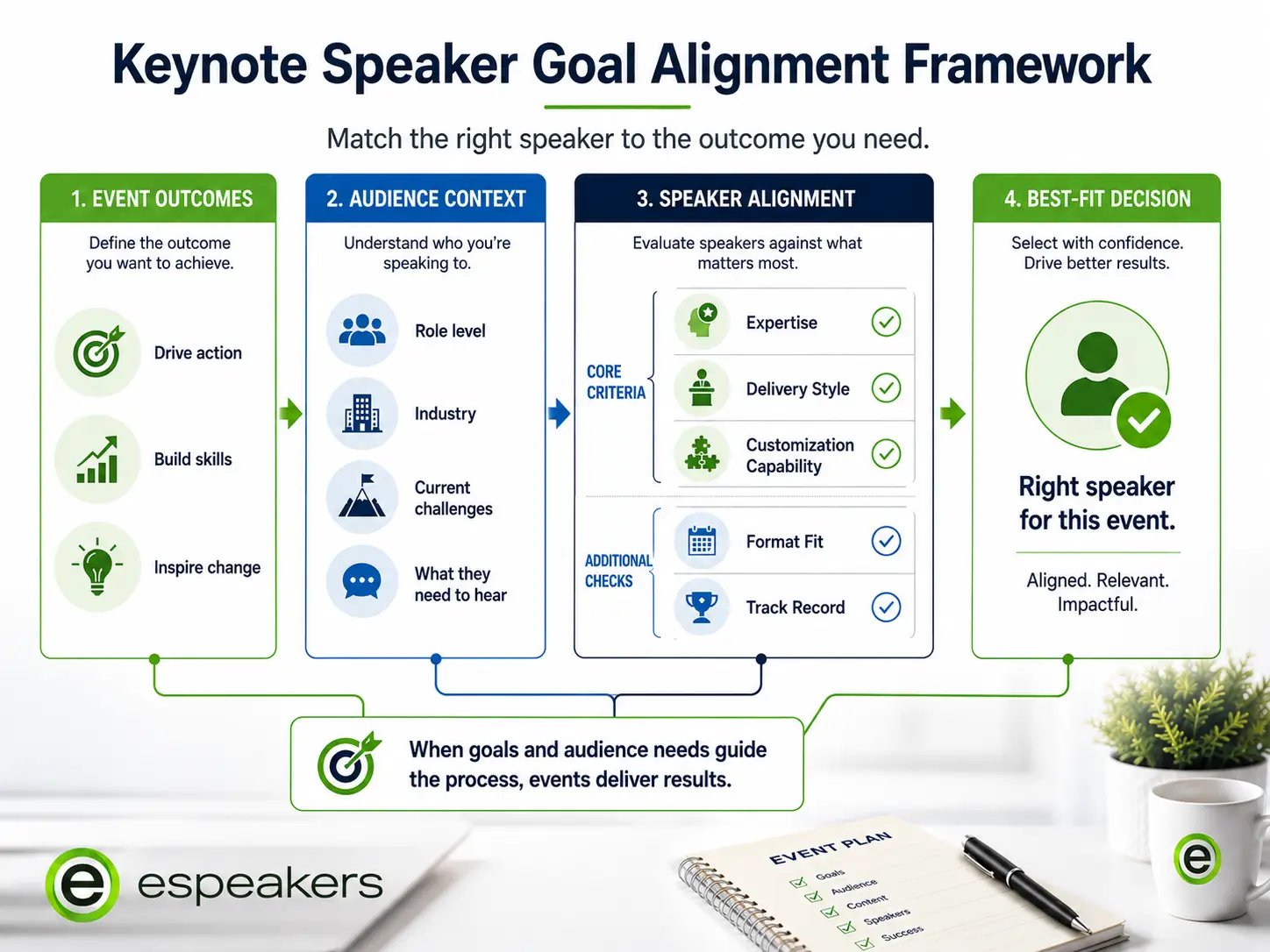
Stage 1: Define Alignment Before You Search
The most important alignment work happens before you open a speaker directory. It’s the two-question framework that should precede every speaker search.
The Two Questions That Determine Everything
Question 1: What do you want attendees to DO as a result of this event?
The operative word is do. Not feel. Not think. Not “be inspired about.” Do specific, observable, action-oriented outcomes that you can measure or at least describe.
Weak answer: “We want attendees to feel motivated about the company’s direction.”
Strong answers:
- “We want every manager to leave with a specific, written plan for a performance conversation they’ve been avoiding.”
- “We want attendees to commit to using our new CRM system and understand why it directly affects their bonus.”
- “We want our sales team to leave the kickoff with three specific prospecting behaviors they’ll implement in the first two weeks of the quarter.”
- “We want our association members to understand the regulatory change and what three specific adaptations their practices need to make in the next 90 days.”
Strong answers don’t just describe an emotional experience; they describe a behavior change. That behavior change is what you’re hiring the speaker to produce. And it’s the filter you’ll apply to every speaker you evaluate.
Question 2: What do you want attendees to do as a result of hearing this specific speaker?
This narrows the event’s purpose to the speaker’s specific contribution. It defines the role this slot in your agenda plays and what success looks like for this particular presentation.
The answer to Question 2 becomes the brief you share with every speaker candidate, and their response to it tells you whether they understand what they’re being asked to do and whether they’re capable of doing it.
When you can answer both questions specifically and confidently, you have an alignment filter that the eSpeakers search algorithm can’t replicate. You know not just what topic you need, but what outcome you’re hiring the speaker to produce.
The Audience Profile: The Context That Completes the Filter
The third piece of the pre-search alignment framework is a specific audience profile. “Corporate employees” is not a useful profile. Here’s what is:
- Functional identity: Who specifically is in the room? Directors and above? Frontline managers? Sales representatives? An association’s entire membership? Mixed levels?
- Domain expertise: What do they know about this topic? Expert-level professionals who would be bored by a 101-level keynote, or general employees who need the foundational context before the advanced application?
- Current situation: What’s happening in their organizational world right now that’s relevant? A recent restructuring? A new strategic direction? A challenging competitive environment? A morale problem after a difficult year?
- Potential skepticism: What are they likely to be resistant to, skeptical about, or unwilling to hear? A speaker who doesn’t account for this will hit it and lose credibility with the audience at the moment they need it most.
- Engagement preference: Do they prefer interactive, participatory formats, or structured, high-content presentations? Both have their place, but they require different speakers.
This profile is the audience context that every speaker needs to align their content effectively. It’s also the lens through which you’ll evaluate every candidate: not “is this a good speaker?” but “is this speaker right for this audience?”
Stage 2: Aligning Your Speaker Type to Your Event Goals
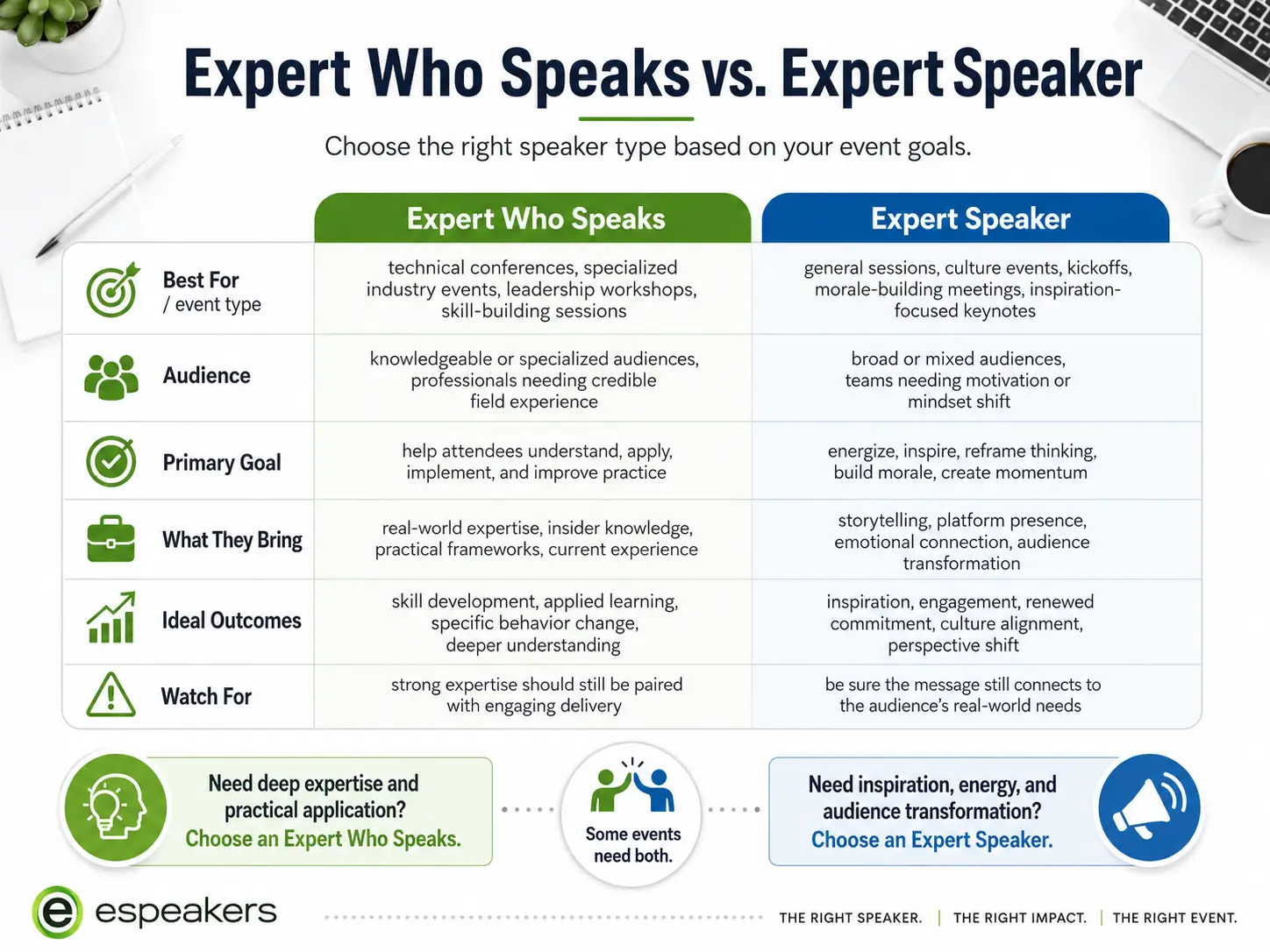
One of the most useful distinctions the Smooth Sailing ebook makes, and one that planners frequently overlook, is the difference between an Expert Who Speaks and an Expert Speaker. The right choice depends directly on your event goals.
Expert Who Speaks: When Your Goals Require Depth
An Expert Who Speaks has real, current, professional experience in the field they present on. They speak from what they’ve done, not what they’ve studied. Their credibility comes from having navigated the situation your audience is currently facing, and their content reflects the specific, insider knowledge that comes from that experience.
When to choose an Expert Who Speaks:
- Your event’s purpose requires specific, current, technical knowledge that a generalist speaker couldn’t credibly deliver.
- Your audience is sophisticated in the domain, and they’ll recognize when someone is presenting textbook knowledge vs. hard-won experience.
- The outcome you need requires behavioral change grounded in specific expertise, not just inspiration or reframing.
- You’re in a specialized industry where industry-specific examples and terminology are what make content land.
What to watch for: The world’s foremost expert in a field is a poor investment if they can’t hold a room. Technical depth without delivery skill loses audiences in the first twenty minutes. If you must choose between expertise and delivery, the most experienced planner and the Smooth Sailing ebook recommend erring toward delivery. An engaging speaker with somewhat less technical depth almost always serves your audience better than the deepest expert who can’t connect.
Expert Speaker: When Your Goals Require Transformation
An Expert Speaker is a professional communicator whose primary skill is connecting with and transforming audiences through storytelling, emotional intelligence, platform mastery, and the specific craft of changing how people think and feel. They’ve done extensive research on their topic, but they’re not current practitioners in a specific profession.
When to choose an Expert Speaker:
- Your event’s goal is primarily behavioral or attitudinal: motivation, mindset shift, resilience, culture change, team morale
- Your audience is general or mixed, not a specialized professional group that would require domain-specific expertise
- The outcome you need is inspiration plus practical application, not deep technical instruction
- You need the speaker to move a room, not just inform it
The signal for this choice: If you described your event goal and the answer involved words like “energize,” “inspire,” “re-commit,” “shift perspective,” or “build morale”, you likely need an Expert Speaker. If the answer involved words like “understand,” “apply,” “implement,” “change their practice,” or “develop skills in”, you likely need an Expert Who Speaks.
When You Need Both
Some events need both depth and transformation, a speaker who has genuinely done what they’re talking about and can deliver it in a way that moves a sophisticated audience. These speakers exist. They’re rarer and often command higher fees, but they’re exactly what flagship corporate conferences, senior leadership events, and high-stakes industry keynotes require.
When both are required, prioritize delivery quality over credential depth in your search. An engaging speaker with genuine expertise is easier to find than you might expect when you search by topic in a comprehensive keynote speaker directory and evaluate both reel quality and client reviews from similar organizations.
Stage 3: The Five Alignment Criteria for Evaluating Candidates
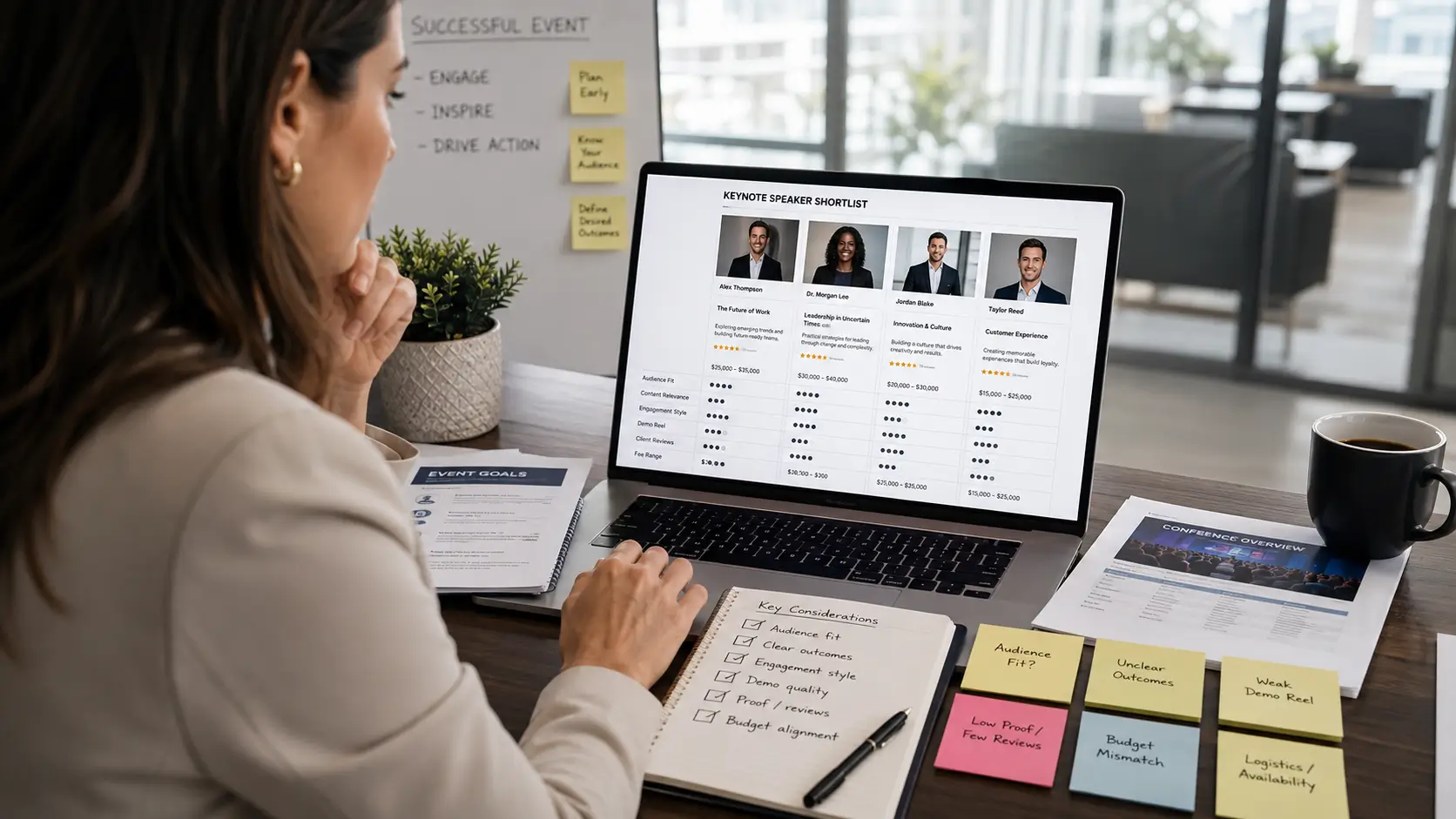
With your event goals defined and your speaker type identified, you’re ready to evaluate candidates. Apply these five alignment criteria, in order, to every speaker on your shortlist.
Criterion 1: Audience Fit, Does Their Content Match YOUR Audience’s Situation?
This is the most important alignment criterion, and the one most frequently evaluated too broadly.
The question is not: “Does this speaker cover the topic of leadership?” It’s: “Does this speaker’s leadership content address the specific challenges my audience, mid-level managers at a regional healthcare system, is actually facing right now?”
How to evaluate it:
Read the speaker’s program descriptions carefully. Do they name a specific audience and a specific problem, or do they describe their content in terms that could apply to any organization? “Leadership is about vision and execution” could be applied to anyone. “Equipping first-time managers with the frameworks to build trust and accountability in the first 90 days” is clearly for a specific type of leader at a specific career stage.
Then read their verified client reviews with your audience profile in mind. Look for reviews from organizations that resemble yours, similar industry, similar organizational scale, and similar functional audience. A speaker whose strongest reviews come from technology startups may or may not translate to a mid-size manufacturing association.
Ask directly in the discovery call: “What specific aspects of your content would you change to ensure it resonates with a group of directors and above in a regional healthcare system navigating a merger?” Their answer tells you whether they’ve thought about your audience or whether they’ll deliver their standard program with your organization’s name on the first slide.
Criterion 2: Outcome Alignment, Will Their Content Produce YOUR Specific Goals?
The most experienced keynote speakers describe their presentations in outcome terms, what attendees will be able to do, think, or commit to after the session. Look for this language in their topic descriptions and in their discovery call responses.
What to look for:
Strong outcome alignment: “Attendees will leave with a specific three-step framework they can use in their next difficult performance conversation, plus a written plan for implementing it in the week following the event.”
Weak outcome alignment: “Attendees will be inspired to think differently about leadership.”
The first is accountable to a specific result. The second is a description of what the speaker hopes audiences will feel, not what the speaker is committed to producing.
The test: Describe your event’s specific outcome goals to the speaker candidate. Ask them explicitly: “Can your program deliver these outcomes? What specifically would you include or adjust to ensure they’re achieved?” If their answer is confident and specific, with concrete content elements they’d include, that’s alignment. If their answer is vague or generic (“I always tailor to my audience”), probe for specifics or treat it as a yellow flag.
Criterion 3: Delivery Style Fit, Does Their Approach Match How Your Audience Best Receives Information?
A speaker’s delivery style needs to match how your specific audience will engage most effectively. This requires you to know your audience’s preferences before you evaluate candidates.
Delivery style spectrum:
High-energy, humor-forward: Works exceptionally well for sales kickoffs, general employee events, and annual all-hands meetings where energy and commitment are the primary goals. It can feel inappropriate or insubstantial for senior executive audiences or technically sophisticated professional groups.
Structured, content-dense: Works well for professional association conferences, technical training events, and audiences with domain expertise who value specificity over entertainment. Can feel dry or slow for general employee events that need to be energized and motivated.
Interactive and facilitated: Works well for leadership development events, team-building programs, and smaller groups where participation is feasible and appropriate. Can feel slow or inefficient for large keynote formats where one-to-many delivery is the structure.
Story-driven, emotional: Works well for events focused on culture, values, purpose, or behavioral change. Can feel light on practical application for audiences who need to leave with specific tools and techniques.
How to evaluate it: Watch the reel with your audience’s preferences in mind, not your own. Ask: “Would the people in this room respond positively to this energy, this style, this approach?” If your executives tend to be skeptical of high-energy motivational content, a standing-ovation reel from a sales conference won’t tell you what you need to know.
Criterion 4: Customization Capability, Will They Adapt for Your Specific Context?
Alignment isn’t just what a speaker does by default; it’s what they’re willing and able to do specifically for your event. Customization capability is the criterion that distinguishes speakers who are right for your audience from speakers who deliver one program to every audience.
What genuine customization looks like:
- A structured pre-event process: audience surveys, stakeholder calls, industry research, review of organizational documents
- Specific references to your organization’s situation, language, and current context are embedded in the presentation
- Content elements that are adjusted based on what the pre-event process reveals about your audience
- Examples from your industry or functional area, not generic examples that could apply anywhere
What “customization” that isn’t looks like:
- Adding your organization’s name and logo to the first slide
- Mentioning the event’s theme in the opening paragraph
- “I always tailor my content to the audience I’m speaking to,” without any specifics about how
In the discovery call, ask: “Walk me through your pre-event preparation process, specifically, what information do you collect, how do you use it, and how does it change what you present?” The answer tells you whether customization is a real commitment or a talking point.
Also, read reviews specifically for customization evidence: reviewers who experienced genuine customization will say so. “She referenced specific challenges we’d shared in our pre-event survey throughout the presentation” is verification. “Very engaging!” is not.
Criterion 5: Format and Logistics Fit, Do the Practical Requirements Align?
Even the most perfectly aligned speaker on the first four criteria is the wrong choice if the logistics don’t work. Evaluate:
Virtual vs. in-person capability: For virtual keynotes and hybrid events, look for the CVP (Certified Virtual Presenter) badge on the speaker’s eSpeakers profile; it verifies that their equipment, environment, and platform competence have been independently assessed. A speaker who excels in person may or may not translate to a virtual format, and the CVP tells you that question has been answered before you ask it.
Session length: The speaker’s primary program should match your session slot without modification. A speaker whose standard keynote is 75 minutes will need to cut significantly for a 45-minute slot, and what gets cut matters.
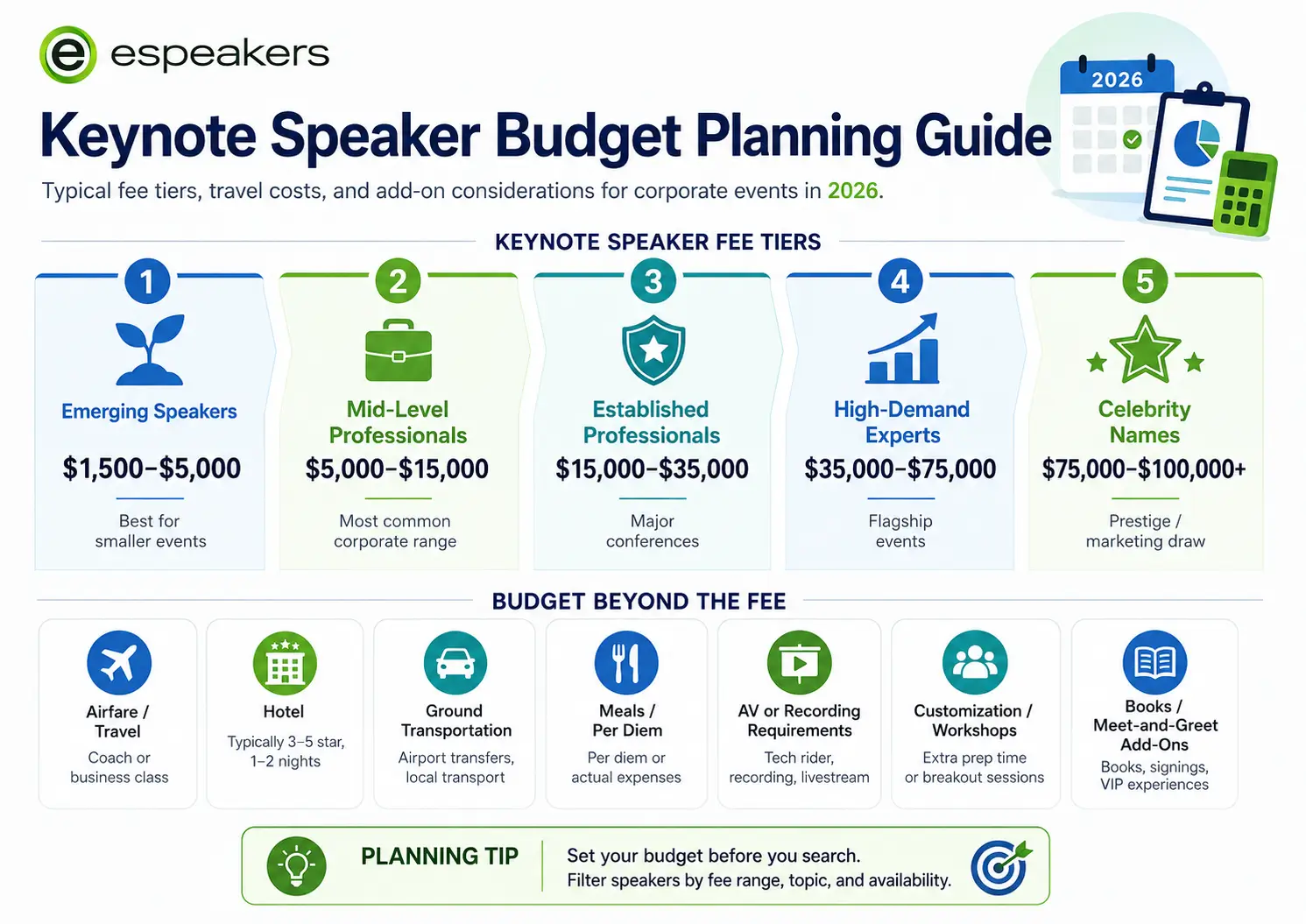
Budget: There should be no fee inquiry required before you evaluate a speaker seriously. The eSpeakers Marketplace displays fee ranges on every profile, allowing you to filter to your budget before you invest evaluation time. Don’t evaluate a speaker whose fee is significantly above your budget, hoping to negotiate down; it wastes your time and the speaker’s.
Availability: Check availability before significant evaluation investment. The eSpeakers live availability calendar tells you whether a speaker is open for your event date before you watch the reel.
Travel: For in-person events with travel budget constraints, searching for keynote speakers near your event location reduces the $2,000–$5,000 travel and accommodation cost that out-of-market speakers require. Searching “keynote speakers in [city]” via the eSpeakers location filter returns speakers who are local or regional for your event.
Stage 4: The Alignment Discovery Call
Once you’ve applied all five criteria to your shortlist and narrowed to two or three finalists, the discovery call is where you confirm or disconfirm the alignment you’ve identified on paper.
What the Discovery Call Is Really Testing
The discovery call is not primarily a logistics conversation. It’s an alignment verification, and its most important function is revealing how the speaker thinks about your audience.
The best speakers use the discovery call to learn. They ask more questions than they answer. They want to know things you haven’t volunteered yet, specific names of audience challenges, recent organizational events that are relevant context, what past speakers have and haven’t worked with this group, and what the audience tends to be skeptical about.
Speakers who use the discovery call primarily to pitch their program are telling you something important: they prioritize their content over your audience’s specific situation. That’s a misalignment signal.
The Discovery Call Questions That Reveal Alignment
On audience understanding:
– “Based on what I’ve shared about our audience, what would you specifically change about your standard program, and why?”
– “What aspects of our audience’s situation would you want to know more about before you could design the most effective presentation?”
– “What are the most common misconceptions or resistance points you encounter with this type of audience, and how do you address them?”
On the customization process:
– “Walk me through your pre-event preparation process, what do you collect, from whom, and how does it actually change what you present?”
– “Can you give me a specific example of how you adapted your content for an organization facing a situation similar to ours?”
On outcome accountability:
– “If our attendees could only walk away with one thing from your presentation, what would you want it to be, and how do you ensure they actually get it?”
– “How do you measure whether your presentation achieved its intended outcomes? What do you typically see in post-event feedback?”
On virtual delivery (if applicable):
– “For our virtual format, how do you maintain engagement throughout the session, and what interactive elements do you typically build in?”
– “What does your virtual setup look like, camera, mic, lighting, and have you gone through the CVP certification process?”
What Confirms Alignment in the Discovery Call
They ask before they answer. A speaker who responds to your description of the event by asking three follow-up questions is demonstrating the same listening orientation they’ll bring to the pre-event preparation and the presentation itself.
Their customization ideas are specific. Not “I’ll weave your theme throughout” but “Based on what you’ve told me about the merger situation, I’d want to add a segment specifically on maintaining trust during structural uncertainty, because that’s the most acute challenge your managers are likely to be facing, and it connects directly to the commitment-building content I’d cover in the first twenty minutes.”
They push back thoughtfully. A speaker who tells you something doesn’t fit, “That session length is actually too short to do justice to the interactive component I’d want to include; here’s what I’d recommend instead”, is a speaker who cares about the actual outcome, not just the booking.
They can describe specific past outcomes. Not just “the audience really loved it” but “at their 90-day check-in, the planner told me that three of the specific frameworks from the session were still in active use by the management team.”
Stage 5: Aligning Your Speaker With Your Conference Structure
Booking the right speaker is half the work. Getting the most from that speaker requires aligning their engagement with your full conference structure, before and after they take the stage.
Positioning the Speaker in Your Agenda
Different agenda positions have different audience energy profiles and different requirements:
Opening keynote: Sets the tone and creates the emotional foundation for everything that follows. Requires a speaker who can establish energy and direction from a cold start. High energy and aspirational framing work well here.
Post-lunch session: The most challenging slot, post-meal energy dip, reduced attention, and a longer day are already behind the audience. Requires a speaker with exceptional energy management and interactive elements that re-engage attention.
Closing keynote: Synthesizes and amplifies the event’s themes and sends the audience out with momentum. Should connect explicitly to what was covered in the event and provide a forward-looking frame. Requires a speaker who can build on rather than restart.
Breakout sessions: Smaller, more intimate format, often more interactive. Allows for higher content density and more participatory delivery than a main stage keynote.
Share your full agenda with every speaker candidate and ask explicitly how their content relates to what comes before and after their slot. A speaker who ignores the agenda context, who treats their presentation as an independent event, will miss the cumulative impact that great conference programming creates.
Preparing Your Audience for the Speaker
The Smooth Sailing ebook makes a point that experienced planners know, but newer ones sometimes skip: the impact of a speaker’s presentation begins before they take the stage.
Attendees who know what to expect from a speaker, who have been primed with context, have seen a clip, and have been given a pre-session question to hold, engage more deeply and retain more than attendees who encounter the speaker cold.
Practical audience preparation:
- Feature the speaker prominently in all event communications, name, photo, topic title, and a specific statement of why this matters to your audience
- Include a 60-second clip from their reel in pre-event emails
- Assign a pre-event reflection: “Before attending [speaker]’s session, think about the most challenging leadership conversation you’ve been avoiding this quarter.”
- Describe the specific outcome you expect attendees to take away, not just the topic.
The research cited in the Smooth Sailing ebook is straightforward: people remember 10% of what they read, 20% of what a speaker teaches, 50% of what a speaker teaches with visual presentations, and 90% of what they do. Preparing your audience to arrive ready to engage, not as passive recipients, moves the dial from 20% to 50% and beyond.
Extending the Alignment After the Event
The best alignment doesn’t end when the speaker leaves the stage. For high-impact events, consider:
Post-event follow-up with the speaker. Many experienced speakers offer follow-up webinars, coaching sessions, or resource packages that extend the event’s impact at 30 or 60 days, often at reduced cost since the primary engagement is complete.
Building on the speaker’s framework in your programming. If the speaker introduces a model, a framework, or a set of practices, your internal leadership team can reference and reinforce it in the months after the event. This is the mechanism that turns a keynote from a one-day event into a cultural shift.
Measuring what changed. A 60-day post-event survey asking specifically about the speaker’s content, “What from [speaker]’s presentation have you actually applied?”, tells you whether the alignment was achieved and informs your next speaker selection with real data.
How to Search for Aligned Speakers on eSpeakers Marketplace
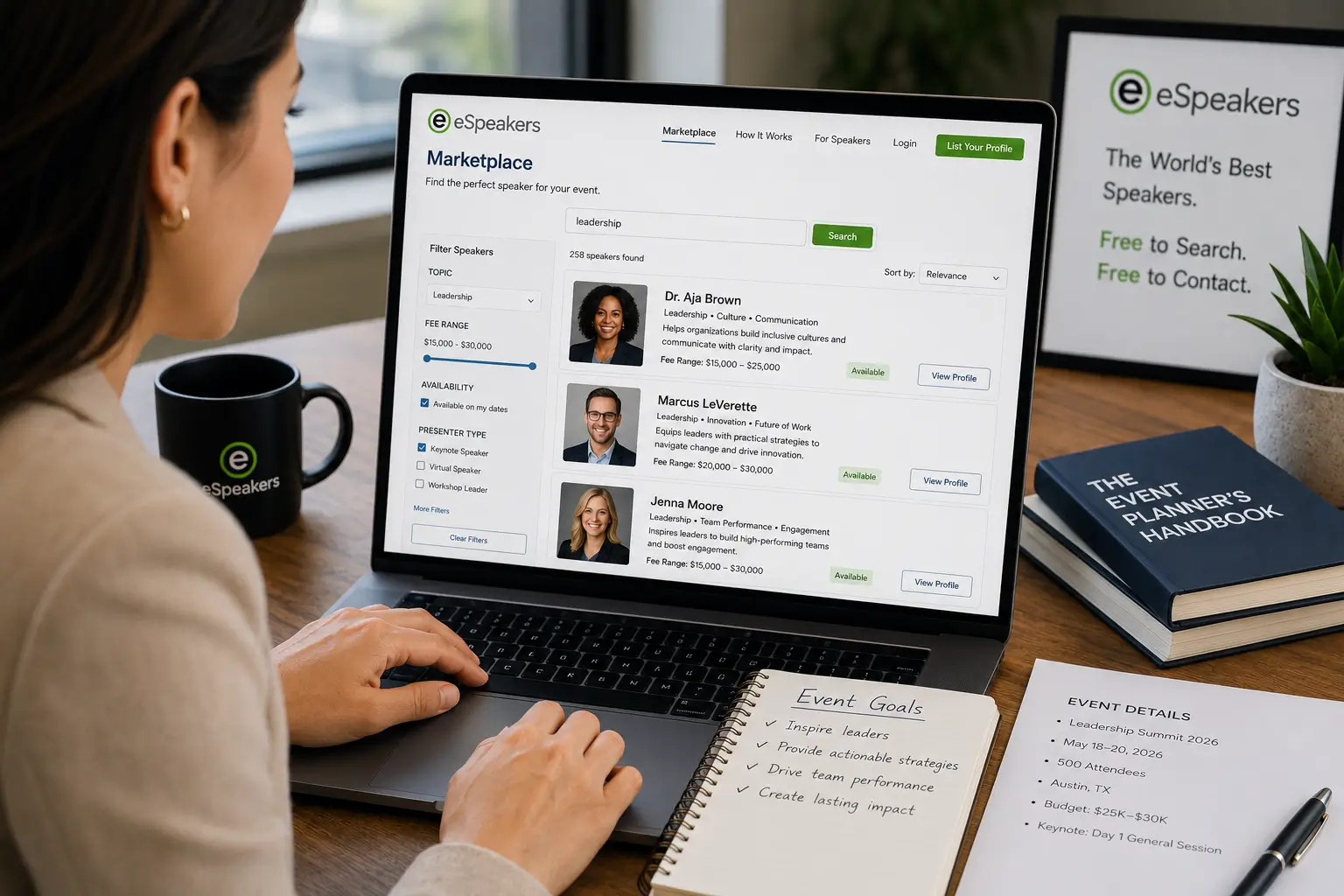
The eSpeakers Marketplace keynote speaker directory is built for alignment-driven speaker search. Every filter it offers is a proxy for one of the alignment criteria in this article.
Topic + keyword filter → Criterion 1: Audience fit
Search by the specific topic your event needs, not just “leadership” but “change management for healthcare leaders” or “employee engagement in hybrid teams.” The search returns speakers whose topic pages specifically address that combination.
Fee range filter → Criterion 5: Budget logistics alignment
Set your budget before you evaluate anyone. The eSpeakers fee range filter ensures you’re only investing evaluation time in speakers whose published rates match your available budget.
Format filter (virtual/in-person/hybrid) → Criterion 5: Format logistics alignment
For virtual keynotes, the format filter surfaces speakers who have confirmed virtual availability. The CVP is recognized by Meeting Professionals International (MPI), confirming its standing as a planner-relevant credential rather than a self-awarded designation.
Availability filter → Criterion 5: Schedule logistics alignment
Enter your event date. Only speakers who are open for that date appear. No wasted evaluation on unavailable candidates.
Location filter → Criterion 5: Travel cost logistics
For planners managing tight travel budgets, the location filter surfaces keynote speakers near your event city. “Keynote speakers in [city]” returns speakers in or near any of the top 250 US markets and hundreds of international locations.
Credential filter (CSP/CVP/VMP) → Criteria 2 and 5: Outcome credibility and format verification
CSP-holders have documented professional standards across 250+ paid engagements. CVP-holders have verified virtual delivery capability. Filtering for credentials doesn’t guarantee alignment, but it reduces the baseline risk in the field you’re evaluating.
Once You’ve Filtered: Use Reels and Reviews for Criteria 1–3
With your field narrowed by logistics criteria (budget, format, date, location), reels and reviews become your primary tools for evaluating Criteria 1–3: audience fit, outcome alignment, and delivery style fit.
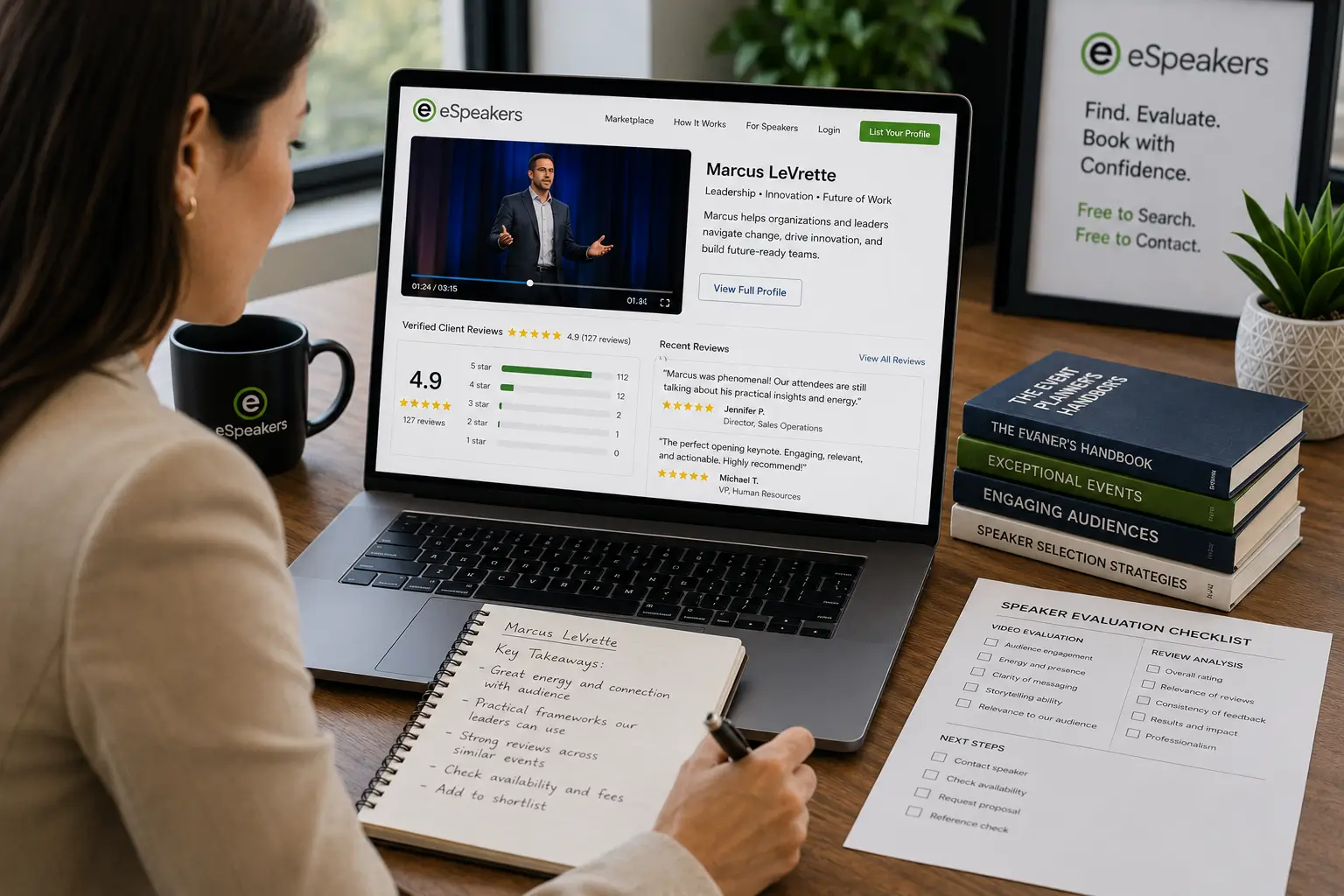
Watch the reel asking: Would this energy, this style, this content work with my specific audience? Read the verified reviews asking: Does this speaker consistently deliver for organizations like mine, with audiences like mine, with goals like mine?
The worked evaluation framework in the companion article, How to Use Speaker Reviews and Videos to Select the Right Speaker, applies directly here once you’ve applied the alignment framework from this article.
A Goal-Alignment Matrix: Match Your Event Goal to Speaker Type
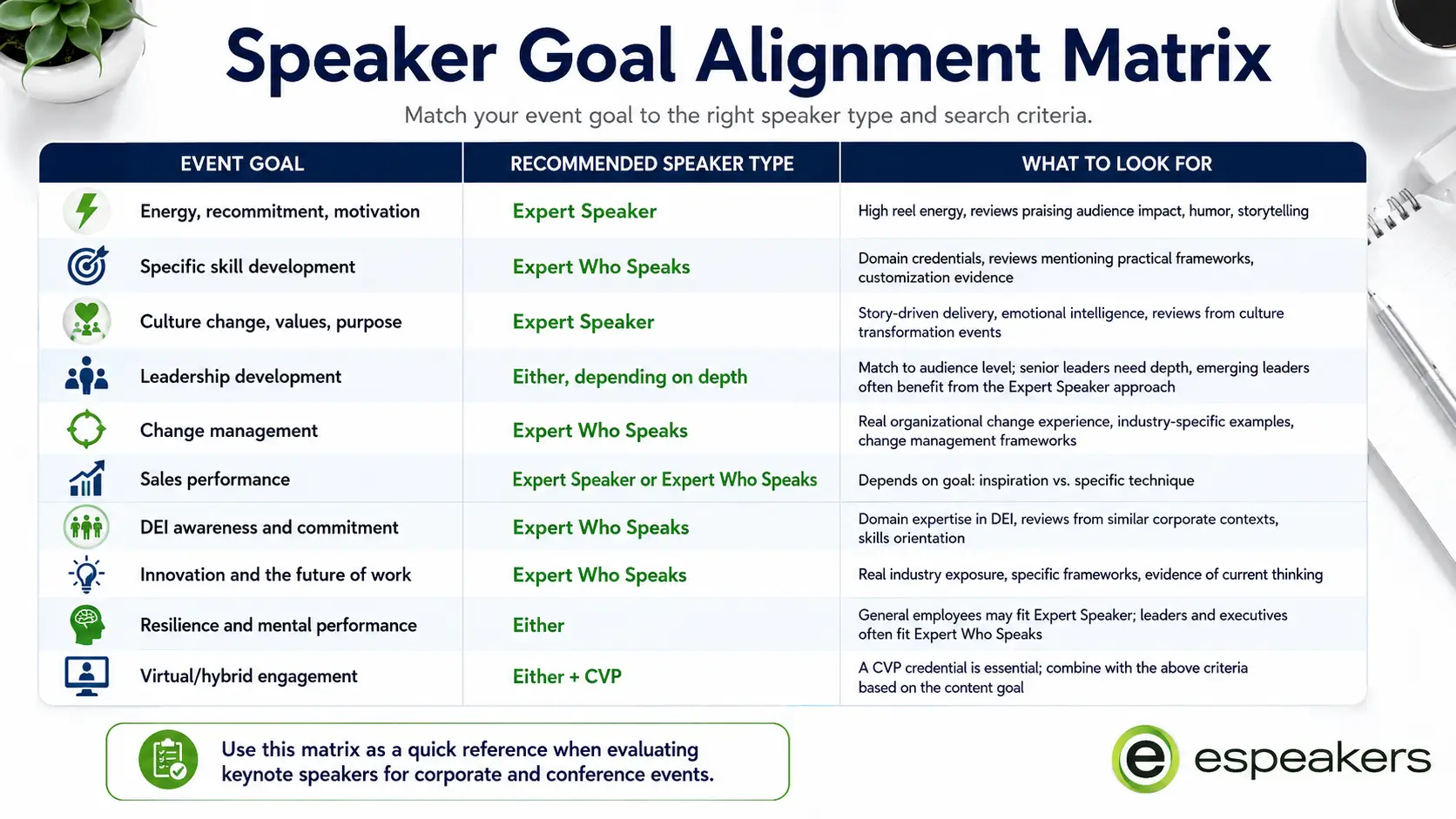
Use this as a quick reference for the most common conference and corporate event goals.
Event Goal | Speaker Type | What to Look For |
Energy, recommitment, motivation | Expert Speaker | High reel energy, reviews praising audience impact, humor, storytelling |
Specific skill development | Expert Who Speaks | Domain credentials, reviews mentioning practical frameworks, and customization evidence |
Culture change, values, purpose | Expert Speaker | Story-driven delivery, emotional intelligence, and reviews from culture transformation events |
Leadership development | Either, depending on depth | Match to audience level; senior leaders need depth, emerging leaders often benefit from the Expert Speaker approach |
Change management | Expert Who Speaks | Real organizational change experience, industry-specific examples, and change management frameworks |
Sales performance | Expert Speaker or Expert Who Speaks | Depends on goal: inspiration (Expert Speaker) vs. specific technique (Expert Who Speaks) |
DEI awareness and commitment | Expert Who Speaks | Domain expertise in DEI, reviews from similar corporate contexts, and skills orientation |
Innovation and the future of work | Expert Who Speaks | Real industry exposure, specific frameworks, evidence of current thinking |
Resilience and mental performance | Either | Depends on audience: general employees (Expert Speaker), leaders and executives (often Expert Who Speaks) |
Virtual/hybrid engagement | Either + CVP | A CVP credential is essential; combine with the above criteria based on the content goal |
FAQ
Start by defining two things before searching: what you want attendees to DO as a result of the event (specific, action-oriented outcomes), and what you want them to do as a result of the speaker specifically. Then build a specific audience profile covering who they are, what they already know, what they’re facing, and what they’re likely to resist. Use these answers as your evaluation filter when searching a keynote speaker directory, evaluating candidates not just on topic fit, but on audience fit, outcome alignment, delivery style match, customization capability, and logistics fit.
The terms overlap significantly. A keynote speaker delivers the featured presentation at an event, which may be motivational, educational, strategic, or inspirational. A motivational speaker specifically focuses on inspiring audiences to change behavior, adopt a new mindset, or commit to action. When choosing between them, focus on your event’s specific goal: if the goal is primarily behavioral and attitudinal change, motivation, morale, recommitment, a speaker with strong motivational delivery is the right fit. If the goal is specific skill development or knowledge transfer, you likely need a speaker with deeper domain expertise who can also deliver effectively.
Define your audience profile before searching, including their domain expertise, current situation, potential skepticism, and engagement preferences. Then use those criteria to evaluate speakers beyond just topic alignment. Read their topic descriptions for specific audience targeting, not generic topic coverage. Read verified client reviews from organizations similar to yours. In the discovery call, ask directly how they’d adapt their content for your specific audience and what pre-event preparation process they use. A speaker who can describe specific, concrete adaptations for your audience is demonstrating the alignment you’re looking for.
Define your event goals and audience profile first. Then search a keynote speaker directory, the eSpeakers Marketplace allows filtering by topic, fee range, format, availability, location, and credential status. Evaluate shortlisted speakers using their demo reels and verified client reviews. Conduct discovery calls with your top 2–3 finalists to verify alignment. Make your selection, share your shortlist with key stakeholders for input, and confirm the booking with a written contract that covers presentation specifics, financial terms, recording rights, customization commitments, and cancellation terms. Searching and contacting speakers through eSpeakers Marketplace is free.
The most revealing discovery call questions are: Based on what I’ve shared about our audience, what would you specifically change about your standard program, and why? Walk me through your pre-event preparation process in detail. Can you give a specific example of how you adapted your content for a situation similar to ours? If attendees could only walk away with one thing, what would you want it to be, and how do you ensure they get it? How do you measure whether your presentation achieved its intended outcomes? Speakers who answer these questions specifically and confidently are demonstrating the alignment orientation you’re looking for.
Use the fee range filter in the eSpeakers Marketplace to search only within your budget before evaluating any candidates. Emerging professional speakers, those with strong content and delivery but earlier in their speaking career, often provide excellent value at $3,500–$7,500. Local and regional speakers eliminate travel costs that can add $2,000–$5,000 to the total engagement cost. Virtual keynote speakers typically charge 20–50% less than in-person. The eSpeakers location filter helps you find speakers near your event city, and the virtual format filter surfaces speakers available for lower-cost virtual delivery.
First clarify whether your goal is inspiration (leadership mindset, motivation, cultural values) or skill development (specific frameworks for leading teams, difficult conversations, change management). Inspirational goals favor an Expert Speaker with strong delivery. Skill development goals favor an Expert Who Speaks, someone with genuine experience leading organizations through the specific challenge your audience faces. Then evaluate candidates on audience fit for your leaders’ specific level and situation, delivery style compatibility with an executive audience, and evidence of customization in past engagements. Senior executives are sophisticated audiences who will quickly dismiss generic content.
Yes. Searching the eSpeakers Marketplace keynote speaker directory, browsing profiles, watching demo reels, reading verified client reviews, checking real-time availability, and sending inquiries to speakers is completely free for event planners. There is no account required to start browsing, no subscription fee, and no service charge for contacting speakers through the platform.
Find Your Aligned Speaker, Free on eSpeakers Marketplace.
The eSpeakers Marketplace gives you the filters, the reels, the verified reviews, and the direct contact capability to find the speaker who is genuinely right for your conference, not just topically relevant, but aligned to your audience’s specific situation and your event’s specific goals.
Searching is free. Browsing is free. Contacting is free.
→ Search Keynote Speakers for Your Conference
→ Find Leadership Speakers for Corporate Events
→ Find Motivational Speakers for Events
→ Browse Virtual Keynote Speakers
→ Find Keynote Speakers Near You
This guide was written for meeting planners and event professionals in the speaker selection phase who want a systematic, goal-driven framework for choosing the right keynote speaker. The eSpeakers Marketplace is free for planners to search and use.
Last updated: April 2026
Joe Heaps, Chief Marketing Officer at eSpeakers
Joe Heaps is the Chief Marketing Officer at eSpeakers and is responsible for creating and accelerating the company's sales & marketing strategies. He is focused on driving the company's vision of helping organizations and individuals improve in substantial, long-term ways. He believes it happens when the perfect speaker is in front of the right audience. Over 25 years in the industry, Joe’s strategic vision and leadership have propelled eSpeakers to the leading software platform for speakers, coaches, and experts.
Joe Heaps
Chief Marketing Officer, eSpeakers
Latest Articles

Related Articles