How to Use Speaker Reviews and Videos to Select the Right Speaker
Every meeting planner has been in this position: you've found several speakers who look right on paper. Their topics align with your event's goals. Their bios check the credential boxes. Their fees are within range. Now you have to choose, and the difference between the right choice and the wrong one often comes down to two things that exist before the first phone call: the speaker's demo reel and their client reviews.
Used casually, reels and reviews give you a general impression. Used systematically, they give you something much more valuable: a reliable predictor of whether this speaker will actually work with your specific audience at your specific event.
This guide teaches you how to use both, with specific evaluation criteria, questions to ask, red flags to recognize, and green flags that signal a speaker worth pursuing. It also explains why the eSpeakers Marketplace keynote speaker directory is designed specifically around these two evaluation tools, and how to use them together to make a faster, more confident booking decision.

John Doe
Chief Marketing Officer at eSpeakers
Watch reels and read verified reviews, free on eSpeakers.
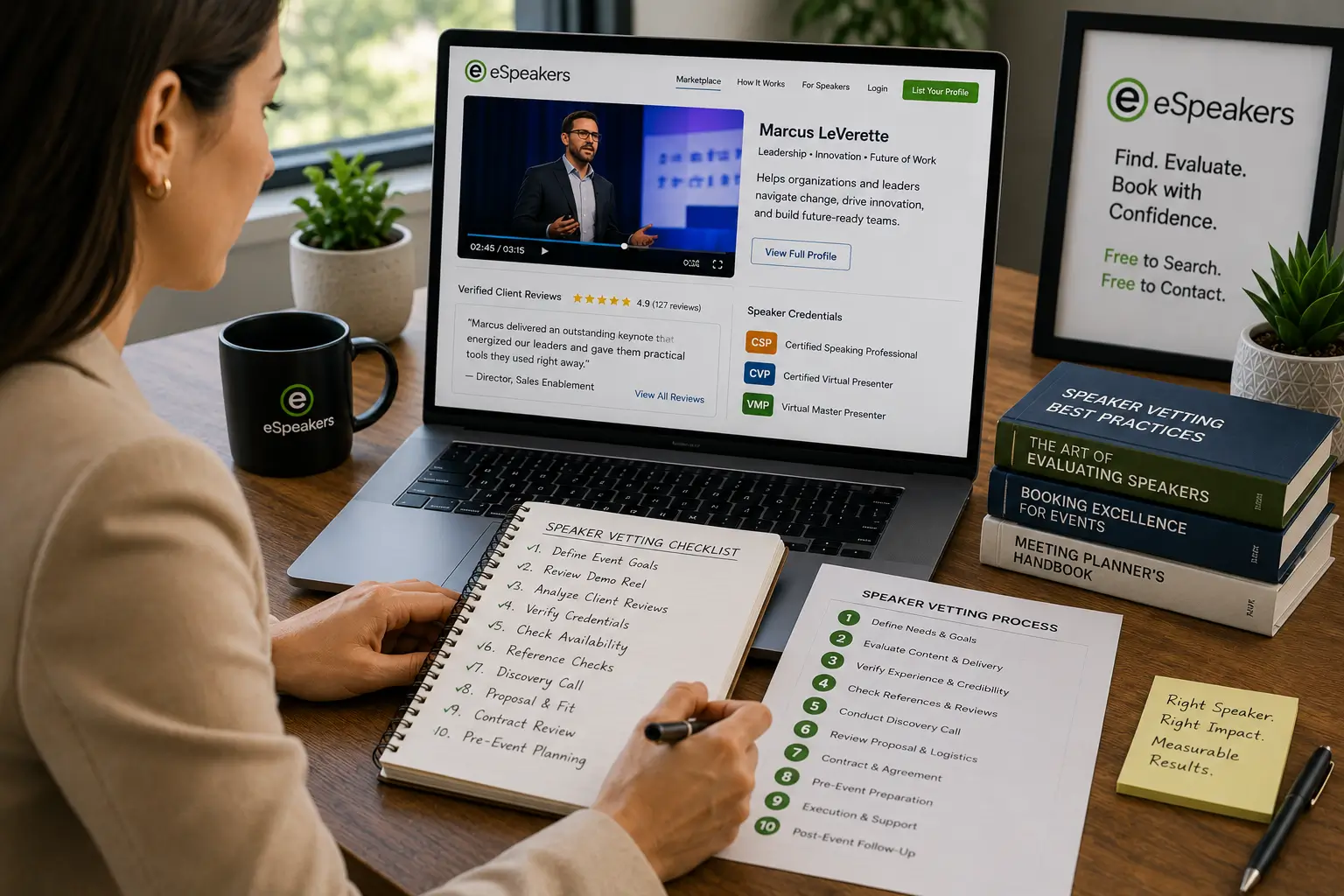
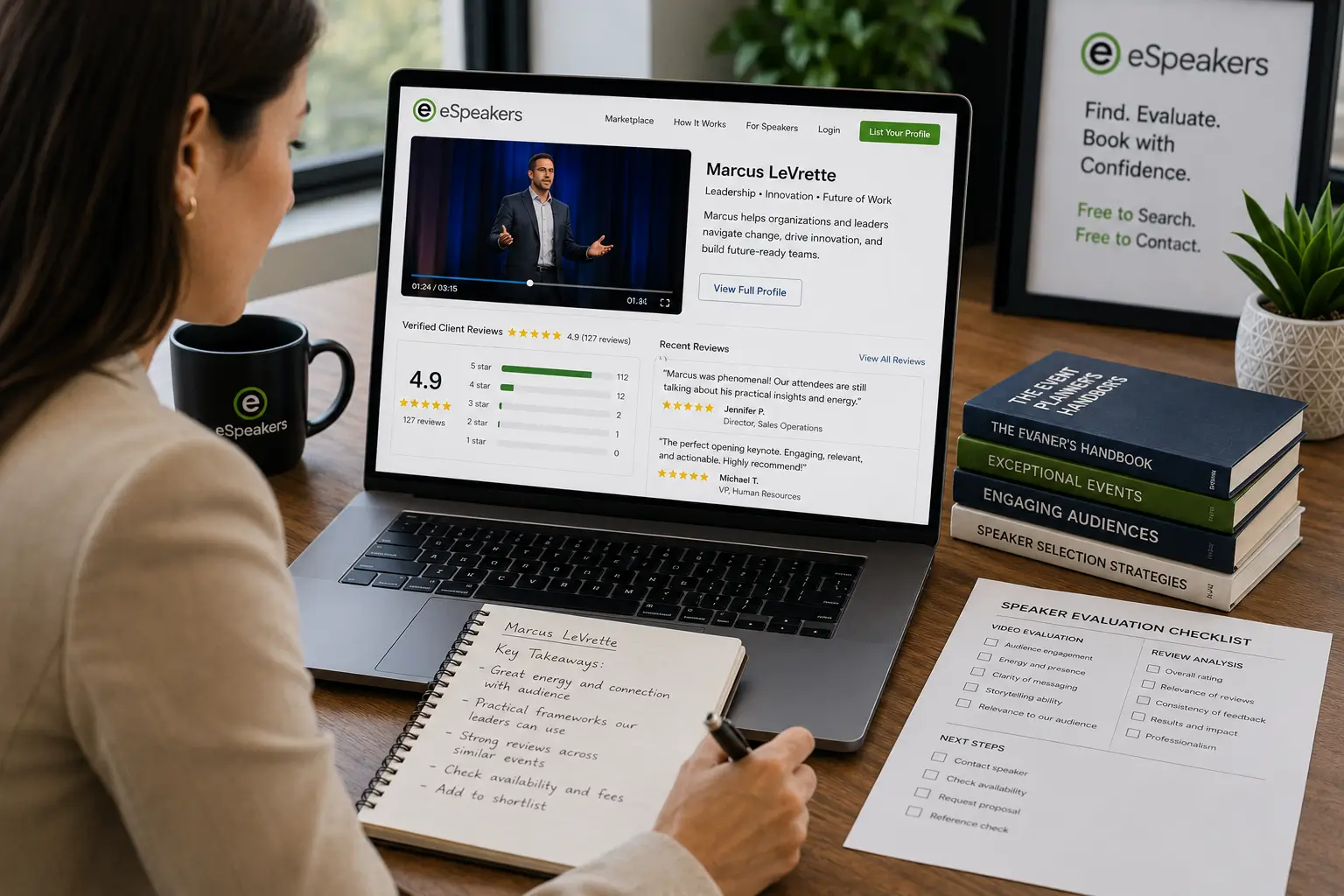
Every speaker profile on the eSpeakers Marketplace includes an embedded demo reel, verified client reviews submitted by real planners, live availability, and fee ranges. Apply the evaluation framework in this article directly to your shortlist, no account required.
Why Reels and Reviews Are Your Most Reliable Pre-Booking Signals
Before we get into the how, it's worth understanding why these two sources matter more than almost anything else in the speaker evaluation process.
Pipeline conversion rate by source
Speaker bios are written by the speaker. They're accurate; professionals don't fabricate credentials, but they're curated. The information in a bio is the best version of the speaker's professional story, not the most useful version for a planner trying to decide if this speaker will land with their audienceProgram descriptions are useful for identifying topical alignment, but they don't tell you how a speaker delivers that content, whether they connect with audiences, or whether their depth on the topic is genuine or surface-level.Fees tell you whether a speaker is in your budget. They don't tell you whether the investment is worth it.Reference calls are the gold standard, but they come after you've already narrowed your field significantly, and they're limited by what past planners are willing to say on the record.
What Reels and Reviews Actually Show You
The demo reel is the closest thing to watching a speaker perform before you hire them. It shows you delivery quality, energy, audience reaction, storytelling style, content depth, and, critically, whether this speaker's particular way of being on stage would work with your particular audience.Verified client reviews show you how the speaker's performance has actually landed with real planners who hired them for real events. Not what the speaker says about themselves. Not what a bureau says to move a booking. What the person sitting in your chair, evaluating a speaker for an event they were responsible for, experienced, and chose to document.Together, a demo reel and a body of verified reviews give you a picture of a speaker that no other pre-booking source can match. The eSpeakers Marketplace keynote speaker directory is built around making both of these available, in one place, for every speaker in the database.
Part 1: How to Evaluate a Speaker’s Demo Reel
The Biggest Mistake Planners Make When Watching Reels
Most planners watch a speaker’s demo reel focused on the speaker. They’re evaluating delivery style, stage presence, vocal quality, and content. All of those things matter, but they’re the wrong primary focus for the first two minutes.
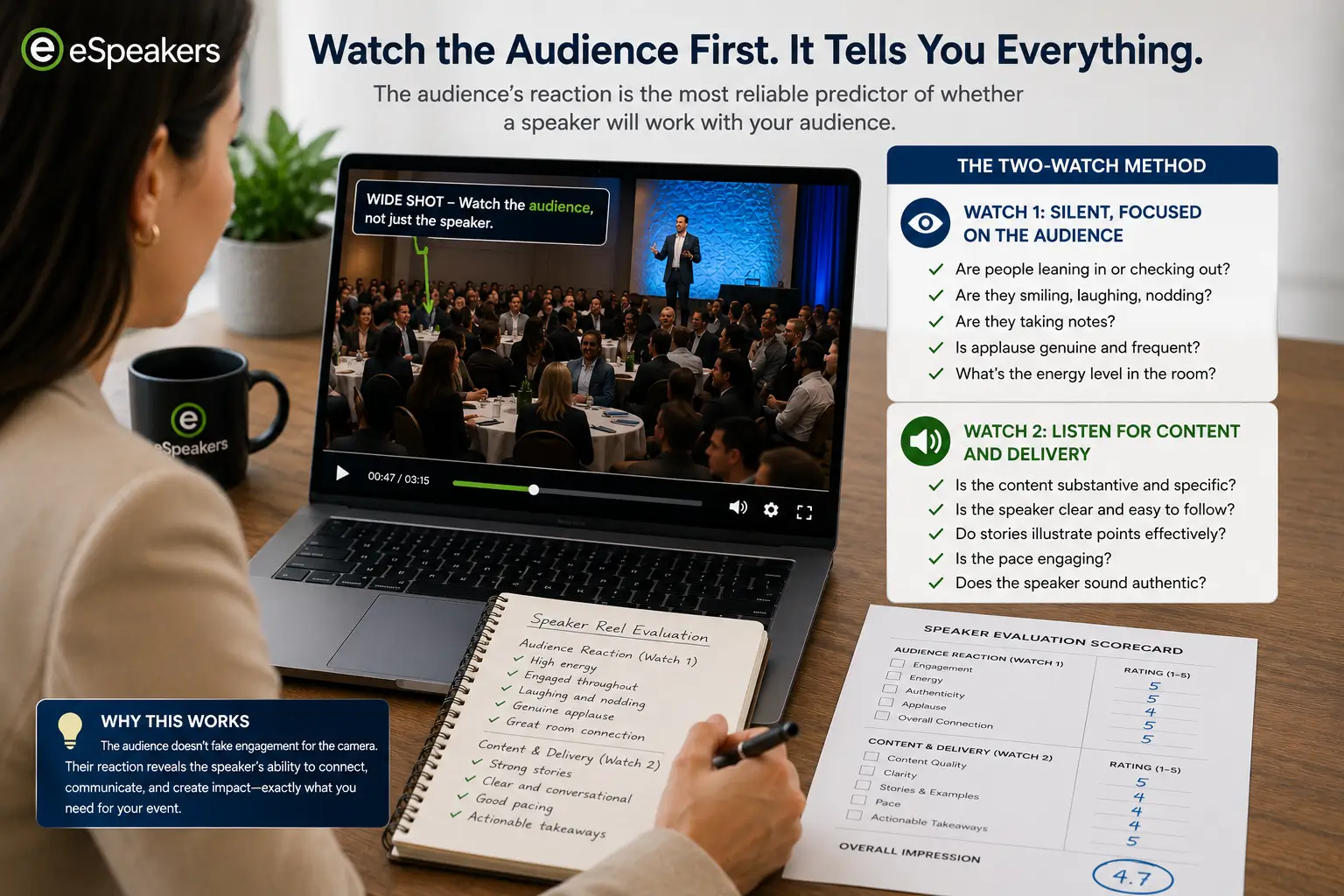
Watch the audience first.
The audience’s reaction to a speaker is the most reliable single indicator of whether that speaker will work with your audience. A speaker can have impeccable delivery, compelling content, and an impressive bio, and still not move a room. Conversely, a speaker with a simpler style and fewer credentials can generate visible, authentic engagement that tells you everything about what they’re actually capable of.
The Two-Watch Method
Watch 1: Silent, focused on the audience.
Turn the volume off, or at least redirect your attention from the speaker to the crowd. What do you see? Are people leaning forward or sitting back? Are there visible reactions, laughter, nodding, and taking notes? When the camera pans the room, does the audience look engaged or politely present?
After this watch, you should have a clear gut-level answer to: did this speaker hold this room?
Watch 2: Active evaluation against specific criteria.
Now watch with the sound on and evaluate the speaker directly, using the criteria below.
The Reel Evaluation Criteria
Work through these systematically. For each criterion, make a simple assessment: strong, adequate, or weak.
Delivery energy and vocal variety
Does the speaker’s voice change, in pace, volume, tone, and emphasis, to match the content they’re delivering? Flat, monotonous delivery loses corporate audiences faster than almost anything else. Look for a speaker whose energy varies: slower for a poignant moment, faster for a call to action, quieter for emphasis, louder for excitement. The variation itself signals that the speaker is connected to what they’re saying, not reciting it.
Eye contact and room connection
Is the speaker looking at the audience, genuinely engaging with individuals in the room, or are they looking at slides, notes, a teleprompter, or a spot on the back wall? Real eye contact creates real connection. A speaker who delivers a technically excellent presentation while looking past their audience is a speaker whose audience will feel talked at, not talked to.
Storytelling specificity
The ebook puts it directly: look for stories about things they experienced, not stories they read about. “My research shows…” and “When I did this…” are signals of genuine expertise. Stories with specific details, names, places, numbers, and outcomes are stories that stick. Generic examples and vague anecdotes are the hallmarks of a speaker who has absorbed material without having lived it.
Red flag phrase: “Studies show that…” without any “In my experience…” to ground it.
Content depth vs. surface coverage
In 90 seconds of a reel clip, can you tell whether a speaker genuinely knows their subject at depth, or whether they know it well enough to deliver a polished-sounding version of conventional wisdom? The distinction matters enormously for corporate audiences who are often more knowledgeable about their own domain than a speaker with general expertise in that area.
Look for: counterintuitive takes, specific frameworks the speaker has developed, real data from their own work, or examples that couldn’t have come from a book.
Audience interaction quality
Does the speaker involve the audience, through questions, exercises, reflection prompts, or humor, in a way that generates genuine participation? Or does the “interaction” feel like a scripted pause that the speaker clearly intends to continue past? Genuine interaction is spontaneous and responsive. Scripted interaction is visible in how the speaker receives audience responses: they hear them, but they don’t actually use them.
The 30-second test
What happens in the first 30 seconds of the reel? The opening should be the speaker’s single most compelling moment, the hook that makes you want to keep watching. If the first 30 seconds are a logo animation, a credential recitation, or a slow build to the speaker’s subject matter, that’s information: either the speaker doesn’t have a better opening moment, or whoever built the reel didn’t know to lead with it.
Virtual presentation quality (for virtual or hybrid bookings)
If you’re evaluating speakers for a virtual keynote or hybrid event, watch specifically for a separate virtual delivery clip, not just the speaker on a physical stage. Evaluate: camera quality, audio clarity, lighting, background, and whether the speaker maintains camera eye contact (the equivalent of eye contact in a virtual setting).
The CVP (Certified Virtual Presenter) badge on an eSpeakers profile tells you a speaker’s virtual setup has been independently verified through a live assessment. The CVP is recognized by Meeting Professionals International (MPI), SMART Meetings, and SPIN, the professional organizations whose members are the planners booking virtual speakers. But even with credentialed speakers, watching their virtual footage gives you a direct look at what your virtual attendees will experience.
Reel Red Flags: What to Look For
These are the signals that warrant additional scrutiny or eliminate a speaker from consideration:
No audience footage
A reel with only talking-head footage, the speaker to camera, no live event footage, is a significant red flag. It usually means either the speaker doesn’t have footage from live events, or their live event footage isn’t strong enough to include. Neither is reassuring.
All footage from a single event
If every clip in a reel comes from the same conference or the same setting, you have one data point, not many. Ranging across different audiences, different event sizes, and different venues tells you the speaker can adapt. Single-source footage tells you they had one good day.
Heavily produced visual package compensating for delivery.
When a reel has exceptional production, cinematic b-roll, dramatic music, slick transitions, but the actual speaker footage is sparse or unremarkable, the production budget may be doing work the speaker can’t do on stage. Strip away the polish and ask: Is there a compelling speaker underneath it?
Reading from slides or notes during the reel
If a speaker reads from their slides in their demo reel, in the footage they chose to represent their best work, assume this is standard. Slide-reading speakers lose corporate audiences in the first ten minutes.
Generic content that could apply to any audience
If you watch a reel and think, “I have no idea what kind of organization or audience this speaker works with best,” that’s a problem. The best corporate keynote reels give you a clear sense of who this speaker is and what they specifically do for that audience.
Reel Green Flags: What Confident Bookings Look Like
Authentic audience reaction in wide shots
Genuine laughter, visible head-nodding, people writing things down, attendees clearly moved by a moment. These signals can’t be faked in a wide shot, and they’re the most reliable single indicator of a speaker who is genuinely effective.
Specific, personal stories with vivid detail
“When I was running my third company, and we had to lay off forty people…” is a story. “Research shows that difficult decisions require courage…” is a sentiment. Stories you can’t make up because they’re too specific are stories that build trust.
A speaker who is clearly comfortable, not performing
The best speakers on stage look like they’re having a conversation with the room, not delivering a performance to an audience. Comfort and genuine engagement are visible even in short clips.
Evidence of customization
References to the specific organization, industry, or event, “What I heard from many of you in the pre-event survey…” or “Your CEO mentioned in the opening session…”, are the highest possible signal that this speaker does real preparation work.
Part 2: How to Evaluate Speaker Reviews
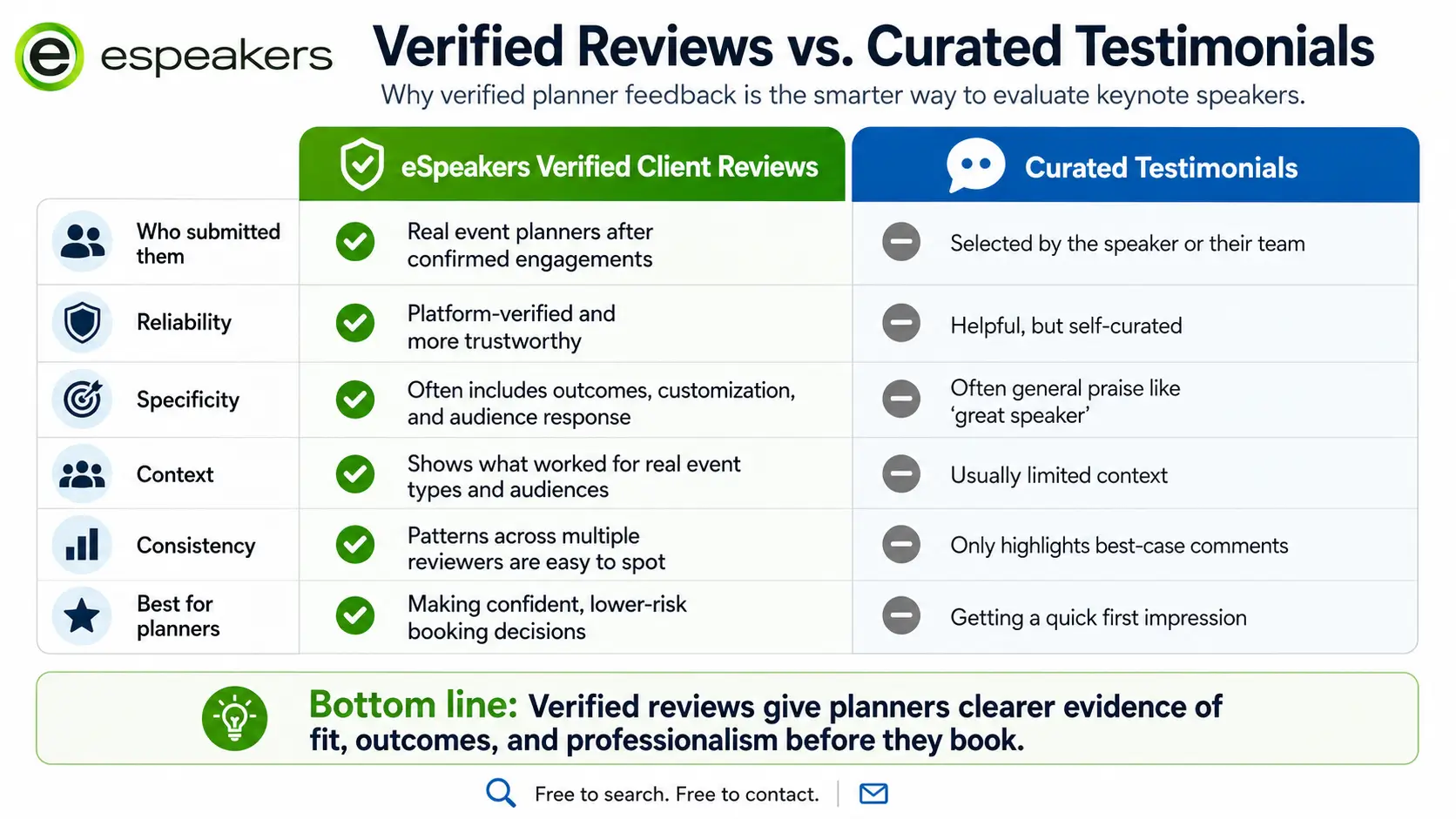
Reviews are where you get the planner’s eye view of a speaker, the experience from the chair you’re sitting in, written by someone who made the same decision you’re about to make.
Curated Testimonials vs. Verified Reviews: The Difference That Matters
There are two categories of speaker review, and they are not equally valuable.
Curated testimonials are quotes selected by the speaker (or their team) and displayed on their website or bureau page. These are almost always positive, they’re chosen specifically because they’re positive, and they’re typically vague: “Wonderful speaker!” “Our audience loved it!”,e’d hire them again!” They’re not false, but they tell you very little because you’re reading the best 1% of what past clients said.
Verified platform reviews are assessments submitted by planners through a booking platform. In the case of eSpeakers Marketplace, reviews are submitted after confirmed engagements. They’re not curated by the speaker. They represent a fuller picture of client experience, including the specific moments that worked and, occasionally, the caveats that a curated testimonial would never include.
When you’re searching a keynote speaker directory and reading reviews, always note whether you’re reading curated testimonials or verified platform reviews. The difference in reliability is significant.
The Five Questions to Ask When Reading Reviews
Don’t read reviews passively. Work through these five questions for each speaker on your shortlist.
Question 1: Are the reviews specific or generic?
Generic review: “Great speaker! Everyone loved it. Would definitely book again.”
Specific review: “Sarah’s framework for navigating manager-employee conflict was immediately applicable to what our leadership team is dealing with right now. Three of our VPs told me after the session that they’d already planned to use her three-step de-escalation model in conversations that week.”
Specific reviews tell you what actually happened. Generic reviews tell you the planner was satisfied, but not with what. A speaker with 10 specific reviews is almost always a better booking risk than a speaker with 50 generic ones.
Question 2: Do reviews mention outcomes, or only delivery?
Many positive reviews describe the experience of hearing a speaker: funny, engaging, energetic, captivating. These are real and valuable signals. But for corporate events where the goal is behavior change, skill development, or cultural shift, look for reviews that describe what actually changed:
- “Our follow-up survey showed 78% of attendees implemented at least one of her frameworks within 30 days.”
- “We’ve seen measurable improvement in our cross-team collaboration since the event.”
- “Our post-event NPS score was the highest we’ve recorded in eight years.”
Delivery quality gets people to enjoy a presentation. Outcome evidence gets you a budget approval for the next one.
Question 3: Is there consistency across reviews?
Read all available reviews, not just the most recent or most prominent ones. Look for patterns:
Consistent strengths: Multiple reviewers mention the same thing, customization, specific content moments, audience engagement at a specific exercise, without seeming to coordinate. Consistency is the signal that you’re seeing something real, not an outlier.
Consistent caveats: If three out of twelve reviews mention that the speaker needed more lead time to prepare, or that the content ran long, or that the pre-event communication was slower than expected, those patterns are information. Not disqualifying, but worth raising in the discovery call.
Inconsistency: A mix of very strong and very weak reviews for the same speaker can indicate variable performance, a speaker who is exceptional when well-briefed and mediocre when not. That’s still useful information: it tells you the briefing process matters a lot for this particular speaker.
Question 4: Do reviews come from organizations like yours?
A keynote speaker directory with verified reviews gives you some ability to assess whether past clients resemble your organization. Look for:
- Industry markers: “our healthcare conference,” “our national sales kickoff,” “our association annual meeting.”
- Organization size signals: Fortune 500 clients vs. regional associations vs. small business events
- Audience role descriptions: “our frontline managers,” “our executive team,” “our 800 sales representatives.s”
A speaker who consistently delivers for corporate audiences similar to yours is a meaningfully lower risk than a speaker whose reviews all come from different contexts. The eSpeakers Marketplace keynote speaker directory often includes organizational context in reviews, giving you this signal directly.
Question 5: What do reviews say about customization and preparation?
This is the most predictive question for corporate event success. Look specifically for any mention of:
- Pre-event research, check that the speaker did
- Audience surveys or stakeholder calls, the speaker initiated
- Specific organizational references made during the presentation
- Evidence that the content was adapted vs. delivered generically
Reviews that say “she clearly did her homework” or “he referenced specific challenges we’d shared in our pre-event call throughout the presentation” are the highest-value signals a review can contain.
Reviews that say “great content but could have been more tailored to our specific situation” are equally valuable. They tell you this speaker’s default is to deliver their standard program without extensive customization, and that to get tailored content, you’ll need to invest significantly more in the briefing process.
Reading Between the Lines: What Reviews Don’t Say
Pay attention to what’s absent as much as what’s present.
No mention of customization in any review: This speaker may not customize significantly. Strong generic delivery, but the content likely won’t reference your organization’s specific situation.
No mention of audience interaction: The speaker’s default may be to present rather than facilitate. For audiences that expect participation, this could be a problem.
Reviews only from the same event type: A speaker with only association conference reviews may not have experience with corporate formats. Worth confirming directly.
Very few reviews for a speaker who has been active for many years: Either they don’t often book through platforms with verified review systems, or client satisfaction is not consistently high enough to generate voluntary reviews.
Part 3: Using Reels and Reviews Together
The most reliable speaker evaluation process uses reels and reviews in sequence, each informing how you interpret the other.
The Sequence That Works
Step 1: Start with the reel (first 60–90 seconds)
The first watch is a gut-level filter. Does this speaker hold a room? Would this energy work with my audience? Can I imagine them in front of my leadership team, my sales force, my association members?
If the answer is yes, continue.
If the answer is no, the reviews rarely change it.
Step 2: Read the reviews before the second reel watch
What do reviewers say this speaker does well? What moments do they reference? What outcomes do they describe? Now go back to the reel knowing what to look for, and you’ll see the reel differently, more specifically.
Step 3, Second reel watch with the review context
Is the thing reviewers consistently praise visible in the reel? A speaker whose reviews consistently mention “incredible customization” should show evidence of customization in the reel, references to the event or organization, and specific audience references. A speaker whose reviews praise their humor should have moments in the reel where the room genuinely laughs.
Step 4, Identify the questions the reel and reviews raise
What’s missing from your assessment? What would you need to know that neither the reel nor the reviews answer? These become the questions you bring to the discovery call.
When Reels and Reviews Conflict
Occasionally, you’ll find a speaker with an excellent reel but mediocre reviews, or strong reviews but an underwhelming reel. Here’s how to interpret those gaps:
Strong reel, weak reviews:
This speaker performs well in ideal conditions. The reel represents their peak. The reviews represent their average. Something about the gap between peak and average is worth understanding: are the reviews weak because the events were poorly set up, or because the speaker’s consistency is variable? A discovery call focused on what conditions produce their best work, and how much of that depends on planner preparation vs. their own, will tell you a lot.
Weak reel, strong reviews:
This speaker may have underinvested in their reel, which is common, particularly among newer professional speakers or experts who speak as a secondary activity. If the reviews from real events are consistently specific and strong, the reel may simply not capture what the speaker actually delivers in person. Worth a discovery call. Ask for raw event footage rather than the produced reel.
Strong reel, no reviews:
A new speaker, or a speaker who hasn’t been booked through platforms with verified review systems. Treat this with appropriate caution. The reel is genuinely good, but without reviews, you’re relying on a marketing asset rather than peer evidence. Weight your reference calls more heavily in this case.
Part 4: The eSpeakers Keynote Speaker Directory, Built for This Evaluation Process
The eSpeakers Marketplace keynote speaker directory is designed around the specific evaluation process described in this article. Every speaker profile provides the two primary evaluation tools, demo reel and verified client reviews, alongside the supporting information that makes them more useful.
What Every eSpeakers Profile Provides
Demo reel and video
Every speaker profile on eSpeakers includes embedded video, accessible directly on the profile without navigating to external platforms. Multiple clips may be available, including format-specific footage (in-person and virtual), topic-specific clips, and raw event footage in addition to edited reels.
Verified client reviews
Reviews on eSpeakers are submitted by planners who booked the speaker through the platform. They’re not curated by the speaker, not anonymously posted, and not filtered for positivity. They represent the verified experience of planners who sat in your chair and then wrote down what happened.
Program pages with audience and outcome descriptions
Each speaker’s keynote programs are described with specific audience targeting and learning outcomes, giving you the context to read reviews more specifically. If a review says “the content was immediately applicable,” the topic page tells you what content was being applied.
Live availability calendar
Real-time availability display means you know before reading a single review whether a speaker is available for your event date.
Fee range
Displayed on every profile, before you contact anyone. No inquiry is required to discover whether a speaker is within your budget.
Credential badges
The CSP (Certified Speaking Professional), CVP (Certified Virtual Presenter), and VMP (Virtual Master Presenter) badges display directly on profiles. For the purposes of review evaluation, credentialed speakers have been peer-reviewed and assessed against professional standards. CSP-holders in particular have submitted to video review by NSA peers, meaning their delivery quality has already been independently evaluated.
How to Search the Directory for Your Specific Criteria
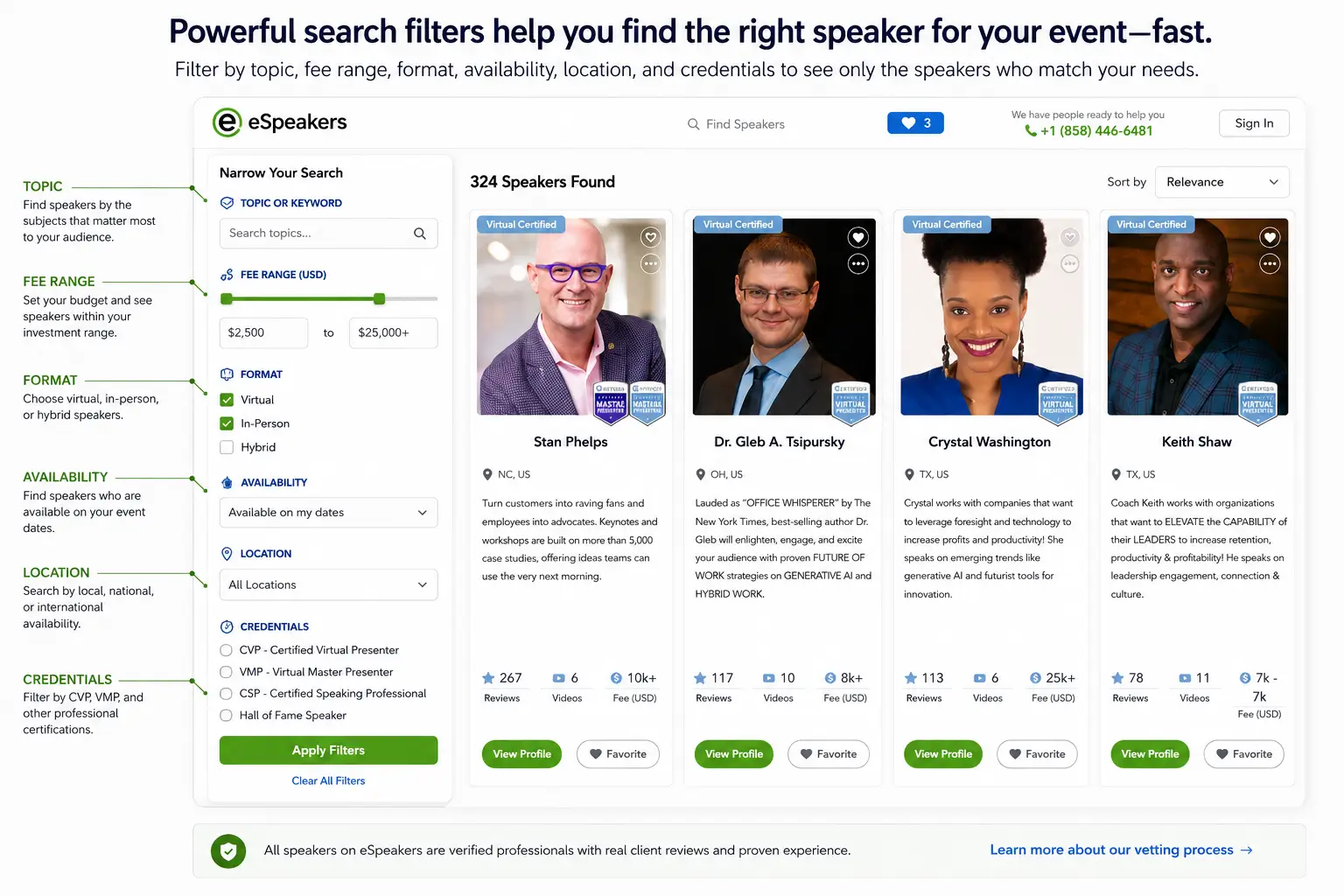
The eSpeakers search allows you to combine filters to narrow the field before you begin real and review evaluation:
- Topic + keyword, Match to your event’s theme
- Fee range, Budget filter before evaluation investment
- Format: Virtual, in-person, or hybrid
- Availability, Your event date
- Location, for local speaker searches
- Credential status, CSP, CVP, VMP
A filtered search returns a shortlist of speakers who meet your basic criteria. Reel and review evaluation then tells you who among that shortlist is the right fit for your specific event.
Practical Application: A Worked Example
Here’s how the full evaluation process works for a specific scenario.
The event: Annual leadership summit for a regional healthcare system. 200 leaders, directors, and above. Theme: Navigating organizational change while maintaining team morale and performance. Budget: $12,000–$18,000. Format: in-person. Date: six months out.
The search: eSpeakers Marketplace, filtered for “change management,” fee range $10,000–$20,000, in-person, available on the event date. Returns 12 candidates.
Reel evaluation, first pass:
Watch the first 60 seconds of each reel with the sound off, audience-focused. Three candidates immediately show visible audience engagement, genuine reactions in wide shots. Three more look promising but less certain. Six are eliminated in the first pass.
Review evaluation for the six remaining:
Read all verified reviews for each speaker. Two patterns emerge:
- Speaker A has eight reviews, six of which specifically mention customization. Three reviewers reference the speaker making specific organizational references during the presentation. Two reviews come from healthcare contexts.
- Speaker B has twelve reviews, all positive but generic. No mention of customization in any review. No healthcare context reviews.
Speaker A moves to the top of the shortlist. Speaker B drops.
Second reel watch, Speaker A:
Now watch their reel, specifically looking for the customization the reviews mentioned. There it is: the speaker references “the conversation I had with three of your department heads this morning” and “what I heard in your pre-event survey about the biggest challenge your managers are facing right now.” The reviews and the reel confirm each other.
Discovery call prep:
Questions arise from there. Review assessment: Reviews mention customization. What does that process specifically look like for this speaker? Reviews are all from non-healthcare organizations. How familiar are they with healthcare culture and the specific challenges clinical and administrative leaders face?
Outcome: The discovery call answers both questions satisfactorily. The speaker’s process involves a 90-minute stakeholder call, an audience survey, and industry research. They’ve worked with three health systems in adjacent states. The booking moves forward.
This is the process. It takes less time than traditional research, produces more confidence than gut feel, and results in fewer post-event regrets.
The Planner’s Reel and Review Evaluation Checklist
Use this as your working reference for evaluating speakers through reels and reviews.
Reel Evaluation
- Watched the first 60 seconds, focused on the audience, not the speaker
- Evaluated audience engagement: forward lean, visible reactions, authentic response
- Assessed delivery: vocal variety, eye contact, no slide-reading
- Evaluated storytelling: specific personal stories vs. generic examples
- Assessed content depth: counterintuitive, specific frameworks, genuine expertise
- Evaluated interaction quality: authentic vs. scripted
- Noted the 30-second hook: compelling or slow?
- For virtual bookings: evaluated camera quality, audio, lighting, eye contact
- Identified red flags: no audience footage, single event only, reading from slides
- Identified green flags: authentic reactions, specific stories, customization evidence
Review Evaluation
- Confirmed reviews are verified (platform-submitted) vs. curated testimonials.
- Assessed review specificity: specific outcomes vs. generic praise
- Looked for outcome evidence: behavior change, measurable results, follow-up data
- Checked for consistency: patterns across multiple reviews
- Assessed organizational similarity: reviews from events like yours
- Specifically looked for customization mentions: evidence of preparation and tailoring
- Noted what reviews don’t say: gaps in topic coverage, interaction, adaptation
- Identified questions raised by reviews for the discovery call follow-up
Reel + Review Integration
- Read reviews before the second reel watch.
- Confirmed: Do reviews and reel tell the same story?
- Identified any conflict between reel quality and review quality
- Prepared specific discovery call questions based on gaps
FAQ
Start by watching the audience, not the speaker, genuine audience engagement in wide shots is the most reliable indicator of a speaker’s effectiveness. Then evaluate the speaker on: vocal variety and energy, genuine eye contact with the audience, specific personal stories rather than generic examples, evidence of content depth versus surface-level coverage, and authentic audience interaction. For virtual bookings, also evaluate camera quality, audio clarity, lighting, and whether the speaker maintains camera eye contact. Red flags include no live audience footage, all clips from a single event, and reading from slides.
The most reliable reviews are verified platform reviews, submitted by planners who actually booked the speaker through a booking platform, rather than curated testimonials selected by the speaker. The eSpeakers Marketplace provides verified reviews from planners who confirmed engagements through the platform. When evaluating any reviews, look for specificity (specific content moments and outcomes mentioned, not just general praise), consistency across multiple reviewers, and reviews from organizations similar to yours.
The most useful speaker reviews for corporate event planners are specific about outcomes (what changed as a result of the speaker’s presentation), mention customization (evidence that the speaker researched and tailored their content), come from organizations similar to yours in industry or event type, and are consistent across multiple reviewers. Generic praise like ‘great speaker’ or ‘audience loved it’ is less useful than specific descriptions of what content landed, what the audience applied, and what the speaker did in their preparation process.
Start by filtering the directory by your event’s specific criteria: topic, fee range, format (virtual or in-person), availability on your event date, and location if you need a local speaker. Then evaluate the resulting shortlist using demo reels and verified client reviews, not just bios and topic descriptions. The eSpeakers Marketplace keynote speaker directory provides all of these filtering options alongside embedded reels and verified reviews on every profile, making the evaluation process faster and more reliable than searching individual speaker websites.
A strong speaker demo reel should open with the speaker’s single most compelling moment in the first 30 seconds, not a logo animation or credential recitation. It should include live stage footage with visible audience reaction, 3–5 content clips showing delivery range and style, social proof elements such as client testimonials or recognized event names, and a clear contact CTA at the close. For virtual speakers, a high-quality virtual delivery clip should be included alongside in-person footage. Reels without live audience footage, or reels with footage from only a single event, provide limited evaluation value.
Yes. Browsing speaker profiles, watching demo reels, reading verified client reviews, checking availability, and comparing speakers on the eSpeakers Marketplace is completely free for event planners. No account is required to browse profiles, and there is no fee to contact speakers through the platform.
A speaker with a compelling reel but few or no verified reviews may be newer to professional speaking, or may not have been booked frequently through platforms with verified review systems. Treat this as a signal to weight other evaluation sources more heavily: call references directly rather than relying on platform reviews, ask for raw event footage in addition to the produced reel, and use the discovery call to probe more deeply into past engagements and client outcomes. The reel can tell you what’s possible, references and the discovery call tell you what’s consistent.
Read all available verified reviews, not just the most recent or the top-rated. Patterns emerge across a body of reviews that a sample wouldn’t reveal, consistent strengths, occasional caveats, the type of events the speaker performs best at. Research suggests that five or more specific, verified reviews provide meaningful statistical reliability for predicting performance. Fewer than five reviews warrants additional scrutiny through reference calls. The quality of reviews (specific, outcome-oriented) matters more than the quantity.
Start Evaluating Speakers, Free on eSpeakers Marketplace.
The eSpeakers Marketplace keynote speaker directory gives you every tool described in this article, embedded demo reels, verified client reviews, topic pages, live availability, and fee ranges, on a single profile, for thousands of professional speakers, at no cost to search.
Apply what you’ve learned here. Filter by your criteria. Watch with the audience in mind. Read with specific questions. Make a confident decision.
→ Search the Speaker Directory
→ Find Top-Rated Keynote Speakers
→ Browse Virtual Keynote Speakers
→ Find Corporate Keynote Speakers
→ Search Motivational Speakers for Events
This guide was written for meeting planners and event professionals who are actively evaluating keynote speakers and want a systematic method for using reels and reviews to make confident booking decisions. The eSpeakers Marketplace provides verified reviews and embedded demo reels for thousands of professional speakers, free to search and browse.
Last updated: April 2026
Joe Heaps, Chief Marketing Officer at eSpeakers
Joe Heaps is the Chief Marketing Officer at eSpeakers and is responsible for creating and accelerating the company's sales & marketing strategies. He is focused on driving the company's vision of helping organizations and individuals improve in substantial, long-term ways. He believes it happens when the perfect speaker is in front of the right audience. Over 25 years in the industry, Joe’s strategic vision and leadership have propelled eSpeakers to the leading software platform for speakers, coaches, and experts.
Joe Heaps
Chief Marketing Officer, eSpeakers
Latest Articles




Related Articles