How to Find and Hire the Right Speaker for Your Event (Complete Guide)
Hiring a speaker is one of the most consequential decisions you make as an event planner. The right speaker transforms a well-organized event into a memorable, action-generating experience. The wrong one, no matter how beautiful the venue, how excellent the food, how engaging the theme, makes the whole event feel flat.
That pressure is real. When your leadership team asks, "Who are we bringing in to keynote?" the answer you give commits budget, sets attendee expectations, and ultimately determines whether your event is referenced for years as a highlight or quietly forgotten.
This guide gives you the complete process for hiring a speaker, from knowing what you want before you start searching to getting the most out of the engagement long after the keynote ends. Whether you're sourcing keynote speakers for a corporate annual conference, motivational speakers for a sales kickoff, leadership speakers for an executive retreat, or virtual keynote speakers for a global all-hands event, every step is covered here.

John Doe
Chief Marketing Officer at eSpeakers
Start your speaker search, free on eSpeakers.
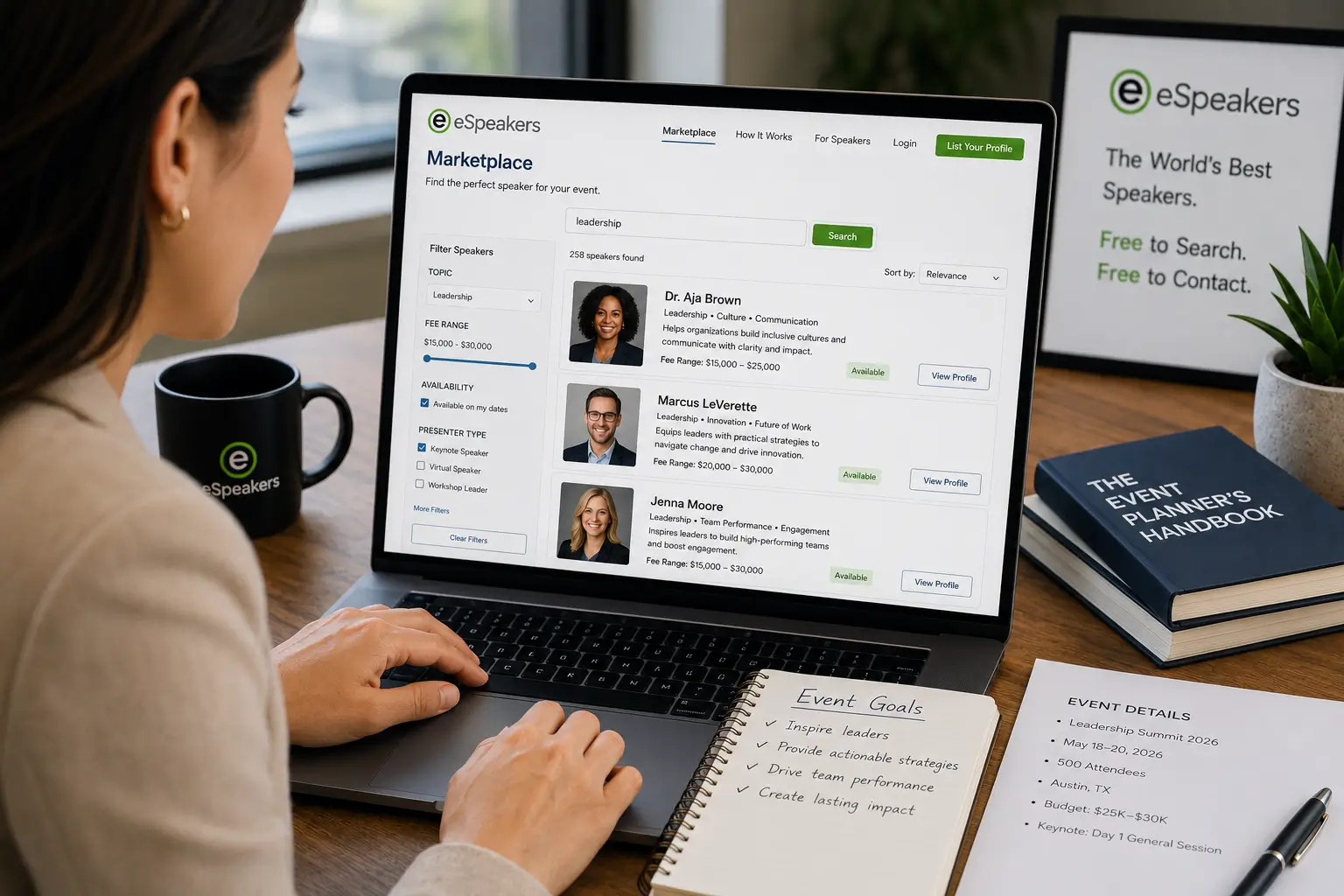
The eSpeakers Marketplace is where meeting planners find, vet, and book professional speakers for every event type and budget. Search by topic, fee, format, availability, and location. Every profile includes a demo reel, verified client reviews, and live availability. No fee to search or contact.
Part 1: Before You Search, Define What You Actually Need
The most common mistake planners make when hiring a speaker is starting the search before answering the two questions that determine everything else.
The Two Questions That Drive Every Good Speaker Decision
Question 1: What do you want attendees to DO as a result of this event?
Not feel. Not think. Do. Your event needs a guiding purpose focused on specific actions your attendees should take because they attended. Before you look at a single speaker profile, you and your event committee should be able to answer this from memory:
“The purpose of our event is to…”
Strong answers look like:
- “Ensure every attendee understands how AI tools can increase their team’s productivity by 30% and commits to piloting one this quarter.”
- “Help our sales team embrace the new CRM and leave with three concrete strategies for integrating it into their workflow.”
- “Recognize the hard work of the past year while energizing the team for a challenging Q.1.”
- “Help our leadership team build the skills to have the retention conversations that keep top performers”
Weak answers look like: “Motivate our team” or “Inspire innovation.” These are themes, not purposes. They won’t help you evaluate whether a speaker will deliver what your event actually needs.
Question 2: What do you want attendees to do as a result of hearing THIS speaker specifically?
Once you have your event purpose, define the speaker’s specific role within it. By the end of the presentation, what should attendees be able to do, feel, or commit to?
“After hearing this speaker, attendees should…”
- “Understand three specific frameworks for leading teams through organizational change”
- “Feel energized and personally appreciated, ready to approach the new quarter with renewed commitment”
- “Have committed the new company mission statement to memory.”
- “Be prepared to use the two sales conversation scripts that close enterprise deals.”
These two answers become your speaker evaluation filter. Every candidate you consider gets measured against them.
Know Your Audience Before You Search for Your Speaker
The best speaker for your event is not the most famous speaker available. It’s the speaker whose expertise, style, and message align with who will be in your room.
Build your audience profile before you open a speaker directory:
- Demographics: Industry, role level, age range, career stage
- What they already know: Don’t bring in a speaker to tell your experienced team what they already know
- What keeps them up at night: The challenges, fears, and pressures your audience is navigating right now
- What they need to hear vs. what they want to hear: Sometimes these are the same. Sometimes they’re very different.
- How they prefer to learn: Do they want tactical frameworks, inspirational stories, interactive workshops, or data-driven analysis?
This profile is the brief you give every speaker you seriously consider. Speakers who ask about it before you offer it are almost always better speakers than those who don’t.
Set Your Budget, Before You Fall in Love with a Speaker
Budget is the variable that determines your entire field of options. Don’t begin your search without a number. Don’t fall in love with a speaker before you know whether they’re in your range.
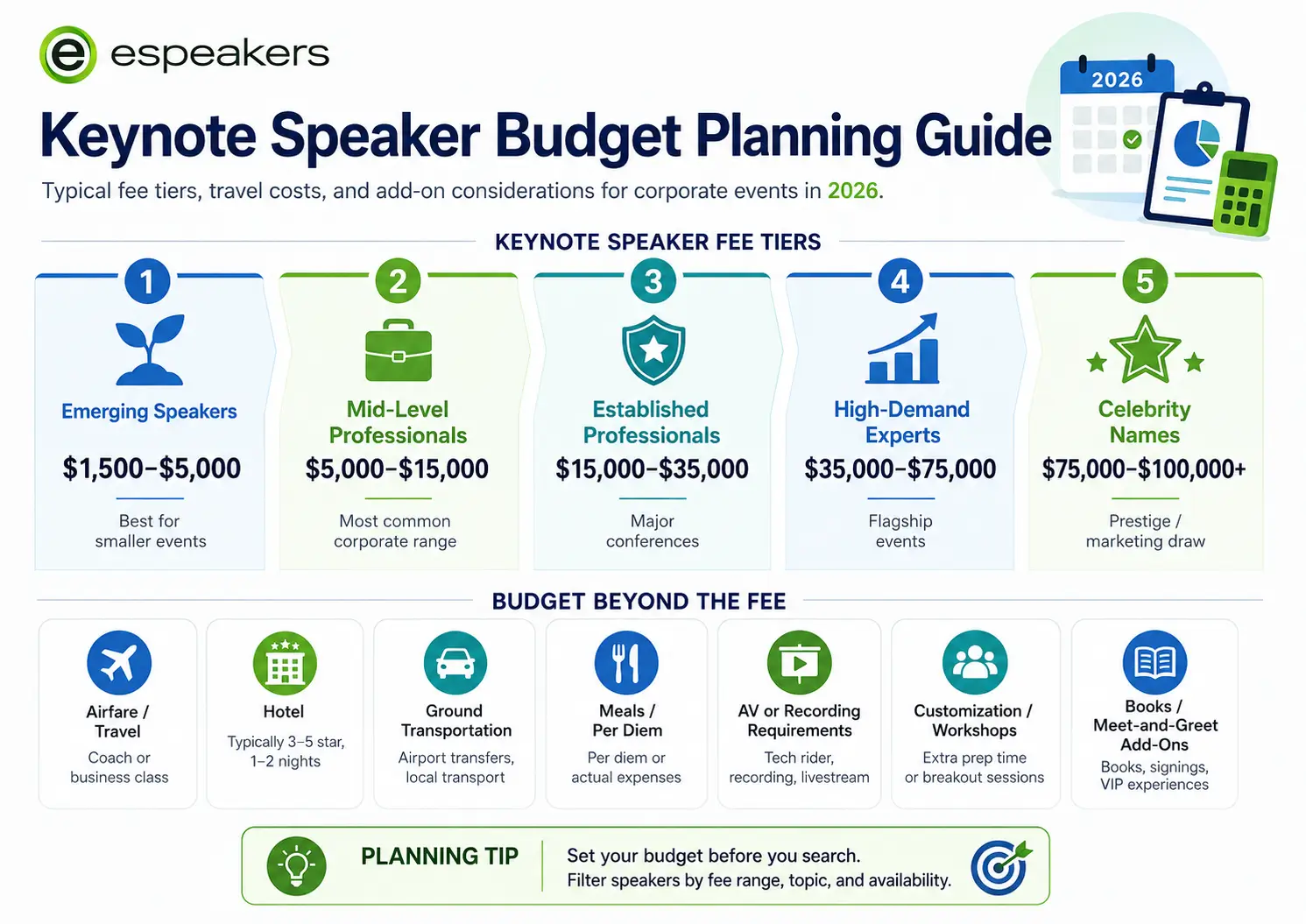
Speaker fee ranges in 2026:
| Experience Level | Typical Fee Range |
| Emerging speakers (building their career, regional recognition) | $1,500 – $7,500 |
| Mid-level professional speakers (established track record, national recognition) | $7,500 – $20,000 |
| Established professional speakers (significant credentials, bestselling books, major conference veterans) | $20,000 – $50,000 |
| High-profile and celebrity speakers (national/global name recognition) | $50,000 – $100,000+ |
What affects fees within these ranges:
- Event type: Corporate events typically carry higher budgets than nonprofit or educational events
- Customization: Speakers who do significant research and tailor charges more, and they’re usually worth it
- Format: Virtual keynote speakers typically charge 20–50% less than in-person, because travel and logistics are eliminated
- Exclusivity: Some speakers charge more for first-of-season bookings or agreements not to speak for competitors
- Add-ons: Pre-event workshop, book purchase for all attendees, post-event webinar, breakout sessions
On budget: Many planners assume that a higher fee automatically means a better speaker. It doesn’t. There are speakers charging $5,000 who will transform your event, and speakers charging $50,000 who will bore your audience. The fee is a factor in your decision, not the determinant.
Part 2: Understanding the Types of Speakers
Before you search, understand what you’re actually looking for. There are two distinct categories of professional speakers, and knowing which you need narrows your search significantly.
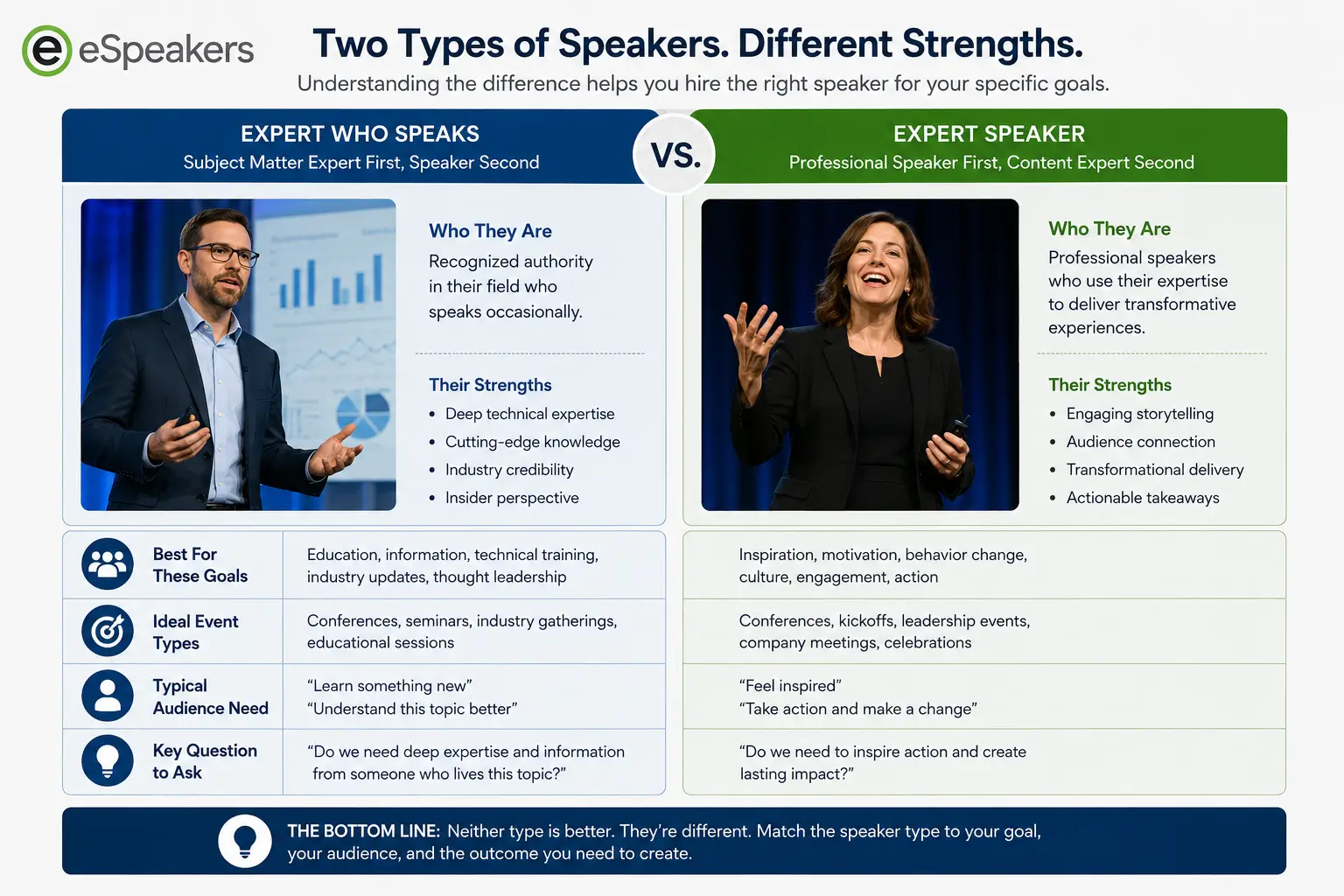
The Expert Who Speaks
An expert who speaks has real-life experience in their field and speaks from that earned knowledge. Their credibility comes from having done the thing they’re talking about, not from studying it or researching it.
When corporate speaker Scott McKain advises audiences on how to grow an organization, he speaks from running several multi-million dollar companies outside his speaking business. When a change management speaker advises on leading organizations through transformation, they’re drawing on years of having managed that transformation themselves.
Signs of a strong expert-who-speaks:
- Their bio includes active professional experience, not just speaking history
- Their stories are about things they did, not things they read about
- When you ask them about their expertise, they have more to say than you have time to hear
- They stay current in their field, and their content evolves as their industry evolves
When to hire an expert who speaks: When your event requires current, specific, industry-relevant knowledge. Sales strategy conferences. Healthcare regulatory updates. Technology implementation training. Leadership development for a specific type of leader.
The risk to watch for: A world-class expert with weak delivery skills. The most current knowledge in the room is worthless if it’s presented in a way that loses the audience. If you have to choose between expertise and delivery, most experienced planners err toward delivery.
The Expert Speaker
An expert speaker is a professional communicator first. They’ve done extensive research on their topic and can present it compellingly, but their primary skill is connecting with and engaging audiences. They may not have deep technical expertise in a specific field, but they understand human behavior, communication, storytelling, and motivation at a level that technical experts rarely match.
Signs of a strong expert speaker:
- Their demo reel shows clear audience engagement and reaction, not just smooth delivery
- They can adapt their core message for different industries and audience types
- Their past client list is varied, and they speak to different types of organizations
- They have a signature story or framework that is distinctive and repeatable
When to hire an expert speaker: When your event goals are behavioral rather than technical. Motivation, culture change, resilience, teamwork, customer service attitude, and leadership presence. The goal isn’t to teach a specific skill; it’s to shift a mindset or inspire action.
When You Need Both
Ideally, you find someone who has deep expertise AND outstanding delivery. They exist, the eSpeakers Marketplace is full of credentialed professionals who have spent years developing both their domain knowledge and their platform skills. But if you have to choose, err toward delivery. An engaging speaker with somewhat less technical depth almost always serves your audience better than the world’s foremost expert who loses the room.
Part 3: Where to Find Speakers to Hire
Speaker Directories and Marketplaces
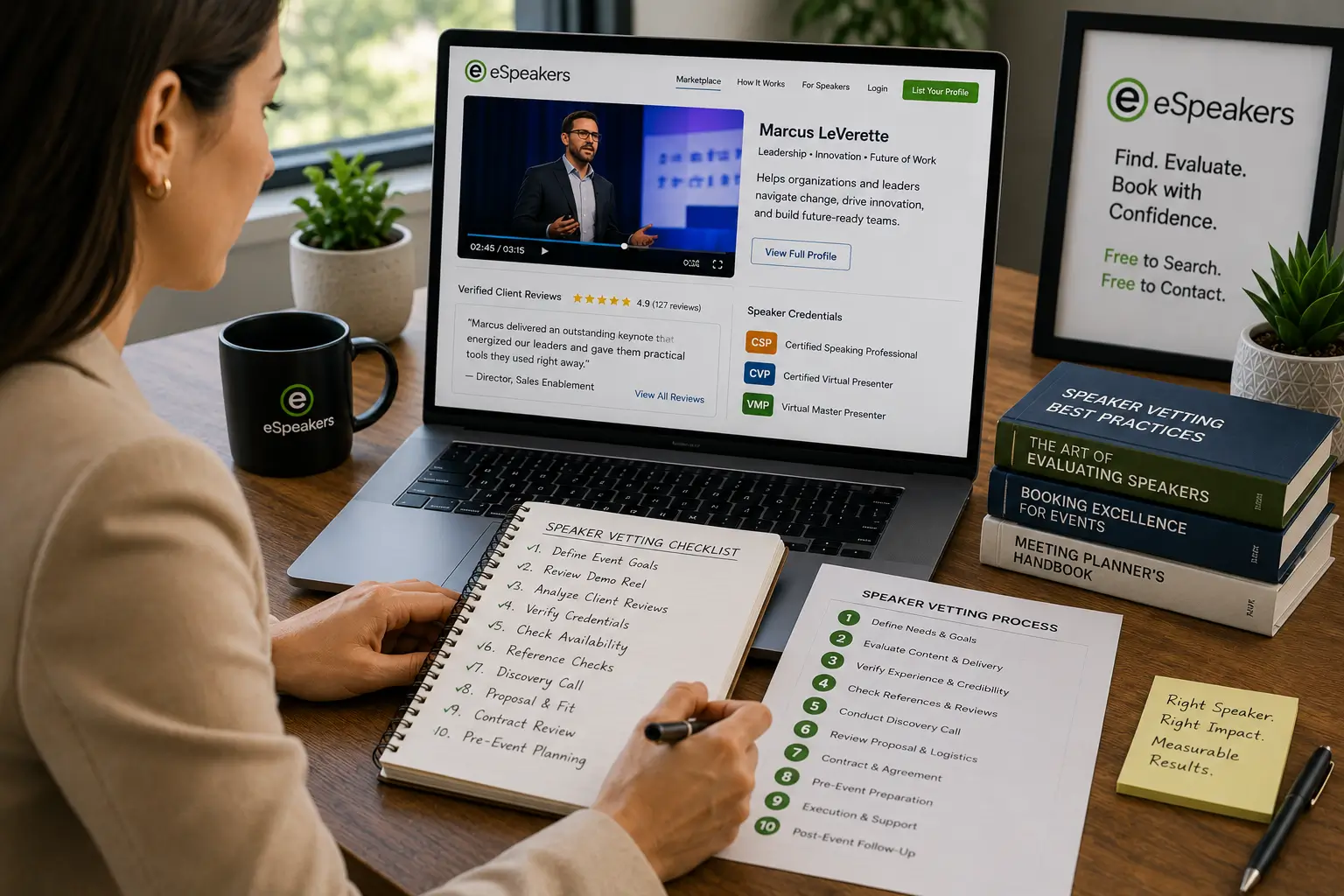
The most efficient way to search for speakers is through a professional speaker directory. The eSpeakers Marketplace is the most comprehensive online speaker directory for events, with thousands of verified professional speakers searchable by topic, fee range, format (virtual, in-person, hybrid), availability, location, and certification status.
What you can see on eSpeakers before making contact:
- Full speaker bio and professional background
- Topic pages with audience descriptions and outcome statements
- Demo reel and additional video clips
- Verified client reviews from past engagements
- Live availability calendar, see if your date is open before you reach out
- Fee range, no guessing whether a speaker is in your budget
- Credential badges, CVP (Certified Virtual Presenter), CSP (Certified Speaking Professional), and others that signal verified professional standards
- Past client logos
Searching the eSpeakers Marketplace is free for planners. Browsing, watching reels, reading reviews, and comparing candidates costs nothing.
Other discovery channels:
- Speaker bureaus are agencies that represent curated rosters of professional speakers. Bureaus are helpful for complex, high-stakes bookings where you want vetting support and logistics assistance. Typical bureau commission: 20–30% of the speaker’s fee
- Referrals from colleagues and other meeting planners are your most reliable source of speaker recommendations. “Who blew your audience away last year?” is worth more than any search result.
- Association networks, MPI, PCMA, ASAE, and similar professional associations often have recommended speaker resources.
- LinkedIn searches are useful for finding subject-matter experts who speak, particularly for niche technical topics.
Keynote Speakers Near Me vs. National vs. Virtual
Geography used to be a significant constraint in speaker sourcing. In 2026, it’s largely optional.
In-person keynote speakers near your event location remain relevant primarily for budget reasons; a local or regional speaker eliminates travel and accommodation costs that can add $2,000–$5,000 to the total engagement cost. For smaller events with tighter budgets, searching for keynote speakers in or near your event city is a practical strategy.
National and international speakers are accessible at any fee level, and travel costs are typically budgeted separately from the speaking fee. For high-profile events where the speaker is part of your marketing and attendance draw, geographic constraints shouldn’t limit your search.
Virtual keynote speakers have become a permanent, strategic choice, not a compromise. Virtual keynotes are typically priced 20–50% lower than in-person engagements. They open access to speakers whose travel schedule or fee would otherwise put them out of reach. And they enable you to book speakers for multiple shorter sessions rather than a single long keynote, a format that the data consistently shows produces better audience engagement for remote attendees.
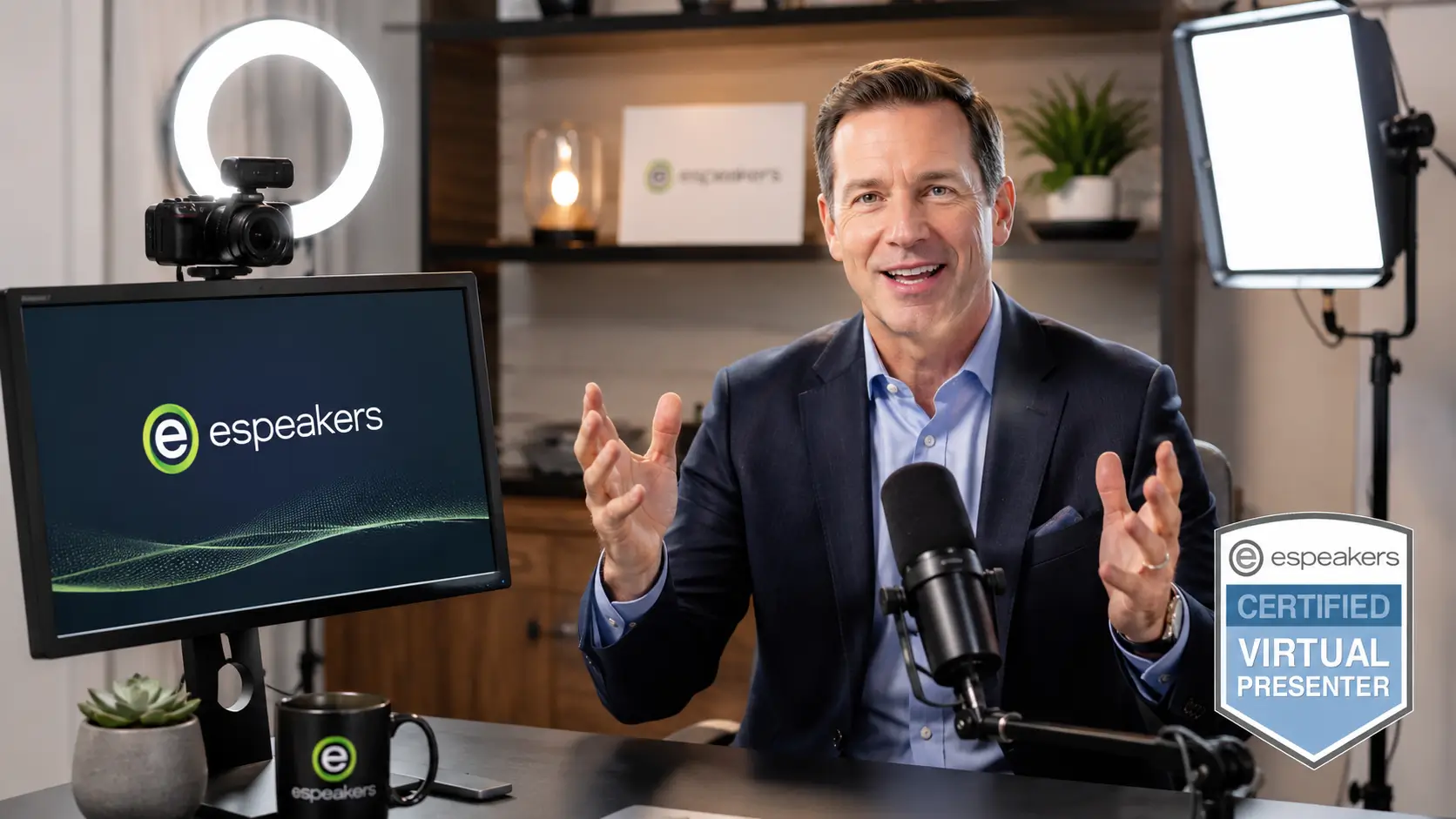
If you’re hosting a hybrid event, confirm that any in-person speaker is also comfortable and technically equipped for virtual delivery to remote attendees. The eSpeakers CVP (Certified Virtual Presenter) badge tells you exactly that without having to ask.
Part 4: How to Evaluate and Shortlist Speakers
Build Your Long List First
You can begin your shortlist on eSpeakers Marketplace
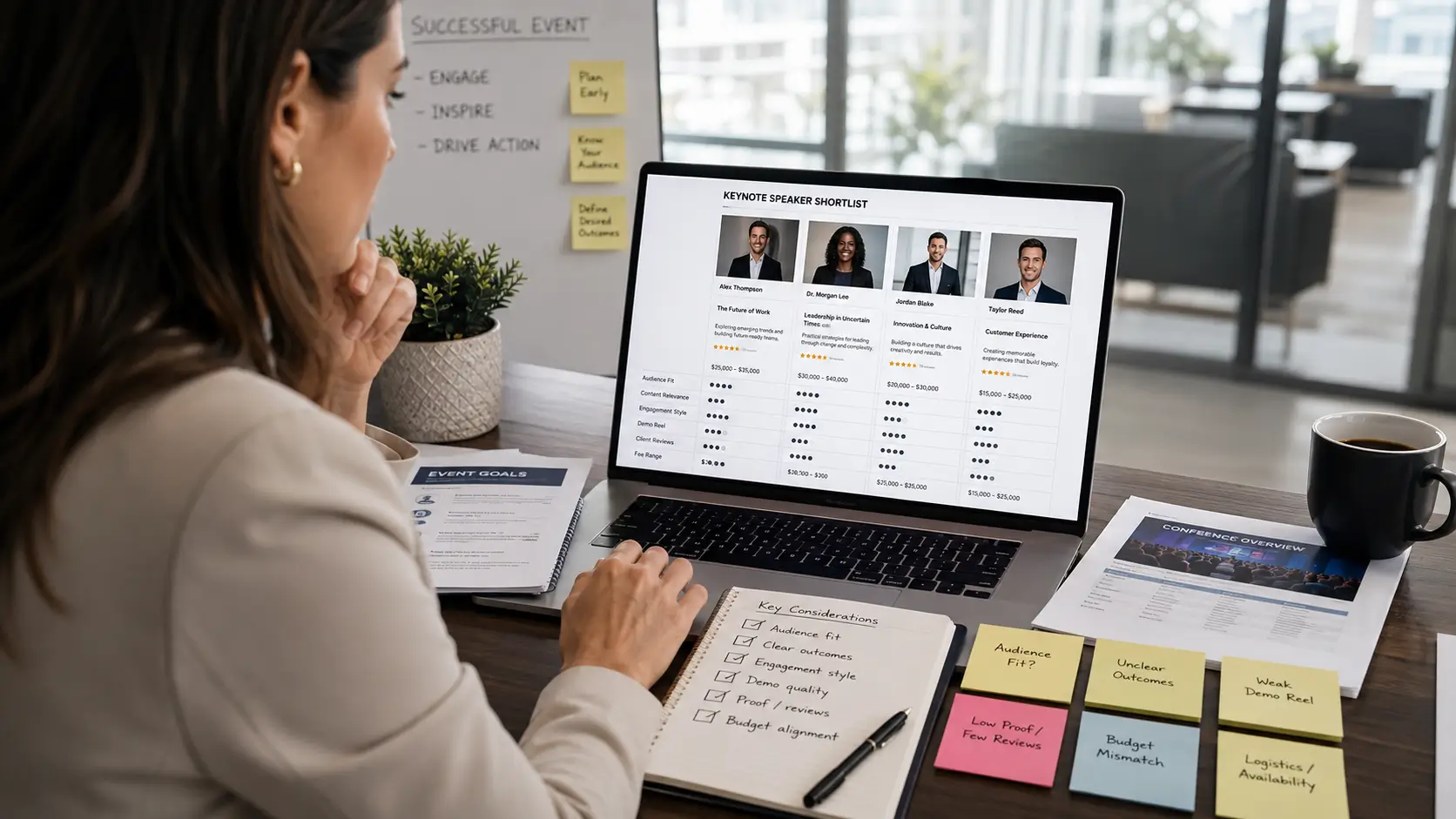
Don’t be too picky too early. Your first pass through the directory should generate 8–12 candidates who broadly match your topic, budget, and audience profile. At this stage, you’re looking for plausible matches, not your final selection.
Quick-pass criteria for your long list:
- Topic alignment with your event purpose
- Fee range within your budget
- Available on your event date
- Format compatibility (virtual/in-person/hybrid)
- At least one video you can watch to assess delivery basics
Narrow to a Working Shortlist
From your long list, narrow to 3–5 candidates for serious evaluation. This is where you go deeper on each one.
The evaluation framework: 7 questions for each shortlisted speaker
- Does their content match our specific audience’s situation right now?
Not just the topic, the application. A “change management” speaker who specializes in nonprofit organizational change is not the same as one who works primarily with corporate technology teams. Watch their videos and read their topic descriptions, asking: would this land with my specific audience?
- Can they customize?
A canned keynote delivered identically to every audience is the most common complaint planners have about speakers after an event. Look for evidence that a speaker does genuine pre-event research: audience surveys, stakeholder interviews, industry-specific examples. Ask directly: “How do you prepare for a new audience, and what does your customization process look like?”
- What do their clients say, specifically?
Read the reviews on their eSpeakers profile carefully. Vague reviews (“Great speaker! Loved it!”) are less valuable than specific ones (“Rebecca’s framework for handling manager-employee conflict was immediately applicable, we saw measurable change in our retention metrics within 90 days”). Look for reviews from organizations similar to yours.
- What does their demo reel actually show?
The reel is your preview. Watch it asking three questions: Is the audience visibly engaged? Does the speaker’s energy translate through a screen (or through a ballroom)? Would I personally keep listening after 60 seconds? If the reel is well-produced but doesn’t show audience reaction, ask why.
- What is their professional background outside of speaking?
This is especially important for expert-who-speaks candidates. What have they actually done in the field they speak about? Real experience shows in the specificity of their stories and the credibility of their insights.
- Have they spoken to audiences like mine?
A speaker with a client list of technology companies may struggle to connect with frontline healthcare workers. This isn’t a dealbreaker; great speakers adapt, but it’s information worth having. Ask about comparable engagements.
- Are they easy to work with?
This matters more than planners typically expect. A speaker who is responsive, asks good questions, submits their headshot on time, and communicates clearly before the event is worth more than a brilliant speaker who is disorganized, unresponsive, and requires hand-holding on every detail.
Check References
Once you’ve narrowed it down to your top 2–3 candidates, call references. Not email, call. An email reference response is usually positive regardless of the actual experience. A phone call to a past planner gives you real information.
Reference questions that get honest answers:
- “What specific moments in the presentation were most effective with your audience?”
- “What would you have done differently in terms of briefing or preparing the speaker?”
- “Did anything not go as planned? How did the speaker handle it?”
- “Would you hire them again, and have you?”
- “What type of event do you think this speaker is best suited for?”
Part 5: The Discovery Call, Evaluating Candidates Directly
Before you make a final decision, get the shortlisted speakers on the phone or video call. This conversation is not just a formality; it’s one of the most valuable pieces of information you’ll collect.
What to Cover in the Discovery Call
Share your event goals in detail.
Tell the speaker exactly what you told your planning committee about the event’s purpose. Share your audience profile. Tell them what the stakes are. Then ask: “Based on what I’ve described, how would your presentation serve our goals, and what specifically would you change from your standard program to fit this audience?”
The quality of their answer tells you almost everything you need to know. A speaker who gets energized by the specifics of your situation, asks follow-up questions, and has concrete ideas for customization is the speaker who will show up prepared on event day.
Ask the hard questions.
- “What presentations have you done that are most similar to what we need, and what was the outcome?”
- “Can you walk me through your pre-event prep process, what information do you need from us, and what will you do with it?”
- “Have you ever done a presentation that didn’t go as planned? What happened and how did you handle it?”
- “What format do you typically use for virtual presentations, and what does your setup look like?”
Listen for responsiveness to your audience.
The best speakers don’t just talk about their program; they start demonstrating, right there on the call, that they’ve heard you. They reference specific things you said. They ask questions that show they’re thinking about your audience. They offer concrete examples of how they’d adapt.
Ask about something extra.
Great speakers often extend their value beyond the main keynote:
- A pre-event survey they distribute to your attendees to customize their content
- A pre-event webinar or Q&A session to build anticipation
- Books or materials for attendees
- A post-event debrief call with your leadership team
- A follow-up webinar 60 days later to reinforce key points
- A breakout session in addition to the main keynote
Ask about what they include and what’s available. The answer tells you how invested they are in your event’s actual outcomes, not just their fee.
Part 6: Making the Final Decision
Involve Your Stakeholders
Once you have a shortlist of 3–5 strong candidates, share it with the other decision-makers involved in your event. This accomplishes two things: you get additional perspective, and the people who will be evaluating the event feel ownership over the selection.
eSpeakers Marketplace makes this easy; you can save and share a shortlist of speaker profiles with your committee and collect their input, all within the platform.
The Decision Framework
When you’re ready to decide, evaluate each candidate on:
| Criterion | What to Assess |
| Content relevance | How precisely does their expertise match your audience’s specific situation? |
| Delivery quality | Will they hold your audience’s attention and generate genuine engagement? |
| Customization commitment | Have they demonstrated willingness and ability to adapt to your specific group? |
| Professional track record | What do their verified reviews and references say about past engagements? |
| Logistical fit | Budget, availability, format requirements, additional asks |
| Responsiveness | Have they been easy to communicate with throughout your evaluation? |
The speaker who will make your event a success will be clear. When you see them, hire them, and do it promptly. Popular speakers book out 6–12 months in advance, and top candidates can lose their availability window quickly.
Part 7: The Contract, Protecting Both Parties
Once you’ve selected your speaker, a written contract is non-negotiable. It protects you, and it protects them. A verbal agreement is not a contract.
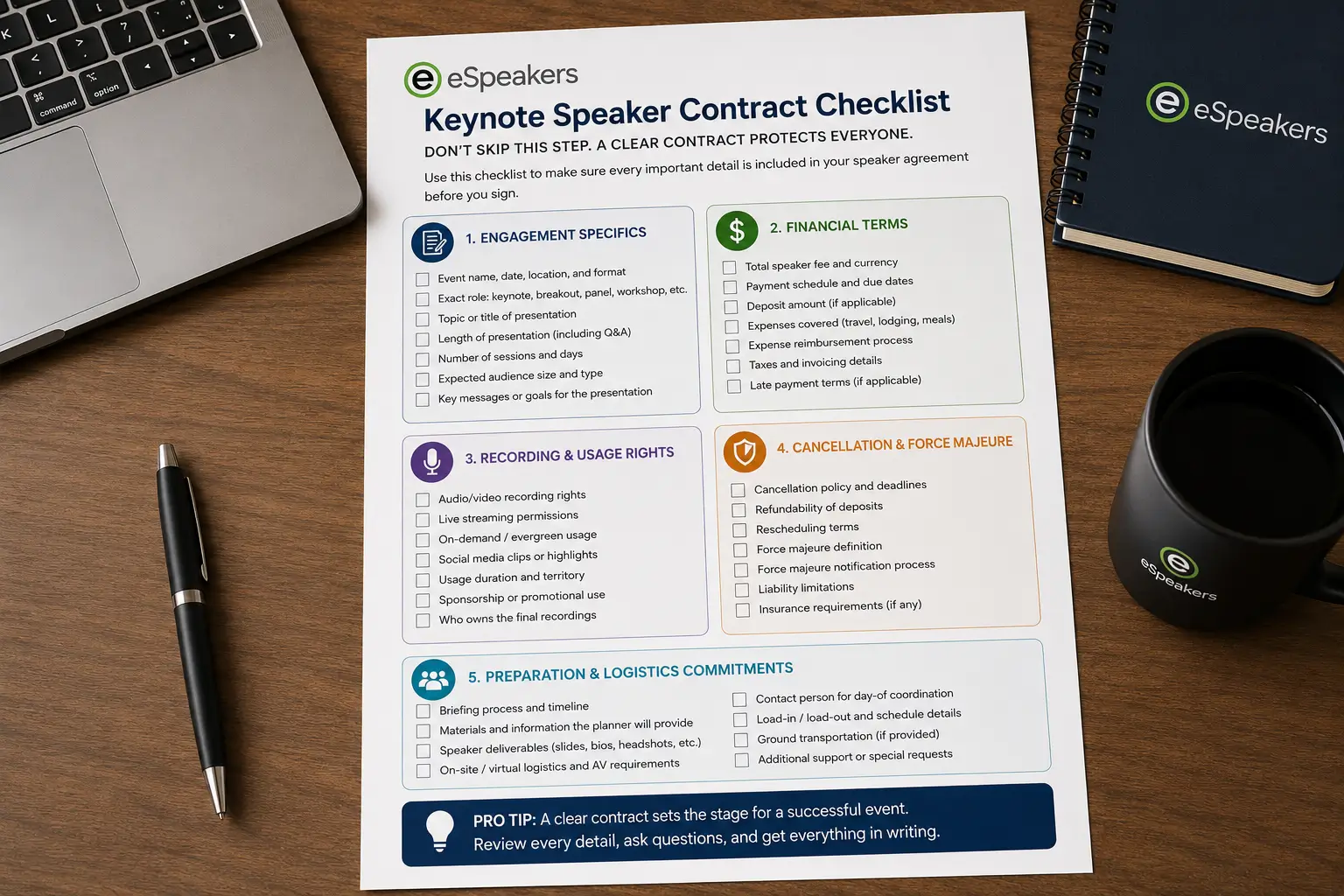
What Every Speaker Contract Must Include
The basics:
- Full legal name and entity of both parties
- Event name, date, and location (or platform for virtual)
- Presentation title and description
- Presentation length and format
- Fee amount and currency
Financial terms:
- Deposit amount and due date (typically 50% upon contract signing)
- Balance payment timeline (typically 30 days before the event or immediately after)
- Payment method accepted
- Travel and accommodation reimbursement terms: are these included in the fee or billed separately?
- Cancellation terms for both parties: what happens if the event is canceled, postponed, or the speaker can’t attend?
Presentation specifics:
- Whether the presentation can be recorded, streamed, or distributed
- Any exclusivity requirements (e.g., speaker won’t present the same content at a competing event within 60 days)
- Audience participation expectations: Is Q&A included? Breakouts?
- Materials provided to attendees (books, handouts, resource downloads)
Pre-event commitments:
- Deadlines for bio, headshot, topic description, and promotional materials
- Pre-event call schedule and agenda
- AV requirements and technical setup specifications (especially for virtual)
Additional provisions:
- What happens if the speaker needs to cancel or be replaced
- How the speaker’s name and likeness can be used in event promotion
- Post-event intellectual property: Who owns the recording?
Using eSpeakers Marketplace to handle the contract and invoicing process makes this simpler for both parties, and it’s free for event planners.
Part 8: Preparing Your Speaker and Your Audience
Brief Your Speaker Like a Professional
The speakers who deliver the most tailored, high-impact presentations are the ones whose clients prepare them well. Don’t send a generic event program and expect customization. Brief your speaker with:
- Audience profile: Who is in the room, role levels, industry experience, company context
- What your audience already knows about this topic, avoid a presentation pitched at the 101 level to a sophisticated audience.
- The challenges your audience is currently facing, the more specific,c the better
- The organizational context, what’s happened recently that’s relevant (a major restructuring, a new strategy, a challenging quarter)
- Event agenda and positioning, where does the keynote sit in the day? What comes before and after?
- What you want the audience to walk away doing, your answer to Question 2 from Part 1
The best speakers will ask you for all of this. If they don’t ask, offer it anyway.
Promote Your Speaker to Build Anticipation
The impact of a speaker’s presentation begins before they take the stage. Attendees who know what to expect, why it matters to them, and why this particular speaker is worth their attention engage at a higher level when the moment arrives.
How to prepare your audience:
- Feature the speaker prominently in all event communications, name, photo, topic, and two to three sentences on why this matters to this specific audience
- Include a clip from the speaker’s demo reel in pre-event emails
- Ask the speaker to provide a short teaser video specifically for your event. Many are happy to do this.
- Assign a pre-event question or reflection that your attendees complete before arriving: “What’s the most significant change challenge you’re facing right now?” This primes their attention for a change management speaker
- Include the speaker’s bio and topic description on your event registration page.
Remember: attendees who are anticipating a speaker absorb more from that speaker’s presentation. Promotion is preparation.
Logistics: The Details That Prevent Disasters
For in-person events:
- Confirm AV requirements in writing, then confirm again 72 hours before the event
- Arrange a sound check and stage walkthrough before attendees arrive
- Provide a quiet green room or prep space
- Assign a point of contact who is available to the speaker from arrival through departure
- Have a backup plan for every technical element (wireless mic fails, slide clicker dies, projector goes dark)
For virtual events:
- Schedule a full tech check 48–72 hours before the event, not the day of
- Confirm the speaker’s platform setup, including camera, microphone, lighting, and internet connection
- Test screen sharing, slide transitions, and any interactive tools you plan to use
- Have a communication channel (text or separate call) to reach the speaker if something goes wrong during the live event
- Confirm backup options if the primary platform fails
CVP-certified speakers have had their virtual setup independently verified by eSpeakers; their equipment, environment, and platform competence have been assessed by a trained evaluator. For virtual or hybrid events, the CVP badge on a speaker’s profile tells you they’ve passed that check before you ask.
Part 9: After the Event, Getting the Most from Your Investment
Debrief Immediately
Within 24 hours of the event, gather feedback from your planning team, your stakeholders, and, where possible, your attendees. What landed? What needed more time? What would you do differently in how you briefed or promoted the speaker?
Measure Impact Beyond the Day
The impact of a great speaker doesn’t end when the applause does. The most valuable events produce behavior change, and behavior change takes time to measure.
Consider:
- Post-event survey 7 days after the event, not just immediately after, immediate surveys measure emotional response, not retention
- 60-day check-in with attendees: “What from the keynote have you actually applied in your work?”
- Tracking the specific outcomes the speaker addressed, if the speaker was brought in to increase adoption of a new sales methodology, measure adoption rates 90 days later
Maintain the Relationship
The best speakers are often re-hired by organizations that saw results the first time and brought them back when a new challenge arose. If your speaker delivered and your relationship was positive, maintain it.
- Send a thank-you note from your organization’s leadership (not just from you)
- Share results: “Our follow-up survey showed 78% of attendees implemented at least one of your frameworks within 30 days.” Speakers love this, and it builds a real relationship
- Consider a follow-up webinar or Q&A session 60 days after the event to reinforce key messages.
- Keep them on your list for future events.s
Part 10: Special Considerations by Event Type
Corporate Speakers for Hire: Annual Conferences and Summits
Corporate events, annual conferences, leadership summits, sales kickoffs, and company-wide town halls typically represent the highest-stakes and highest-budget speaker bookings. The speaker is often the most visible element of the event and the most frequently discussed in post-event feedback.
Corporate event speaker considerations:
- Book 6–12 months in advance for annual conferences; top corporate speakers for hire book far in advance
- Budget 15–25% of your total event cost for the keynote speaker investment
- Corporate planners should specifically search for speakers with verifiable corporate client experience, not just general speaking experience.
- CSP-credentialed speakers (Certified Speaking Professional) have documented 250+ paid engagements, served at least 100 different clients, and passed a peer review process, a meaningful risk-reduction signal for high-stakes corporate events.s
Hire a Motivational Speaker: Sales Kickoffs and Team Events
Motivational speakers for events have a specific function: generating energy, commitment, and optimism that carry attendees from the event back into their work. The bar isn’t just content quality; it’s emotional impact.
When hiring a motivational speaker:
- Watch their demo reel with the sound on and your eyes on the audience, not the speaker. If the audience is visibly moved, you have your answer.
- Ask specifically about how they end their presentations. A motivational speaker who ends with inspiration but no specific action plan leaves attendees buzzing without direction.
- Consider the authentic story; the most effective motivational speakers have a personal story that earns the right to tell their audience something difficult.
Hire a Leadership Speaker: Executive Retreats and Leadership Development Events
Leadership speakers occupy a specific niche: they speak to people who are already successful and need to think differently about what they’re doing, not be inspired to try harder.
Leadership speaker considerations:
- Avoid speakers who are generic “leadership is about vision!” presenters; your leadership audience has heard that.
- Look for speakers with specific expertise in the type of leadership challenge your leaders are facing: leading through change, building high-trust teams, managing performance, and navigating uncertainty.
- Executive audiences are sophisticated evaluators; they will quickly dismiss a speaker who doesn’t demonstrate deep, current knowledge.e
- Pre-event access to your leadership team is essential for this type of speaker; if they’re not willing to do the prep work, they won’t be the right fi.t
Virtual Keynote Speakers: Remote and Hybrid Events
The virtual keynote speaker market is now permanent, professional, and fully capable of delivering the same impact as in-person delivery when the right speaker is selected and the right preparation is done.
Virtual speaker considerations:
- Look for the CVP (Certified Virtual Presenter) badge, which verifies setup, environment, and platform competence.
- Watch their virtual proof video on eSpeakers. This shows you exactly what a planner sees when they’re on the other side of a virtual presentation.
- Ask about their interactive tools, polls, breakout rooms, Q&A, chat, and how they build these into virtual sessions rather than treating virtual as a passive format.t
- Confirm platform compatibility: Zoom, Teams, WebEx, Hopin, and other platforms have different capabilities; make sure your speaker works well with the platform your organization uses
- Session length: virtual keynotes are most effective in the 20–45 minute range with planned interaction checkpoints, not the 60–90 minute in-person format transplanted to a screen
The Planner’s Speaker Hiring Checklist
Use this as your end-to-end reference for every speaker booking.
Before You Search
- Event purpose defined and written: “The goal of our event is to…”
- Speaker’s specific role defined: “After hearing this speaker, attendees should…”
- Audience profile documented: role, industry, experience level, and current challenges.
- Budget established, including travel/accommodation allowance
- Event date, location, and format confirmed
- Timeline set: how far in advance are you booking?
Finding and Shortlisting
- eSpeakers Marketplace searched with relevant filters (topic, fee, format, availability, location)
- Long list of 8–12 plausible candidates reviewed
- Demo reels watched for each long-list candidate
- Reviews read and checked for specificity and relevance
- Short list of 3–5 candidates prepared for deeper evaluation
- References checked by phone for the top 2–3 candidates
Discovery and Selection
- Discovery call completed with each shortlisted candidate
- Customization capability assessed for each candidate
- Professional background verified
- Additional offerings discussed (pre-event survey, books, follow-up session)
- Shortlist shared with key stakeholders for input
- Final selection made and confirmed promptly
Contracting
- Contract drafted covering: date, topic, fee, travel, deposit, balance, cancellation, AV, recording rights, materials
- Deposit payment processed
- Contract signed by both parties
- All key dates (material deadlines, prep calls, balance payment) calendared
Preparation
- A detailed audience brief was provided to the speaker
- Pre-event prep call scheduled and completed
- Speaker materials (bio, headshot, topic description) received and used in promotion.
- AV/tech requirements confirmed (twice)
- Attendees primed: speaker featured in pre-event communications
- Day-of logistics confirmed: arrival time, green room, point of contact
After the Event
- Immediate feedback was collected from the planning team
- Attendee survey sent within 48 hours
- Balance payment processed (if not prepaid)
- Thank-you note sent to the speaker from organizational leadership
- Results shared with the speaker
- 60-day follow-up assessment: what did attendees actually apply?
FAQ
Keynote speaker fees in 2026 range from $1,500 for emerging speakers to $100,000 or more for celebrity-level names. Most professional keynote speakers for corporate events charge between $7,500 and $30,000 for in-person engagements. Virtual keynote speakers typically charge 20–50% less than in-person, because travel and logistics costs are eliminated. Fees are affected by experience level, topic specialization, event type, degree of customization required, and whether the speaker is booked directly or through a bureau. (Industry fee benchmarks are tracked annually by PCMA and the National Speakers Association.
For major annual conferences with in-person keynote speakers, 6–12 months in advance is standard for top-tier speakers who book early. For smaller corporate events or events with more flexibility, 3–6 months typically provides sufficient lead time. Virtual keynote speakers often have more schedule flexibility and can sometimes be confirmed with shorter lead times. The key rule: once you find the right speaker, confirm promptly, availability can close quickly.
Both approaches work. Speaker bureaus provide curated rosters, handle negotiations and logistics, and can be valuable for complex or high-stakes bookings where you want expert vetting support. Bureaus typically add 20–30% to the speaker’s base fee through commissions. Booking directly through a platform like the eSpeakers Marketplace gives you access to thousands of verified professional speakers, lets you review profiles, watch reels, read verified client reviews, and contact speakers directly, all for free. Many experienced planners use eSpeakers for initial research and direct contact, which saves cost and enables more personalized communication with the speaker.
The most important questions to ask a speaker before booking are: How do you customize your presentation for a specific audience and event goal? What is your pre-event preparation process, and what information do you need from us? Can you describe a similar engagement and what the outcome was? What would you include in the presentation that’s specifically relevant to our audience’s current challenges? What do you offer beyond the main keynote, pre-event materials, follow-up sessions, Q&A? How do you handle technical issues or unexpected situations during a presentation? The quality of their answers to these questions tells you more about the speaker’s professionalism and commitment than their demo reel does.
The eSpeakers Marketplace allows you to filter speaker search results by location, making it easy to find keynote speakers in or near any major city. Searching by location is most relevant when you want to reduce travel costs, local and regional speakers eliminate airfare and hotel expenses that can add $2,000–$5,000 to the total engagement cost. However, for high-profile events where speaker quality is the priority, consider both local and national speakers, and factor travel costs into your total budget comparison.
Yes, when the right speaker is selected and the right preparation is done. The most effective virtual keynote speakers are those who have mastered the specific craft of virtual delivery, not just in-person presenters who happen to be on Zoom. Look for speakers who hold the Certified Virtual Presenter (CVP) credential, which verifies that their equipment, environment, and platform skills have been independently assessed. The CVP badge on a speaker’s eSpeakers profile confirms virtual readiness before you contact them. Virtual keynotes are typically most effective at 20–45 minutes with planned interactive elements, rather than replicating a 60-minute in-person format on screen.
A complete speaker contract should cover: the event date, location and format, presentation topic and length, speaking fee and deposit amount, balance payment timeline, travel and accommodation terms (if separate from fee), cancellation terms for both parties, recording and distribution rights, AV and technical requirements, pre-event preparation commitments and deadlines, any materials or add-ons included, and exclusivity provisions if applicable. eSpeakers Marketplace includes contract and invoicing tools for planners and speakers, making the contracting process straightforward for both parties.
Yes. Searching the eSpeakers Marketplace, browsing speaker profiles, watching demo reels, reading client reviews, checking availability, and submitting inquiries to speakers is completely free for event planners and organizers. There is no fee to use the Marketplace as a planner, regardless of how many speakers you evaluate or how many inquiries you send.
Finding the Right Speaker Starts With the Right Search
The eSpeakers Marketplace is the world’s most trusted online speaker directory for events, used by meeting planners, corporate event managers, association executives, and independent event organizers to find and hire professional speakers across every topic, format, and budget.
Every profile includes a demo reel, verified client reviews, a live availability calendar, a fee range, and a professional background. Filtering by topic, fee, location, format, and certification status narrows thousands of options to a focused shortlist in minutes.
Searching is free. Browsing is free. Contacting is free.
→ Search the eSpeakers Marketplace
→ Browse by Speaker Category
→ Find Virtual Keynote Speakers
This guide was written for meeting planners and event professionals sourcing professional speakers for corporate events, association conferences, sales meetings, virtual summits, and every other event format. eSpeakers has been connecting professional speakers with planners since 1999. The eSpeakers Marketplace is free to use for event organizers.
Page last updated: April 2026
Joe Heaps, Chief Marketing Officer at eSpeakers
Joe Heaps is the Chief Marketing Officer at eSpeakers and is responsible for creating and accelerating the company's sales & marketing strategies. He is focused on driving the company's vision of helping organizations and individuals improve in substantial, long-term ways. He believes it happens when the perfect speaker is in front of the right audience. Over 25 years in the industry, Joe’s strategic vision and leadership have propelled eSpeakers to the leading software platform for speakers, coaches, and experts.
Joe Heaps
Chief Marketing Officer, eSpeakers
Latest Articles

Related Articles