7 Mistakes Meeting Planners Make When Hiring a Keynote Speaker (And How to Avoid Every One)
Knowing how to hire a keynote speaker is one of the most consequential skills a meeting planner can develop, and one of the hardest to get right without learning from experience.
The stakes are real. Your keynote speaker is often the most visible, most discussed, and most remembered element of your entire event. When it goes well, attendees talk about it for months, and the planner who made it happen earns serious professional credibility. When it goes badly, wrong message, wrong energy, generic delivery, or a technical disaster on a virtual event, no amount of excellent logistics can recover the day.
What's striking is that most speaker booking failures aren't random. They follow recognizable patterns. The same seven mistakes appear repeatedly in post-event debriefs, planning committee reviews, and candid conversations among meeting professionals. They happen to experienced planners and first-timers alike.
This article names them, explains exactly what goes wrong in each case, and shows you what to do instead, so you can avoid the most common and most costly errors in the keynote speaker hiring process.

John Doe
Chief Marketing Officer at eSpeakers
Find your next keynote speaker, free.
eSpeakers Marketplace lets you search thousands of verified professional speakers by topic, fee, format, location, and availability. Watch reels, read verified client reviews, check live availability, and contact speakers directly, no fees, no account required.

Mistake 1: Starting the Search Without a Clear Purpose
What goes wrong: A planner starts scrolling speaker directories, watching reels, and building a shortlist before they’ve defined what the speaker is supposed to accomplish. They find someone compelling, pitch them to the committee, and only then realize they can’t articulate why this speaker is right for this event with this audience at this moment.
This is by far the most common mistake, and the one that causes the most downstream problems. When you don’t know what you need a speaker to do, you can’t evaluate candidates objectively. You end up choosing based on who impressed you in their demo reel rather than who will serve your audience’s specific situation.
The ebook puts it directly: “Bring in the wrong speaker and your event will be lackluster at best. Hire the right speaker for your event, and you can change the lives, thinking, and even performance of your attendees.” The difference between those two outcomes usually comes down to whether the planner started with a clear purpose.
What to do instead:
Before you open a search tool or watch a single speaker video, answer these two questions in writing, and make sure your event committee can recite them.
Question 1: What do you want attendees to DO as a result of attending this event?
Not feel. Not think. Do. Strong answers are specific and action-oriented:
- “Commit to integrating AI tools into their weekly workflow within 30 days”
- “Leave with three specific conversation frameworks for difficult performance discussions.”
- “Re-commit to the company’s service standards and understand why they directly affect each person’s bonus.”
Weak answers: “Get motivated.” “Feel inspired about the company.” These are themes, not purposes. They won’t help you select a speaker or brief one effectively.
Question 2: What do you want attendees to do specifically as a result of hearing this speaker?
This narrows the general event purpose to the speaker’s specific role. A clear answer to this question is also the briefing document every candidate speaker should receive before they talk to them, and their response to it tells you whether they’re the right fit.
The eSpeakers fix: Once you have your purpose defined, the eSpeakers Marketplace lets you search by topic and filter by audience outcome, so you’re matching speakers to your specific goals, not just browsing a catalog.
Mistake 2: Waiting Too Long to Start the Search
What goes wrong: The event date is nine weeks away. The keynote slot is still open. The planner, scrambling, begins searching for speakers who are available on that specific date, which immediately eliminates the majority of the best candidates. They end up booking someone who was available rather than someone who was right.
This is the #2 challenge planners consistently identify when asked what makes speaker booking stressful: “Waiting until the last minute to find the right presenter.” The timing problem compounds itself: last-minute bookings reduce your ability to brief the speaker thoroughly, limit customization, compress the contract and logistics timeline, and eliminate any opportunity to promote the speaker’s appearance in event marketing.
The best keynote speakers for conferences and corporate events book 6–12 months in advance. Some of the most in-demand names in leadership, motivation, technology, and culture are unavailable for engagements less than 90 days out. Waiting doesn’t just limit your options; it limits the quality ceiling of what you can achieve.
What to do instead:
Build your speaker search into your event planning timeline from the moment the event is confirmed, not as a late-stage item.
Speaker sourcing timeline by event type:
| Event Type | When to Start | Latest Acceptable |
| Large annual conference (1,000+ attendees) | 10–12 months before | 6 months |
| Mid-size corporate conference (200–999 attendees) | 6–9 months before | 4 months |
| Sales kickoff or team event (under 200) | 4–6 months before | 2 months |
| Virtual keynote, any size | 3–6 months before | 6 weeks |
| Last-minute booking (any type) | As soon as you know | Immediately |
If you’re already in last-minute territory, The eSpeakers Marketplace lets you filter by availability date, and you can see exactly which speakers are open for your event date the moment you search. Availability is live, not manually updated, so what you see reflects the actual open calendar. Virtual keynote speakers also tend to have more schedule flexibility than in-person speakers, since there’s no travel to coordinate.
The eSpeakers fix: Set up your event in eSpeakers at the beginning of your planning cycle. Browse the Marketplace with your date filter active from the start, so you know exactly what the available field looks like while you still have time to make a considered choice.
Mistake 3: Prioritizing Celebrity Over Fit
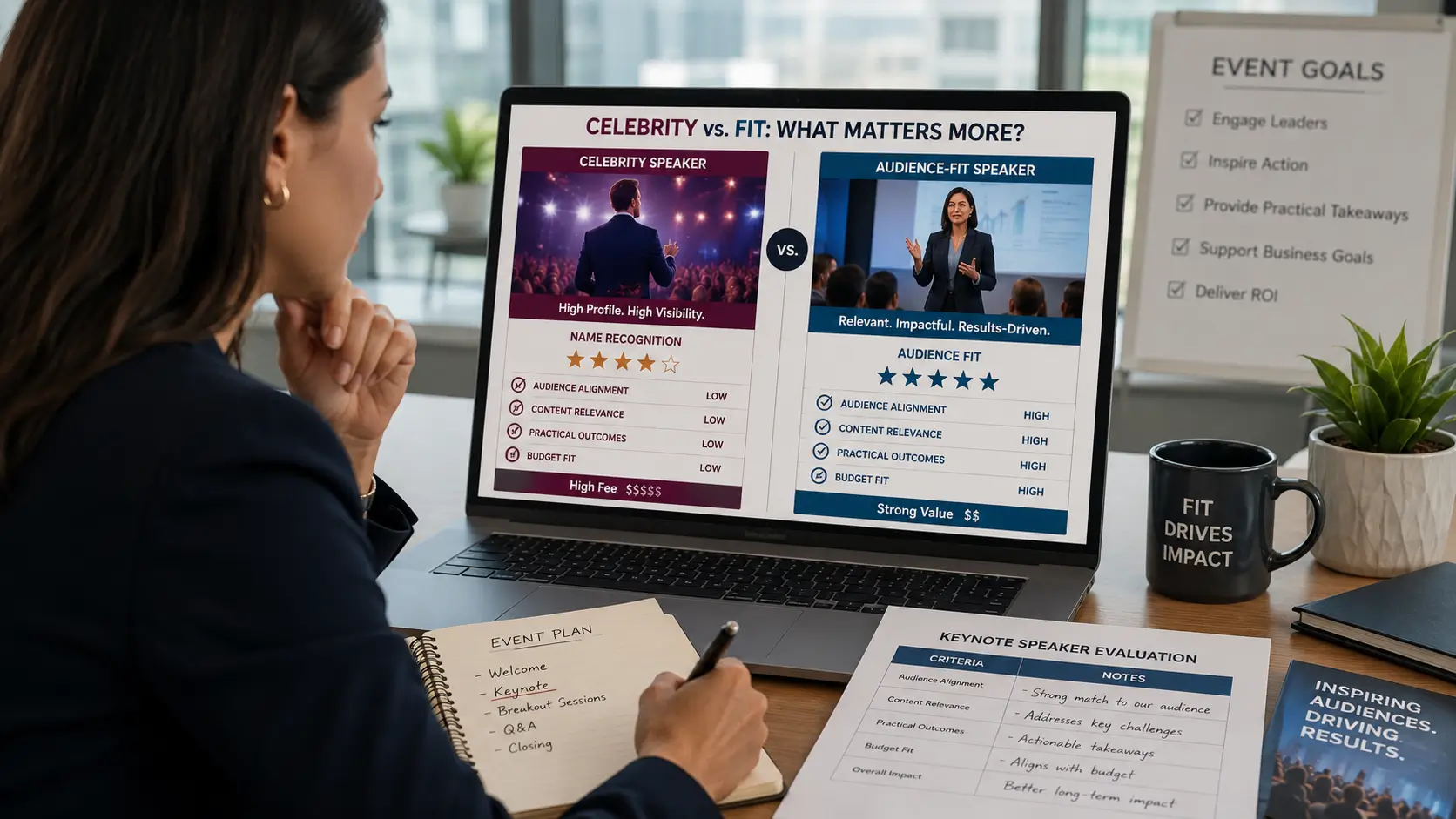
What goes wrong: The planning committee is excited about a recognizable name. The planner books the celebrity speaker because the name will look impressive in the event program and generate buzz in pre-event communications. The event happens, the audience is mildly impressed by the name, and the speaker delivers a polished but generic presentation that has almost nothing to do with the specific challenges your attendees are facing.
The committee remembers the applause. Nobody remembers a single thing the speaker said three months later. Nothing changed.
Celebrity and name recognition are legitimate factors in some booking decisions, particularly when the speaker’s reputation drives event registration or adds external prestige. But when the primary reason for hiring a speaker is “our attendees will be excited about the name,” you’ve made the hiring decision for marketing reasons and expected training outcomes. Those are different goals with different ideal solutions.
The ebook makes this distinction clearly: “Hiring the world’s foremost expert in a particular topic is a huge mistake if the speaker can’t deliver their knowledge in a way that engages your audience.” The reverse is equally true: a name that generates pre-event excitement but doesn’t serve your actual audience is a mismatch regardless of how impressive it looks in the program.
What to do instead:
Evaluate every candidate, celebrity or not, against the same two criteria: fit with your audience’s specific situation, and ability to deliver on your defined event purpose.
The fit evaluation checklist:
- Does this speaker regularly work with organizations like ours or audiences like ours?
- Does their content address the specific challenges our attendees are facing right now, not just the general topic category?
- When you read their topic descriptions, do you see your attendees’ reality reflected? Or is it generic?
- Do their verified client reviews mention specific outcomes, or just general enthusiasm?
- Would this speaker need to significantly customize their standard program to serve our audience, and are they willing to do that?
A $10,000 speaker who nails your audience’s specific situation will deliver more value than a $50,000 name who delivers a polished version of what they present to every audience.
The eSpeakers fix: Every eSpeakers profile includes verified client reviews from real planners, not testimonials curated by the speaker’s team. Reading reviews from organizations similar to yours tells you far more about fit than a speaker’s follower count or media mentions.
Mistake 4: Evaluating Reels Instead of Referencesty Over Fit
What goes wrong: A planner watches a speaker’s demo reel, is impressed by their energy and delivery, and books them without checking references or speaking to past clients. The demo reel, typically the speaker’s single best moments, professionally edited, accurately reflects their potential but not their consistency. The planner discovers post-event that the speaker’s delivery varies significantly based on how well they’re briefed, how aligned the audience is, or how much preparation they put in for each engagement.
Demo reels are essential evaluation tools. But they’re marketing materials, not performance guarantees. They show you the ceiling, what’s possible when everything goes right. What they don’t show you is how the speaker performs when the audience is tough, when the AV fails, when the event runs long and their time is cut, or when they received a rushed or incomplete brief about the event.
What to do instead:
Treat the reel as the first filter, not the final decision. For any speaker you’re seriously considering, verify three additional things:
Check the reviews carefully. The eSpeakers Marketplace shows verified client reviews, submitted by planners who hired the speaker through the platform. Read them asking: are these reviews specific or generic? Do reviewers mention actual outcomes, or just general impressions? Do multiple reviews mention the same strength (or the same weakness)? A pattern of reviews is far more reliable than a single glowing reference.
Call references by phone. Email references almost always produce positive responses regardless of the actual experience. A five-minute phone call to a past planner yields real information. Ask: “What would you have done differently in how you briefed the speaker?” “Did anything not go as planned? How did they handle it?” “Would you hire them again, and have you?” The answers to these questions in a real conversation are materially different from what you’d get in an email.
Watch live footage when possible. Ask if the speaker has recordings from recent engagements they can share, not their edited reel, but raw event footage. A speaker who is confident in their consistent quality will have this. Footage showing real audience reaction in an unedited context tells you more than any produced highlight reel.
The eSpeakers fix: eSpeakers Marketplace verification ensures that client reviews come from actual planners who hired the speaker, not anonymous internet ratings or reviews the speaker solicited directly. The platform also shows you the speaker’s full engagement history, which lets you see whether their reviews are consistent across different event types and audience categories.
Mistake 5: Skipping the Brief, and Expecting Customization Anyway
What goes wrong: A planner hires a speaker, sends them the event program and a generic welcome email, and expects to receive a customized keynote in return. The speaker shows up (or logs on) having done minimal research because minimal information was provided. The presentation covers the right topic in a technically competent way, but it has almost nothing to say about this specific organization, this specific audience, or the specific challenges these people are facing right now. It could have been delivered to any group, anywhere.
This is the “canned presentation” problem, one of the most common frustrations planners report after keynote bookings that technically met expectations but failed to generate real impact. And the honest version of this mistake is that planners often contribute to it by not providing the information the speaker needs to customize effectively.
Great speakers want to customize. But customization requires information, detailed, specific, honest information about your organization’s context, your audience’s situation, and your event’s purpose. Without it, even the most skilled speaker is guessing.
What to do instead:
Brief your speaker as your event’s success depends on it, because it does.
The speaker’s brief should include:
About the audience:
- Who they are: role levels, industry experience, company function
- What they already know about this topic (don’t let the speaker teach 101 to an advanced audience)
- The specific challenges your audience is facing right now, the more specific, the better
- What they’re skeptical about or resistant to hearing
- What they most need to hear, even if it’s difficult
About the event context:
- What’s happened in the organization recently that’s relevant
- Where the keynote sits in the day’s agenda and what comes before and after
- Your event’s stated purpose (your answer to Question 1 from the planning stage)
- What you want attendees to do as a result of the speaker’s presentation, specifically
About the engagement:
- Presentation length and format (keynote only, Q&A included, breakout after?)
- AV setup and any technical considerations
- Whether there are restrictions on topics, examples, or stories
Then schedule a pre-event call, not just a logistics call, but a real conversation where you walk the speaker through the brief, answer their questions, and discuss how their standard content will be adapted for your specific group.
The eSpeakers fix: The eSpeakers platform includes tools for sharing event details with confirmed speakers, streamlining the brief, and ensuring nothing falls through the cracks between confirmation and event day.
Mistake 6: Ignoring Delivery Quality in Favor of Credentials
What goes wrong: The planner hires the most credentialed expert on the subject, the person with the most impressive academic background, the most publications, the longest career in the field. PCMA’s research on meeting planner booking decisions shows that delivery quality and audience fit consistently rank above credentials as predictors of post-event planner satisfaction. The credentials check every box. The presentation does not. The speaker reads from slides, uses jargon the audience doesn’t recognize, loses the room 20 minutes in, and runs over time.
The audience has access to the world’s most credentialed experts in any field through a 30-second internet search. What they don’t have access to, and what a hired speaker is uniquely able to provide, is that expertise delivered in a way that creates genuine connection, emotional resonance, and behavioral change. Credentials are the qualifications for the topic. Delivery is the qualification for the stage.
The ebook is blunt: “Because an engaged audience is willing to listen to a speaker’s message, it’s usually safer to err in favor of speaking skills and give up some technical expertise.” An engaging speaker with somewhat less technical depth almost always serves your audience better than the world’s foremost expert who loses the room.
What to do instead:
Evaluate delivery quality explicitly and systematically, not just as a general impression from a reel, but through specific indicators.
Delivery quality signals to look for:
- Audience reaction in the reel, are people leaning forward, laughing, nodding? Or are they checking their phones?
- Eye contact with the audience (vs. reading from slides or notes)
- Vocal variety: Does the speaker vary their pace, volume, and tone to maintain energy?
- Storytelling, do they use specific, vivid stories rather than abstract principles?
- Interaction, do they involve the audience, or present to them?
- Adaptability, ask the speaker directly: “Tell me about a time your presentation didn’t go as planned and how you handled it.” A great speaker has a story about recovery, not a defensive blank.
For virtual keynote speakers specifically, Virtual delivery is a distinct skill from in-person delivery. A speaker who commands an in-person stage may or may not translate effectively through a camera and screen. Look for the CVP (Certified Virtual Presenter) badge on eSpeakers profiles; it tells you the speaker’s virtual setup and platform competence have been independently verified by a trained evaluator. The CVP is recognized by Meeting Professionals International (MPI, SMART Meetings, and SPIN. For advanced virtual delivery mastery, the VMP (Virtual Master Presenter) credential goes further.
The eSpeakers fix: eSpeakers profiles include demo reels embedded directly on the speaker’s profile, no navigating to external sites. You can watch multiple speakers’ reels in sequence for direct comparison, using the same set of delivery criteria.
Mistake 7: Treating the Contract as a Formality
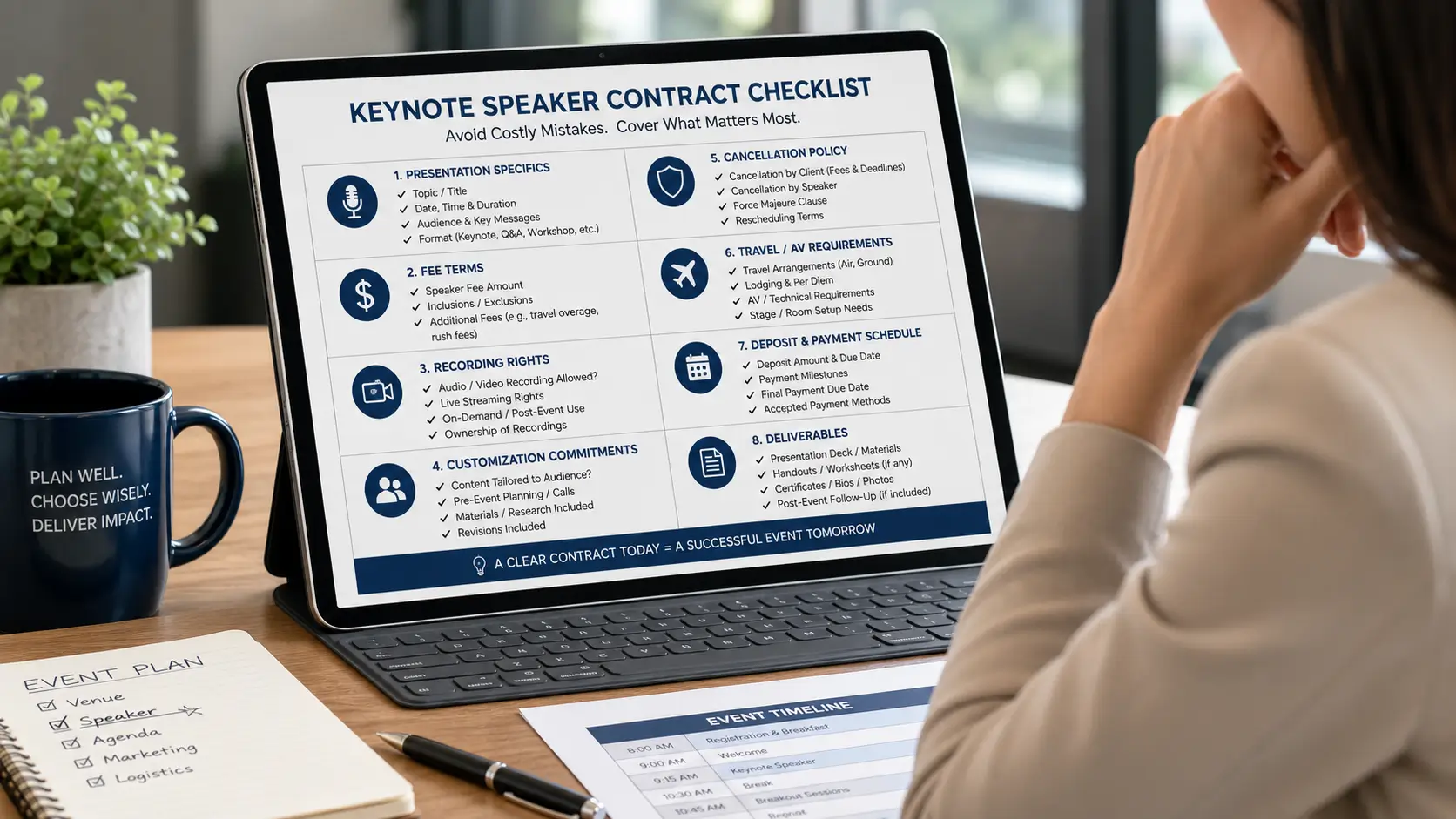
What goes wrong: The verbal agreement is made. Everyone is excited. The planner sends a brief email confirming the date and fee. The speaker responds positively. Three months later, the speaker assumed the presentation included Q&A; the planner assumed it didn’t. The speaker expects their travel costs to be reimbursed; the planner assumed they were included in the fee. The speaker delivers a standard 60-minute program; the planner needed 45 minutes to fit the agenda. The speaker records the presentation for their own portfolio; the planner assumed the content was exclusive.
Any one of these misunderstandings creates friction, expense, or a damaged relationship. The planner who says “we had an understanding” is the planner who has no leverage when reality diverges from what they thought they understood.
A signed contract is not a formality. It is the shared definition of what both parties have agreed to, and it is the document that prevents every one of these misunderstandings from becoming a problem.
What to do instead:
Use a written contract for every speaker engagement, regardless of the speaker’s fee, your relationship with them, or how confident you feel about the verbal agreement. The contract should cover:
The engagement specifics:
- Event date, time, and location (or virtual platform)
- Presentation title and description
- Presentation length, including whether Q&A is included and how much time it gets
- Format: keynote only, breakout session, full-day training, virtual keynote, hybrid format
Financial terms:
- Total speaking fee
- Deposit amount and due date (typically 50% at signing)
- Balance payment terms (typically 30 days before the event, or net-30 after)
- Travel and accommodation: included in the fee, or billed separately? What class of travel?
- What happens if either party cancels, cancellation fees, refund terms, or substitute speaker provisions
Content and preparation:
- Level of customization expected and agreed to
- Pre-event calls: how many, when, how long
- Materials the speaker will provide (bio, headshot, topic description, audience survey)
- Deadline for each deliverable
Intellectual property and exclusivity:
- Can the event be recorded? Who owns the recording?
- Can the recording be distributed, and if so, to whom and on what terms?
- Are there exclusivity terms (e.g., speaker won’t present the same content to a direct competitor within 90 days)?
Additional offerings:
- Books or materials for attendees, who provides them, who pays?
- Post-event webinar or follow-up session, is it included or priced separately?
- Social media promotion commitments from the speaker
The eSpeakers fix: The eSpeakers Marketplace includes contract and invoicing tools for managing the formal agreement between planners and speakers. Using the platform’s contracting process ensures both parties are working from the same documented agreement, eliminating the email-thread ambiguity that causes most contract disputes.
The Common Thread: All 7 Mistakes Share One Root Cause
Look at these seven mistakes again. They’re distinct in their specifics, but they all come from the same underlying problem: treating speaker booking as a task rather than a process.
A task is something you check off. You find a speaker, you make a call, you send an email, you put the name in the event program. Done.
A process is a sequence of defined steps, each one informing the next, all of them aimed at a specific outcome. Define your purpose. Profile your audience. Set your budget. Build a long list. Evaluate systematically. Brief thoroughly. Contract precisely. Prepare both the speaker and the audience. Measure impact after.
When planners approach speaker booking as a process, they make fewer mistakes because each step creates the information and structure that prevents errors in the next step. Define your purpose first, and you won’t prioritize celebrity over fit. Brief your speaker thoroughly, and you won’t get a canned presentation. Write a complete contract, and you won’t have a dispute over recording rights.
The Quick-Reference Checklist: Avoiding All 7 Mistakes
Before you search:
- Event purpose defined in writing: “The goal of our event is to…”
- Speaker’s specific role defined: “After hearing the speaker, attendees should…”
- Audience profile documented: role, industry, current challenges, and what they need to hear.
- Budget established, including travel/accommodation allowance
- Search started with enough lead time (see timeline table above)
While evaluating:
- Evaluating fit with this specific audience, not just the general topic
- Watching demo reels with eyes on the audience, not just the speaker
- Reading verified client reviews from similar organizations
- Checking references by phone, not just email
- Assessing delivery quality against specific indicators, not just general impressions
- Verifying virtual readiness (CVP badge) for any virtual or hybrid engagements
Before signing:
- Discovery call completed with finalist speakers
- Brief shared with finalist speakers; their response to it is part of the evaluation
- Complete contract drafted covering: engagement specifics, financial terms, content and preparation, IP and exclusivity, and additional offerings.
- Contract signed by both parties before confirming the speaker for the event marketing
After booking:
- Detailed brief provided to confirmed speaker
- Pre-event prep call(s) scheduled and completed
- Speaker featured in attendee communications before the event
- AV/tech requirements confirmed in writing (and again 72 hours before the event)
- Post-event: attendee feedback collected, results shared with speaker, 60-day behavior change check-in scheduled.
FAQ
Start by defining the specific purpose of your event and the specific role you need the speaker to play, what should attendees be able to do after hearing the presentation? Then search a verified speaker directory like eSpeakers Marketplace, filter by topic, fee range, format, and availability, watch demo reels and read client reviews for your shortlist, call references for your top candidates, conduct a discovery call with finalists, and confirm the booking with a written contract. Start the search 6–12 months before large events, and book promptly once you’ve identified the right fit.
For large annual conferences, start your search 10–12 months in advance and aim to confirm 6 months out. For mid-size corporate events, begin 6–9 months before. For smaller team events and sales kickoffs, 4–6 months provides comfortable lead time. Virtual keynote speakers often have more flexibility and can sometimes be confirmed with 6–8 weeks notice. The most in-demand speakers book quickly, so starting early dramatically expands your options. eSpeakers Marketplace shows live speaker availability, so you can filter immediately by your event date.
The most revealing questions are: How do you customize your presentation for a specific audience, walk me through your process? What similar engagements have you done, and what were the outcomes? Can you provide references from organizations like ours? What information do you need from us to prepare? What do you offer beyond the keynote, pre-event preparation, post-event follow-up, audience surveys? How do you handle situations when something goes wrong on stage or during a virtual presentation? The quality of their answers tells you as much about the speaker as their demo reel does.
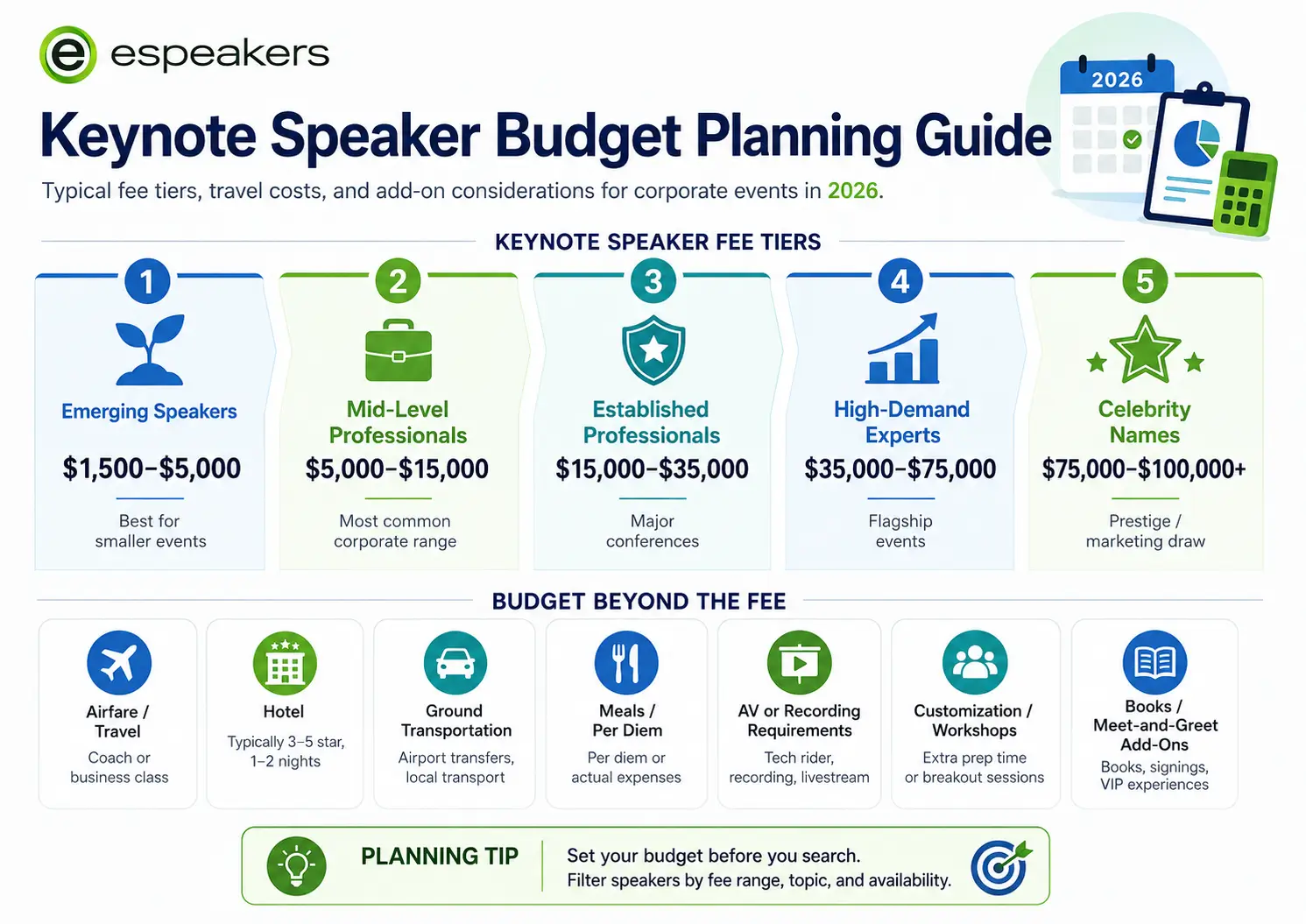
Keynote speaker fees range from approximately $1,500 for emerging speakers to $100,000 or more for celebrity-level names. Most professional speakers for corporate events and conferences charge between $7,500 and $30,000. Virtual keynote speakers typically charge 20–50% less than in-person, since travel costs are eliminated. Fees are affected by experience, topic demand, event type, level of customization, and whether you book directly or through a bureau. Speaker bureaus — members of the International Association of Speakers Bureaus (IASB) typically add 20–30% to the speaker’s base fee. eSpeakers Marketplace displays each speaker’s fee range on their profile, so you can filter by budget before investing time in evaluation.
Use the eSpeakers Marketplace location filter to search for keynote speakers in or near your event city. Local and regional speakers eliminate travel and accommodation costs, which can add $2,000–$5,000 to an in-person engagement. For events where speaker quality is the priority over cost savings, the location filter is useful but shouldn’t limit your search to nearby candidates only. Virtual keynote speakers are an alternative that opens access to any speaker, regardless of geography, often at lower total cost.
The terms overlap significantly in practice. A keynote speaker delivers the featured presentation at an event, which may be motivational, educational, strategic, or entertaining. A motivational speaker specifically focuses on inspiring audiences to change behavior, adopt a mindset, or commit to action. Many speakers function as both. When searching for speakers, focus on the specific outcome you need your audience to achieve rather than the label, whether you call it motivational, keynote, or leadership, the key question is whether this speaker’s content and delivery will serve your specific audience’s situation.
Search for virtual keynote speakers using the format filter in eSpeakers Marketplace. Look for speakers with the CVP (Certified Virtual Presenter) badge, this verifies their equipment, environment, and platform competence have been independently assessed. Schedule a tech check 48–72 hours before your event, not the day of. Confirm platform compatibility (Zoom, Teams, WebEx, or your preferred platform). Brief the speaker with the same detailed audience and event information you’d provide for an in-person keynote. Virtual keynotes are most effective at 20–45 minutes with planned interactive elements built into the presentation.
Yes. Searching the eSpeakers Marketplace, browsing profiles, watching demo reels, reading client reviews, checking availability, and submitting inquiries to speakers is completely free for event planners and organizers. There is no fee to search, no account required to browse, and no charge for contacting speakers through the platform.
Find Your Next Keynote Speaker, Free
The eSpeakers Marketplace is where meeting planners find, vet, and book professional keynote speakers for every type of event, corporate conferences, association meetings, virtual summits, sales kickoffs, leadership retreats, and everything in between.
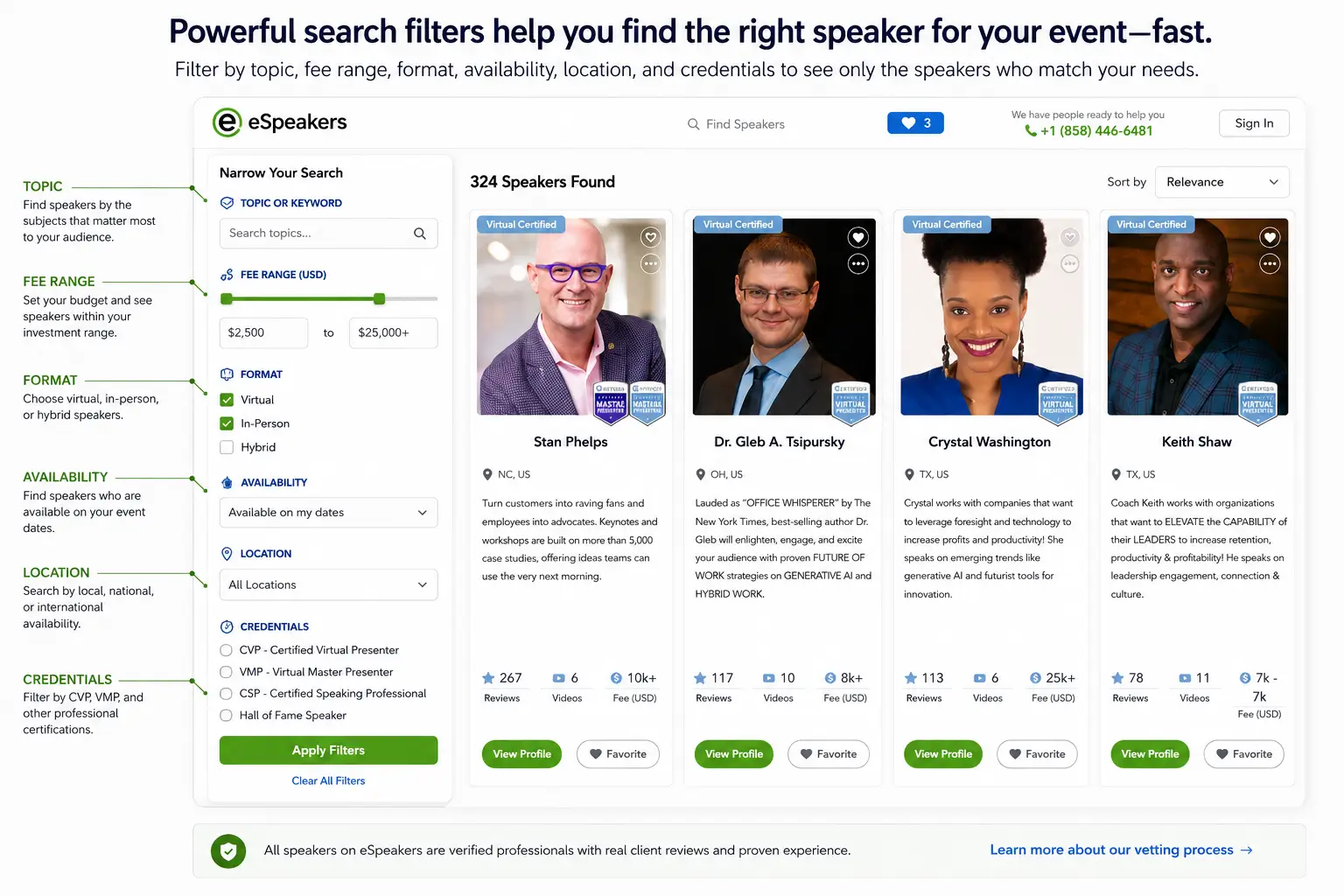
Every profile includes a demo reel, verified client reviews, live availability, fee range, and professional credentials. Filters for topic, budget, format, location, and certification status take you from thousands of options to a focused shortlist in minutes.
No fee. No account required to start searching.
→ Search Keynote Speakers Now
→ Find Motivational Speakers for Events
→ Browse Virtual Keynote Speakers
→ Find Corporate Speakers for Hire
This article was written to help meeting planners, corporate event managers, and association executives avoid the most common and costly mistakes in the keynote speaker hiring process. eSpeakers Marketplace is free for event planners to search and use. eSpeakers has connected professional speakers with planners since 1999.
Last updated: April 2026
Joe Heaps, Chief Marketing Officer at eSpeakers
Joe Heaps is the Chief Marketing Officer at eSpeakers and is responsible for creating and accelerating the company's sales & marketing strategies. He is focused on driving the company's vision of helping organizations and individuals improve in substantial, long-term ways. He believes it happens when the perfect speaker is in front of the right audience. Over 25 years in the industry, Joe’s strategic vision and leadership have propelled eSpeakers to the leading software platform for speakers, coaches, and experts.
Joe Heaps
Chief Marketing Officer, eSpeakers
Latest Articles

Related Articles