Why Every Professional Speaker Needs an Online Calendar Management Tool
Every day, meeting planners are ready to book speakers, and the speakers they don't book aren't always the wrong choice. They're often the right choice with the wrong infrastructure. A planner finds a speaker's profile, wants to move forward, and can't find an easy answer to a single question: Are you available on my date? Without an online calendar management tool connected to a live availability display, the planner moves on. That opportunity doesn't come back.
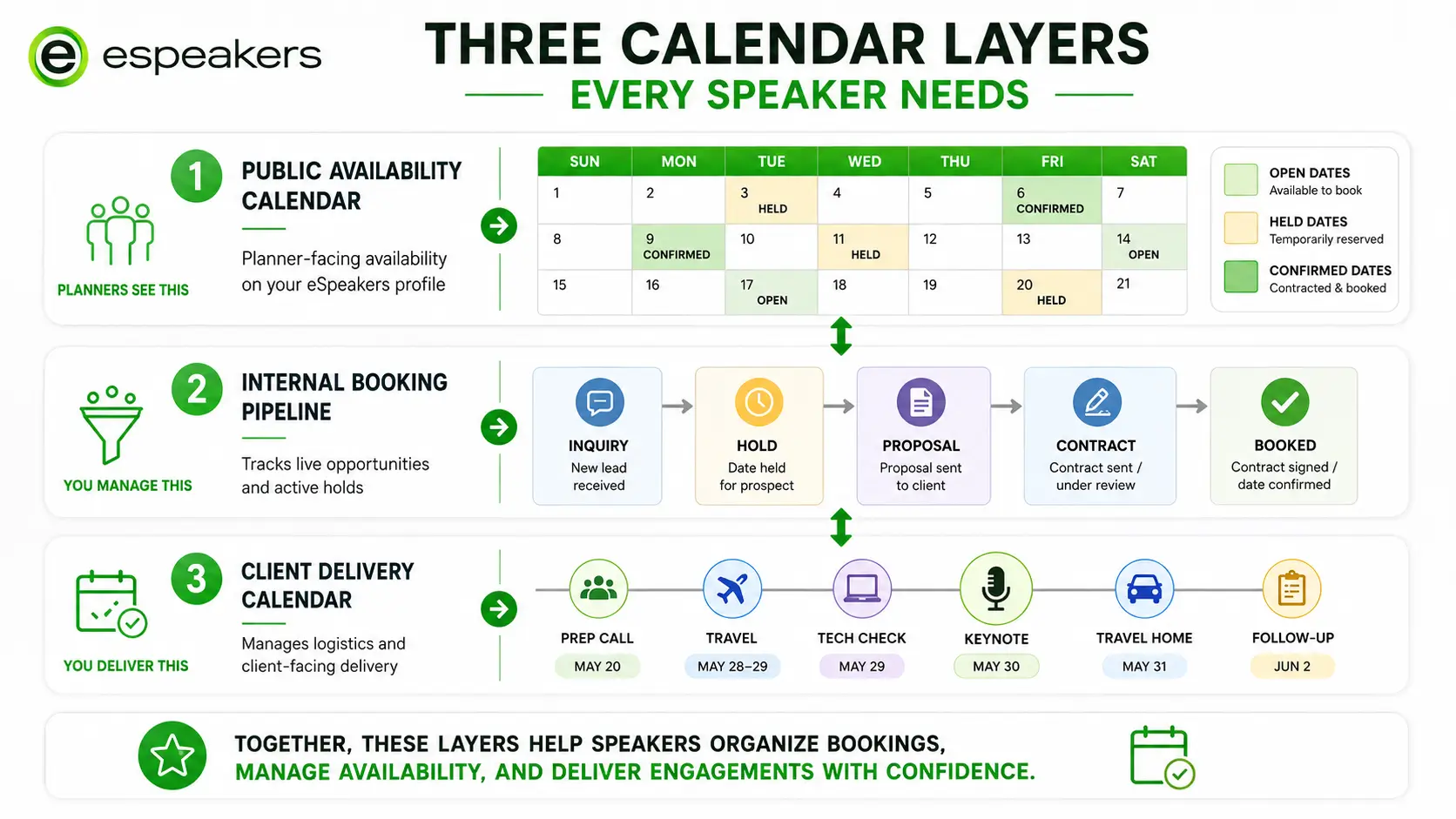
Online speaker scheduling software solves this by syncing a speaker's real-time availability to their public profile, automating the back-and-forth that compresses booking timelines, and managing the hold-to-confirmation lifecycle that most speakers track manually in email threads and personal calendars. In 2026, when planners are working with increasingly compressed booking windows, the absence of an online calendar management tool is a direct, measurable drag on bookings, not a minor operational inconvenience.

John Doe
Chief Marketing Officer at eSpeakers
The Way Most Speakers Handle Availability (And Why It's Costing Them)
Ask most professional speakers how they manage their availability, and you'll get some version of the same answer: "I check my phone calendar, and if it's clear, I let them know."
It sounds reasonable. For one or two inquiries a week, it mostly works. But it breaks down in ways that aren't always visible until the revenue is already lost.
The availability gap
Between the moment an inquiry arrives and the moment you respond, a planner may have moved to another candidate. Most planners work multiple events simultaneously, and open questions don't stay open; they get resolved by whoever responds first. If responding to an availability question requires you to stop what you're doing, check your calendar, craft a reply, and send it, and you're mid-flight, on stage, in a prep call, or simply offline, that window can stretch from hours to days.
The accuracy problem
A phone calendar reflects your personal commitments. It doesn't account for travel days around confirmed engagements, prep time you've protected before a major keynote, or the fact that you've verbally agreed to hold a date that hasn't been officially blocked. The result: a speaker who says "yes, I'm available" and then has to walk it back two days later, damaging trust with a planner who may have already begun building the event around that commitment.
The capacity illusion
Without a system, most speakers dramatically underestimate how full their schedule actually is. A confirmed date on February 8th looks like a single blocked day, but a speaker flying coast-to-coast needs February 7th for travel and probably shouldn't take another engagement until February 10th to recover and prep. None of that shows up in a phone calendar unless someone put it there deliberately. Most don't.
The visibility ceiling
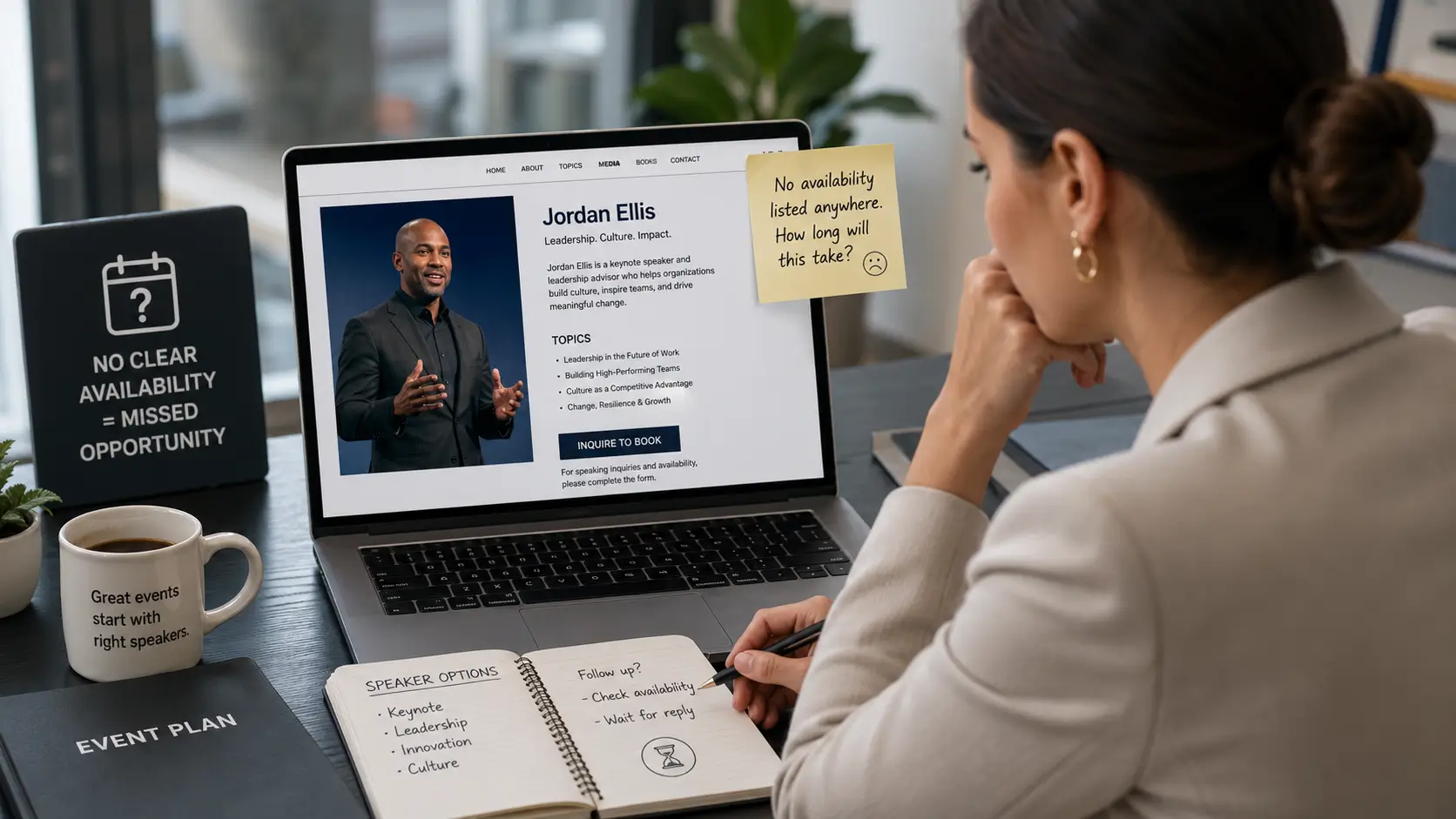
If your availability isn't displayed somewhere a planner can check without contacting you, you are effectively invisible at the most critical moment of the booking process. Event planners looking for speakers on eSpeakers or similar directories have several options. Speakers who are marked as "available" in real-time and offer a smooth initial interaction are more likely to receive inquiries. In contrast, those who require an email exchange to begin the conversation are often overlooked.
What Planners Actually Experience, and What They Remember
It’s worth spending a moment on the planner side of this, because that’s where the decision gets made.
Meeting planners in 2026 are operating under pressure from every direction. Nearly half say inexperienced support staff impacts their events, while others cite slow RFP responses as a core frustration, trends documented annually in PCMA’s Meetings Outlook research. They’re working faster, not slower. 2026 promises continued condensed booking windows and last-minute sourcing decisions as planners grapple with budgetary and geopolitical uncertainty. And they have more options in front of them than ever, with an estimated 10,000 or more speakers actively working the circuit worldwide.
In that context, a speaker who simplifies availability checks truly stands out. It’s not due to their topics, reel, or fee, but rather because the overall experience of working with them is seamless right from the first interaction.
There’s an important truth buried here: planners don’t just remember who delivered a great keynote. They remember who was easy to work with. Meeting Professionals International trains its members to evaluate speaker responsiveness and booking infrastructure as part of the overall speaker vetting process. Slow responses create doubt. Delayed follow-through creates stress. And stress is what prevents a planner from rebooking you the following year, recommending you to a colleague, or reaching out when a new event comes up. The logistical experience of working with a speaker is as much a part of their brand as what they say on stage.
Speaker scheduling software shifts this experience from reactive to proactive. Instead of a planner waiting for an email response, they can view your calendar, confirm the date is open, and send an inquiry within five minutes. The first impression they form isn’t “I’ll have to wait and see”, it’s “this speaker has their business together.”
The 5 Things Speaker Scheduling Software Actually Does for Your Business
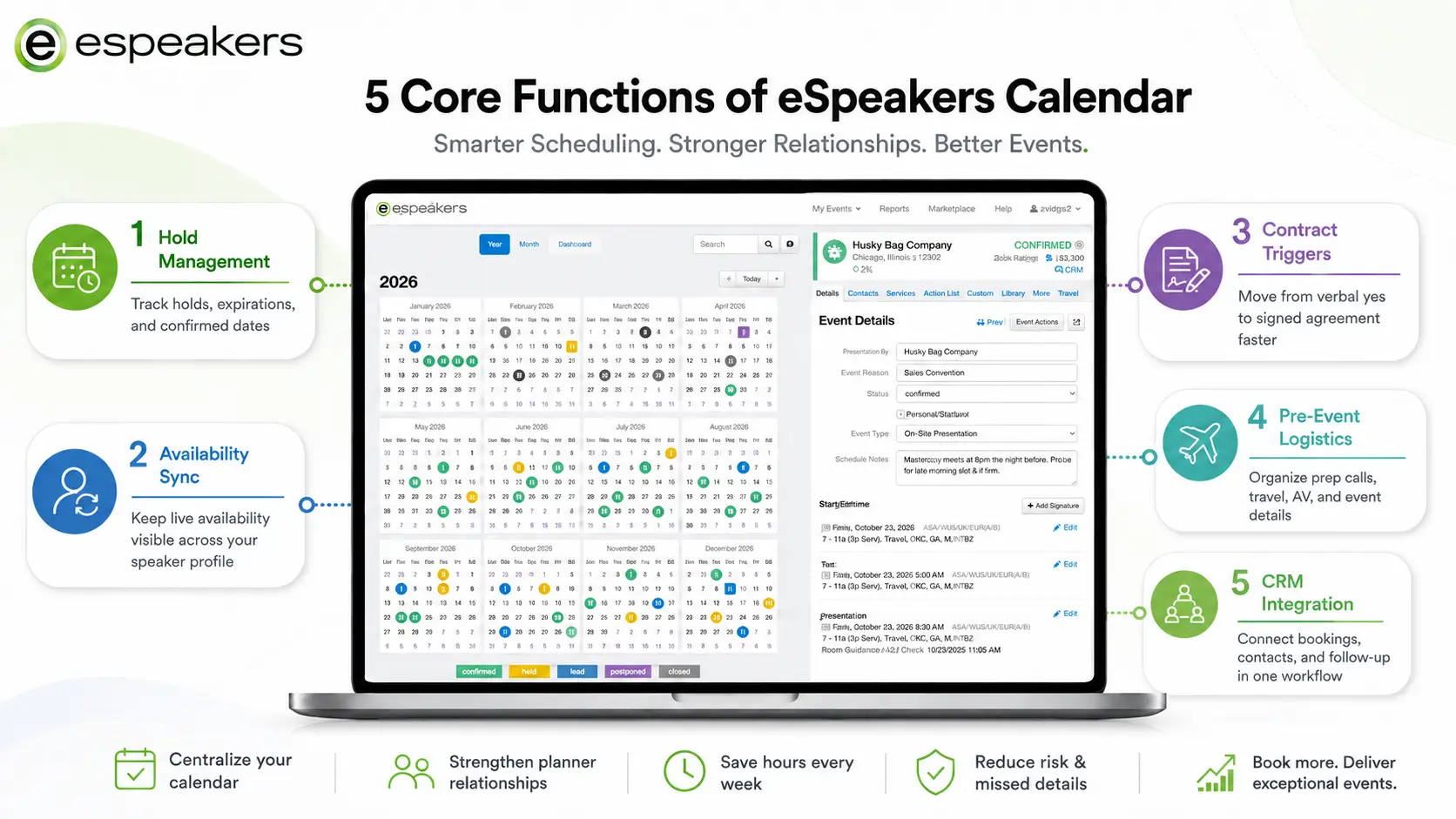
When most speakers think of scheduling software, they think of a calendar widget. That’s a narrow view of what the right tool actually does. Here’s the complete picture.
1. It Answers the Availability Question Before It’s Asked
The most direct function, and still the most valuable. When a planner visits your eSpeakers profile or your website, they can see your open dates without waiting for your response. Dates you’ve blocked for personal commitments, travel, or existing engagements appear as unavailable. Open dates appear as open.
This real-time visibility converts passive profile browsers into active inquiries. A planner who can confirm you’re available on their date is a planner who has reason to keep reading your profile, watch your reel, and reach out. One who can’t confirm availability often won’t bother.
2. It Protects You from Yourself
The manual scheduling approach can lead to hidden conflicts, not only between appointments but also between your actual bookings and unformalized commitments. Verbal holds, periods reserved for preparation, travel days, and personal obligations that are not accurately recorded, can create discrepancies between your perceived schedule and the reality of it.
Good speaker scheduling software enforces buffer rules automatically. Block a confirmed engagement on March 15th, and the tool can automatically protect March 14th as a travel day and March 16th as a recovery day. The result: a calendar that reflects reality rather than optimism.
The cost of double-booking, even once, extends well beyond the engagement you have to cancel. The professional reputation damage with a planner who had already committed to a room, a printed program, and a promoted event is severe and long-lasting. Speaker scheduling software doesn’t just prevent double booking; it removes the conditions that make it likely.
3. It Makes Your Business Work While You’re on Stage
A speaking career is built in the margins, the hours between engagements when you’re traveling, prepping, or recovering. Those are also the hours when new inquiries arrive, holds expire, and planners need responses.
Speaker scheduling software allows you to manage your business development without being physically present. A planner can check your availability, send an inquiry, and receive an automated confirmation. Additionally, they can have a pre-event questionnaire ready in their inbox even before you land from your flight. This process is possible not because you hired a full-time assistant, but because the system is designed to handle the initial stages of every interaction without requiring your direct involvement.
This is the compounding advantage that separates speakers who scale from those who plateau: at some volume of activity, the speaker who relies on manual responses simply cannot keep up. The speaker with an automated scheduling system can continue to capture and respond to inquiries even at full capacity.
4. It Connects Your Public Presence to Your Private Operations
One of the most common and costly failure points in speaker operations is the disconnect between public-facing availability and internal reality. A speaker updates their eSpeakers calendar manually, infrequently, and inconsistently. A planner sees an open date that’s actually held. The planner reaches out, gets told it’s not available after all, and the interaction ends on a note of confusion rather than confidence.
The right speaker scheduling software syncs bidirectionally with your master operations calendar, typically your Google Calendar or Outlook, so any change in one reflects immediately in the other. Block a new date in your personal calendar, and your public eSpeakers availability updates in real time. No manual reconciliation. No stale information. No awkward corrections after a planner has already started planning around your supposed availability.
5. It Generates Business Intelligence You Can’t Get Any Other Way
Once your scheduling data lives in a system rather than your head, it becomes analyzable. How many inquiries came in this quarter versus last quarter? What’s your hold-to-confirmed conversion rate? Which months consistently have open dates and need active outreach? Which time of year do you have the most last-minute inquiries? What was my best lead source?
These aren’t just abstract concepts; they are crucial inputs that enable you to make better decisions regarding pricing, marketing, outreach timing, and capacity. For example, a speaker who is aware that their fall calendar fills up in July should launch outreach campaigns in May rather than waiting until September. Similarly, a speaker who knows their hold conversion rate is 40% can adjust their deposit pricing accordingly. None of this analysis is feasible without a system in place to track the data.
Why Generic Scheduling Tools Fall Short for Speakers
At this point, some speakers reading this will think: "I already use Calendly", or Google Calendar, or another general scheduling tool, "so I'm covered."
Not quite. General scheduling tools are built for appointment booking: they show your available hours and let people pick a slot. They work well for consulting calls, coaching sessions, and sales demos. They don't understand the specific lifecycle of a speaking engagement, and that gap shows up in several ways.
They don't understand holds
A general scheduling tool doesn't have a concept of a soft hold, a date that's tentatively reserved pending a planner's confirmation, neither fully open nor confirmed. This is one of the most common states in a speaker's pipeline, and without a tool that handles it natively, holds get managed through a combination of phone calendar blocks and memory. That combination fails.
They don't understand travel
A general scheduling tool displays the speaker as available on both the day before and the day after a confirmed booking. However, the speaker should not be available on those days. If those days are not manually blocked each time, the tool will inaccurately show availability, leading to potential issues when a second booking is confirmed.
They don't connect to your directory listing.
A Calendly link on your website doesn't update your eSpeakers profile. Your eSpeakers profile is where planners actively search for speakers, and it needs to show accurate availability to surface you in search results and availability filters. Only a tool built specifically for eSpeakers integration can keep both in sync automatically.
They don't understand the engagement lifecycle
From inquiry to hold to contract to prep calls to post-event follow-up, a speaking engagement has eight to ten distinct stages, each with its own required actions, communications, and deadlines. A general scheduling tool captures the initial appointment booking and stops there. Speaker-specific software continues to track and manage the engagement through completion.
What to Look For in Speaker Scheduling Software
If you're evaluating tools or reconsidering the patchwork of apps you're currently using, these are the capabilities that matter.
Real-time sync with your eSpeakers profile
Your public availability should reflect changes to your internal calendar instantly—no manual updates, no lag, no gaps between what planners see and what’s actually real.
Hold management
The tool should support tentative holds as a distinct status, neither fully open nor confirmed, with the ability to set expiration windows and trigger follow-up reminders automatically.
Travel buffer automation
The ability to automatically protect days around confirmed engagements so your public calendar never shows false availability adjacent to a booking.
Mobile access with full functionality
Speakers are traveling constantly. Your scheduling tool needs to work completely from a phone, not a stripped-down mobile version that requires a laptop to make meaningful changes.
CRM pipeline connection
When a date moves from hold to confirmed, your CRM pipeline stage should update automatically. When a new inquiry comes in through your scheduling link, a CRM record should be created. The goal is one source of truth across your entire business, not two systems you have to reconcile manually.
Forward visibility of at least 12 months
Major conference planners work 6–12 months out. If your public calendar only shows the next 90 days, you disappear from consideration for the biggest opportunities.
eSpeakers' built-in calendar and scheduling tools were designed with all of this in mind, because the company was built by people who understand the speaking business from the inside. It's not a generic scheduling widget adapted for speakers. It's a system that understands holds, travel windows, engagement stages, and directory visibility as native concepts.
The Compounding Cost of Waiting
Here’s the uncomfortable math every speaker should sit with for a moment. The [National Speakers Association’s professional conduct guidelines address hold management as a professional obligation; speakers are expected to communicate hold status clearly and promptly.
If a speaker gets 10 availability inquiries per month, and a slow-response or no-calendar setup loses even 20% of those to a faster competitor, that’s two lost inquiries per month. At an average engagement fee of $7,500, that’s $15,000 in potential monthly revenue that went to someone else, not because of talent, not because of topic fit, not because of price, but because of friction in the first five minutes of the booking process.
Over a year, that’s $180,000 in missed opportunity from a problem that speaker scheduling software solves.
The exact numbers will vary by speaker. The outcome won’t.
Every inquiry that runs into friction, whether it’s a contact form, a three-day delay, or a stale calendar with no visible availability, carries a real chance of going somewhere else.
Speakers who remove that friction don’t just convert more inquiries; they build momentum. Planners who experience a smooth booking process return, refer colleagues, and recommend you across their networks, compounding your advantage over time.
FAQ
The volume argument cuts the wrong way. If you’re doing 10–15 engagements a year, every single inquiry matters more, not less. Losing two bookings to slow availability responses at lower volume is a higher percentage impact on your revenue than losing two bookings at 40 engagements a year. The ROI of scheduling software scales down with volume, but the stakes of losing individual bookings scale up.
Because even the best human scheduler isn’t available 24/7, can’t update a public-facing directory in real time, and introduces a communication layer between an interested planner and an available date. Software handles the first-pass availability display and inquiry capture automatically, freeing your manager or VA to focus on the higher-judgment work of converting inquiries to confirmed bookings.
Sharing a personal Google Calendar creates a different problem: planners can see everything on it, including personal appointments, family commitments, and internal notes not meant for client visibility. It also doesn’t integrate with your eSpeakers directory listing, meaning planners searching for speakers won’t see your accurate availability in search results. A dedicated speaker scheduling tool maintains the right level of visibility, open and unavailable dates, without exposing your full personal schedule.
Yes, and arguably more so. Bureau relationships require fast, accurate availability confirmation. When a bureau agent calls to check availability for a client, having real-time calendar access speeds up the hold confirmation process and builds the agent’s confidence that working with you is efficient. Bureau agents work with dozens of speakers. The ones who make availability checking easy get called first.
For most speakers, the initial setup takes just a few hours: connect your master calendar, define your availability rules, set travel buffers, and sync your eSpeakers profile. From there, it largely runs itself, with only light upkeep as you add confirmed dates and update holds as they resolve.
Stop Managing Availability the Hard Way
The speaking business rewards responsiveness. It rewards professionalism at every touchpoint. It rewards speakers who make the booking process feel easy, because easy to book is memorable in exactly the same way that hard to book is memorable, just in the opposite direction.
Speaker scheduling software is not a luxury for high-volume professionals. It’s the baseline infrastructure that lets you compete at the level your talent deserves, in a market where the speaker who responds first, clearly, and with real-time availability data wins the inquiry more often than the one who asks a planner to wait.
Start your 60-day eSpeakers PRO free trial →
Set up your speaking engagement calendar, sync it to your eSpeakers profile, and start showing planners real-time availability today, so the next time a planner is ready to book, the path to yes is already clear.
Joe Heaps, Chief Marketing Officer at eSpeakers
Joe Heaps is the Chief Marketing Officer at eSpeakers and is responsible for creating and accelerating the company's sales & marketing strategies. He is focused on driving the company's vision of helping organizations and individuals improve in substantial, long-term ways. He believes it happens when the perfect speaker is in front of the right audience. Over 25 years in the industry, Joe’s strategic vision and leadership have propelled eSpeakers to the leading software platform for speakers, coaches, and experts.
Joe Heaps
Chief Marketing Officer, eSpeakers
Latest Articles


Related Articles