How to Brief a Keynote Speaker for Maximum Impact
Most meeting planners invest significant time and care in deciding which keynote speaker to hire. They search speaker directories, watch reels, read reviews, conduct discovery calls, and negotiate contracts. All of that work is necessary and valuable.
Then the contract is signed, and for many planners, the active engagement ends. The speaker is booked. The event is on the calendar. What's left is logistics.
This is one of the most consistent gaps between speaker engagements that generate lasting impact and those that generate polite applause and forgotten handouts. The work that happens between booking and stage, the briefing process, is what separates a keynote that changes how your audience thinks and behaves from one that fills a time slot competently.
The best keynote speakers know this, too. They want the briefing information. They ask for it. The speakers who produce the most impact at corporate events, association conferences, and leadership retreats are the ones who show up having done real preparation work, and real preparation work requires real information from the planner.
This guide gives you the complete briefing framework: what to include, how to deliver it, when to schedule the key conversations, and how to prepare your audience to receive maximum value from the speaker you've hired.

John Doe
Chief Marketing Officer at eSpeakers
Haven't found your speaker yet? Start here, free.
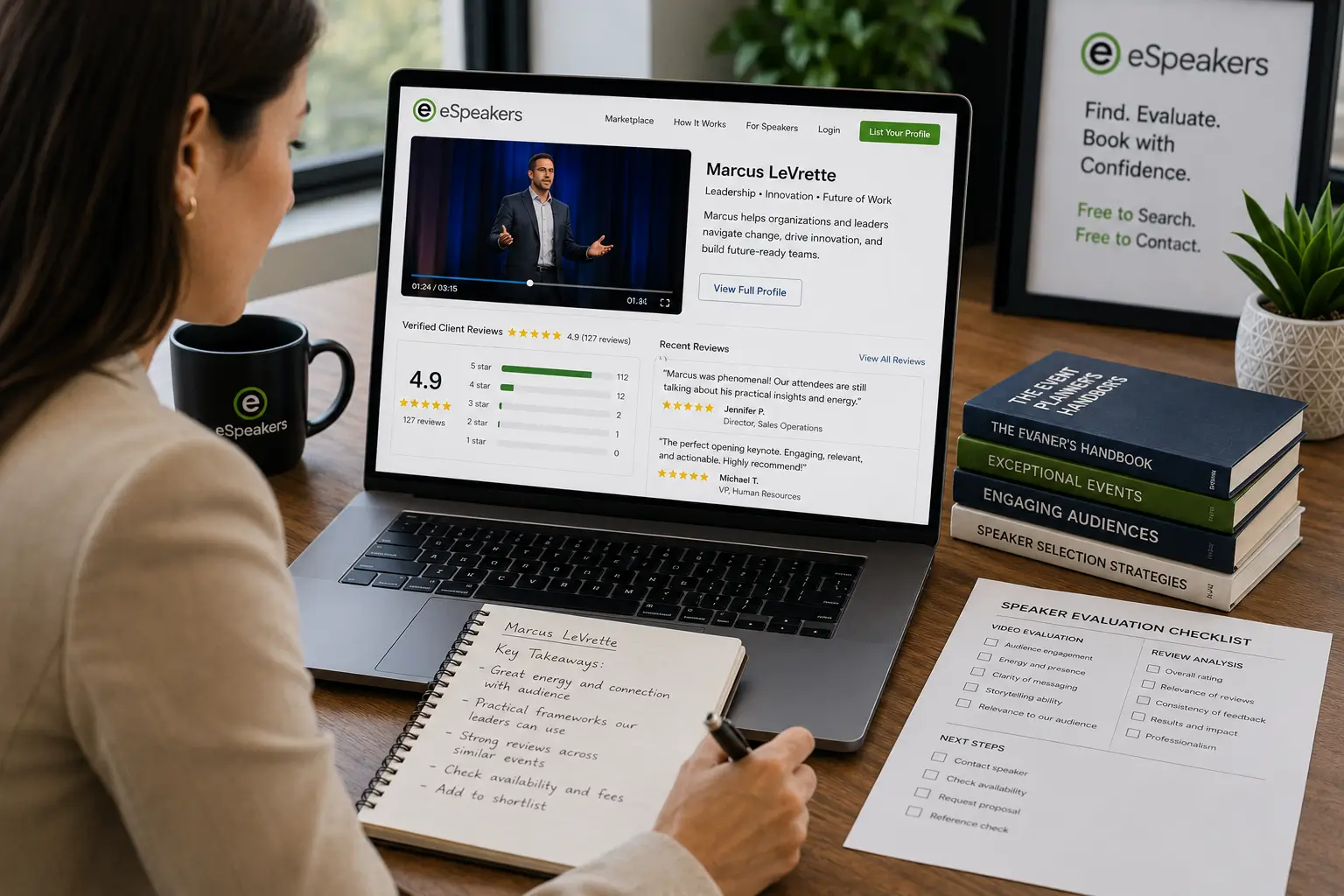
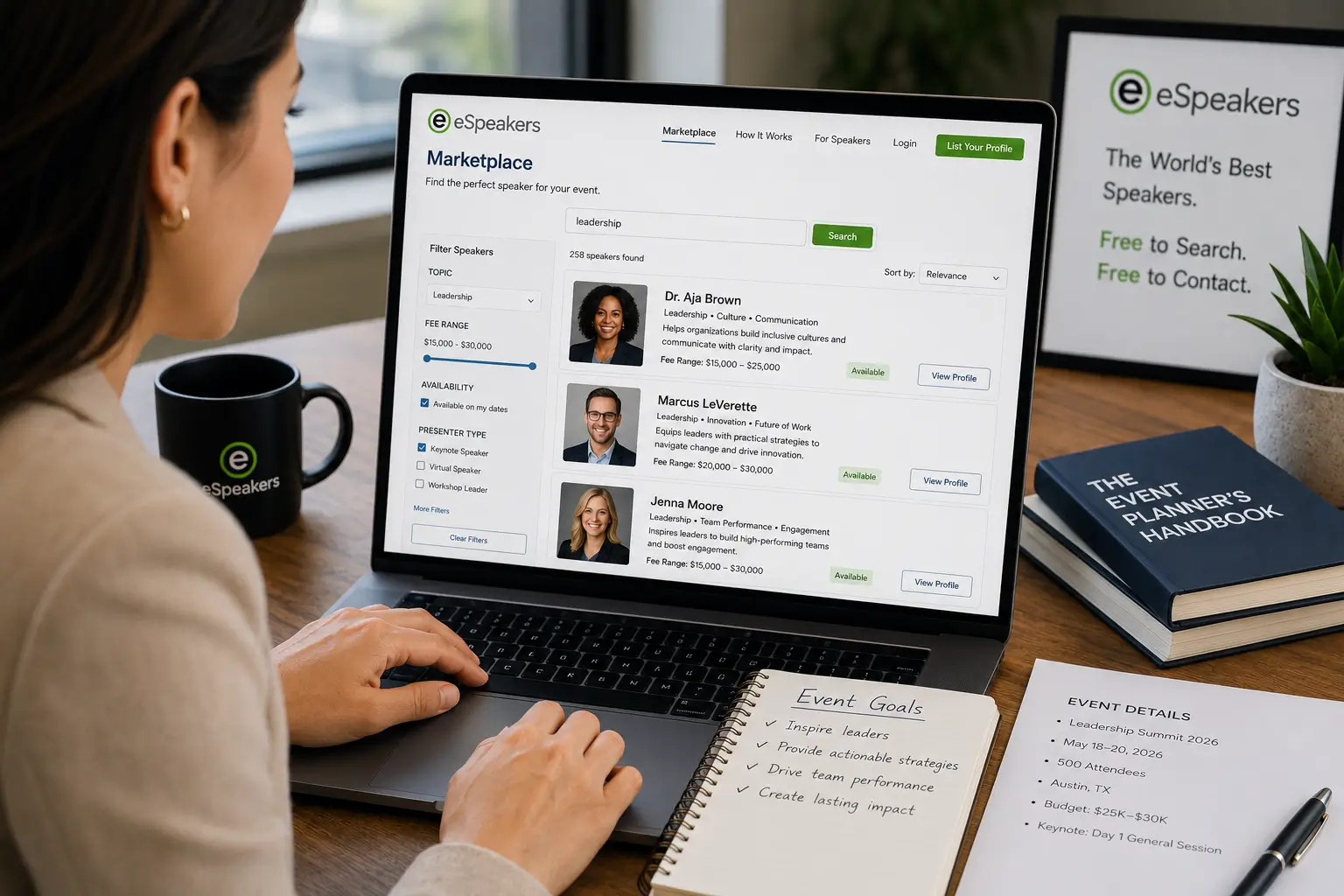
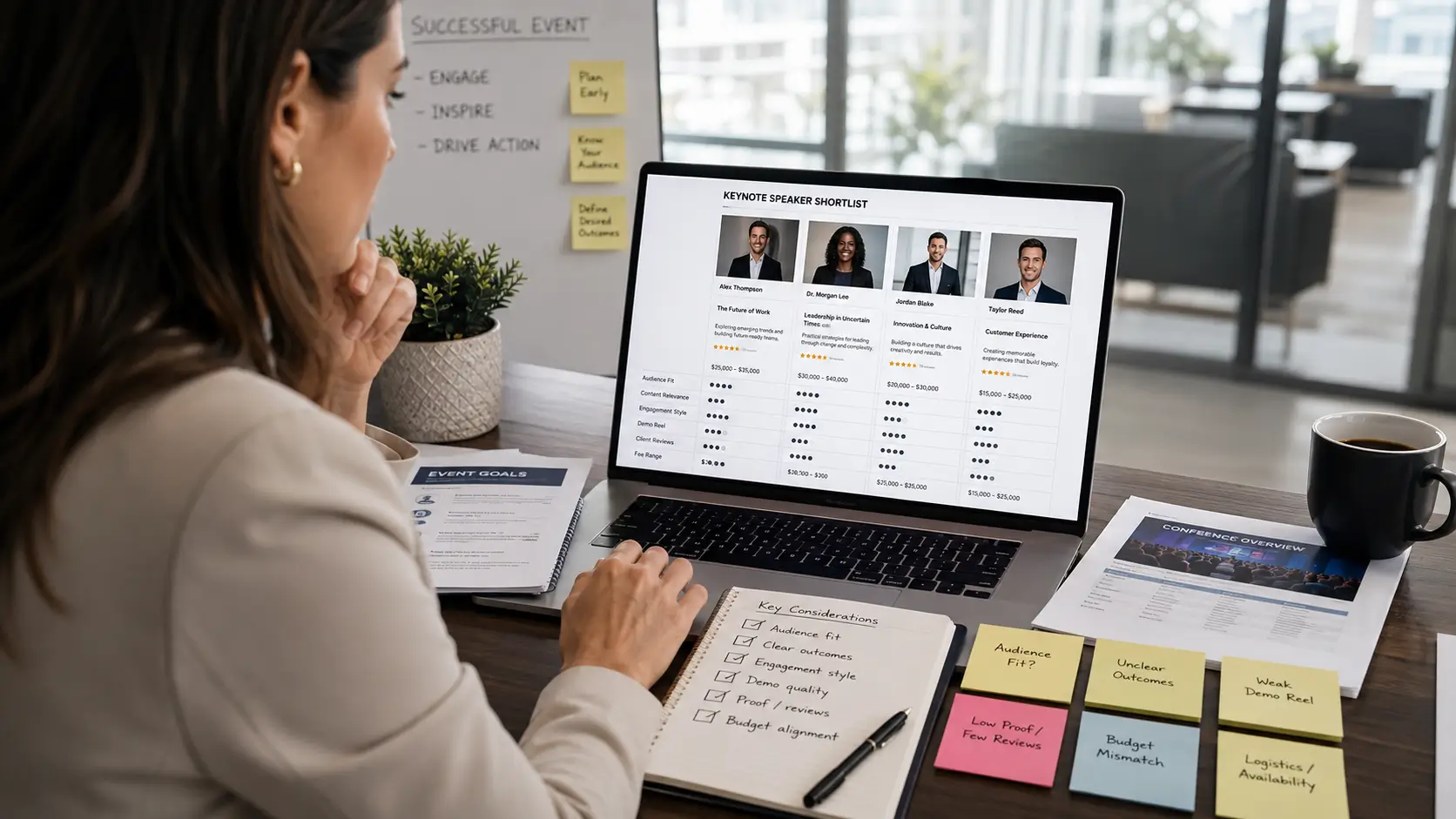
Before you can brief a speaker, you need to find the right one. The eSpeakers Marketplace gives you demo reels, verified client reviews, live availability, and fee ranges on every profile — all the information you need to make a confident selection before the briefing process begins.
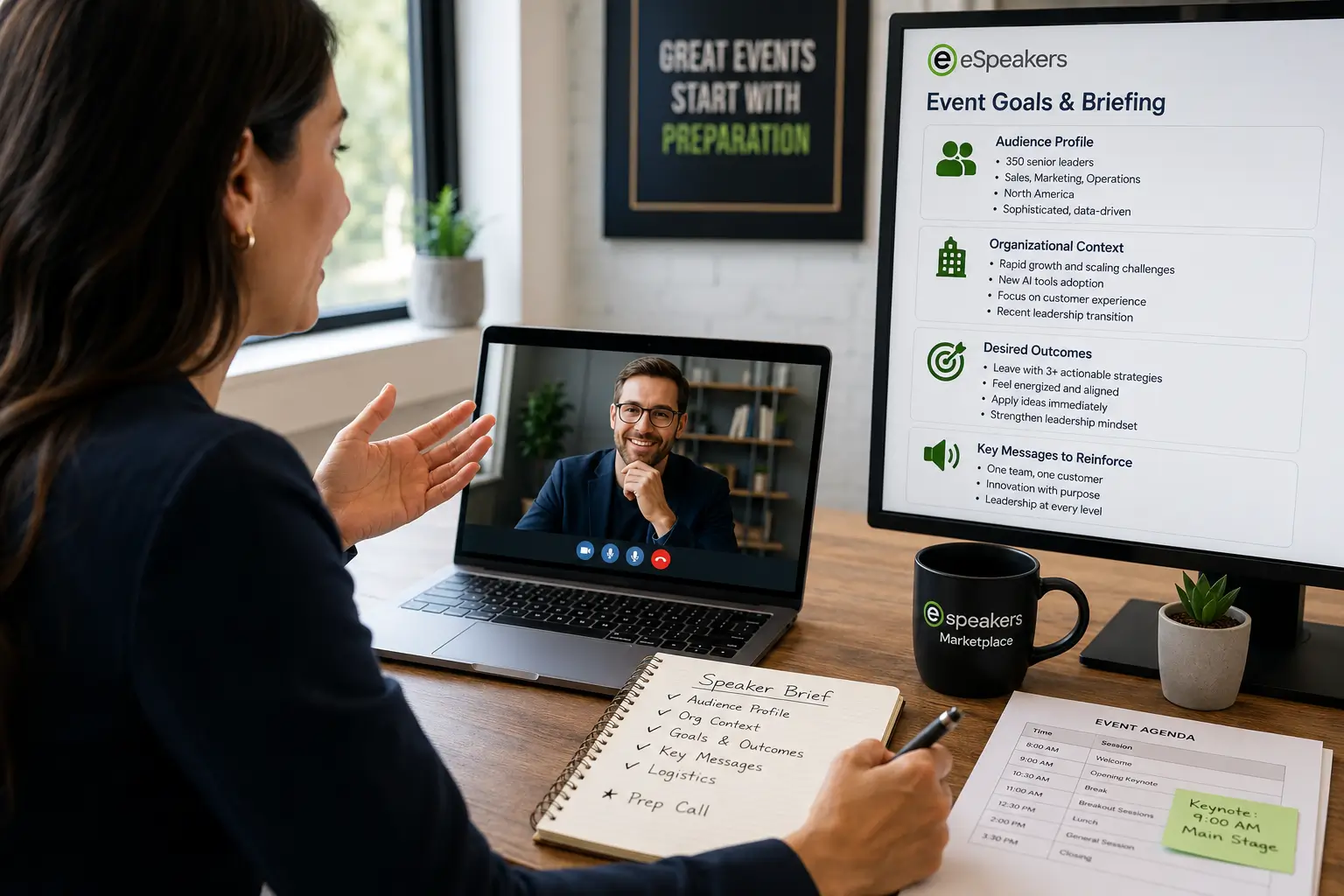
Why the Brief Matters More Than Most Planners Realize
There’s a version of the speaker briefing that most planners do: send the event agenda, a brief description of the audience, and the logistics document. This is the minimum. It produces the minimum result: a speaker who shows up technically prepared but not specifically prepared for this audience at this moment.
There’s another version of the speaker briefing, the one the best planners do and the best speakers insist on, that gives the speaker everything they need to tailor their content, their examples, their references, and their calls to action to the specific organizational context they’re walking into. This version produces the maximum result: a speaker whose presentation feels like it was written specifically for this room, because it largely was.
The Smooth Sailing ebook frames this precisely: when you communicate your goals clearly to your speaker and work with them closely on their role, “the speaker will be able to address your group’s specific needs.” That connection between the planner’s brief and the speaker’s customization is not automatic; it requires information, and the planner is the only source of that information.
The briefing is also where misalignment surfaces before it becomes a problem. A speaker who understands your audience’s sophistication won’t pitch a 101-level keynote to a room of experienced professionals. A speaker who knows their audience is resistant to certain messaging will frame their content differently than one who assumes receptive listeners. A speaker who knows about a recent organizational challenge will reference it in ways that demonstrate they understand what the room is living through, and that relevance is what converts a good keynote into a memorable one.
Part 1: The Complete Speaker Brief, What to Include
A complete speaker brief covers five categories of information. Every category matters. Leaving any of them out produces a gap in the speaker's preparation that the best speaker can't fully compensate for on stage.
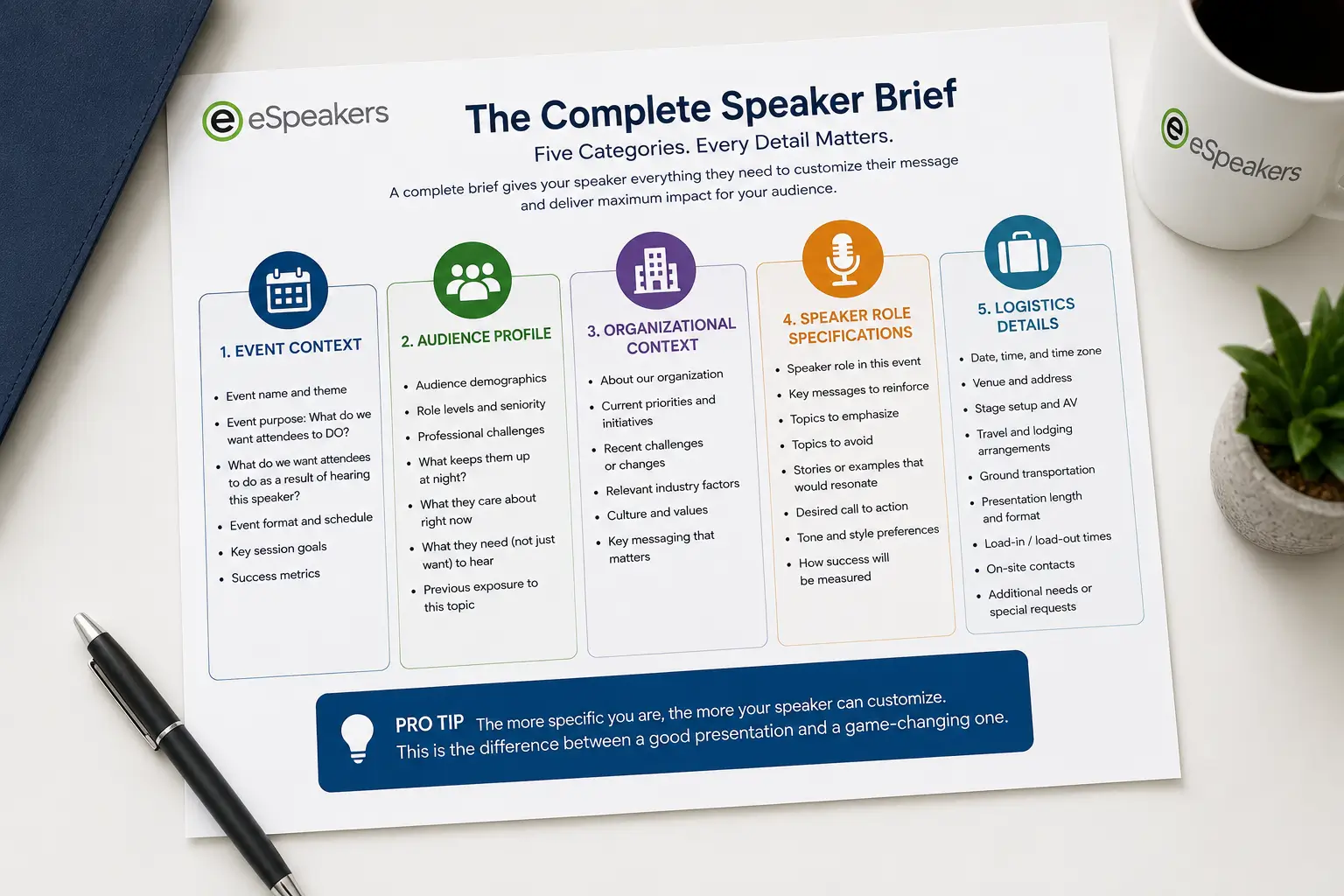
Category 1: The Event Context
Event name and theme:
The event’s name tells the speaker what framing language to use. The theme, if there is one, tells them the conceptual anchor their content should connect to. A speaker who references the event’s theme explicitly in their presentation signals that they paid attention to the bigger picture.
Event purpose, your exact answer to the two questions:
Provide your written answers to: “What do we want attendees to DO as a result of this event?” and “What do we want attendees to do as a result of hearing this speaker specifically?” These aren’t rhetoric; the speaker needs them verbatim, in the specific language you used when you set them, because that language is what you’ll use to measure whether the event succeeded. The speaker can’t calibrate their content to your goals unless they know your goals in this level of specificity.
Full agenda:
Send the complete event agenda, all sessions, all speakers, all social and networking elements, and all breaks. The speaker needs to know:
- Where their session sits in the day (opening, post-lunch, closing, breakout)
- What comes immediately before their presentation
- What other speakers are covering and in what sequence
- Whether there are workshop or breakout elements that follow their keynote that they could seed
A speaker who gives the second presentation of the day at a conference where the morning session covered adjacent content needs to know, so they don’t spend 20 minutes on foundational context that the audience already received. A speaker whose closing keynote follows a day of strategic planning sessions should close differently from one who is the first presenter of the event.
Event format:
In-person, virtual, or hybrid. Room layout for in-person events (theater seating, rounds, classroom, auditorium). Platform for virtual events (Zoom, Teams, WebEx). Whether there is a confidence monitor, a clicker, a stage, or a flat floor, these details affect how the speaker frames their delivery and designs their movement.
Session length:
Specify the total time allocated and how much of that is the primary presentation vs. Q&A. If Q&A is included, specify whether questions come from the floor, through a moderator, from a pre-submitted question pool, or through a digital tool.
Event location and time zone:
For in-person events: city, venue, and the room name. For virtual events, the time zone in which the event is scheduled is critical for international speakers and for virtual events with distributed audiences.
Category 2: The Audience Profile
This is the most important category in the brief. The speaker cannot tailor their content without knowing who is in the room, and the more specific this profile, the more precisely they can tailor.
Who they are:
- Job titles and functional roles represented
- Career level: entry-level, individual contributor, manager, director, executive, C-suite
- Industry or sector
- Whether the audience is homogeneous (all the same function) or mixed (cross-functional, cross-level)
- Approximate number of attendees
What they already know: This is the most underused piece of audience information in most speaker briefs. Describe your audience’s existing familiarity with the speaker’s topic area, honestly. An audience of experienced HR professionals who have spent a decade navigating organizational change needs a different starting point than a group of frontline managers encountering formal change management frameworks for the first time. A speaker who doesn’t know your audience’s expertise level may pitch their content at the wrong level, either boring an advanced audience with basics or losing a novice audience in specialized language.
The specific challenges they’re currently facing: What is this audience navigating professionally right now? The organizational challenges, team dynamics issues, strategic pressures, or external forces that are shaping their work environment in the weeks and months around your event. The more specific this description, the more the speaker can make their content feel immediately relevant rather than theoretically applicable.
Examples of specific vs. vague:
- Vague: “Our managers are dealing with change.”
- Specific: “Our managers are six months into a technology migration that has increased their administrative load by approximately 40%, while simultaneously being asked to maintain team performance metrics that were set before the migration began. Most feel under-supported, and some are openly expressing frustration about conflicting priorities.”
A speaker who receives the specific version can build examples, references, and calls to action that resonate precisely with what the audience is living. A speaker who receives the vague version will build content that could apply to any organization dealing with change.
What they need to hear, and what they’re resistant to: Every audience comes with assumptions, biases, and skepticism that a great speaker accounts for rather than ignores. What is your audience likely to be resistant to in this topic area? What messaging has been tried before and hasn’t landed? What organizational history might make certain framings feel tone-deaf?
This is information that only you have, and it’s the information that turns a good speaker into a trusted one. A speaker who opens by acknowledging a known organizational tension, framing it in a way that demonstrates they understand it rather than dismissing it, builds credibility with the audience in the first five minutes that sustains their attention throughout.
What they’re hoping to get from this session: If you’ve done a pre-event survey of attendees, share the results. What questions did they submit in advance? What challenges did they describe? What specific outcomes are they hoping for? This information is gold for a motivated speaker; it gives them the words their audience is already using to describe their situation, which they can mirror in the presentation to create an immediate sense of connection and relevance.
Category 3: The Organizational Context
What’s happening in the organization right now:
Has the organization recently gone through a restructuring, a leadership change, a merger, an acquisition, a difficult performance period, or a major strategic shift? Is there a new initiative being launched? Is the culture in transition? Is morale high, low, or complicated?
This context is often the most sensitive part of the brief; it requires sharing information that planners may be accustomed to keeping internal. The brief to a speaker is confidential; professional speakers treat client context with discretion, and it’s worth sharing specifically enough to be useful. A speaker who knows that morale is low following a difficult year can frame their motivational content in a way that acknowledges the reality rather than cheerfully ignoring it. A speaker who doesn’t know will deliver content calibrated for an audience that’s in a more neutral or positive state, which can land as dismissive or tone-deaf.
The organization’s language and frameworks:
If your organization has specific terminology, values, language, or frameworks that are in active use, a set of leadership principles, a company-specific model, or a cultural initiative with its own vocabulary, share these with the speaker. A speaker who can reference your organization’s actual language in their presentation creates an integration between what they’re saying and what your organization is already building. This is the highest form of customization.
Who is in leadership and what they’ve communicated recently:
Has your CEO or executive sponsor set a specific strategic direction for this event? Are there themes from recent all-hands communications that the speaker’s content should connect to? If the executive team has been building a particular narrative, the speaker’s keynote can either advance that narrative or inadvertently undercut it, and the difference is whether the speaker knows it exists.
What speakers or programs preceded this one:
Has this audience heard other speakers recently on adjacent topics? Have they been through training or development programs that covered similar ground? A speaker who knows what content your audience has already received can build on it, reference it, and differentiate from it, rather than inadvertently repeating it.
Category 4: The Speaker's Specific Role and Goals
Your outcome statement for this specific presentation:
Restate your answer to “what do we want attendees to do as a result of hearing this speaker” in the most specific terms you can. This is the deliverable you’ve hired the speaker to produce.
Any specific topics to emphasize:
If there are particular areas within the speaker’s expertise that are especially relevant to your audience’s current situation, flag them explicitly. Don’t assume the speaker will know without being told.
Any topics or examples to avoid:
If there are organizational situations, competitor references, or topic areas that would be counterproductive for this audience at this moment, tell the speaker. This isn’t censorship, it’s context. A speaker who unknowingly uses an example that resonates badly with your organization’s recent experience will lose the room, and they can’t avoid it if they don’t know it’s a risk.
Whether Q&A is included and how you want it managed:
If the session includes audience Q&A, specify: how long, how questions are submitted (microphone, digital tool, moderator-curated), whether there are sensitive areas you’d like the speaker to deflect, and whether you’ll have a moderator who manages the Q&A process or whether the speaker manages it directly.
The call to action you want the speaker to close with:
What specifically do you want audience members to do immediately after the session? If there’s a specific action, a follow-up resource, a survey, or a next step built into your event’s flow, the speaker should close in a way that sets that up rather than ending in a way that leaves the audience emotionally peaked but directionally unclear.
Category 5: Logistics and Technical Requirements
Day-of schedule:
When the speaker arrives. When they have access to the room or platform. When the sound check or tech check is. What the exact session start and end times are. Who greets them on arrival, and who is their point of contact throughout the day?.
AV and technical requirements:
What’s available in the room: screen size and format, microphone type, clicker/remote, internet access, and confidence monitor. What the speaker needs to bring or request in advance.
Virtual technical specifications (for virtual/hybrid events):
Platform name and version. How the speaker will be given access (host link, panelist invitation). Who manages the technical environment during the session (and how to reach them if something fails). Recording: Will the session be recorded, and is the speaker’s consent confirmed in the contract?
The introduction:
Who is introducing the speaker, and does the speaker need speaker-provided language for that introduction? A bio recitation is the standard, and the standard is largely ineffective. MPI’s speaker management guidelines note that speaker introductions are one of the most consistently underprepared elements of corporate event programs. The best introductions are 60–90 seconds, written or approved by the speaker, and designed to create anticipation rather than recite credentials.
Post-session logistics:
Does the speaker stay for a book signing, networking, or a meal? Are there VIP meetings or executive dinners to schedule? What is the speaker’s departure timeline, and who manages it?
Part 2: How to Deliver the Brief
A well-constructed brief is only useful if it reaches the speaker in a format they can actually work with. The delivery structure matters as much as the content.
The Written Brief: Send It First
The complete written brief should be delivered to the speaker 4–6 weeks before the event, earlier for flagship conferences or high-customization engagements. Send it before the prep call, not as an agenda item to discuss during it. The speaker needs time to read and absorb the brief before the conversation. If you send it at the start of the call, you’ve reduced a 45-minute preparation conversation to a 45-minute document reading.
Format recommendations:
Structure the brief so the speaker can navigate it without reading every word in sequence. Use clear headers for each category. Use bullet points for list-type information (audience roles, specific challenges) and prose for context that needs explanation (organizational history, what the audience has been through).
Keep it as concise as possible while including everything necessary. A 12-page brief that requires an hour to read will be skimmed. A well-organized 4–6 page brief with clear sections will be thoroughly absorbed.
Include:
- Event overview (name, date, venue/platform, session time, length)
- Your two event goal statements verbatim
- Your specific outcome statement for this session
- Complete audience profile (all five audience-profile elements)
- Organizational context (current situation, language and frameworks, relevant history)
- Call to action for the close
- Any topics to emphasize or avoid
- Logistics document (day-of schedule, AV details, point of contact)
Send separately: The complete event agenda, any pre-event survey results from attendees, recent relevant organizational communications (if shareable), and any materials from previous similar speaker engagements that give the speaker context about what has worked and not worked with this audience.
The Prep Call: Use It for Dialogue, Not Document Review
The prep call is where the brief becomes a briefing, a conversation in which the speaker can ask questions, probe for deeper context, and share how they’re planning to adapt their content.
Schedule the prep call 3–4 weeks before the event, far enough after the brief has been sent that the speaker has absorbed it, and far enough before the event that there’s time for meaningful content adaptation based on what you discuss.
Call length: 45–60 minutes for a standard keynote. 90 minutes for a flagship engagement or when the brief reveals a significant customization opportunity.
How to structure the prep call:
In the first 10 minutes, their questions are about the brief. Let the speaker lead. What did they need to ask about after reading the brief? The questions a speaker asks tell you a great deal about how they’re approaching your event. A speaker who asks about specific audience situations, about what content has landed with this group before, about the organizational context behind the event purpose, that’s a speaker who is genuinely preparing to tailor. A speaker who asks primarily about logistics is a speaker who may not be doing deep customization work.
Next 20 minutes, discuss the audience situation in depth. This is where the brief’s audience profile section comes alive. The speaker should have read the written profile; the call is where they ask follow-up questions about the specifics, test their assumptions about the audience’s situation, and share how they’re thinking about adjusting their content.
For the next 15 minutes, the speaker walks you through their plan. Ask the speaker to describe specifically how they’re planning to adapt their content for your audience. Not “I’ll tailor it to your group”, that’s not specific. But: “I’m planning to open by acknowledging the technology migration situation you described and framing it as a specific type of organizational change my research shows is particularly hard on managers. Then I’m going to spend about 20 minutes on the accountability framework, which I think addresses the competing priorities problem directly. And I want to close by connecting back to [specific organizational value] that you mentioned is the language your team uses.”
That level of specificity tells you the brief was read and used. It also gives you the opportunity to course-correct: “Actually, the accountability framework might land better after you’ve addressed the morale element. Let me tell you more about that.”
Final 10 minutes, logistics confirmation, and next steps. Confirm the day-of schedule, point of contact, AV requirements, and any outstanding logistics items. Agree on whether there’s a follow-up call closer to the event.
The Pre-Event Check-In: One Week Out
A brief check-in call or email 7–10 days before the event serves two purposes: confirming that nothing has changed that would affect the speaker’s content, and giving the speaker the opportunity to surface any remaining questions.
What to include:
- Any organizational developments since the prep call that are relevant
- Confirmation of all logistics (time, access, contacts)
- For virtual events: tech check scheduling (48–72 hours before the event)
- Any last-minute updates to the agenda that affect the speaker’s slot
If the prep call was thorough and the event is stable, this check-in can be brief, a short email rather than a call. If there have been organizational developments since the prep call, make it a call.
Day-of Preparation
For in-person events:
- Assign a dedicated point of contact who meets the speaker on arrival and is available throughout the day
- Give the speaker access to the room before attendees arrive, preferably 30–45 minutes for setup and orientation
- Schedule a sound check or tech check with the AV team
- Brief the speaker on any last-minute audience context: who’s in the room that they should know about, any relevant conversations that have happened that morning.
For virtual events:
- Confirm the tech check has been completed in the 48–72 hour window before the event.
- Send a “day-of” message 2 hours before with: platform access link, moderator contact information, and any final logistics notes.s
- Have a dedicated backup contact method, not the event platform, for reaching the speaker if technical issues arise during the session.on
Part 3: Preparing Your Audience for the Speaker
The brief to your speaker is only half of the preparation equation. The Smooth Sailing ebook is explicit about this: “your event planning committee can help prepare your attendees through advertising, pre-event assignments, and other preparation.”
The best keynote speakers are made more effective by audiences that are primed to receive their content. Attendees who arrive knowing what to expect, why it’s relevant to them, and what pre-session thinking they’ve been asked to do engage at a meaningfully higher level than attendees who encounter the speaker cold.
Pre-Event Audience Communication
Feature the speaker prominently in event communications:
Include the speaker’s name, photo, session title, and a brief statement of why this session matters to your specific audience, not generic event marketing language, but a genuine connection between the speaker’s content and what your audience is currently navigating. “Join us for a keynote on leadership” is less effective than “Join us for a keynote on leading through uncertainty: practical frameworks for the manager who is being asked to do more with less.”
Include a video clip:
A 60-second clip from the speaker’s reel in a pre-event email does more to build anticipation than any amount of written description. Attendees who have watched even a brief clip arrive with a sense of who the speaker is and what their energy is like, which primes engagement rather than requiring it to be built from a cold start.
Give attendees a pre-session question to hold:
A single, specific question distributed to attendees before the session significantly increases the relevance of the speaker’s content. Not “think about leadership” but something like: “Before the session, write down one conversation you’ve been avoiding with a direct report and the reason you’ve been avoiding it.” An audience that arrives holding a specific, personal context for the speaker’s content engages differently than one that arrives expecting to be entertained.
The Smooth Sailing ebook puts the mechanics of learning in useful terms: attendees retain 10% of what they read, 20% of what a speaker tells them, 50% of what a speaker teaches with visual presentations, and 90% of what they actually do. Pre-session preparation moves the starting point from passive reception toward active engagement, and the difference in retention reflects that.
Part 4: The Brief for Different Speaker Types
Briefing a Motivational Speaker for a Corporate Event
When you hire a motivational speaker for a corporate event, the brief should emphasize the emotional context more than the informational context. Motivational speakers need to know:
- What the audience is currently feeling, not just what they’re thinking
- What the organization is asking them to recommit to, and why
- What has already been said in this event cycle that the speaker can build on rather than repeat
- What the audience’s energy is when they arrive, whether they’re depleted, skeptical, cautiously optimistic, or already engaged
The common mistake with motivational speaker briefings is treating them like informational speaker briefings, loading the speaker with organizational context that they don’t need while underspecifying the emotional and cultural context that they do.
Briefing a Leadership Speaker for a Corporate Retreat
When you hire a leadership speaker for an executive retreat, the brief needs to account for a sophisticated audience with a higher tolerance for nuance and a lower tolerance for generic content.
Leadership speakers for executive audiences need:
- The specific leadership challenges the executives are navigating, not generic leadership themes
- The political and relational dynamics in the room, to the extent that the planner can describe them
- What the executives need to think differently about, not what they need to be inspired about
- Any pre-existing leadership frameworks or models the organization uses that the speaker can connect to or build on
Briefing a leadership speaker for a small business differs from briefing one for a Fortune 500 executive team. Small business leadership audiences typically benefit from more immediately applicable, actionable content; the frameworks that work for a 20-person team are different from those designed for a 5,000-person organization. Include company size and structure in your audience profile.
Briefing a Speaker for a Virtual Event
For virtual keynote speakers, the brief includes all of the standard elements plus specific virtual context:
- Platform: Name the exact platform and version your event uses
- Audience camera status: Will cameras be on or off? What’s the default expectation?
- Chat and interaction tools: What interactive features are enabled? Who manages them?
- Recording: Is the session being recorded? How and to whom will it be distributed?
- Audience size and composition for virtual: Virtual audiences sometimes include people who wouldn’t attend in-person, employees in different time zones, team members on maternity or medical leave, and international partners. Flag any audience composition that differs from the typical in-person composition.
- Technical moderator: Who manages the platform during the session, and how does the speaker reach them if something fails?
- Pre-session audience energy: Remote audiences arrive differently from in-person ones. If your audience has been on calls all day, if there’s a known engagement issue, or if the session follows an intense morning of content, the speaker needs to know.
Part 5: After the Brief, What Excellent Speakers Do With It
The brief gives the speaker the raw material. What they do with it reveals the quality of your selection decision.
Signs the brief was used well:
- The speaker asks follow-up questions that demonstrate they read it thoroughly
- The prep call focuses on audience-specific adaptation, not logistics
- The speaker references specific elements from the brief in their content planning
- Post-event, audience members mention that the speaker “clearly knew what we were going through.”
- The review the speaker receives mentions customization or specific organizational references
Signs the brief wasn’t used:
- The prep call is primarily logistical
- The speaker doesn’t ask follow-up questions about the audience profile
- The presentation makes no references to the organizational context you provided
- Post-event, audience members describe the keynote as “good, but a bit generic.c”
If you see signs that the brief wasn’t being used after the prep call, address it directly. Ask the speaker to walk you through how they’re planning to adapt their content for your specific audience. If they can’t answer specifically, follow up with more explicit guidance about what customization you expect.
The Complete Speaker Briefing Template
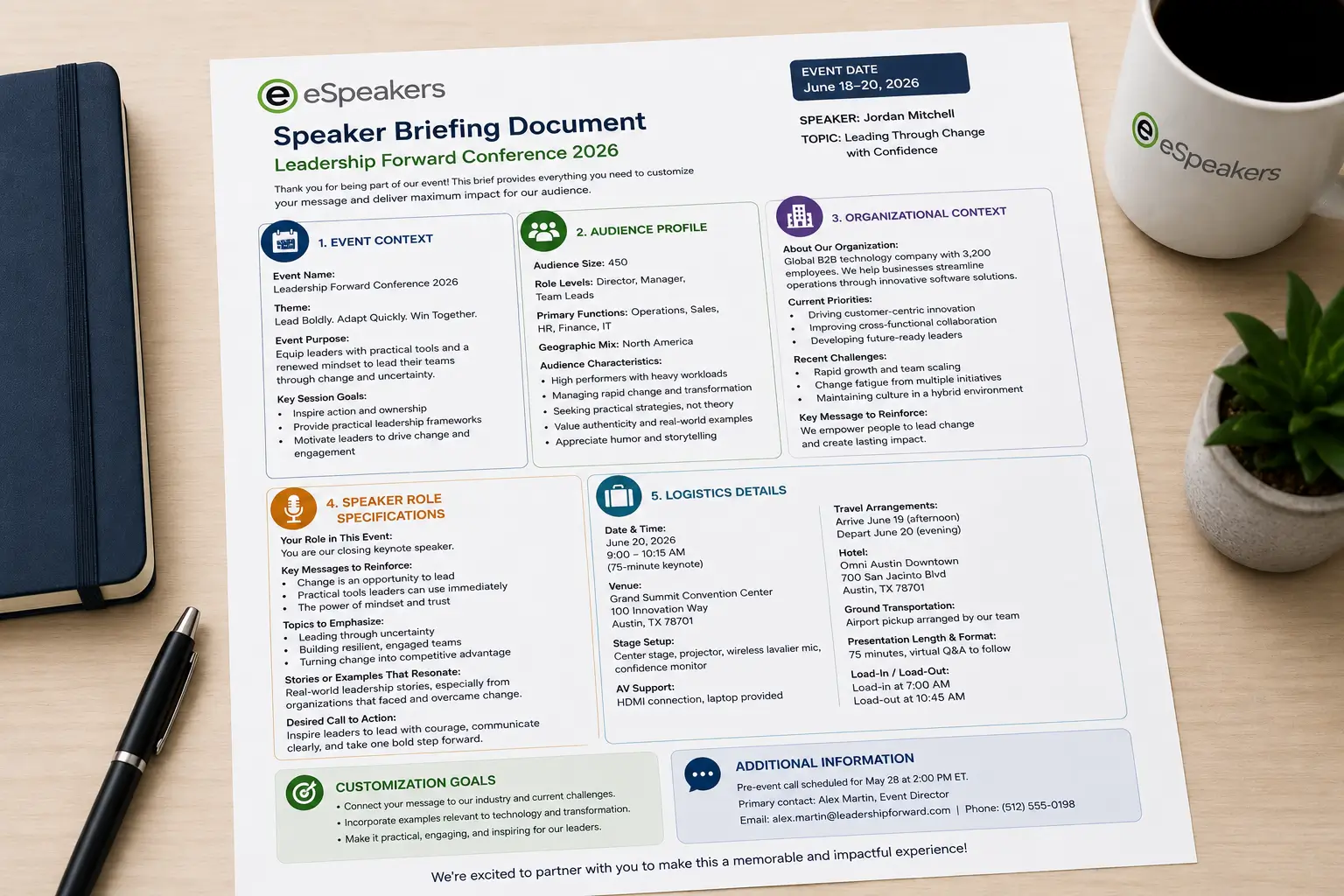
Use this as your standard brief template for every keynote speaker engagement.
[EVENT NAME], Speaker Brief
Prepared by: [Planner name]
Date prepared: [Date]
Event date: [Date] | Venue/Platform: [Location/Platform]
SECTION 1: EVENT OVERVIEW
Event name and theme:
Event purpose (what we want attendees to DO):
Speaker’s specific role (what we want attendees to do after your presentation):
Session time slot: [Start time] to [End time] | Presentation length: [X] minutes + [Y] minutes Q&A
Position in agenda: [Opening keynote / Post-lunch / Closing / Breakout]
[Attach: Full event agen
SECTION 2: AUDIENCE PROFILE
Who they are:
- Titles/roles represented:
- Career level:
- Industry/sector:
- Audience size:
- Audience composition (homogeneous or mixed level/function):
What they already know about your topic:
The specific challenges they’re currently facing:
What they’re likely to be resistant to or skeptical about:
What they’re hoping to get from this session:
(If you have pre-event survey results, attach them.
SECTION 3: ORGANIZATIONAL CONTEXT
What’s happening in the organization right now that’s relevant:
Our organization’s specific language and frameworks:
(Values, cultural initiatives, leadership models, vocabulary in active use)
What leadership has been communicating recently:
What previous speakers or programs have covered with this group:
Sensitive areas or recent organizational events to be aware of:
SECTION 4: SPEAKER ROLE AND DELIVERABLES
Specific topics to emphasize:
Specific topics or examples to avoid:
The call to action we want you to close with:
Q&A format: [Included / Not included] | Length: [X minutes] | Managed by: [Speaker / Moderator] | Method: [Floor microphone / Digital submission / Moderator-curated]
SECTION 5: DAY-OF LOGISTICS
Arrival time:
Room/platform access time:
Sound check/tech check time:
Session start:
Your point of contact (name, cell):
AV available: [Screen format / Microphone type / Clicker / Confidence monitor]
(For virtual: Platform / Host link sent to: [email] / Technical moderator name and contact)
Post-session commitments: [Book signing / Executive dinner / None]
Introduction: Provided by [Name]. Speaker-provided introduction language: [Attached / Requested]
Thank you for your preparation for our event. Please contact me at [email/cell] with any questions.
The Brief Is an Investment, Not an Administrative Task
organizational context section requires vulnerability about what the organization is going through. The call-to-action section requires clarity about what the event is actually trying to produce.
That investment, 2–3 hours of careful preparation, is what enables a $15,000 keynote speaker to deliver $50,000 worth of impact. The speaker’s capability is the ceiling. Your brief is what determines how close to that ceiling the engagement reaches.
The Smooth Sailing ebook frames the contract in these terms: the agreement between planner and speaker is the foundation of a shared commitment to the event’s goals. The brief is what makes that commitment real. Without it, the speaker is working toward your goals in the dark. With it, they’re working toward them with everything they need.
FAQ
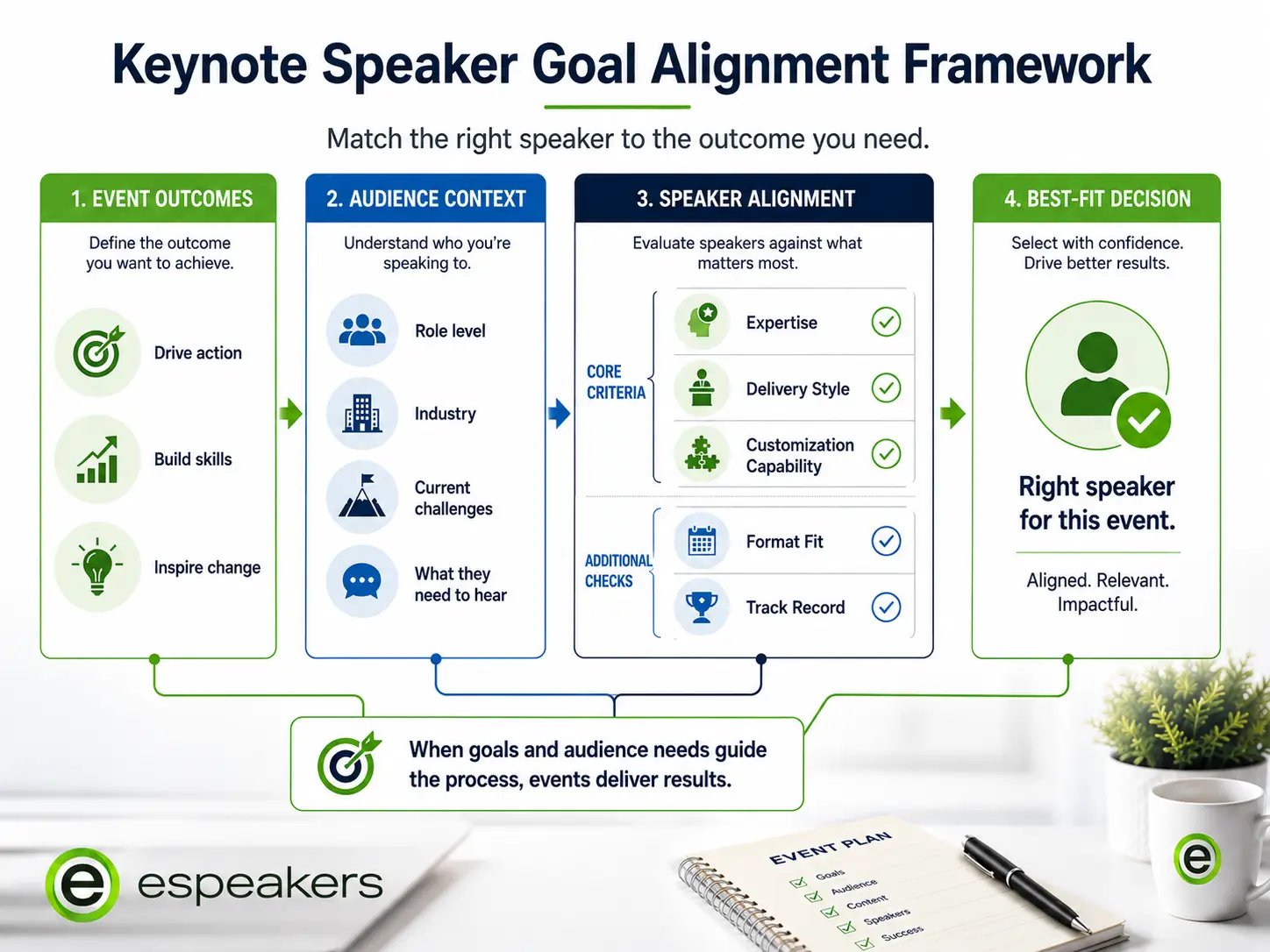
To hire a keynote speaker, start by defining your event goals and the specific outcomes you want the speaker to produce. Then search a speaker directory like the eSpeakers Marketplace, filtering by topic, fee range, format, location, and availability. Evaluate shortlisted speakers using demo reels and verified client reviews. Conduct discovery calls with your top two or three finalists. Select the speaker whose expertise, delivery style, and customization capability best align with your audience’s specific situation. Confirm the booking with a written contract, then begin the briefing process to ensure maximum impact.
A complete speaker brief includes five categories: event context (name, theme, purpose, full agenda, session length and position), audience profile (who they are, what they already know, current challenges, likely resistance, what they hope to gain), organizational context (what’s happening in the organization now, internal language and frameworks, recent leadership messaging), speaker role specifications (topics to emphasize or avoid, desired call to action, Q&A format), and logistics (day-of schedule, AV requirements, point of contact). Send the written brief 4–6 weeks before the event, then follow up with a preparation call 3–4 weeks out.
The written brief should be sent 4–6 weeks before the event, with a preparation call scheduled 3–4 weeks out. Send the brief before the prep call so the speaker has time to absorb it, using the call for dialogue and follow-up questions rather than reading through it together. A brief check-in 7–10 days before the event confirms that nothing has changed and surfaces any outstanding questions. For virtual events, a dedicated tech check should be scheduled 48–72 hours before the event.
A speaker preparation call should cover: the speaker’s questions after reading the brief (allow them to lead), an in-depth discussion of the audience’s specific situation and current challenges, the speaker’s specific content adaptation plan for this audience (ask them to walk you through what they’re planning to change and why), and logistics confirmation. The most valuable part of the prep call is hearing the speaker describe their specific customization plan, this tells you both that the brief was used and gives you the opportunity to course-correct before the event if something isn’t quite right.”
Effective audience preparation includes featuring the speaker prominently in all event communications with a specific statement of why their content is relevant to your audience right now, not generic event marketing language. Include a brief video clip from the speaker’s reel in pre-event emails. Distribute a single, specific pre-session question for attendees to reflect on before arriving. Research shows that attendees retain 20% of what a speaker tells them, 50% when visual presentations are included, and 90% of what they actively do, pre-session preparation moves audiences toward active engagement from the start. (a framework cited widely in adult learning research and supported by PCMA’s event design resources)
An effective briefing is specific rather than general, written before the prep call so the speaker has time to absorb it, and delivered in a structured format the speaker can navigate without reading every word in sequence. It includes the audience’s current challenges in specific organizational terms, not generic topic descriptions, and it covers both what to emphasize and what to avoid. The effectiveness of a briefing is ultimately measured by what you hear in the prep call: a speaker who asks specific follow-up questions about the audience’s situation and can describe their specific content adaptation plan has been effectively briefed.
Yes. All standard briefing elements apply to virtual keynote speakers, plus specific virtual context: the exact platform name and version, whether audience cameras are on or off, which interactive features are enabled and who manages them, whether the session is being recorded and how it will be distributed, the name and contact information of the technical moderator during the session, and any audience composition differences from a typical in-person event. For virtual engagements, also confirm that a full tech check is scheduled 48–72 hours before the event, not the morning of.
Yes. Searching the eSpeakers Marketplace, browsing speaker profiles, watching demo reels, reading verified client reviews, checking real-time availability, and contacting speakers directly is completely free for event planners and organizers. There is no subscription, no per-search fee, and no service charge for using the platform to find and contact speakers.
The Brief Starts With Finding the Right Speaker
A great brief multiplies the impact of a great speaker. The first step is finding the speaker who is worth briefing well, one whose expertise, delivery style, and customization capability are aligned with your event’s specific goals and audience.
The eSpeakers Marketplace is where that search starts. Every profile includes demo reels, verified client reviews, live availability, and fee ranges. Searching is free.
→ Search Keynote Speakers on eSpeakers
→ Hire a Motivational Speaker for Your Event
→ Hire a Leadership Speaker for Corporate Events
→ Find Virtual Keynote Speakers
→ Find Corporate Speakers for Hire
This article was written for meeting planners and event professionals who want to maximize the impact of their speaker investment through excellent briefing and preparation. The eSpeakers Marketplace is free for event planners to search and use.
Last updated: April 2026
Joe Heaps, Chief Marketing Officer at eSpeakers
Joe Heaps is the Chief Marketing Officer at eSpeakers and is responsible for creating and accelerating the company's sales & marketing strategies. He is focused on driving the company's vision of helping organizations and individuals improve in substantial, long-term ways. He believes it happens when the perfect speaker is in front of the right audience. Over 25 years in the industry, Joe’s strategic vision and leadership have propelled eSpeakers to the leading software platform for speakers, coaches, and experts.
Joe Heaps
Chief Marketing Officer, eSpeakers
Latest Articles

Related Articles