How to Stand Out as a Certified Virtual Presenter in 2026
The Certified Virtual Presenter (CVP) designation, administered by eSpeakers, is designed to answer that question before a planner even thinks to ask it.
In this article, you’ll learn what the certification is, what it evaluates, how to earn it, and where it sits on the credibility ladder for serious virtual presenters. You’ll also see how to strategically position it within the HighLevel CRM marketing system to turn online visibility into real booking opportunities.
The Certified Virtual Presenter (CVP) certification is the speaking industry’s recognized standard for virtual delivery readiness. In 2026, it stands out as one of the highest-ROI investments a professional speaker can make.
Earned through a live 30-minute assessment administered by eSpeakers, the CVP validates the three essentials meeting planners need to know before booking a virtual speaker: equipment quality, a professional presentation environment, and fluency on the speaker’s primary virtual platform.
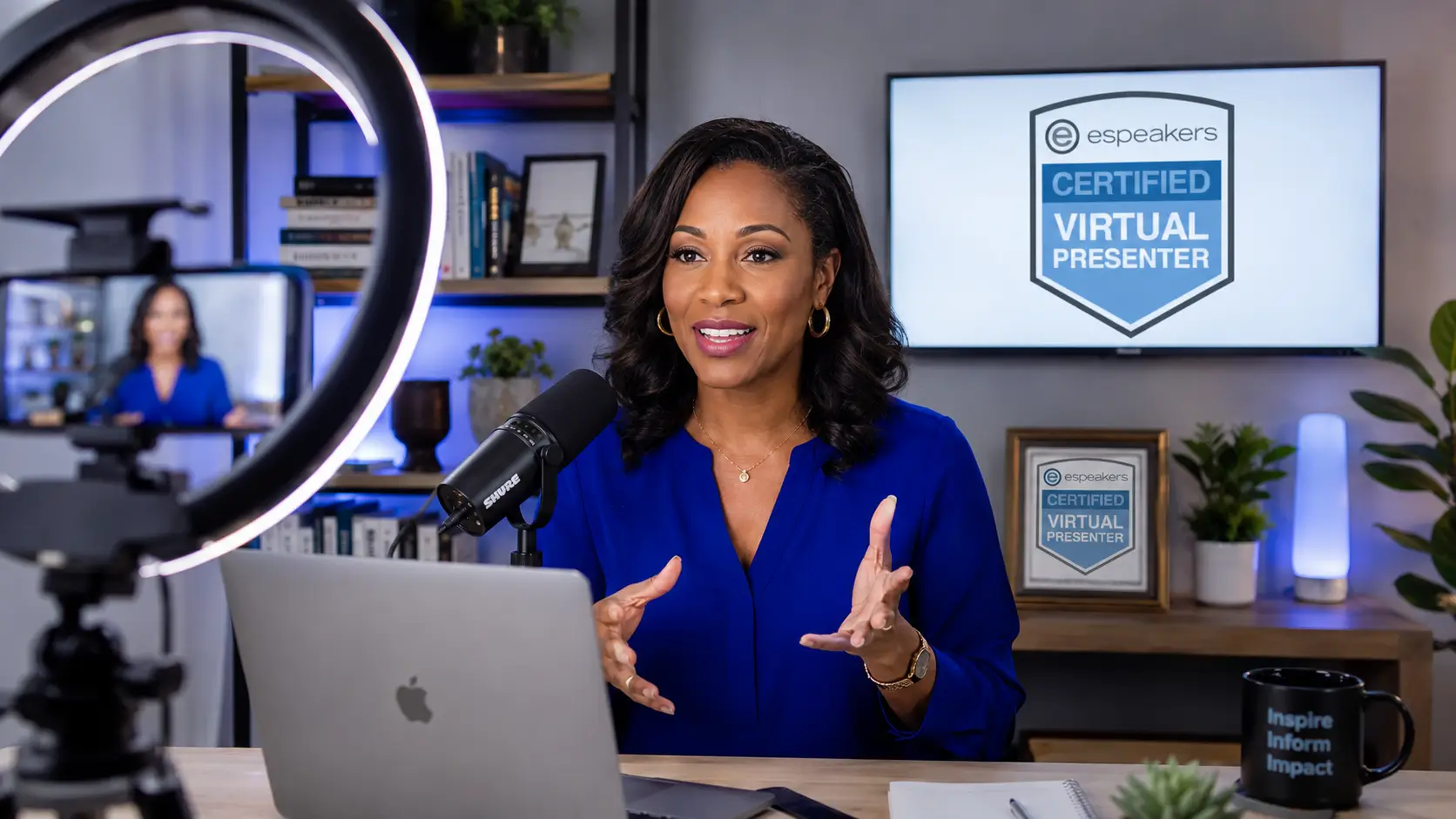
Once earned, the credential is displayed on the speaker’s eSpeakers Marketplace profile, unlocks inclusion in a CVP-only search filter featuring certified speakers, and includes a proof-of-performance video that shows planners exactly what their audience will experience.
For eSpeakers PRO members with an active paid account of at least three months, the assessment is included at no additional cost.
In 2026, the real question meeting planners are asking isn’t just “Can this speaker present virtually?” It’s “Can this speaker present virtually well enough that I don’t have to worry about it?”
The Certified Virtual Presenter (CVP) exists to answer that question before it ever comes up.
This article breaks down what the certification assesses, how to earn it, where it sits on the credential ladder for serious virtual presenters, and how to leverage it to actively convert planners who discover you online.

John Doe
Chief Marketing Officer at eSpeakers
Why Virtual Still Demands Proof in 2026
Because not everyone presenting virtually does it well, and planners have learned to be discerning in ways they weren't forced to be in 2020, when they had no other options.
Here's the answer: because everyone presenting virtually doesn't mean everyone is doing it well, and planners have learned to be discerning in a way they weren't forced to be in 2020, when they had no other options.
Here's the answer: because everyone presenting virtually doesn't mean everyone is doing it well, and planners have learned to be discerning in a way they weren't forced to be in 2020, when they had no other options.
The bars that now separate a professional-grade virtual presenter from an amateur are specific and visible. Planners who have run dozens of virtual events know exactly what they're looking at when they preview a speaker's setup during a discovery call. They notice the camera angle. They register whether the audio has a room echo. They can tell within thirty seconds whether the lighting was set up deliberately or whether the speaker just opened their laptop wherever they happened to be sitting.
Content quality is the top driver of attendee satisfaction for professional events, rated "very important" by 78% of event professionals across two consecutive years of industry surveys. Interactive tools, including polls, Q&A, and breakout rooms, now drive meaningful ROI, with 76% of virtual event attendees actively using these features. Passive, pre-recorded sessions without interaction have fallen sharply in planner preference. What works in 2026 is a live, technically polished presenter who knows how to generate engagement through a screen rather than fighting against it.
Session lengths have contracted: the industry consensus has moved from the traditional 60-minute keynote to a preferred range of 20–30 minutes for virtual delivery, with tighter, denser content that respects remote attention spans. This format shift rewards speakers who have genuinely mastered virtual delivery, who know how to build interaction checkpoints into a 25-minute program, who manage their time on camera with the same precision as their stage timing, and who can handle a live Q&A queue without losing their thread.
The CVP certification is the industry's standardized way of confirming a speaker meets these expectations before booking. For planners who have been burned by a technically unprepared virtual presenter, seeing the CVP badge on an eSpeakers profile is meaningful risk reduction. For speakers competing for the same booking with other qualified candidates, it's a visible differentiator that costs thirty minutes and, for eSpeakers PRO members, nothing at all.
What the CVP Assessment Actually Tests
The Certified Virtual Presenter certification is a live, 30-minute assessment conducted one-on-one with an eSpeakers certifier over the same type of video conferencing platform you'd use for an actual presentation, Zoom, WebEx, Teams, or equivalent.
It's not a written exam. It's not a course you complete asynchronously at your own pace. It is a demonstration of readiness, conducted in real time, where a trained evaluator assesses three specific dimensions of your virtual setup and capability.
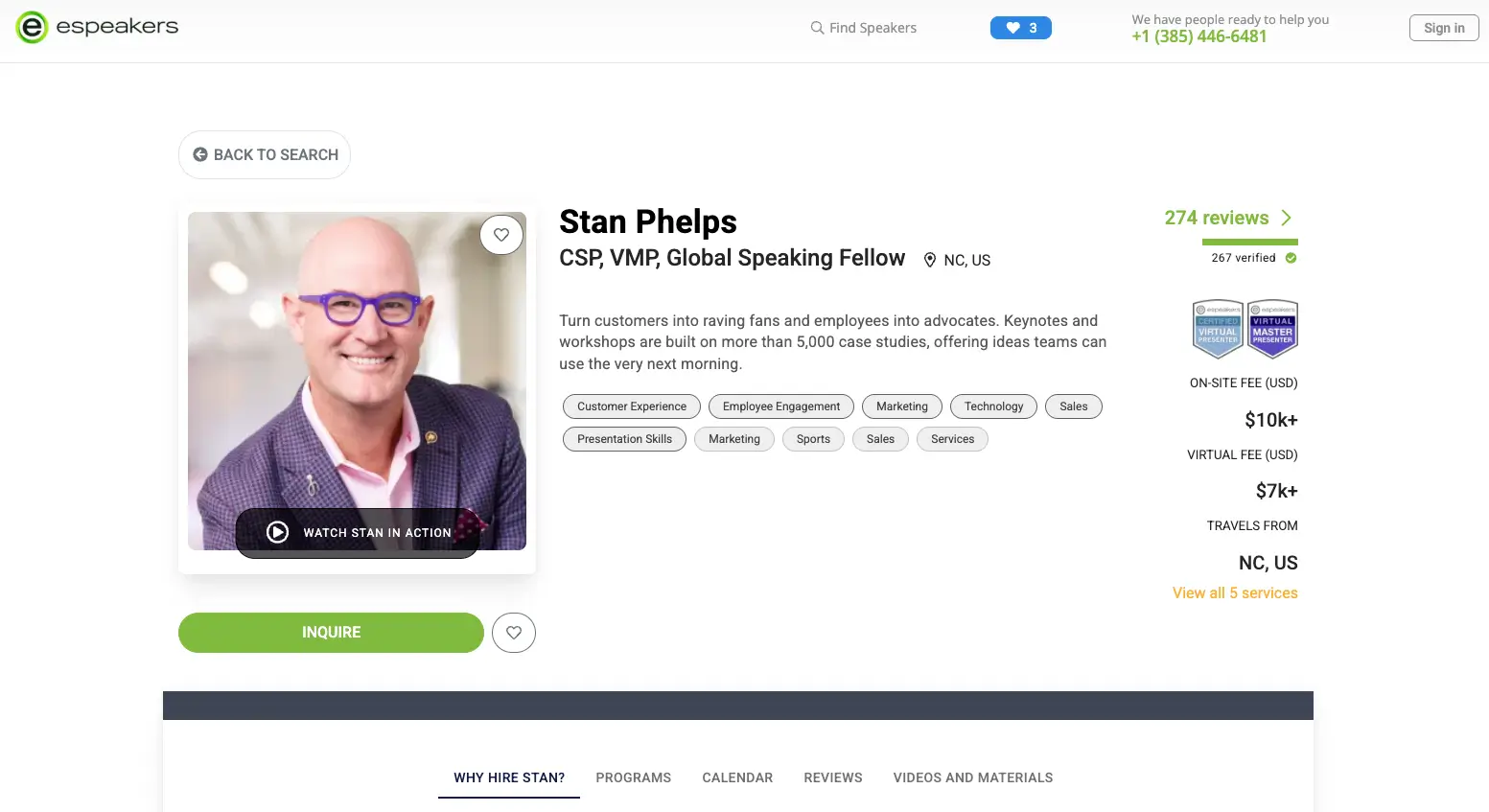
Equipment. The certifier evaluates your camera (clarity, framing, positioning), your microphone (audio quality, absence of echo or background noise), and your lighting (whether your face is properly illuminated, whether there's backlight creating silhouette problems, whether the overall visual quality meets professional broadcast standards). These aren't abstract criteria; the certifier is asking the same question a planner would ask, watching your intro video: would I feel confident putting this person in front of my audience?
Environment. Your presenting space is evaluated for noise and distraction. A coffee shop background with ambient chatter is a problem. A home office where family noise might interrupt is a risk. A virtual background layered over a messy physical space is something certifiers are trained to recognize. The standard is a space that is controllable, quiet, and professional, either a well-configured home studio or a dedicated office environment that you can reliably replicate for every engagement.
Skill. This is the component most speakers underestimate going in. The certifier is evaluating your comfort and competence with the platform itself, your ability to share your screen, manage your slides, navigate between presenter tools and participant-facing content, and operate the basic controls (muting, camera toggling, chat, Q&A) without visibly fumbling. Not mastery-level production expertise. Baseline professional competence with the tools you're using to take people's money.
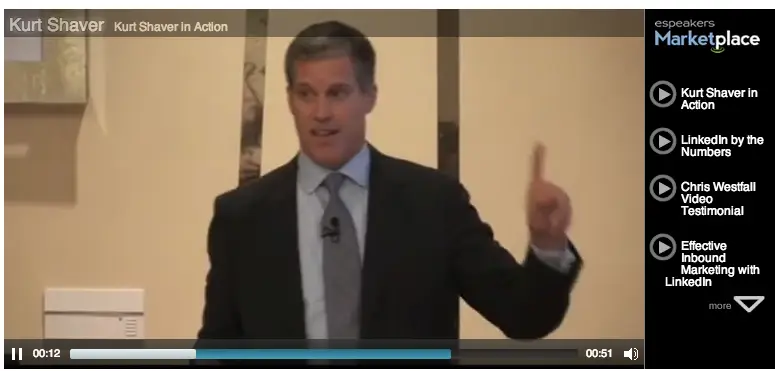
The assessment ends with the certifier recording a 30–60 second virtual proof video of you presenting, a short, in-the-moment sample of you on camera, delivering content, with the audio and video quality captured at assessment standards. This proof video is attached to your eSpeakers profile. Planners can watch it. It is the most powerful single element the CVP adds to your profile, because it converts a credential into evidence.
The Cost: Free for PRO Members
The CVP assessment is $85 USD for most speakers. However, eSpeakers PRO members who have maintained an active PRO-level account for at least three consecutive months prior to certification receive the assessment at no additional cost.
This is the most underutilized benefit in the eSpeakers PRO membership. A certification that is recognized by Meeting Professionals International (MPI), SMART Meetings, and the Senior Professional Industry Network (SPIN), all organizations whose members are actively booking speakers, is available at zero incremental cost to PRO members. It requires thirty minutes of your time and produces a permanent badge on your profile, a proof video, and a searchable credential that shows up in directory filters planners use when sourcing virtual speakers.
If you are an eSpeakers PRO member and you haven't earned your CVP certification, there is no rational argument for not doing it this week. Schedule the assessment. Thirty minutes. Free. Badge on your profile by the end of the day.
What the Assessment Does Not Test, and Why That Matters
Dave Reed, President of eSpeakers, was explicit about this when the CVP was launched: "The certificate does not speak to the presenter's content, platform skills, experience, etc. There are other industry certificates for that. When you hire a Certified Virtual Presenter, you can be confident you're hiring someone who will look good and sound good online, and is comfortable using the tools."
This clarity of scope is a feature, not a limitation. The CVP answers a specific, practical question that planners need answered at the evaluation stage: Will this speaker's virtual setup be professional enough that I don't have to manage a technical crisis on event day?
It does not evaluate the quality of your keynote content, the depth of your speaking experience, or whether your stage presence translates effectively through a camera. Those factors are established through your demo reel, testimonials, speaker profile, and track record.
Instead, the CVP focuses on the fundamentals—ensuring your virtual setup is sound—so planners can move confidently into assessing the higher-order elements without lingering uncertainty about your technical readiness.
This also means the CVP is accessible to speakers at every career stage. You don't need a decade of virtual keynotes behind you to earn it. You need a good setup, a professional presenting environment, and basic competence with the platform. If you have those three things, you can pass the assessment. And if your setup isn't there yet, if you're still presenting from a built-in laptop camera with no dedicated lighting, the preparation process for the assessment is itself valuable, because it forces you to bring your virtual setup up to professional standards.
Building a Professional Virtual Setup: The Three Tiers
Not every speaker needs a broadcast studio. But every CVP-level speaker needs a setup that reads as intentional and professional on camera. Here's a practical framework organized by investment level.
Tier 1: The Functional Setup (~$200–$400 total)
This is the minimum that passes the CVP assessment and reads as professional to planners. An external webcam at 1080p (Logitech C920 or equivalent, $80), a USB condenser microphone or a good-quality headset with a boom mic ($50–$100), and a key light or ring light positioned in front of you at eye level (~$30–$60). A clean, solid-color wall or a simple bookshelf background. A reliable broadband connection with at least 10 Mbps upload speed.
At this level, your audio and video quality will be visibly better than most video calls. Planners won't be distracted by technical problems. The CVP assessment, approached with this setup, is a pass.
Tier 2: The Professional Setup (~$600–$1,200 total)
This is the standard for speakers doing regular paid virtual engagements. A Sony ZV-E10 or Logitech Brio as your camera (better low-light performance and more natural image quality than basic webcams), an XLR condenser microphone on a desk arm with an audio interface or a high-quality USB mic like the Blue Yeti or Rode NT-USB Mini, and two-point key lighting with softboxes or the Elgato Key Light system. A dedicated presenting space with controlled lighting conditions. Wired Ethernet rather than WiFi for connection stability.
At this level, your setup is competitive with professional broadcast standards for most virtual event platforms. You'll look better on screen than a majority of keynote speakers, which has a direct effect on planner confidence and audience engagement.
Tier 3: The Studio Setup ($2,000+)
For speakers doing 20+ virtual engagements per year, a permanent studio setup is a worthwhile capital investment. A Sony mirrorless or DSLR camera with a capture card (Elgato Camlink 4K), a dynamic broadcast microphone (Shure SM7B or equivalent), professional studio lighting with full light control (able to block all ambient light), an acoustic-treated room or portable acoustic panels to eliminate room echo, and an Elgato Stream Deck for switching between presentation modes without touching your trackpad.
This setup produces results indistinguishable from broadcast television. It makes your virtual proof video compelling, your eSpeakers profile video stand out, and your per-engagement experience significantly more confident. At this investment level, your virtual delivery equipment is no longer a variable; it's a guaranteed advantage.
Beyond the CVP: The Credential Ladder
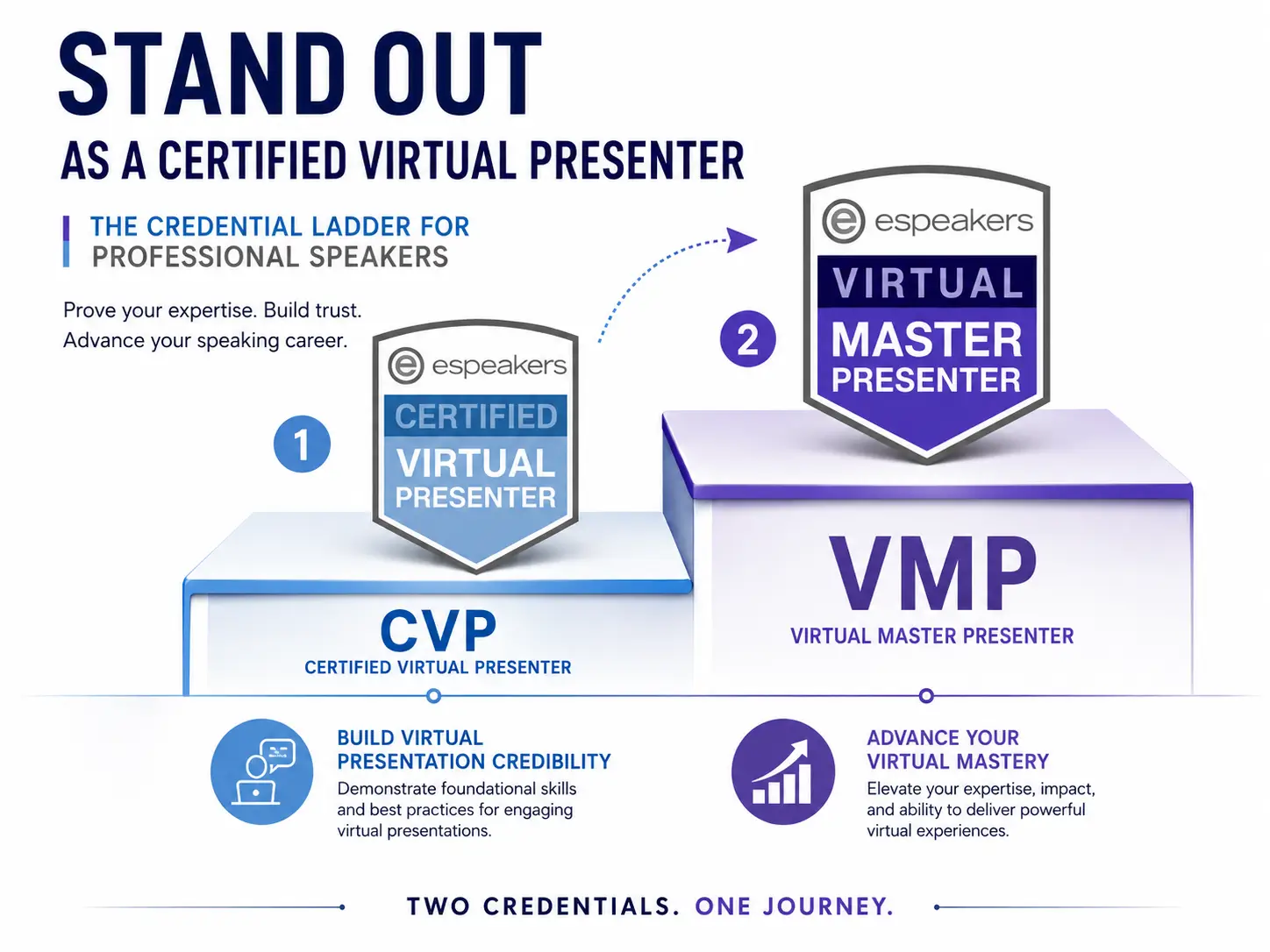
Certified Virtual Presenter (CVP) is the baseline. Equipment, environment, and platform competence. Free for PRO members, $85 otherwise. Required as a prerequisite for the next levels.
Virtual Master Presenter (VMP) is the advanced professional designation. A five-session live course (each session is three hours), totaling 15 hours of facilitated instruction, taught over Zoom with a limited class size. You must attend at least four of the five sessions to qualify for the VMP badge. The course goes deep into what the CVP doesn't cover: engagement strategy, advanced platform features, audience psychology for remote presentations, interactive design for virtual sessions, and the professional craft of performing through a camera rather than on a stage. Assessment after the course is a 30-minute live demonstration across five competency areas. The badge is automatically added to your eSpeakers profile on certification. Investment: $1,895 (with early bird pricing available; individual sessions purchasable at $395 each if you prefer to start with one session).
Certified Virtual Host (CVH) is a separate designation for speakers who also serve as event facilitators, panel moderators, or virtual meeting hosts. Requires CVP as a prerequisite. Taught by Rebecca Morgan. Valuable for speakers whose work increasingly involves hosting and moderating alongside keynote delivery.
The logical progression for a speaker building a premium virtual practice: earn CVP first (it's free with PRO, takes 30 minutes, and is required for the others), add VMP when you're ready to invest in advancing your virtual delivery craft, and consider CVH if facilitation is part of your service offering.
Each badge is automatically added to your eSpeakers profile as earned, building a visible credential stack that tells planners, at a glance, this speaker takes virtual seriously.
The CVP Badge in Your Marketing System
Earning the CVP and letting the badge sit on your eSpeakers profile is leaving value unrealized. The badge is a marketing asset that belongs in every channel where planners encounter you.
On your eSpeakers profile
Automatically added. This is the primary channel; the badge is visible to every planner who views your profile, and CVP status is a searchable filter on the eSpeakers Marketplace. Planners who specifically need a verified virtual presenter can filter for CVP holders. This filter positions you as an option for planners who have been burned by unverified virtual speakers.
Your virtual proof video
This is the highest-conversion element the CVP adds to your profile after the badge itself. A 30–60 second video of you on camera, properly lit and clearly audible, delivering content, recorded at professional standards, answers the planner's setup question visually rather than asking them to trust a credential. If your existing demo reel doesn't have a clear, high-quality virtual delivery segment, your proof video fills that gap.
Your website
The CVP badge belongs in the credentials section of your speaker website, near the top of your "About" or "Speaker Information" page, not buried in a footnote. The badge image, linked to the eSpeakers certification page for verification, adds independent credibility to the claim that you're a professional virtual presenter.
Your email signature
Every outbound email you send to planners, bureau agents, and referral contacts should carry your CVP badge. A planner who receives your pitch for an upcoming virtual event sees your certification in the signature before they've clicked anything. It answers a question they haven't yet asked.
Your speaker one-sheet
Virtual engagements increasingly have their own one-sheet, a formatted PDF that highlights your virtual setup, your virtual proof video link, your CVP badge, and your virtual-specific testimonials. This is the asset you send when a planner specifically asks about your virtual capability.
CVP in the HighLevel CRM Pipeline
The CVP isn't just a badge to display. In the HighLevel CRM marketing system, it becomes a specific contact-stage signal that improves conversion for virtual inquiries.
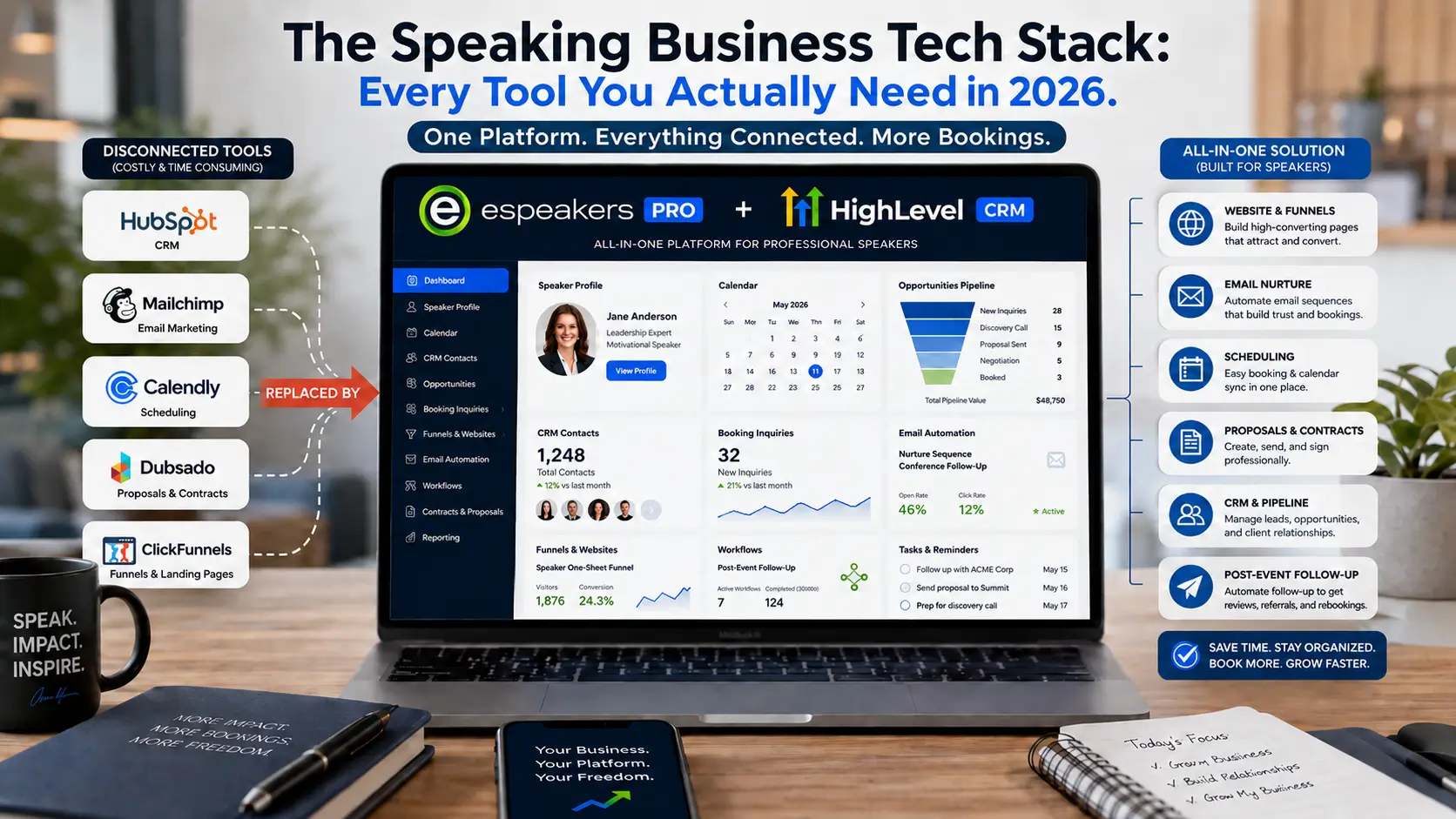
When a planner's inquiry comes in through your eSpeakers profile or your website, the form capture in HighLevel can include a field: "Is this engagement virtual, in-person, or hybrid?" Inquiries that flag as virtual or hybrid automatically route to a pipeline stage called something like "Virtual Inquiry, Qualified" and trigger a specific automation sequence distinct from your standard inquiry workflow.
That virtual inquiry automation serves up the CVP proof video in the first follow-up email, alongside your virtual-specific testimonials and your one-sheet. The planner doesn’t need to wonder whether you can present virtually. That question is answered immediately; your first post-inquiry touchpoint provides clear, verifiable proof of your virtual readiness before the discovery call even takes place.
This matters because virtual bookings close faster than in-person bookings. There's no travel to coordinate, no venue-specific logistics to align, and no date blocking around extended travel time. If the planner is confident in your setup and your content from the first email, the path from inquiry to signed contract can happen in 24–48 hours. The CVP-specific automation in HighLevel creates that fast-close path by front-loading the evidence that produces confidence.
Set up your HighLevel Smart Lists to segment CVP-relevant contacts: planners who have booked you virtually before, associations that run regular virtual programming, and organizations with distributed workforces that need virtual-first content delivery. Tag them with virtual-buyer in HighLevel, and build a targeted campaign that promotes your CVP credential specifically to that segment during slow booking periods. This is the kind of precise, low-friction outbound that fills virtual dates without requiring manual outreach from scratch.
What Planners Actually See When They Find a CVP
Let's trace the planner's experience through the eSpeakers Marketplace, because it illustrates why the CVP operates differently from other credentials at the search and discovery stage.
A meeting planner at a professional association needs a virtual keynote speaker for their spring conference. They have 400 remote attendees, a 30-minute slot, and they've been burned once before by a speaker whose home office background looked unprofessional on the event livestream.
They go to eSpeakers Marketplace and filter by topic, fee range, and virtual availability. Among the optional filters is "Certified Virtual Presenter." They apply it.
The speakers who appear in their filtered results all carry the CVP badge. For this planner, the search itself answers the technical question before they've read a single bio. They're now evaluating speakers on content, fit, and fee, the factors that actually determine who gets booked.
Your eSpeakers profile in this filtered view shows: your CVP badge (visible credential), your virtual proof video (evidence), your profile video (demo reel), your topic tags, your fee range, and your testimonials. If all of those elements are strong and the profile optimization series in this library covers each of them in detail, this planner has everything they need to add you to a shortlist.
The follow-up inquiry arrives in your HighLevel CRM. The virtual inquiry automation fires. The planner receives your proof video and virtual one-sheet within minutes. The discovery call is scheduled through your HighLevel calendar. The contract is sent and signed. The booking is confirmed.
That entire sequence, from Marketplace search to confirmed booking, is shorter and less friction-intensive than almost any in-person booking cycle. The CVP certification, combined with a strong eSpeakers profile and a working HighLevel pipeline, is what makes it routine rather than exceptional.
FAQ
No, any speaker can earn the CVP for $85. But eSpeakers PRO members who have maintained their account for at least three months get the certification fee waived entirely. Given that the PRO membership provides the eSEO ranking, the HighLevel CRM integration, and the certification at no extra cost, the PRO membership pays for itself many times over in the first additional booking it generates.
The assessment itself is 30 minutes. Preparation, getting your setup to standard, reviewing what the certifier evaluates, and doing a dry run typically takes 1–3 hours, depending on your current setup. Total time investment from start to badge: a half-day at most.
The CVP badge is permanent once earned. It doesn’t have an expiration date or an annual renewal requirement. However, if your setup changes significantly, if you move to a new presenting environment, upgrade your equipment substantially, or shift to a different platform, it’s worth considering whether your setup still meets the standards the badge implies.
The certification has been formally recognized by Meeting Professionals International (MPI), SMART Meetings, and the Senior Professional Industry Network (SPIN), all organizations whose members include the planners, event managers, and association executives who book professional speakers. Outside of these organizations, the CVP functions as a professional signal rather than a universally recognized credential. Its primary value is on your eSpeakers profile (where planners are actively searching) and in your marketing materials (where it communicates a specific, verifiable claim about your virtual readiness).
The CVP certifies setup and platform competence. The VMP certifies advanced virtual presentation craft engagement strategy, interactive design, audience psychology for remote delivery, and professional performance through a camera. The CVP is the entry-level standard. The VMP is the advanced professional designation. CVP is required to enroll in the VMP course.
If virtual engagements represent 30% or more of your bookings, or if you want them to, the VMP is worth serious consideration. Fifteen hours of facilitated instruction with Rebecca Morgan, who has been presenting virtually since 1996, will provide the CSP and CMC, in addition to both virtual credentials, and who has appeared on major media covering these topics, is not boilerplate certification content. It’s the most concentrated professional development available specifically for virtual presentation mastery.
The Question Planners Are Asking in 2026
Virtual didn’t disappear when the pandemic ended. It evolved into a deliberate, strategic format. Organizations now use it for global reach, workforce accessibility, budget efficiency, and the ability to bring in speakers for events that would otherwise be limited by travel logistics.
As a result, meeting planners have become far more discerning. They recognize what strong virtual delivery looks like and, just as importantly, they understand the cost of poor delivery: disengaged audiences, post-event frustration, and damage to their own credibility for selecting a speaker whose setup wasn’t truly ready.
The CVP certification exists because eSpeakers, MPI, SMART Meetings, and SPIN recognized that planners needed a faster way to answer the setup question without having to evaluate it from scratch on every speaker profile they reviewed.
You can answer that question for planners in 30 minutes. It’s included at no cost for eSpeakers PRO members, and it results in a permanent badge on your profile along with a proof video that demonstrates your virtual readiness every time a planner reviews your listing.
The planners who are filtering for CVP-certified speakers are ready to book. What they’re looking for is a speaker whose setup they can trust.
Make sure yours is the profile they find.
Start your eSpeakers PRO 60-day trial →
eSpeakers PRO includes the CVP certification assessment at no additional cost after three months of membership, plus the HighLevel CRM integration that routes virtual inquiries from your profile directly into your booking pipeline.
Joe Heaps, Chief Marketing Officer at eSpeakers
Joe Heaps is the Chief Marketing Officer at eSpeakers and is responsible for creating and accelerating the company's sales & marketing strategies. He is focused on driving the company's vision of helping organizations and individuals improve in substantial, long-term ways. He believes it happens when the perfect speaker is in front of the right audience. Over 25 years in the industry, Joe’s strategic vision and leadership have propelled eSpeakers to the leading software platform for speakers, coaches, and experts.
Joe Heaps
Chief Marketing Officer, eSpeakers
Latest Articles

Related Articles