How to Use HighLevel to Book More Speaking Gigs (Complete Guide)
HighLevel CRM books more speaking gigs by automating the follow-up that most speakers either do manually or forget, and by making outbound prospecting systematic rather than sporadic. The inquiry that gets an instant response converts at a higher rate than the one that waits 18 hours. The warm lead that receives a 12-month automated nurture sequence books eventually; the one that gets a single email and silence usually doesn't. The past client who receives a re-engagement campaign at the right moment in their planning cycle calls you before they call anyone else.
Here's a number worth sitting with: 83% of professional speakers do no outbound sales at all. They build their careers on referrals, inbound leads, and directory listings, and while those sources are valuable, they share a common flaw: you can't control the volume. The speakers who consistently fill their calendars and increase their fees don't just wait to be found. They have a system. That system is HighLevel CRM, and this is the offensive playbook for using it to get on more stages.
The previous two articles in this series covered why HighLevel is the right CRM for speakers and how to configure the pipeline, workflows, and funnels from scratch. This article is the offensive playbook, the specific strategies, sequences, and HighLevel-powered campaigns that turn a configured CRM into a booking engine.
The infrastructure is already built. This is how you use it to get on more stages.
John Doe
Chief Marketing Officer at eSpeakers
The Booking Math Every Speaker Should Know
Before the tactics, the math. Understanding your conversion funnel makes the strategy meaningful.
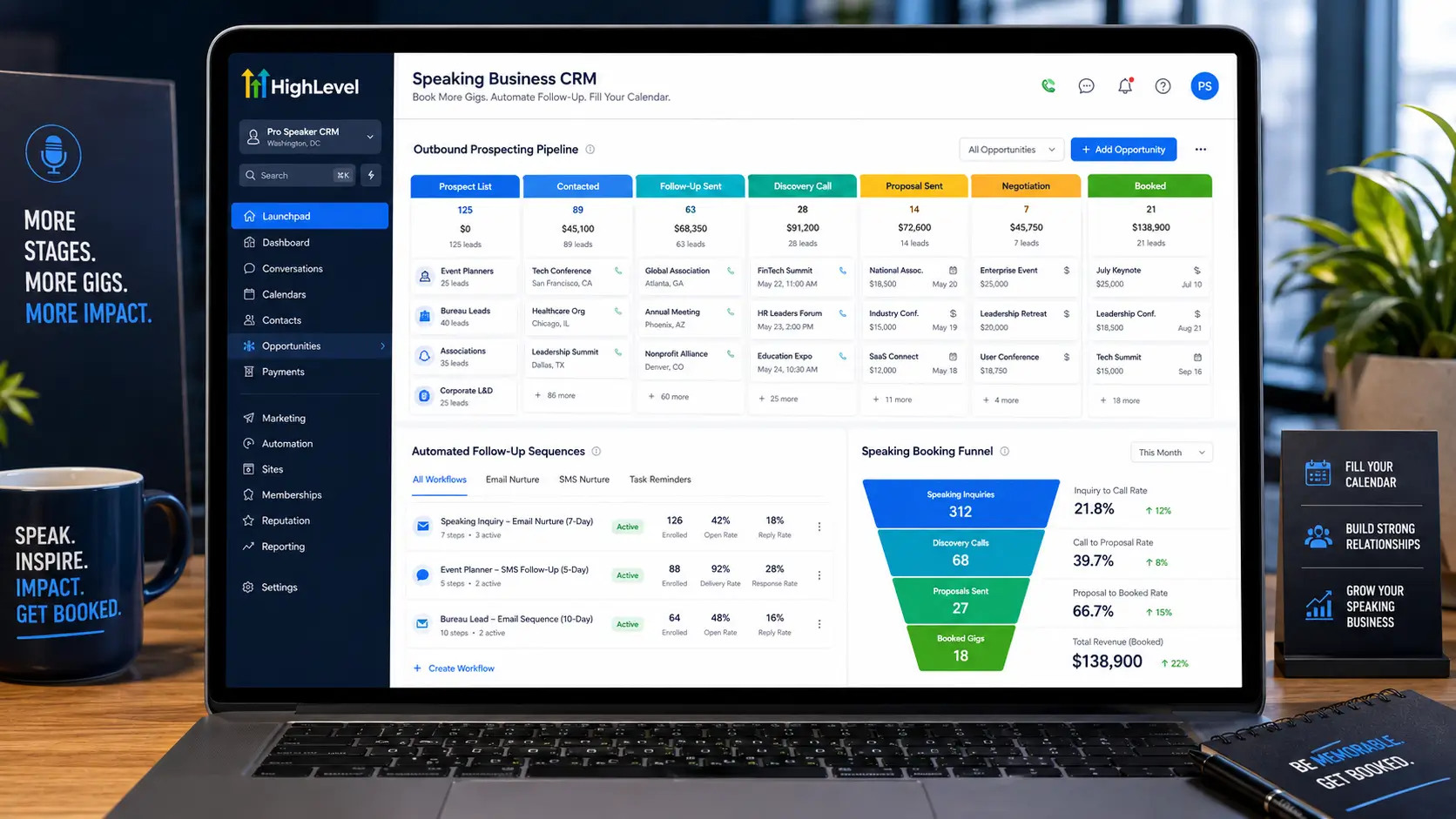
We recently collected data from customer surveys and found that a speaking business typically needs approximately 150 outreach contacts to generate 15 conversations with event planners. Of those 15 conversations, roughly 3 will be a good fit. Of those 3, approximately 1 will convert to a confirmed booking.
That's a 1-in-150 conversion rate from cold contact to booked gig, which sounds discouraging until you do the multiplication. If you want 20 new bookings next year, you need to have 300 meaningful conversations with planners. To have 300 conversations, you need to make contact with approximately 3,000 people in your target market over the course of the year.
Most speakers never reach those numbers because they're doing outreach manually. They send a dozen emails, get discouraged by the low response rate, and conclude that outreach doesn't work. What doesn't work is doing 150 contacts manually and expecting 20 bookings.
HighLevel changes the math by making 3,000 contacts and 300 follow-ups operationally feasible for a solo or small-team speaking business. The sequences run. The follow-up fire. The conversations happen at scale. You show up for the ones that convert.
This is the core premise of the following strategies.
Your Six Active Booking Channels in HighLevel
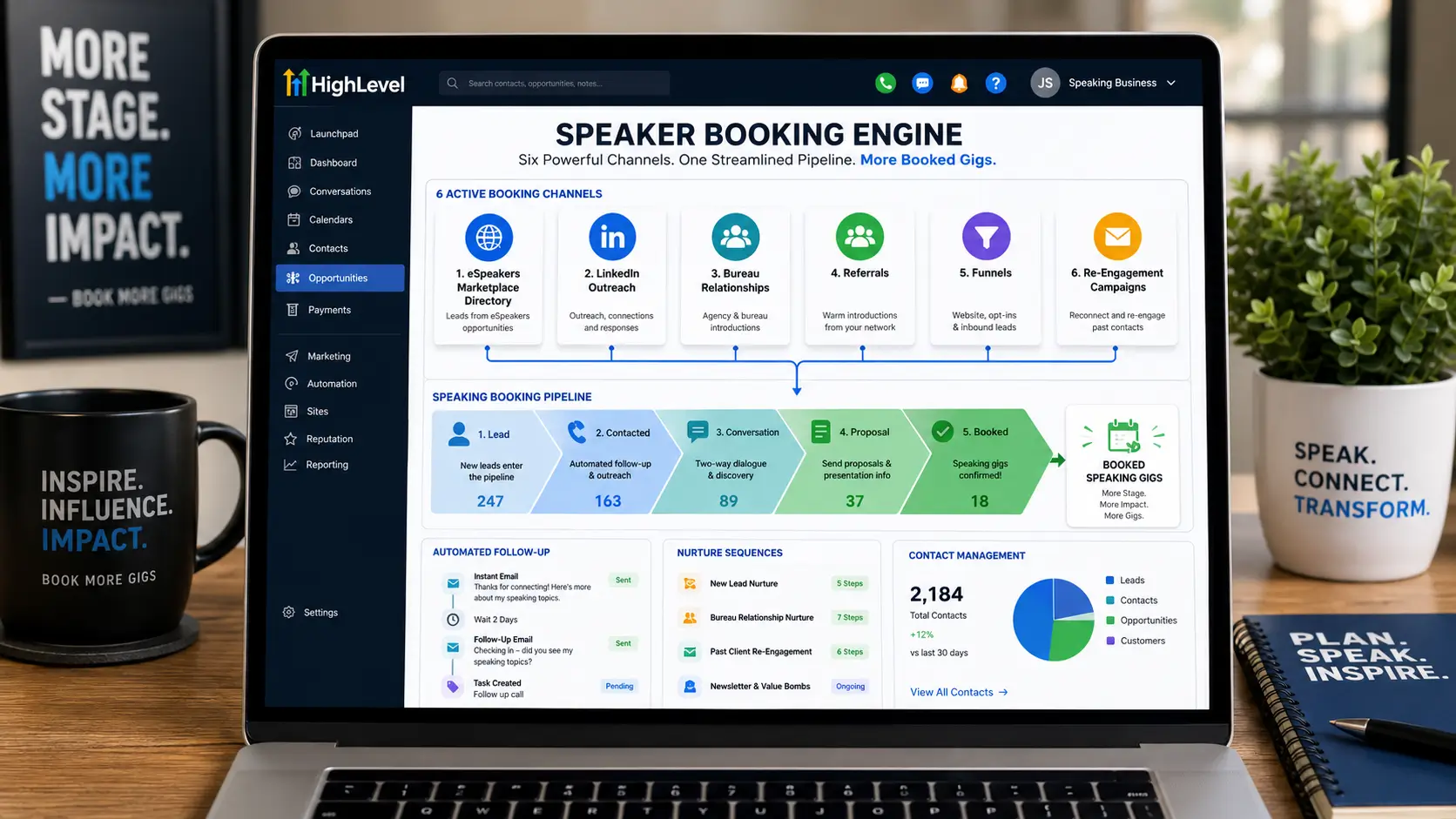
A fully deployed HighLevel CRM setup for speakers runs booking activity across six parallel channels simultaneously. Each channel has a different role, a different audience, and a different conversion timeline. Together, they create a system that generates bookings from multiple sources every month, not just the one or two referrals that happen to land.
Channel 1: Past Client Re-Engagement
Why this is Channel 1: Reactivating existing relationships is five times less expensive than acquiring new ones. Every speaker has a database of past clients and planners who already know your work, have seen your impact firsthand, and have approved at least one booking. This is the highest-conversion segment in your entire CRM and the most overlooked.
The HighLevel approach:
Build a Smart List in your CRM: filter for contacts with the tag past-client AND last activity date more than six months ago. This is your re-engagement target list.
Create a three-email broadcast sequence for this segment. The timing and tone matter:
Email 1 (Month 1): The genuine check-in. No ask. Reference the event specifically, the date, the audience, and something memorable from the day. Ask how the organization has evolved since then. This email should read as if it came from a colleague, not a vendor. Subject lines that work: “Checking in after [event name]” or “How’s [organization] doing these days?”
Email 2 (Month 2): A value-add. Share something relevant to their industry, a trend piece, a framework from your current keynote, or a resource that applies to their audience. Include one soft sentence at the bottom: “If you have any upcoming events where [topic] might be a fit, I’d love to hear about them.”
Email 3 (Month 3): The direct ask. “I’m opening my calendar for the second half of [year]. Before I go public with my availability, I wanted to reach out to clients I’ve worked with first. Is there an event coming up where we might work together again?”
Build this sequence as a HighLevel Broadcast campaign (one-time send to the filtered list), not a workflow. This gives you full control over timing and allows you to personalize individual emails before they go out. Schedule a two-minute review of each batch before sending.
Expected result: Past client re-engagement campaigns typically generate response rates of 15–25% among genuinely warm contacts. Even a 10% conversion from conversation to booking from a list of 50 past clients means five new bookings from people who already trust you.
Channel 2: Warm Lead Reactivation
The target: Planners who inquired, engaged with your content, or had a conversation, but never booked. These contacts are tagged warm leads in your CRM and exist at various stages of your long-term nurture sequence.
The difference between this channel and the past client channel lies in the depth of the relationship. Warm leads know of you; past clients know you. The reactivation message is different accordingly.
The HighLevel approach:
Create a Smart List: tag = warm-lead AND pipeline stage NOT in active booking stages AND last activity > 90 days.
Build a two-step reactivation sequence:
Step 1: Pattern interrupt email. Most planners who received a warm-lead nurture sequence have been receiving value emails for months. The reactivation email breaks the pattern with directness: “Quick question for you, I’ve been sending you occasional updates for a while now, and I want to make sure it’s been useful. Are you planning any events in the next six months where a [topic] keynote might be a good fit? If not, no worries, I’m happy to keep sharing content as long as it’s relevant to you.”
This email does three things: it acknowledges the relationship, asks a direct qualifying question, and gives permission to disengage, which paradoxically increases response rates because it feels respectful rather than pushy.
Step 2 (if no response after 14 days), SMS follow-up. A single text: “Hi [first name], this is [your name]. I sent you an email a couple of weeks ago about upcoming events. Happy to chat if the timing is right.” SMS messages have open rates above 95%. Many planners who missed the email will respond to the text.
Any contact who responds positively moves out of the warm-lead segment and into your active booking pipeline at the appropriate stage. Update the pipeline stage manually when a conversation starts. This removes them from the reactivation sequence automatically via the exit trigger.
Channel 3: Prospecting New Associations and Corporations
The target: Organizations in your focus industries that have never contacted you, planners and decision-makers who fit your ideal client profile but don’t yet know you exist.
This is pure outbound prospecting, and it’s the channel most speakers avoid entirely. It’s also the channel with the most leverage because it’s the only one that adds genuinely new relationships to your pipeline.
Building your outbound list:
Identify your two or three primary target industries (e.g., healthcare associations, financial services companies, technology corporations). For each industry, research:
- Annual conferences and industry events in that vertical
- Trade associations with annual conventions and chapter events
- Corporate headquarters in your geography that hold annual sales kickoffs, leadership summits, or HR conferences
- Companies that have recently undergone significant change (mergers, leadership transitions, major product launches) often create demand for speaking
The decision-maker for each event type varies. For associations, it’s typically the Director of Education or Meetings & Events Manager. For corporate events, it’s often the VP of Human Resources, Director of L&D, or the executive assistant to the C-Suite. For conferences, it’s the Program Chair or Conference Director.
The HighLevel outbound sequence:
Once you’ve built a prospect list (even 50–100 contacts is a meaningful starting point), import them into HighLevel with appropriate source and industry tags. Build a three-touch outbound sequence delivered over 21 days:
Touch 1 (Day 1), Email: A brief, specific pitch that leads with their context, not your credentials. “Hi [first name], I noticed [organization] is hosting your annual [conference name] in [month]. I work with [industry] organizations on [specific outcome your keynote delivers]. If you’re still finalizing your speaker lineup, I’d love to share a brief overview of my program. Is that something worth a 10-minute call?”
The key is specificity. A planner receiving 20 speaker pitches per week ignores generic ones. The pitch that references their specific event, mentions a current industry challenge, and leads with outcomes rather than credentials gets opened. PCMA’s research on planner preferences consistently identifies outcome-focused communication as the primary differentiator between speaker outreach that generates responses and outreach that gets archived.
Touch 2 (Day 8), Email follow-up: “Following up on my note from last week, I know your inbox is busy. I’ve worked with [similar organization type] to deliver [specific result], and I think there’s a strong fit for your audience. Happy to send over my speaker page and a few client references if that helps.” Attach your one-sheet as a PDF.
Touch 3 (Day 21), Final email: “Last follow-up from me on the [conference] speaker conversation, if the timing isn’t right for this cycle, I’d genuinely appreciate being added to your file for future events. I’ll make it easy, here’s my profile: [eSpeakers profile link].”
If there’s no response after three touches, move the contact to your long-term nurture segment (tagged cold-prospect) and add them to a low-frequency educational email sequence, four to six emails per year that establish expertise without pitching.
A critical note on volume and personalization: The three-touch sequence above requires real personalization in Touch 1. Do not send generic cold email blasts; they damage deliverability and your reputation. Build batches of 20–30 contacts per week, research each organization briefly before the sequence launches, and insert one specific detail per email. At 20–30 contacts per week, that’s 1,000–1,500 outreach contacts per year, well within range of the booking math discussed earlier.
Channel 4: Bureau Agent Relationship Building
The target: Bureau agents who represent speakers to corporate and association clients, members of the International Association of Speakers Bureaus (IASB) whose rosters serve the corporate and association markets. A productive bureau relationship can generate multiple bookings per year.
Most speakers approach bureaus incorrectly; they submit a profile, wait to be called, and wonder why nothing happens. Bureau agents work with dozens of speakers. The ones they call first are the ones who stay top of mind.
The HighLevel approach:
Create a dedicated segment in your CRM for bureau agent contacts. Tag them bureau-agent and vip. Build a separate nurture sequence specifically for this segment, with a tone different from your planner sequences, acknowledging the professional context.
The bureau agent nurture sequence runs quarterly at a minimum, and focuses on three things:
Availability updates: A brief email every quarter noting which dates are still open for the next six months, your current focus topics, and any recent notable engagements. Bureau agents need to know you’re active and available; stale information means you don’t get pitched.
New credentials and social proof: When you earn a new certification, complete a significant corporate engagement, receive a strong testimonial, or give a TEDx talk, a brief note to your bureau contacts adds to your perceived value. Keep these short and factual, two sentences, not a press release.
Market-relevant topic updates: If a topic in your repertoire aligns with a current trend that bureaus are being asked about (AI, mental health, leadership in uncertainty), a short note explaining how your program speaks to that trend gives agents a hook for their client conversations.
Build this as a HighLevel email sequence with Smart List filtering so it runs automatically to everyone tagged bureau-agent, and flag any replies for personal follow-up within 24 hours. Bureau relationships are built on responsiveness; an agent who gets a reply the same day they ask a question will call you next.
Channel 5: Referral Activation
The target: Your existing network, past clients, fellow speakers, and professional contacts, who can refer you but currently lack a system for doing so.
Referrals are the primary source of bookings for most speakers (roughly 50% according to industry data), but the vast majority of those referrals happen organically; someone happens to remember you when someone else happens to ask. The gap between “I should refer you” and “I just referred you” is bridged by making it easy.
The HighLevel approach:
Build a simple referral request workflow triggered by a manual tag application: when you tag a contact referral-request, a short, personalized email sequence fires.
Email 1: “[First name], a quick favor. I’m actively growing my speaking business and would love to connect with HR directors and event planners in [industry]. If anyone comes to mind who might benefit from my work on [topic], I’d be grateful for an introduction. I’ve attached a brief overview to make it easy to forward.”
Attach a simple one-sheet PDF, your photo, your positioning statement, two or three client logos, and a link to your eSpeakers profile.
Email 2 (14 days later, if no response): A gentler reminder: “Just following up on my earlier note, completely understand if no one comes to mind right now. If that changes, I’d be grateful. And of course, happy to return the favor anytime.”
The workflow exists as soon as any response is received. Keep a tally of referrals generated in your HighLevel reporting and follow up each one personally with a thank-you note and a progress update.
Channel 6: Content-Driven Inbound (The Long Game)
The target: Planners who find you through content, LinkedIn articles, YouTube, podcast appearances, published writing, and enter your funnel through a lead magnet or inquiry form.
This channel runs passively through the lead magnet funnel built in Article 2. The HighLevel CRM handles everything downstream automatically: captures the lead, applies the warm-lead tag, and launches the nurture sequence. Your only job is to keep producing the content that drives traffic into the funnel.
Content works on a different timeline than outbound. It takes six to twelve months to generate consistent inbound leads from content, but once it runs, it compounds. A LinkedIn article you write in April can generate a planner inquiry in November. A YouTube video you post in January can bring a warm lead in September.
The HighLevel setup ensures no inbound lead from this channel falls through the cracks. Every opt-in, every inquiry, every profile visit that converts to a form submission enters your CRM pipeline automatically and receives the same consistent nurture sequence as a warm lead from any other source.
Building Your Weekly Outbound Rhythm
Having six active booking channels in HighLevel is only useful if there's a weekly practice driving them. The system handles the automation. You handle the decisions and the personal touches.
Here's what a sustainable weekly outbound rhythm looks like for a speaker managing their own business:
Monday (60 minutes): Review Smart Lists. Check contracts out past five days, active holds approaching expiry, and any warm leads whose sequences have ended without a conversion. Make any needed personal calls or send personalized follow-up emails to the highest-priority contacts.
Tuesday (45 minutes): Prospect research and list-building. Identify 20–30 new organizations in your target industries. Research decision-maker names and contact information. Import into HighLevel with appropriate tags. The three-touch outbound sequence launches automatically.
Wednesday (30 minutes): Check your unified inbox in HighLevel. Respond to any replies from outbound sequences, inbound inquiries, or SMS messages. Every reply, positive, negative, or asking to unsubscribe, gets a human response within 24 hours.
Thursday (30 minutes): Content activity. Post a LinkedIn article, record a short video, and write a paragraph to add to your email newsletter. This feeds Channel 6 over time. It doesn’t need to be elaborate; a 300-word post about a trend in your topic area is enough.
Friday (15 minutes): Pipeline review. Is anything stuck? Are there bookings that should have moved stages this week? Update the pipeline, apply any needed tags, and make sure nothing is aging in the wrong stage.
Total active time: under three hours per week. The system handles everything else: the follow-up sequences, the nurture emails, the hold acknowledgments, and the post-event sequences. You’re making decisions and having conversations, not managing logistics.
The Outbound Email Formulas That Actually Work for Speakers
The quality of your outbound email copy determines whether the sequence generates conversations or gets archived. Here are the frameworks that consistently perform for speakers pitching meeting planners.
The Specific Event Pitch
Use when: You’ve identified a specific upcoming event and are reaching out before the speaker lineup is finalized.
Structure:
- Reference the specific event (name, date, type of audience)
- Name the outcome you deliver that’s relevant to their audience
- One credibility marker (not a list, one strong one)
- A single, low-friction ask
Example:
“Hi [name], I noticed [Association] is hosting your annual leadership summit in [month]. I work with senior leadership teams on [specific outcome], and I’ve seen strong results delivering this program for [similar organization or industry]. Would it make sense to share a brief overview of what I cover and a few client references from [relevant industry]?”
Length: four sentences. Any longer and open rates drop.
The Industry Insight Opener
Use when: You're reaching out to a planner in your focus industry with no specific event in mind, establishing relevance before pitching availability.
Structure:
- One sentence referencing a current challenge or trend in their specific industry
- How your program addresses that challenge
- Proof it’s worked for similar organizations
- Soft asks for a brief call
Example:
“The [industry] sector is navigating [specific challenge] right now. I’ve been speaking to [industry] leadership teams about this for the past year, and the conversation keeps going long after the keynote ends. Most recently, I worked with [company type] on [outcome]. If your organization is working through similar territory, I’d love to have a 10-minute conversation to see if there’s a fit.”
The Warm Re-Engagement
Use when: You've had prior contact, a conversation, an introduction, or they attended an event where you spoke, but there's been no recent connection.
Structure:
- Reference the prior connection specifically
- One sentence on what’s relevant now
- Direct ask
Example:
“[Name], we connected briefly at [event] in [year], when I gave the opening keynote. I’ve been working with a number of [industry] organizations since then on [topic], and [organization type] has been particularly active in this conversation. If you’re planning any events in the next two quarters where this might be a fit, I’d love to reconnect.”
The Referral Introduction
Use when: A mutual contact has introduced you to a planner via email.
Structure:
- Acknowledge the introduction warmly
- Name your focus specifically (not “I’m a speaker”, what you speak about, and for whom)
- One question that opens the conversation
Example:
“[Name], thanks for the intro, [referrer name]. I work with [industry] organizations on [specific topic and outcome]. [Referrer] thought there might be a fit with your upcoming events. Are you planning anything in the next six months where this might be relevant?”
Using HighLevel Reporting to Double Down on What's Working
One of the least-used features of HighLevel for speakers is its reporting dashboard, and it contains the intelligence that separates a speaker growing 10% per year from one growing 50%.
Track these metrics monthly inside HighLevel:
Pipeline conversion rate by source
Of all new inquiries that entered your pipeline this quarter, what percentage converted to confirmed bookings? Now break that down by source tag: eSpeakers, referral, outbound, and content. The source with the highest conversion rate deserves the most attention. The source with the lowest conversion rate either needs better targeting or should be deprioritized.
Hold-to-confirm conversion rate
What percentage of holds converted to confirmed bookings? Industry-wide, this varies widely by speaker and market. Track yours for six months, and you'll have a baseline. If it drops, something changed in your proposal, your pricing, or your competition.
Time in the pipeline stage
How long, on average, does an opportunity sit in "Proposal Sent" before moving to "Hold Confirmed"? If that number grows quarter over quarter, your proposals may need work, or your follow-up timing may be too slow.
Email open and reply rates by campaign
Which outbound sequences generate the most replies? Which nurture emails generate the most click-throughs to your eSpeakers profile? The data tells you what to send more of.
Re-engagement campaign results
Of all past clients contacted through Channel 1, how many responded? How many converted to a new booking? What was the average time from re-engagement email to confirmed date?
Once you have three months of data, you have a predictive model for your booking business. You know how many outbound contacts produce one conversation, how many conversations produce one booking, and which sources produce the highest-quality leads. You can set revenue targets with actual math behind them, not optimism.
That's the difference between a speaking business and a hobby.
FAQ
For a properly configured HighLevel sending domain, a solo speaking business can typically send 200–500 outbound emails per week sustainably, assuming you’ve warmed your sending domain gradually and maintain good list hygiene (removing bounced addresses and unsubscribes promptly). Start at 50 per week for the first two weeks, increase by 50 per week, and monitor your bounce rate. If it climbs above 2%, slow down and clean your list.
No. SMS is best reserved for warmer contacts, people who have submitted an inquiry form, had a prior email conversation, or responded to an outbound email. Cold SMS to people who don’t know you reads as spam and can harm your brand. Use SMS as a follow-up tool for Touch 3 of your warm lead reactivation (Channel 2), not as a cold outreach opener.
Handle these personally and promptly. Remove anyone who requests it from all sequences immediately. HighLevel makes this a one-click action. For “not this year” responses, this is actually a warm result. Add a note to the contact record, tag them with the reason code, and schedule a task for yourself in HighLevel to follow up in 10 months. This year’s “not right now” is often next year’s booking.
Absolutely, and here’s why: thirty past clients, re-engaged properly over a quarter, might generate five to eight replies. Of those, one or two will convert to a new booking. That’s a 3–7% conversion rate from a list of 30, significantly better than most cold outbound efforts. Run Channel 1 first, every time. Then use the revenue from re-engagement bookings to invest in building your outbound list for Channel 3.
This is the problem HighLevel solves. Your outbound sequences, the three-touch prospecting emails, the warm lead nurture, and the past client re-engagement, all fire on schedule regardless of whether you’re in a hotel room in Chicago or on a stage in Singapore. The only pieces that require your active attention are (a) responding to replies, which you batch into two 30-minute windows per day from your phone using the HighLevel mobile app, and (b) the Tuesday prospecting research, which many speakers delegate to a VA once their system is running smoothly.
Lead with them, not you. Every outbound email formula above opens with something about their organization, their industry, or their upcoming event, not with your credentials or your topics. The implicit message is: “I know something about your world, and I think I can help.” That’s a different posture than “I’m a speaker looking for gigs.” The former starts a conversation. The latter gets archived.
The System That Keeps Booking You
The speaking industry’s dirty secret is that most speakers are competing for the same inbound leads: eSpeakers inquiries, bureau referrals, and word-of-mouth recommendations. ASAE represents more than 7,600 association professionals who collectively program thousands of annual conferences, a largely untapped outbound market for speakers who go beyond waiting for directory inquiries. That’s real demand, and it’s worth capturing, but it caps your growth at whatever pace the market finds you.
The speakers who break through that ceiling are the ones running outbound systematically. Not aggressively, but consistently, intelligently, and at a volume that makes the booking math work.
HighLevel makes that possible without consuming your week. The sequences run. The data accumulates. The conversations happen. And because you’re not manually managing every touchpoint, you can keep the quality of your personal interactions high, showing up fully present for the conversations that matter, because the system handled everything else.
Sixty minutes a day. A few hundred contacts per week. A dozen conversations per month. One new booking at a time.
That’s how you fill a calendar.
Start your eSpeakers PRO trial, get HighLevel CRM configured for speakers from day one →
Skip the blank-slate setup. eSpeakers PRO includes a speaker-configured HighLevel environment with pipeline stages, core workflows, outbound templates, and eSpeakers Marketplace integration already in place. Add your contacts, customize the copy, and your booking engine is live.
Joe Heaps, Chief Marketing Officer at eSpeakers
Joe Heaps is the Chief Marketing Officer at eSpeakers and is responsible for creating and accelerating the company's sales & marketing strategies. He is focused on driving the company's vision of helping organizations and individuals improve in substantial, long-term ways. He believes it happens when the perfect speaker is in front of the right audience. Over 25 years in the industry, Joe’s strategic vision and leadership have propelled eSpeakers to the leading software platform for speakers, coaches, and experts.
Joe Heaps
Chief Marketing Officer, eSpeakers
Latest Articles