How to Raise Your Speaking Fee Without Losing Clients
Raising your speaking fee without losing clients requires three things:
- A process that starts with new clients and transitions existing clients with professional advance notice
- A profile and track record that supports the higher number
- The confidence to quote the new rate consistently, rather than negotiating against yourself before the planner asks
Most speakers hold their fee steady longer than they should, not because the market won’t support an increase, but because the move feels riskier than it actually is. The speakers who raise their fees consistently aren’t suddenly more famous; they understand that price signals positioning, that the right increase can strengthen demand rather than reduce it, and that clear communication preserves relationships far better than avoiding the conversation.
This article outlines the full system, including timing, messaging, and profile infrastructure, so that your next fee increase is both justified and well-received.

John Doe
Chief Marketing Officer at eSpeakers

The Psychology Behind the Fear
Let’s start where the article needs to start: with the fear itself.
Most speakers, even experienced ones, describe the moment before quoting their fee as the most uncomfortable in their entire sales process. That’s because the fee conversation triggers a specific and very human concern: “Will they still want me if I say the number?”
The fear isn’t really about losing the booking. It’s about rejecting your worth. When a planner hears your fee and goes quiet, that silence can feel like a judgment on you as a professional, a person, and an expert.
That’s why speakers often quote defensively. They default to a lower number than they should, because it feels safer to be accepted at a discount than to risk being rejected at full value.
Here’s what’s actually happening on the other side of that conversation.
Planners are buying three things when they hire a speaker: knowledge, delivery, and time.
Not just content accumulated over years, but the ability to translate that content into something that moves a specific audience. Not just 60 minutes on stage, but the preparation, travel, and performance energy required to make those 60 minutes land. In reality, they’re buying the two decades it took to distill a career into something capable of producing a standing ovation.
When you undercharge, you’re not simply leaving money on the table; you’re miscommunicating your value. A fee that sits below market for your experience and credibility signals to planners and bureau agents that you’re either early in your career, unsure of your positioning, or operating in a different tier than you actually are.
In speaking, price is one of the clearest signals of quality, because planners can’t fully evaluate your talk until after they’ve booked you.
The NSA’s candid data from 2025 makes this clear: speakers who have doubled their fees since the pandemic did so not because they became dramatically better speakers overnight, but because they made a decision to stop pricing from fear and start pricing from value. Many of them found that raising their fee increased their booking rate, because it moved them into a tier where planners expected to spend what they were charging.
The market in 2026 is genuinely favorable. Budgets are up, confidence about live events is the highest it’s been in five years, and demand is strongest for niche experts who tie ideas directly to performance and organizational outcomes. Planners are under pressure to articulate ROI on their speaker spend, but that pressure cuts in your favor when you can speak the language of outcomes. A speaker who charges $7,500 and describes their value as “an inspiring keynote” is in a different conversation than a speaker who charges $12,500 and says “my program equips your sales leaders with the conversation frameworks that close enterprise deals.” The latter isn’t harder to book. It’s easier.
The Five Signals That Your Fee Is Too Low
Before addressing how to raise your fee, establish whether you should. These five signals, drawn from NSA practitioner data and industry consensus, indicate that your current fee is underpricing your value:
Signal 1: You're consistently booked at a rate that leaves you declining other opportunities
Scarcity is the most straightforward pricing signal in any market. If planners are calling faster than you can say yes, basic economics applies: when demand consistently exceeds supply, price adjusts upward. If you haven't raised your fee during a period of consistent full booking, you've been subsidizing your clients' event budgets.
Signal 2: Clients tell you, directly or indirectly, that you're undercharging
This happens more often than speakers acknowledge. A planner who books you and then says, "I expected to pay more" is telling you something explicit. So is the bureau agent who books you twice, then calls to say they think they can move you into a higher fee bracket. These are professionals whose job is to understand market pricing. When they say you're undercharging, they mean it literally.
Signal 3: You're accepting engagements out of scarcity anxiety rather than genuine fit
If you're saying yes to events that aren't quite right, wrong audience, uncomfortable logistics, below-preferred geography, because you're afraid a no will lead to fewer bookings, you're pricing from fear. A fee that reflects your actual market value attracts planners who need specifically what you offer and can comfortably pay what you charge.
Signal 4: Your fee hasn't changed in two or more years
Not because the market hasn’t moved, and not because your credentials haven’t grown, but because it simply hasn’t been updated. Inflation, growing expertise, stronger social proof, more recognizable client logos, and a tighter positioning all constitute value appreciation that your fee should reflect over time.
Signal 5: You're quoting a different number to different planners based on how they sound on the phone
This is the clearest sign of fee instability. A confident, market-aligned fee is consistent. Variable quoting based on planner energy, perceived budget, or the size of the organization suggests you don't have a clear sense of your own market value, and planners can sense that uncertainty even through email.
If three or more of these apply, your fee needs to change.
How Much to Raise, and When
There is no universal formula, but there is a useful framework.
The gradual method: 15–25% per increase, no more than once per year.
For speakers moving from one fee level to the next within an existing market tier, a 15–25% increase is large enough to meaningfully impact revenue and reposition you in searches and directory filters, while remaining within the range that most existing clients can absorb without a difficult conversation. At $7,500, a 20% increase takes you to $9,000. At $10,000, it takes you to $12,000.
The jump method: a single significant increase tied to a credential, platform, or event
When something materially changes your market position, a TEDx talk is published, a book launches with a major publisher, a Forbes or Harvard Business Review byline appears, a Fortune 500 company books you at a fee significantly above your current rate, that event creates the justification for a larger, faster increase. Speakers who earned a TEDx talk credential, for example, commonly raise their fees by 30–50% within 12 months of the video publishing, because the credential genuinely moves them into a different tier of perceived authority.
The new-client/existing-client distinction
This is the most practical approach for speakers with active client relationships. Increase your fee immediately for all new clients, while providing existing clients with a clear transition window, typically 60 to 90 days of advance notice before their next booking reflects the new rate.
This structure protects the relationships you’ve already built while ensuring every new engagement is priced correctly from the start.
The benchmark check
Before finalizing a new fee, validate it against two key data sources.
First, the eSpeakers Hiring Trends Dashboard (available to PRO members), which shows the fee ranges planners are actively searching within for your topic area. Second, your bureau relationships, if you have them, since bureau agents have direct visibility into what comparable speakers are charging— a market intelligence resource that IASB member bureaus use to counsel speakers on competitive positioning.
When multiple agents independently converge on a similar range, that’s not opinion, it’s meaningful market intelligence.
Communicating the Increase: The Three Types of Past Clients
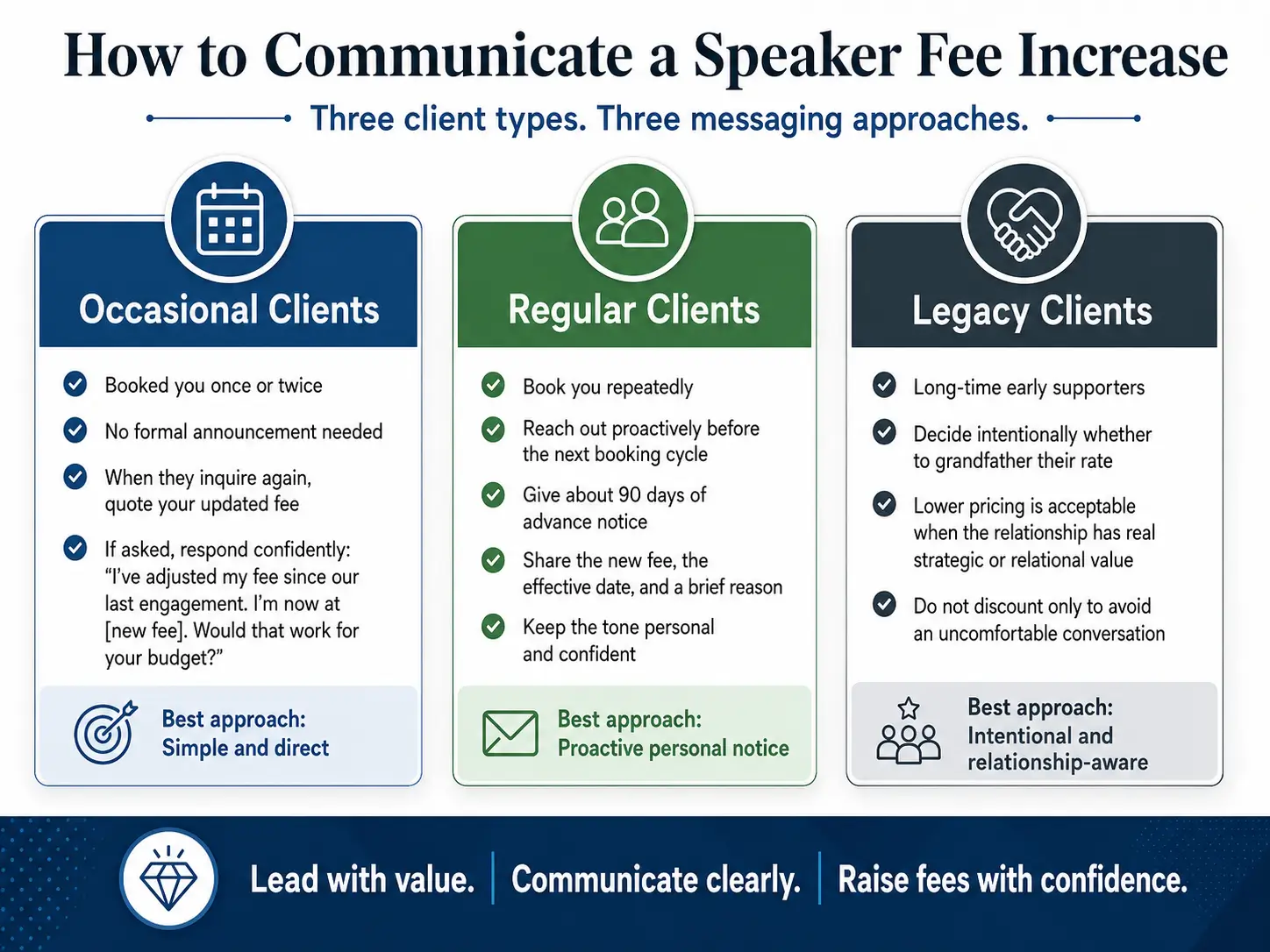
Not all past clients are the same. How you communicate a fee increase should differ based on the nature and depth of the relationship.
Type 1: The Occasional Client
These are planners who have booked you once or twice, value your work, but don’t have an ongoing or repeat cadence. For this group, a fee increase doesn’t require a formal announcement or special discussion. When they reach out again, you simply quote your updated rate.
If they note the change, respond directly and confidently: “I’ve adjusted my fee since our last engagement. I’m now at [new fee]. Would that work for your budget?”
In most cases, it will. Planners who have experienced your value and found you easy to work with are rarely driven primarily by price. They are driven by trust and relationships. At this point, you’ve already passed the most important test.
Type 2: The Regular Client
These are planners or organizations that book you repeatedly, the association that brings you back annually, the corporation that engages you across multiple events, or the training partner that consistently refers you. These relationships deserve a proactive, personal conversation before the next booking cycle, not a surprise at the point of inquiry.
The approach is straightforward. Reach out personally about 90 days before their typical booking window. A phone call or personalized email is appropriate. The structure should be simple: acknowledge the relationship, share the updated fee with a clear effective date, and offer any transition considerations if needed.
For example: “I wanted to give you advance notice that my fee will be adjusted to [new fee] effective [date]. Given how much I value our work together, I wanted you to hear it from me directly and have time to plan accordingly.”
There’s no need to over-justify the increase. A brief reference to what’s changed, such as new credentials, increased demand, or expanded content, is enough context. Over-explaining can signal uncertainty. A clear, confident notification signals that the decision is already made and professionally settled.
Type 3: The Legacy Client
Every speaker has one or two early clients who took a chance on them, booked them when the fee was lower, referred others, and over time became closer to colleagues than customers. These relationships often create the most emotional complexity around fee increases.
NSA data recognizes this directly: some clients may have grandfathered rates. In certain cases, organizations that book frequently or provide significant strategic value may continue at a lower fee. That is a legitimate business decision, not a pricing mistake.
When a legacy client relationship carries clear strategic or relational value, such as consistent referrals, high-profile association, or a meaningful mutual investment in each other’s work, maintaining a grandfathered rate while moving the rest of your market to a new fee level is entirely reasonable. The key is that it must be intentional, not accidental.
What is not appropriate is extending discounted legacy pricing simply to avoid a difficult conversation. That is not client loyalty. It is fee avoidance disguised as loyalty.
The Email Templates That Work
A fee increase communication has four jobs: it acknowledges the relationship, announces the change clearly, provides enough advance notice to respect the planner's planning process, and closes the door on uncertainty. Here are three templates adapted for different contexts.
Template 1: For regular clients, proactive notice
Subject: A note before you plan your [upcoming event/fall calendar]
Hi [first name],
I wanted to reach out directly ahead of you starting to plan for [event name / this year’s program] so you have the most current information as you build your lineup. My fee has recently been updated, and I wanted to make sure you hear it from me first, before you begin scheduling.
Starting [date], my keynote fee will be [new fee]. [One sentence of context if helpful, e.g., “With the updated content I’ve built around [topic], I’ve adjusted my pricing to reflect where I’m positioned in the market.”]
You’ve been a valued client, and I wanted you to hear about this from me first. If you’d like to lock in a date before [effective date] at the previous rate, I’m happy to do that for engagements booked by [date].
Either way, looking forward to working together again.
[Your name]
Template 2: For inquiry responses, new clients
Hi [first name],
Thanks for reaching out about [event]. My keynote fee is [new fee], which includes a pre-event customization call, the keynote, and a post-event debrief.
[One sentence on the outcome: e.g., “My program has helped [type of organization] teams [specific result].”]
Happy to talk through the details and check my availability. What date are you working with?
No apology. No explanation of why the fee is what it is. A confident quote followed by a value context and a forward-moving question.
Template 3: For a bureau agent, informational update
Hi [agent name],
I wanted to give you a quick heads-up that my fee has been updated to [new fee], effective [date].
I’ve had strong momentum this year, including [brief context: new client logos, notable recent engagements, credentials earned], and this adjustment reflects where I’m currently positioned in the market.
I wanted you to have this directly from me, so there are no surprises as you plan upcoming events.
Happy to provide updated one-sheet materials if that helps on your end. Let me know if any questions come up.
Bureau agents need this information to pitch you correctly. Giving them advance notice and a brief rationale for the change helps them position you confidently with their clients.
Updating Your Positioning to Support the New Fee
A fee increase without corresponding positioning changes is a number without a story. Planners evaluating you at a new price point are asking: "Is this speaker worth what they're charging?" Your eSpeakers profile, your website, your speaker one-sheet, and your outbound pitch copy all need to answer that question in the affirmative.
Specifically, four things should be updated in parallel with a fee increase:
Your outcomes language
The higher your fee, the more specific your outcomes need to be. A $6,000 speaker can describe their value as "engaging and inspiring." A $12,000 speaker needs to say: "My program equips [specific audience type] with [specific framework] that produces [specific behavior change]." Review every sentence of your profile bio and topic descriptions. Are they outcomes-first? Are they specific? Do they name a measurable result? At a higher fee, every sentence is doing more work.
Your social proof tier
The clients featured on your one-sheet and eSpeakers profile should reflect the level you are now pricing at. If your current list is dominated by regional associations and mid-sized companies, but your fee now sits in a range where Fortune 500 and nationally recognized brands are common, your next bookings should intentionally prioritize organizations that strengthen that signal.
This isn’t about chasing prestige for its own sake. It’s about alignment. Your social proof should accurately match and reinforce your pricing, so there is no disconnect between what you charge and what your market sees.
Your demo reel currency
A fee increase paired with a two-year-old demo reel creates a narrative mismatch. When planners see a higher fee but watch outdated footage, they are not evaluating the speaker who currently commands that rate.
If your reel no longer reflects your current stage presence, content, and client caliber, it should be updated before the new fee is publicly rolled out.
Your eSEO-optimized profile
The eSpeakers Hiring Trends Dashboard shows the fee ranges planners are actively searching within your topic area. If your new fee moves you into a higher search tier but your profile visibility hasn’t kept pace, you can end up pricing yourself into a category where planners simply don’t see you because your eSEO strength isn’t aligned.
In other words, you’re increasing your fee into a tier where you may not yet be discoverable. That’s why fee increases and profile optimization need to move in lockstep.
How HighLevel CRM Makes the Transition Systematic
The most common failure mode in a fee increase is inconsistency. A speaker raises their fee for new clients but forgets to update their eSpeakers profile, or slips back into quoting the old rate out of habit when a familiar planner calls. The result is two parallel fee structures running at the same time, often for months, without the speaker realizing it.
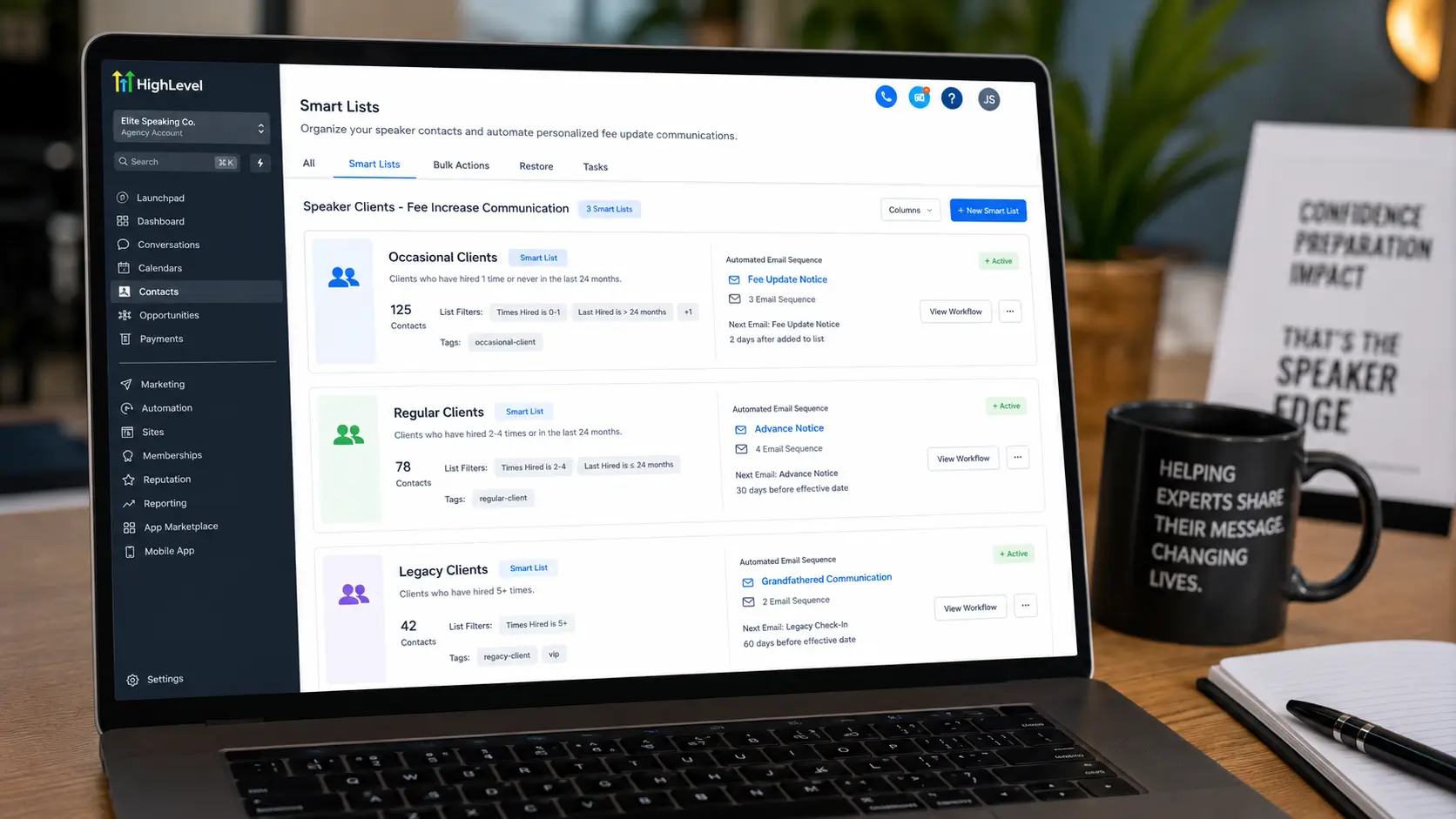
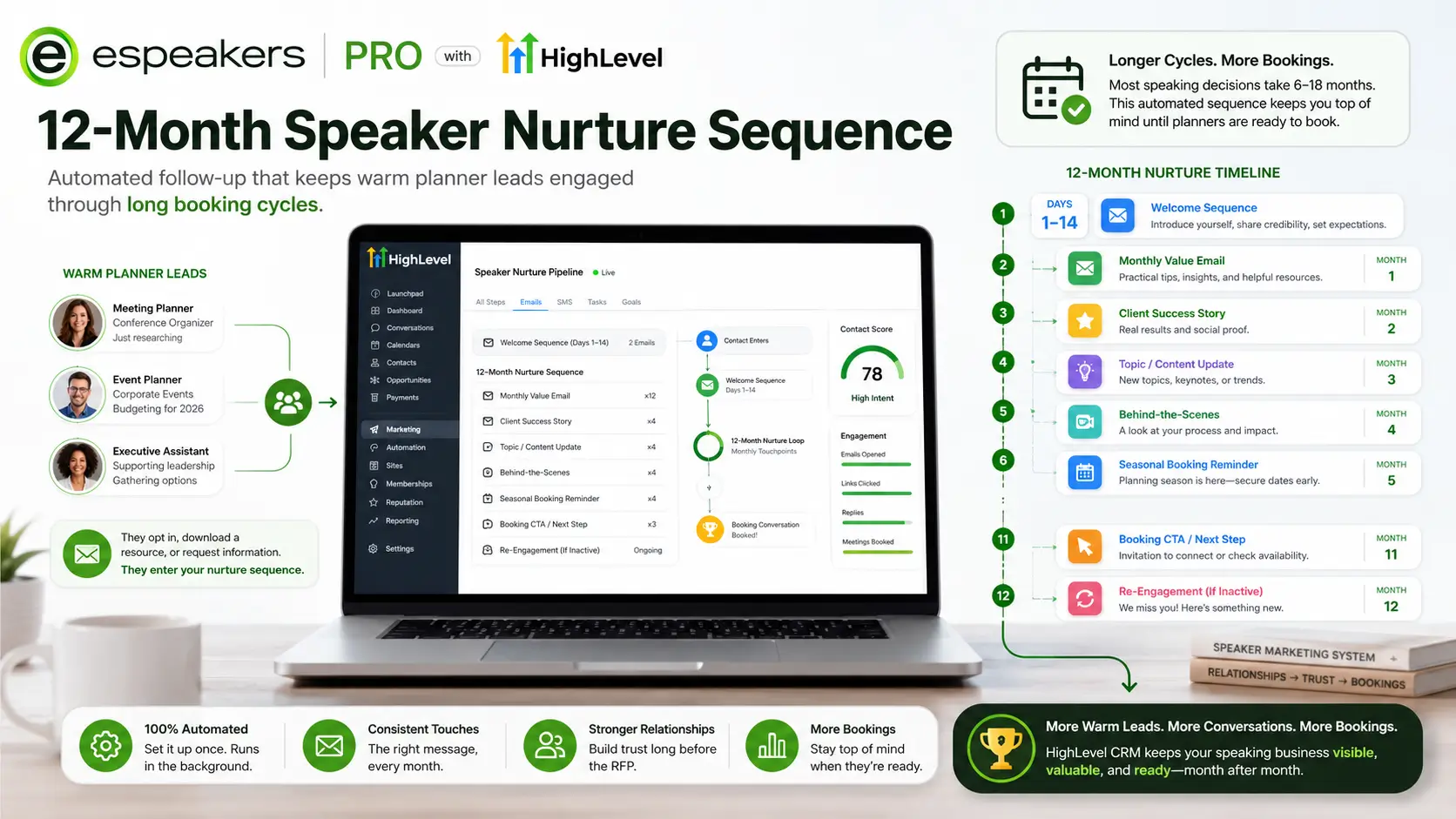
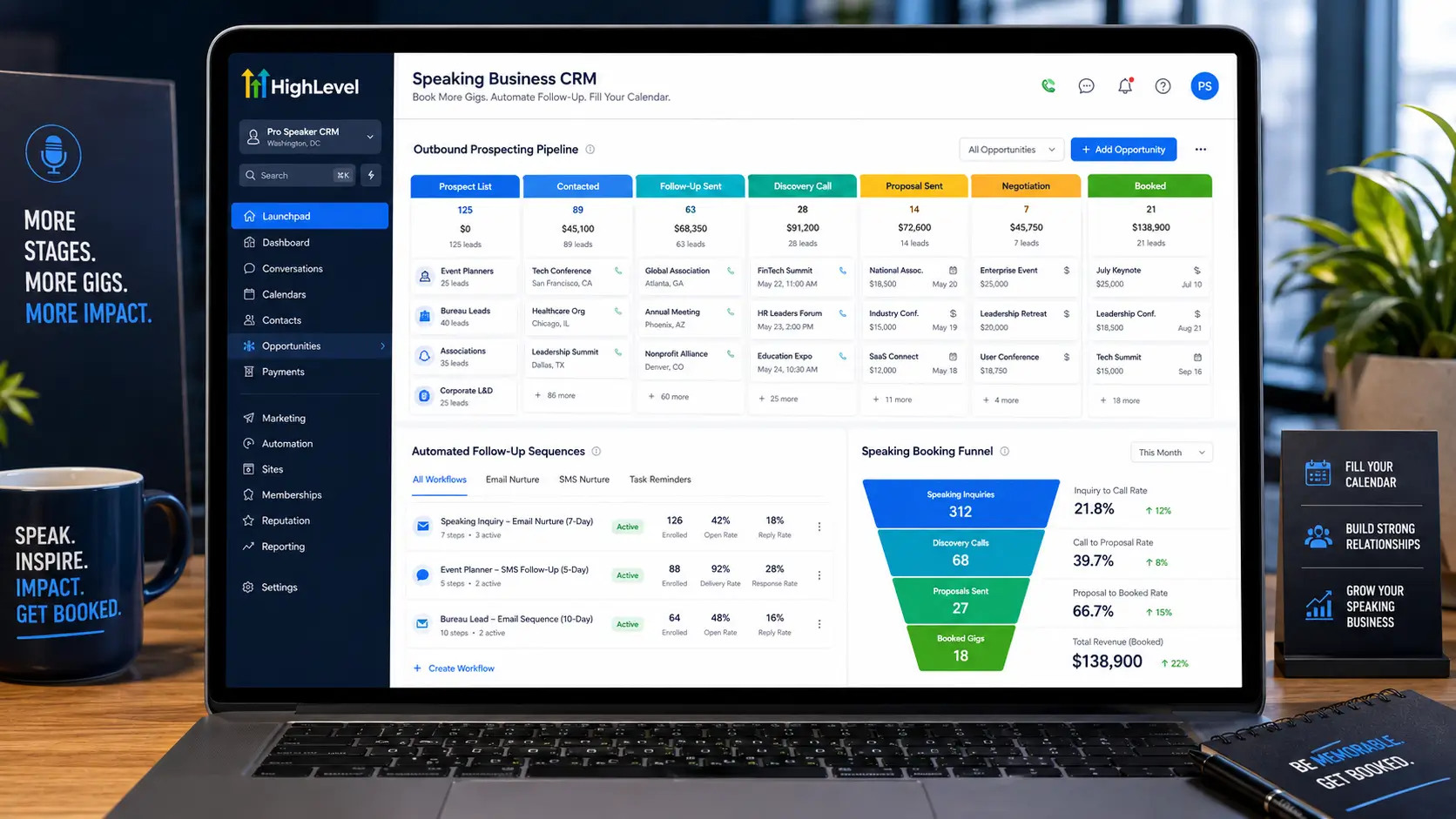
HighLevel CRM solves this through the same pipeline and workflow infrastructure covered in earlier articles in this series, with specific applications to fee transitions:
Custom contact fields for fee context
In your HighLevel contact records, create a custom field called “Fee Context.” Use it consistently to track pricing status across your pipeline. When a past client is on a grandfathered rate, document it. When a new contact is quoted your current fee, record the amount and date. When a bureau agent has been informed of your updated rate, note that as well.
This ensures you never quote from memory or habit. Instead, your pipeline gives you immediate visibility into the exact pricing context for every contact before you engage.
Smart Lists for the transition period
During the 90-day window between announcing a fee increase and its effective date, create a Smart List in HighLevel that filters for clients who booked within the past 12 months but have not yet received the updated rate notice. This ensures no prior client is caught off guard by a change they weren’t informed about.
From there, you can send a single targeted broadcast through HighLevel, personalized with first names and relevant event context, completing the outreach in one streamlined session.
Workflow trigger: quote sent at new fee
Build a simple HighLevel internal task that triggers every time you move an opportunity to “Proposal Sent,” prompting you to confirm that the fee in the proposal matches your current market rate. This creates a deliberate checkpoint at the exact moment autopilot mistakes are most likely, when a familiar planner’s voice or context might otherwise lead you to default to an old number out of habit.
Pipeline reporting to track impact
After implementing a fee increase, your HighLevel pipeline provides the data needed to evaluate its impact: hold-to-confirmed conversion rates at the new fee versus the old fee, average time in each pipeline stage, and changes in new client source distribution.
If conversion rates remain stable or improve at the higher fee, which is what many speakers observe when pricing is correctly aligned, you have clear evidence that the market is supporting the change, not resisting it.
What Happens When a Client Pushes Back
They will. Not frequently, and rarely in a way that ends the relationship, but some clients will express surprise, ask for context, or push back on the number. How you respond in that moment determines whether it costs you the booking or simply becomes a routine part of the conversation.
The first response to any pushback is silence
Let them fully express the pushback. Don’t rush to justify, discount, or soften your response. Most fee objections are not final rejections; they’re questions in disguise. “That’s more than I was expecting” is not a request for a lower number; it’s a prompt to clarify value and stay anchored in your pricing.
Acknowledge and hold
"I understand, it is a meaningful investment. I've consistently seen organizations achieve [specific outcome] from this program, which is why I've positioned it here." Not defensive. Not apologetic. A calm restatement of value.
Offer a scope adjustment, not a fee adjustment
If the budget genuinely won't reach your fee and the engagement matters to you, consider adjusting what's included rather than what you charge. A shorter program, a virtual format instead of in-person, a keynote without the post-event debrief, or a workshop instead of a main stage slot, these scope changes allow you to serve a different budget tier without setting the precedent of discounting your core fee.
Be willing to walk away cleanly
"I understand this may not fit your current budget. If the timing works better for next year, I'd be glad to reconnect." A gracious exit preserves the relationship for a future cycle without creating the ongoing awkwardness of a client who knows they can get you for less than you charge everyone else.
The speakers who dread fee conversations are usually the ones who haven't accepted that some conversations end in a pass, and that a pass isn't failure. A booking at the wrong fee is worse than no booking, because it anchors your perceived value, your energy, and your future conversations with that client at a number that doesn't reflect who you've become.
The Compounding Effect of Getting This Right
Here's what most speakers don't account for when they resist raising their fee: the compounding financial impact of staying too low for too long.
A speaker doing 25 engagements per year at $7,500 earns $187,500 annually. The same speaker at $10,000 earns $250,000, a $62,500 annual difference without a single additional booking. Over five years, that gap is $312,500. And that calculation doesn't account for the secondary effects: a higher fee tier attracting a better-calibrated client mix, stronger testimonials from higher-profile organizations, and more recognizable logos building more persuasive social proof for the next fee increase.
The speakers who have doubled their fees since the pandemic, a real, documented phenomenon reported by NSA members in 2025, didn't do it through luck or sudden fame. They did it through a series of deliberate, systematic increases, each one grounded in a genuine value change and communicated with professional confidence.
HighLevel CRM, when integrated with an up-to-date eSpeakers PRO profile that reflects your current fee range in the Hiring Trends filter, becomes the infrastructure that makes each fee increase visible, measurable, and sustainable.
Your profile ensures you appear in searches aligned with your new tier. Your pipeline gives you the conversion data to confirm whether the market is supporting the change. And your contact records and workflows ensure every client is informed, every quote is consistent, and no relationship is unintentionally strained by an administrative gap.
The conversation you've been avoiding isn't as hard as you've been imagining it. The numbers on the other side of it are real.
FAQ
Cross-reference three data points: the eSpeakers Hiring Trends Dashboard to understand what planners in your topic category are actively searching for, your bureau relationships where agents can provide real-world benchmarks on what comparable speakers are actually charging, and your own conversion data.
If you are converting every inquiry at your current fee, that’s not a sign of optimization; it’s a signal you may be underpriced.
The right fee sits in a range where you consistently win the right engagements and occasionally lose the ones that were never the right fit in the first place.
Expect a short adjustment period. Your existing pipeline was built around a lower fee point, and new inbound will lag slightly while your updated profile, positioning, and messaging propagate through the market. That is normal, and not a signal to reverse course.
Give it a full quarter before drawing conclusions. In most cases, within 60–90 days of a well-executed fee increase, conversion rates stabilize or even improve, because you begin attracting a more accurately aligned planner mix.
Raise them proportionally and at the same time. Keeping virtual fees artificially lower than a market-appropriate rate for your level creates a tiered perception that can dilute your overall positioning.
Virtual keynotes have real value and require real preparation. They should be priced accordingly, typically 20–30% below in-person engagements, not the 50–60% discounts that became normalized during the pandemic and have lingered longer than they should for many speakers.
Bureau agents already build their commission into your quoted fee, meaning the planner pays the full amount while the bureau takes its agreed percentage. When you increase your fee with bureaus, you are increasing the planner-facing price.
Treat bureau partners the same way you treat direct clients: give them advance notice of any change and ensure they are aligned on timing and structure. At the same time, update every bureau profile and agency listing so your fee is consistent across all channels.
Any mismatch between your direct rate and what a bureau quotes creates confusion in the market, and that confusion can cost you bookings.
You are not announcing something for approval; you are communicating your current market position. That clarity helps planners plan accurately, which is what they actually need.
Planners respond to consistency. A speaker who quotes confidently and consistently signals professionalism and reliability. A speaker who hesitates, hedges, or discounts in the moment signals uncertainty, even if the content is strong.
The most professional approach is also the most confident: state the fee, hold the value behind it, and allow the planner to decide with complete information.
The Number You Quote Is the Story You’re Telling
Your fee communicates more than your price. It communicates your tier, your confidence, and your read on your own market value. Planners use it to calibrate expectations before they’ve read a word of your bio or watched a second of your reel.
The speakers who fill their calendars at premium fees aren’t the ones who happened to become famous. They’re the ones who decided their value was worth protecting, who raised their numbers deliberately, communicated changes professionally, and built a CRM infrastructure that made the transition systematic rather than stressful.
That decision is available to you right now. Not after the next TEDx. Not after the next book. Now, with the track record you already have, the outcomes you already deliver, and the clients who already know your work is worth more than what you’re currently charging.
Update the number. Tell your clients. Watch what happens.
Start your eSpeakers PRO 60-day trial →
Access the Hiring Trends Dashboard to benchmark your new fee against what planners in your topic area are actively searching, and connect HighLevel CRM to manage your fee transition consistently across every client contact and pipeline stage.
Joe Heaps, Chief Marketing Officer at eSpeakers
Joe Heaps is the Chief Marketing Officer at eSpeakers and is responsible for creating and accelerating the company's sales & marketing strategies. He is focused on driving the company's vision of helping organizations and individuals improve in substantial, long-term ways. He believes it happens when the perfect speaker is in front of the right audience. Over 25 years in the industry, Joe’s strategic vision and leadership have propelled eSpeakers to the leading software platform for speakers, coaches, and experts.
Joe Heaps
Chief Marketing Officer, eSpeakers
Latest Articles



Related Articles