How to Use HighLevel to Book More Speaking Gigs
Getting more speaking gigs in 2026 requires a system, not just a profile, not just a referral network, and not just an occasional outreach campaign. The speakers who consistently fill their calendars have built a connected infrastructure: directory presence that drives inbound discovery, marketing funnels that capture leads from every channel, CRM automation that follows up without manual effort, and post-event sequences that turn past clients into repeat bookings and referrals.
The market is genuinely strong. Corporate events are well-funded, associations are hungry for high-content programs, and planners are actively sourcing speakers across more channels than ever. The speakers who aren't filling their calendars aren't failing because the demand isn't there. They're failing because they're waiting to be found rather than building the system that finds planners, captures their interest, and converts that interest into confirmed engagements. This article is that system, the complete playbook, from positioning and profile through pipeline and post-event follow-up.
John Doe
Chief Marketing Officer at eSpeakers
The 2026 Market Reality: What's Changed and Why It Matters
Before tactics, context. The market for professional speakers has shifted in meaningful ways over the past 18 months, and the speakers who understand those shifts are outperforming those who don’t.
Planners are spending, but cautiously
Budgets are up compared to recent years, but rising costs in venues, travel, and food & beverage mean planners are more selective with every line item. That puts added pressure on speakers to clearly articulate ROI, not just what they will say, but what will change for the audience afterward. This doesn’t mean fees should be lowered. It means the value conversation has to be sharper and more outcome-focused, giving planners what they need to justify the investment. What happens after the keynote matters more than ever.
Generalist speakers are losing ground to niche experts
Audiences are increasingly drawn to substance over performance. Boards are looking for speakers who can influence strategy, not just energize a room. And planners are operating in tighter budget environments, shorter attention spans, and rooms full of people who can fact-check claims in real time. Broad positioning like “leadership and motivation” places you in an overcrowded category with thousands of competitors. Specific positioning like “navigating AI disruption in mid-market manufacturing” places you in a far smaller, more defensible space where demand is clearer, and competition is limited.
Booking windows are compressing
Early 2026 has opened with organizations under pressure to align leadership faster, energize sales teams, and navigate complex decisions on compressed timelines. Speakers who respond quickly to availability requests and move efficiently through confirmation consistently win bookings over slower competitors, regardless of message strength or reputation.
Content quality is the top driver of repeat bookings
78% of event professionals rate content quality as “very important” to event success, making it the leading driver of attendee satisfaction and overall performance for the second year in a row. For speakers, that’s encouraging. It reinforces a simple truth: investing in genuinely useful, audience-specific content is the most durable competitive advantage you can have.
AI is reshaping how planners find speakers
About half of planners expect to use AI tools in their event planning workflows. That means your online speaker profile, its keywords, its clarity, and its currency need to be optimized for both human readers and the AI-matching tools that increasingly mediate the first stage of planner research. Understanding this context shapes every strategy that follows.
What Planners Are Actually Buying in 2026
Before you can sell more speaking engagements, you need to understand exactly what the buyer is purchasing, because it has evolved
The planner of 2026 isn’t buying an hour of content. Below is what they are buying:
A defined outcome for their audience.
Planners are evaluated on attendee satisfaction, measurable behavior change, and whether the event advances organizational priorities. The speakers who get booked are the ones who can clearly state what their audience will do differently on Monday morning. “My keynote assists sales teams in closing larger deals using consultative conversation frameworks” is specific and actionable. “I speak about leadership and communication” is not.
An experience, not a performance
Attendee experience has become the top planner priority, surpassing cost management as a key metric. That shift puts the emphasis on engagement, interaction, personalization, and sessions that feel dynamic rather than one-way. The focus is on how the audience experiences the moment: how involved they feel, how connected they are, and what stays with them afterward. This marks a clear move away from long, lecture-style keynotes and toward experiences that are participatory, human, and memorable.
Confidence that working with you will be smooth
In a market where planners work with one or two speakers per event per year, they remember who was easy to work with as vividly as who delivered a great keynote. Responsiveness, professionalism at every touchpoint, and delivering exactly what was promised create the repeat bookings and referrals that sustain a speaking career.
Relevance to a specific problem they’re facing now
Demand is strongest for speakers who tie ideas directly to performance, change, and culture, not generic motivation. Decision makers are hiring niche experts who understand their industry and can help teams act in the next 6–12 months. The hottest topics right now are AI and the future of work, mental health and burnout as performance and retention issues, leadership in uncertainty, and the economic and geopolitical landscape.
An extension of the event, not just a slot filled
The most booked speakers in 2026 don’t just show up, speak, and leave. They offer pre-event customization, post-event resources, follow-on virtual sessions, or workshop components that extend the impact. This “Aftercare” approach, packaging a keynote with complementary deliverables, increases the planner’s perceived ROI and makes the booking decision easier to justify internally. With this buyer picture in mind, every strategy below is designed to position you as that speaker, the one who delivers a defined outcome, an experience, a smooth partnership, and ongoing relevance.
Strategy 1: Lock Down Your Positioning Before Anything Else
Every booking strategy in this article depends on this one. A vague positioning statement makes everything harder: the pitch, the proposal, the director’s entry, the SEO. A sharp one makes everything easier.
Your positioning statement has one job: tell a planner immediately who you help, what problem you solve, and what specifically changes for the audience afterward. It should be two sentences maximum and should differentiate you from the hundreds of speakers in your general topic area.
The test: Show your current positioning statement to someone who has never seen your speaker profile. Ask them: “If you were a meeting planner with a leadership conference, would you immediately know whether to consider this speaker?” If the answer is hesitant, the positioning needs work.
The formula: [Specific audience type] struggling with [specific problem], hire me to [specific outcome]. After [your program], they [specific behavioral change].
This formula works because it matches the way planners search for speakers, by problem and audience, not by topic category. “I help mid-size financial services firms prepare their leadership teams for AI-driven disruption” is a search query. “Leadership speaker” is a category that returns 50,000 results.
Once your positioning is sharp, update it everywhere simultaneously: your eSpeakers profile, your website headline, your LinkedIn summary, and your one-sheet opener. Inconsistency between platforms creates doubt. Consistency creates confidence.
Strategy 2: Own a Directory Presence That Converts
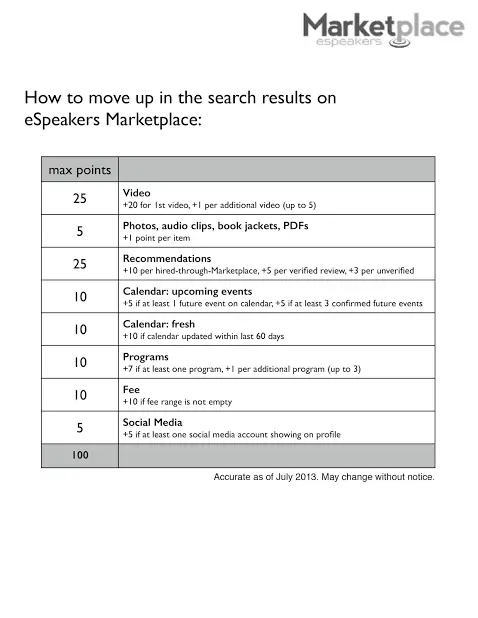
The eSpeakers Marketplace is where meeting planners actively search for speakers by topic, industry, format, and fee range. A complete, optimized profile is your highest-ROI visibility investment; it puts you in front of buyers who are ready to hire, not just browsing.
Most speakers underinvest in their directory profile and then wonder why inbound inquiries are sparse. The profiles that convert share five characteristics:
A positioning statement that matches planner search terms
Use the language planners use to describe their problem, not the language you use to describe your expertise. Planners search “AI leadership speaker for financial services,” not “transformation expert.”
A current demo reel in the first scroll
Planners make preliminary decisions in under two minutes of video. Your reel needs to open with your strongest 10 seconds of stage presence, not an intro card, not background music, not a slow buildup. The audience reaction shots matter as much as your content.
Real-time calendar availability
Profiles connected to a live HighLevel CRM calendar show open dates to planners without requiring an email exchange. This alone significantly increases inquiry conversion. A planner who can confirm you’re available on their date has a reason to keep reading. A planner who has to email first often doesn’t bother.
Specific topic titles, not categories
“The AI-Ready Leader: How to Prepare Your Team for the Next 18 Months” is a session a planner can put on an agenda. “AI and Leadership” is not.
Organizer testimonials, not audience praise
As covered in the profile articles in this series, planner peers carry more weight than audience enthusiasm. One quote from an event director describing specific outcomes is worth ten audience “best speech ever” testimonials.
Strategy 3: Build the Association Circuit Systematically
Associations are among the most consistent buyers of professional speakers, and they’re underworked by most speakers because the pathway feels less obvious than corporate outreach.
Speaking at trade association and professional society meetings is a goldmine for getting in front of business and corporate decision-makers. The key to success lies not just in what you say on stage, but in how you position yourself to get there in the first place.
The association circuit works differently from corporate prospecting. Associations plan 12–18 months ahead for annual conferences. The program committee, not a single decision-maker, selects speakers through a formal proposal process. And association audiences are deeply industry-specific, which rewards speakers who can demonstrate a genuine understanding of their world.
The approach that works:
Target by industry fit, not by budget
Associations in your primary topic area, the ones where your content is most relevant, are your best prospects. A leadership speaker whose niche is healthcare will outperform on the healthcare association circuit, where their specific audience knowledge is apparent in every pitch.
Submit formal call-for-speaker proposals every quarter
Most associations post their annual conference CFP (call for proposals) six to nine months ahead of the event. Set a calendar alert, submit a tailored proposal that addresses the association’s current priorities, and track every submission in your HighLevel CRM pipeline under a dedicated “Association Proposals” pipeline.
Attend before you speak
Associations value speakers who understand their community. Attending a national or regional conference as a member or attendee, before pitching to speak, gives you authentic insight into the audience, builds relationships with committee members, and provides specific references in your proposal (“I attended the 2025 annual conference and noticed the recurring theme of…”) that generic proposals don’t have.
Ask for state and chapter opportunities after the national
A successful keynote at a national association conference is a credential for every chapter and state affiliate event. ASAE (the American Society of Association Executives represents more than 7,600 association management professionals who oversee conference programming for thousands of annual events, a significant addressable market for speakers pursuing the association circuit. A simple follow-up email to the program chair, “I’d love to be a resource for your regional chapters if any are looking for content on [topic]”, opens doors that the national gig unlocked.

Strategy 4: Run Systematic Outbound at a Volume That Makes the Math Work
The average speaking business needs approximately 150 targeted outreach contacts to generate 15 meaningful conversations with planners. Of those 15, roughly 3 will be a strong fit, and 1 will confirm a booking.
That math requires volume. And volume requires a system.
Most speakers send 10 or 20 outbound emails, get a low response rate, and conclude that outreach doesn’t work. What doesn’t work is doing 20 contacts and expecting 2 bookings. What works is 150 targeted contacts per month, run systematically, with consistent follow-up, producing the 10–15 conversations and 1–2 bookings that the math predicts.
Most speakers send 10 or 20 outbound emails, get a low response rate, and conclude that outreach doesn’t work. What doesn’t work is doing 20 contacts and expecting 2 bookings. What works is 150 targeted contacts per month, run systematically, with consistent follow-up, producing the 10–15 conversations and 1–2 bookings that the math predicts.
HighLevel CRM makes this feasible for a solo speaking business. The three-touch outbound sequence (detailed in Article 3 of this series) runs automatically once a contact is imported and tagged. You make the strategic decisions, who to contact, which events to target, which industries to prioritize, and the system handles the execution, follow-up timing, and tracking.
What to prioritize in your outbound:
Sales kickoffs and leadership summits are among the highest-volume corporate speaking categories in 2026. Many speakers’ bureaus report a high volume of sales kickoff and board meeting inquiries, with urgency and frequency elevated compared to previous years. These events often have discretionary budgets and are decided quickly, making responsiveness the primary competitive advantage.
Healthcare and education associations are actively booking for Nurses Week (May), annual conventions, and continuing education programs. These are volume markets for the right speakers.
Corporate anniversaries, rebrands, and major leadership transitions create urgent demand for speakers who can anchor the moment. Follow company news and LinkedIn announcements for organizations in your target industries; a merger, a major product launch, or a CEO transition often precedes a leadership event within 90 days.
Strategy 5: Make Every Engagement Generate the Next One
The most efficient booking strategy in any speaking business isn’t outbound; it’s maximizing the yield from every engagement you’re already doing.
Meeting professionals are looking for speakers who operate as partners. They’re investing in outcomes, implementation support, and post-event impact, not just a one-hour presentation.
Speakers who treat the engagement as a transaction end the relationship when they leave the stage. Those who approach it as a partnership create ongoing value and open the door to future bookings.
The before-the-event conversation
Before every engagement, schedule a 30-minute call with the event organizer, not just for customization, but to understand their organization’s broader calendar. What other events do they run annually? What’s coming up next year? What other teams or divisions might benefit from this content? This conversation, done naturally as part of your preparation, surfaces future opportunities without a sales pitch.
The post-event “what’s next” follow-up
The 72-hour post-event window is the highest-conversion moment in your entire business development cycle. Within 48 hours: send a thank-you that’s specific to something from the day. Within 72 hours: send the testimonial request. Within 30 days: send the “Aftercare” check-in. It’s been a month since [event]. Curious how the team has implemented [specific framework or concept from your talk].” This email does two things: it demonstrates that you care about impact, not just performance, and it reopens a conversation with a planner who already trusts you.
The referral is built into your post-event process
After every successful engagement, a simple referral ask, “If you know of other organizations dealing with [your topic], I’d be grateful for an introduction” , generates a meaningful percentage of warm leads. In your HighLevel CRM, this is a triggered workflow task that fires at Day 30 post-event, reminding you to send a personal referral request when the relationship is at its warmest.
The bundle pitch
Sell bundles: a keynote or program plus a Q&A, breakout, or follow-up virtual session rather than a single talk. Ask yourself: how can I help my client apply what I shared? A planner who books you for a keynote and a half-day workshop generates roughly 150% of the revenue of a keynote alone, from the same relationship, with much lower acquisition cost. Offer the bundle at booking, not as an afterthought.
Strategy 6: Build a Content Presence That Works While You Sleep
Inbound leads, planners who find you through search, LinkedIn, or a podcast, are the lowest-friction bookings in your pipeline. They’ve already qualified themselves by finding you; all you have to do is not lose them.
The two platforms where speakers consistently generate inbound planner attention are LinkedIn and YouTube. Both reward consistent, specific expertise content over time. Neither requires being a content creator full-time.
LinkedIn for authority, LinkedIn for discovery
A LinkedIn article or post on a timely topic in your niche, published consistently, once or twice per week, builds a body of work that planners find when they research you. The algorithm rewards specificity: a post titled “Why your AI adoption strategy will fail without these three leadership conversations” outperforms “Thoughts on leadership in the age of AI” every time. Your bio headline should be your positioning statement, not your job title.
YouTube for the demo that sells itself
A well-optimized YouTube video, even 5–10 minutes of you explaining a core framework from your keynote, creates a searchable asset that works at 3 AM when you’re asleep. Planners who find you via a LinkedIn article will look up your name; if the first thing they find is a credible video of you delivering real content, the qualification process accelerates dramatically.
The lead magnet that captures planner emails
A simple resource, a checklist, a guide, a mini-framework, offered on a landing page connected to your HighLevel CRM turns content viewers into CRM contacts. Every email captured is a planner in your long-term nurture sequence. Over 12 months, that sequence makes you the first speaker they think of when a relevant event comes up.
Strategy 7: Treat Your Speaker Profile as a Living Asset, Not a Static Page
Every booking strategy above drives traffic to your eSpeakers profile, your website, or both. The profile has to convert.
Most speakers set up their profile once and revisit it occasionally. The most booked speakers treat their profile as a living asset, updated quarterly with new clients, fresh testimonials, refined topic descriptions, and current availability. Over time, the difference compounds. A profile updated four times a year signals momentum and demand. A profile untouched since 2023 signals stagnation.
The specific updates that move the needle most:
New client logos
Every notable engagement adds a recognizable logo to your social proof. Add it within a week of completing the engagement.
Organizer testimonials within 48 hours
s covered earlier, the testimonial request window closes fast. Capture it and display it.
Topic description refresh
Are your topic titles current? Do they reference 2026 concerns, AI, burnout, geopolitical uncertainty, the hybrid workforce, or do they read like they were written in 2021? Planners searching for relevant content in 2026 need to see that your work connects to their current problems.
Calendar accuracy
An eSpeakers profile showing incorrect availability, dates marked open that are actually confirmed, damages trust the moment a planner discovers the discrepancy. With HighLevel CRM connected to your eSpeakers calendar, this is a non-issue: every pipeline update syncs automatically.
The System That Ties It All Together
Each strategy above generates bookings independently. Together, they create a compounding booking engine:
- Sharp positioning drives qualified directory traffic
- An optimized eSpeakers profile converts that traffic into inquiries
- Systematic outbound fills the pipeline with new opportunities
- Association outreach opens a consistent, recurring channel
- Post-event follow-up maximizes the yield of every engagement
- Content creates inbound attention between active campaigns
- Profile maintenance ensures every lead that arrives gets a good first impression
The reason most speakers don’t run all seven strategies simultaneously isn’t ambition; it’s bandwidth. Managing outbound sequences, tracking association proposals, running post-event workflows, sending nurture emails, and keeping the profile updated is genuinely more than one person can do manually at any meaningful volume.
HighLevel CRM is the infrastructure that makes it feasible. The outbound sequences run automatically. The post-event workflows fire on schedule. The nurture emails are sent without your involvement. The profile syncs without manual reconciliation . You make the strategic decisions and show up for the conversations. The system handles everything else.
FAQ
Start with positioning and associations. Your positioning statement doesn’t require a long track record; it requires clarity about who you help and what changes for them.
Associations, particularly at the regional and chapter level, regularly book emerging speakers who submit strong proposals. A targeted proposal that demonstrates a genuine understanding of the association’s audience is more competitive than a generic pitch from a famous speaker who clearly didn’t research the audience. As you deliver those engagements, collect testimonials aggressively, and your social proof builds quickly.
Referrals are a strength, not a problem; they reflect high client satisfaction. The issue is that referrals are passive: they grow at someone else’s pace. The strategies in this article don’t replace referrals; they add parallel channels that grow at your pace.
A speaker running active outbound, an association proposal process, and a content presence will generate significantly more referrals, too, because they’re creating more visibility and more opportunities for satisfied clients to make introductions.
Sharpen your positioning and make it specific to a current problem. The 2026 market rewards depth over breadth. A speaker who owns a niche, a specific industry, a specific problem, a specific moment in the organizational lifecycle, commands higher fees, generates more targeted referrals, and wins more outreach conversations because the relevance is immediately obvious. This is the change that makes every other strategy in this article more effective.
HighLevel solves the execution gap that prevents most speakers from running multiple strategies at once. Outbound sequences run automatically, so your monthly outreach continues even when you’re on the road. Post-event workflows run automatically, sending testimonial requests within the critical 48-hour window. Long-term nurture sequences keep you consistently visible to every warm lead in your database, while your eSpeakers profile stays up to date through direct calendar synchronization.
The strategies in this article depend on consistent execution over time. HighLevel turns that consistency into a system, rather than something you have to rely on willpower to maintain.
- Realistically, past client re-engagement produces results within 30–60 days.
- Outbound prospecting produces initial conversations within 60–90 days of consistent volume. Association proposals produce results on the association’s timeline, typically 6–9 months from submission to event date.
- Content and SEO produce compounding results over 12+ months.
A speaker running all seven strategies (discussed above) simultaneously will see pipeline activity building within 90 days and meaningful booking impact within six months.
Speakers who try one strategy at a time, abandon it when it doesn’t produce immediate results, and move to the next one typically never build the compounding momentum that fills a calendar.
2026 Favors the Prepared
The speaking market is genuinely optimistic for the first time in years. Budgets are up. Planners are planning. Organizations are gathering with real purpose and investing in speakers who can move people forward.
The speakers who capture that optimism aren’t waiting for the market to find them. They’re running systematic outreach to the right organizations at the right moments. They’re presenting as niche experts in the topics planners are actively searching for. They’re delivering post-event experiences that make every booking generate the next one. And they’re using tools that turn strategy into execution without requiring them to be everywhere at once.
The window is open. The question is what system you’re using to walk through it.
Start your 60-day eSpeakers PRO trial →
Build your complete online speaker profile, get listed in the eSpeakers Marketplace where planners actively search, and connect HighLevel CRM to run every booking strategy in this article on autopilot.
Joe Heaps, Chief Marketing Officer at eSpeakers
Joe Heaps is the Chief Marketing Officer at eSpeakers and is responsible for creating and accelerating the company's sales & marketing strategies. He is focused on driving the company's vision of helping organizations and individuals improve in substantial, long-term ways. He believes it happens when the perfect speaker is in front of the right audience. Over 25 years in the industry, Joe’s strategic vision and leadership have propelled eSpeakers to the leading software platform for speakers, coaches, and experts.
John Doe
Chief Marketing Officer at eSpeakers
Latest Articles

Related Articles